This is topic INteresting new Edwards & Sutherland 8K Dome System in forum Film-Yak at Film-Tech Forum ARCHIVE.
To visit this topic, use this URL:
https://ft-forum.com/ft/cgi-bin/ubb/ultimatebb.cgi?ubb=get_topic;f=8;t=007659
Posted by Mark Gulbrandsen (Member # 72) on 05-09-2019, 04:04 PM:
It's comprised of five Christie D4K40-RGB laser projectors and a seamless Spitz screen. Thats all I know about it. The only installed system is 90 minutes away in Huntsville, AL, so I will have to go check it out. Apparently it can function as a dome theater and a planetarium. I think Liemax may have gotten left in the dust.
Evans & Sutherland ESX System
Posted by Marcel Birgelen (Member # 6801) on 05-09-2019, 07:47 PM:
They also advertise a LED-dome system. It would be interesting to see such a setup, especially if they manage to get rid of the visible pixel grid.
Posted by Jim Cassedy (Member # 4115) on 05-10-2019, 10:49 AM:
WoW! Five D4K40-RGB/Laser projectors! That system must put out quite an image
& would be something to see. Their LED based dome system looks interesting too.
Just to go "old school" for a moment, the interesting projector below was built for
a film-based system in the 1960's that used a 180° hemisphere suspended at a
45° angle above the heads of the audience who sat in seats arranged in a semi-
circle below. The projector was located below eye level in a cove at center of the
semi-circle a the center of the seating semi-circle, hence the low-slung magazines.
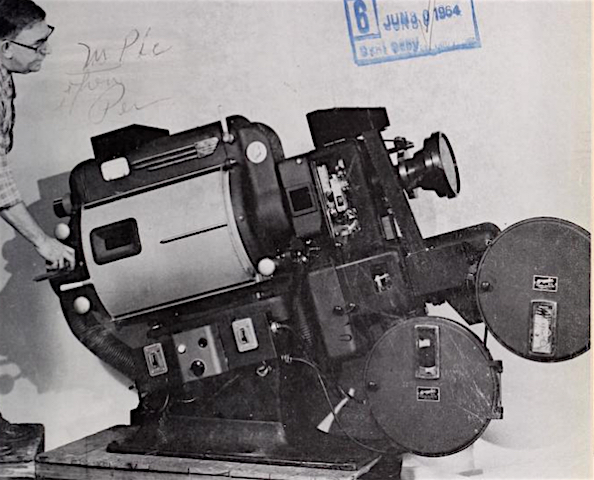
According to an old CENTURY sales brochure I have, the 70mm horizonal 10perf
pull-down (pre Imax!) projector below was built and used for the "Trip To The Moon"
show that was part of the "SPACEARIUM" exhibit at the 1964 NY Worlds Fair, which
projected on a dome that was 39ft high x 78ft in diameter. (apparently without a lens ![[Roll Eyes]](rolleyes.gif) )
)
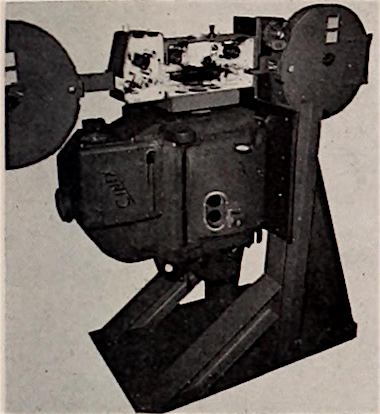
While CENTURY might have built such a projector for the SPACEARIUM, aside from
what appears to be the lack of a lens in the photo, I have some doubts about the
projector as pictured. The "Moon" show ran at least 20min or so. No way you could
run 20min of 70mm 10/perf @24fps with what appear to be 2K magazines in the
picture. The projector had a water-cooled circular aperture. There must have been
a LOT of heat to get rid of. That's an Ashcraft Cinex carbon-arc lamphouse- -
- Having worked with them many times in the past, I can only imagine how
much heat was traveling up to the aperture with the lamphouse mounted
vertically like that. I'm guessing the actual set-up would have required an
extra blower and a helluva heat filter! But whatever they did, I guess it worked!
Posted by Christian Appelt (Member # 1067) on 05-10-2019, 03:27 PM:
quote: Jim Cassedy
The "Moon" show ran at least 20min or so. No way you could run 20min of 70mm 10/perf @24fps with what appear to be 2K magazines in the
picture.
"To the Moon and Beyond" was shown at 18 fps only, according to most sources.
To the Moon and Beyond - Wikipedia entry
MOON's running time was 15 minutes according to this NYT article.
NYT article
Posted by Jim Cassedy (Member # 4115) on 05-10-2019, 03:52 PM:
Thanks for the correction, Christian.
Actually after I posted that I did manage to find the running time in an old
Popular Mechanics article & was going to correct my post, but you beat me to it. ![[Smile]](smile.gif)
Didn't know there was a Wikipedia entry (duh!) or about the 18fps, which makes
me wonder even more about the amount of heat that film was taking!
I'm actually old enough to remember going to that show at the '64 Fair. ![[Frown]](frown.gif)
Posted by Christian Appelt (Member # 1067) on 05-10-2019, 04:23 PM:
Jim, I truly envy you for having seen such historic format screenings! ![[Cool]](cool.gif)
I always thought they used 18fps to put less stress on the film prints. What puzzles me is that two years before, in 1962, another "Cinerama 360°" short was shown at the Seattle World Fair. There is an article on JOURNEY TO THE STARS which was shot, printed and released on ten-perf 70mm stock (ASA 1 type, like in those air reconnaissance and military cameras). Thomas Hauerslev's in70mm.com site has it listed as being 24fps. Cinerama 360° film list @ in70mm.com
The AC article on JOURNEY says they used 20 prints for more than 6000 screenings. On the "special Cinerama projector" pictured you can see what I would estimate to be 6000 ft. magazines.
I'd really like to know whether MOON was standard ten-perf 65/70mm stock or ASA1-type negative and positive like JOURNEY. But why the 18fps frame rate if it did work at 24fps two years earlier?
Posted by Mark Lensenmayer (Member # 134) on 05-10-2019, 08:01 PM:
The low-slung projector above looks like the one I saw at the state fair in the Chevy Show. Projector and operator sat on floor and projected onto a dome-like screen. Would have been in the Mid-60's time frame. I think Jam Handy had something to do with it.
Posted by Bobby Henderson (Member # 840) on 05-12-2019, 03:15 PM:
The obvious question regarding a dome-screened theater with a 8K resolution laser-based setup: what are they doing for content?
No Hollywood movies are being produced in 8K, and that's despite the availability of a couple different breeds of 8K resolution camera systems. Most content is still being produced in mere 2K and framed for the 2.39:1 'scope ratio. Native 8K resolution is one thing. Framing for dome-screen theaters is something else entirely. The system would probably be great for documentaries or motion simulator rides. It's not going to work for traditional Hollywood movies. Not with the very short theatrical release being one burden and most movie viewing happening on ordinary HDTV screens at home being another burden of standards confinement.
quote: Marcel Birgelen
They also advertise a LED-dome system. It would be interesting to see such a setup, especially if they manage to get rid of the visible pixel grid.
That's not an issue if the theater operator is willing to spend the money necessary to accomplish that goal.
Several LED display manufacturers have hit very impressive resolution levels with their SMD LED based boards. Daktronics' indoor LED displays can go as tight as a 1.2mm pitch between pixel centers. Recently in Las Vegas I checked out Daktronics' booth at the International Sign Association World Expo in Mandalay Bay. They had a 1.9mm pitch display hanging over their booth that was full 1080p HD resolution (1920 X 1080). The board was about 7' tall by 12' wide and (at least for me) the pixel grid was not visible looking at it from about 20' away. A 1.2mm board has a much tighter pixel grid. Samsung's new modular LED display "The Wall" has a pitch of only .84mm between pixel centers.
The brightness and color intensity of these exposed LEDs also do much to hide a pixel grid. Samsung's Onyx Cinema Screen product range is typically boards with 2.5mm or 3.33mm pitches between pixel centers.
A bunch of it all comes down to cost per pixel. How much is the theater operator willing to spend? If cost is no object then it's certainly possible today to build a dome screen theater with LED boards sporting 8K or even 16K resolution. But the cost of the display would just be staggering.
Posted by Mark Gulbrandsen (Member # 72) on 05-12-2019, 07:15 PM:
quote: Bobby Henderson
what are they doing for content?
They are producing content right now and there is a decent selection of it. You will find what is available at their web site. Just the fact that it's 8K excites me and I intend to go to the one in Huntsville in the next month or so and check it out. I also want to know more about how they combine the 4K projectors to achieve the 8K image. Very little of that mentioned on the web site except they have the industry leading system that does that.
Mark
Posted by Marcel Birgelen (Member # 6801) on 05-15-2019, 12:33 AM:
quote: Bobby Henderson
Several LED display manufacturers have hit very impressive resolution levels with their SMD LED based boards. Daktronics' indoor LED displays can go as tight as a 1.2mm pitch between pixel centers. Recently in Las Vegas I checked out Daktronics' booth at the International Sign Association World Expo in Mandalay Bay. They had a 1.9mm pitch display hanging over their booth that was full 1080p HD resolution (1920 X 1080). The board was about 7' tall by 12' wide and (at least for me) the pixel grid was not visible looking at it from about 20' away. A 1.2mm board has a much tighter pixel grid. Samsung's new modular LED display "The Wall" has a pitch of only .84mm between pixel centers.
I think the biggest problem for a dome system using LED modules will be sound, in combination with a small pixel pitch.
In a normal cinema setup you can still "cheat" by placing the speakers around the screen and still create a mostly believable "3.1" stage, in a dome setup that will be a lot harder to do.
Most current dome configurations put their speakers behind the screen, while the screen itself consist out of perforated aluminum panels (this includes IMAX domes). The seams of those panels are almost always visible in light scenes.
Putting the speakers behind a LED-wall based setup, would require perforation in the LED wall, but that conflicts with a small pixel pitch. Also, I suppose that a LED wall has much more mass than a thin sheet of aluminum and therefore more potential to generate unwanted resonance.
Powered by Infopop Corporation
UBB.classicTM
6.3.1.2