This is topic Reclining seats (redux) in forum Film-Yak at Film-Tech Forum ARCHIVE.
To visit this topic, use this URL:
https://ft-forum.com/ft/cgi-bin/ubb/ultimatebb.cgi?ubb=get_topic;f=8;t=007685
Posted by Mike Blakesley (Member # 26) on 09-16-2019, 03:44 PM:
I decided to start a new thread on this because there was a previous thread on recliners but it was from 2015 and I'm just wondering what everyone's current thoughts are here in 2019.
Back then, I thought recliners were dumb in a theater because I figured you want to be upright to watch a movie, otherwise your body starts to want to fall asleep. I reasoned that since that happens at my house, it'd happen at a theater too. Somebody (Steve Guttag, I think?) told me, "try it, you'll like it!" But I was still skeptical.
Well I just came back from the annual Rocky Mountain NATO convention (which was a lot of fun) and I've had my mind changed.
I looked at some recliners from VIP Seating. They don't actually "recline" in the classic sense... they just sort of sit back, keeping you still upright, but your feet come up. So you can still see the screen, even on a sloped floor.
So now I'm more of a believer than I was before.
The other thing was, during the convention I talked to a LOT of owners who have installed recliners. They all raved about them and said their grosses have increased dramatically. One guy said he was "doubtful" at first so he only put recliners in half his auditoriums, but now plans to convert the rest.
One owner (who has about 45 screens) put it thusly - he said you have to stop thinking about "capacity" and start thinking about "utilization." There's no point in having a 200-seat auditorium where you only need all those seats four or five times a year, and you have 15% seat occupancy on average... when you could have 75% of them filled, and charge a couple bucks more for them in the process.
The bottom line is, last time I went to a convention (2016) most people were kind of skeptical about recliners, but this time, nearly everybody has either already gone that direction or is considering it.
I'm curious what the current Film-Tech consensus is.
Posted by Scott Norwood (Member # 30) on 09-16-2019, 04:34 PM:
I thought that the idea was dumb, too, but tried them and liked them. Not enough to pay extra for them, but, all things being equal, the recliner chairs are nicer than regular movie seats. Part of that is just having extra elbow room, as opposed to being squeezed againist the person in the next seat.
Unfortunately, these nice chairs usually come with assigned seating, which I really dislike. Especially for those crowded Tuesday 2pm shows. ![[Smile]](smile.gif)
That said, I've only sat in these in recently built cinemas. I'm not sure how they would look in historic buildings. I don't find regular movie seats to be uncomfortable, and the industry has obviously done OK with them for a hundred years, so I don't think that every theatre needs to convert. If I owned a cinema, I would be concerned about cost and longevity (which I haven't personally researched and know nothing about).
How is that for a wishy-washy answer?
Posted by Peter Castle (Member # 1997) on 09-16-2019, 05:49 PM:
This is a current trend in at least one chain in Australia. I find, as others have stated, that if I recline, I fall asleep. Unfortunately, recliners are very uncomfortable if not reclined. So, as with many over 50s, I avoid recliners like the plague.
Posted by Paul Finn (Member # 10726) on 09-17-2019, 06:54 AM:
Also, please consider the additional cleaning and upkeep/maintenance costs over what will probably be a shorter lifetime of the recliner furniture vs. standard chairs.
Posted by Marcel Birgelen (Member # 6801) on 09-17-2019, 09:15 AM:
It's a personal preference, obviously, but I'm also not really a fan of recliners. I've seen the first ones popping up in cinemas in the early 2000s. I like my seats to be adjusted to the viewing angle, they should support my back properly. So if I'm on a more traditional, sloped floor kind of arrangement, I'd like them to be more "reclined" as I'd otherwise constantly need to look up.
In a more stadium seated setting, I don't like seats that are too much inclined, because when I rest my back on them, I'm often looking up, towards the ceiling, while the center of the screen is right in front of me or maybe even slightly below me, depending on where I'm sitting and the layout of the room.
Although I usually don't fall asleep in a reclined position, I'm getting lazy nonetheless. If I'm watching a movie I'm not there to be in some kind of zombie state, but I want to watch what's happening on-screen.
Posted by Geoff Jones (Member # 3668) on 09-17-2019, 12:36 PM:
How often do you fill your theater more than 60-70%? If you add recliners, you'll have fewer seats. If people can't get seats, will they come to another showing? Even so, you wouldn't be increasing ticket sales, just spreading them out more. That could be a plus or minus for staffing, depending on your situation.
quote: Mike Blakesley
They all raved about them and said their grosses have increased dramatically.
Those increases can only come from two sources: Drawing more customers or increased ticket prices.
You don't appear to have any competition within 30 miles, so I can't imagine that adding recliners will draw more customers, unless...
Do your customers complain about the seats? If people are staying home because they find the theater uncomfortable, I suppose adding recliners might increase ticket sales a little.
So I guess the question is: How would increased ticket prices go over in your area? Have you thought about surveying your customers? The answers they give might not be perfectly in line with what they end up actually doing, but it might give you a sense about how passionately they feel about the possibility.
Be sure to check on the sight lines. They may position the viewer's head lower, which could make it harder to see over the chair in front of them. According to your website, that's been an issue in the past.
I also get the impression that theaters with recliners almost always have reserved seating. (Someone correct me if I'm wrong.) Reserved seating gives theaters an excuse to add an online surcharge, in addition to the increased ticket price. But there's also the website set-up and the need for touchscreens or something at the box office. Are you prepared to set all that up?
I personally dislike them because they result in fewer seats in the area of the theater where I want to sit. (I assume this is why they are usually paired with reserved seating.)
$0.02 from someone who likes going to the cinema but knows very little about running one.
Posted by Bobby Henderson (Member # 840) on 09-17-2019, 01:41 PM:
Recliner seating can work in the right environment and theater location. Due to the expense and cost of upkeep I sure wouldn't install them in a lower income location. It might sound a tad bit elitist, but some people feel entitled to damage and vandalize seats and other fixtures in an auditorium. If the customer base is usually well-behaved then recliner seats might be a positive addition.
One thing is certain: audiences do take notice which theaters have recliners. It has turned into a bullet point thing, just like dine-in options. A lot of new theaters are being built recliners in most or all the auditoriums just as a means of keeping up with the competition.
Seat utilization is a big issue. We'll probably never see new theaters with more than 1000 seats in a single auditorium ever again due to that factor. There is a certain amount of operational cost per seat in a theater. More seats equals more cubic space to heat and cool. It also means more real estate to clean and more stuff to maintain. So if a given auditorium is expected to fill seats only to a certain level why go overboard with seating capacity?
It's possible to cram a lot of traditional style seats into an auditorium. But like Scott said, you get little if any elbow room with those seats. It's not too big a deal if the people sitting next to you are slender. It's a different matter if they're, well, like so many Americans these days. So that is indeed an added attraction for recliners.
Here's one thing I do like about some recliner based auditoriums:
Some of these houses feature solid wall-like partitions between each row. AMC's Dolby Cinema auditoriums all do this. Just past your feet is this partition that visually hides the people in the rows in front of you. The big reason why this is great: if some jackass is playing with his phone down in the next row you can't see the bright display. That cuts down on the light pollution and distractions. Of course that doesn't do anything about people to your left and right farting around with their phones. But you have other options at your disposal. Maybe slap them or bust out a really nasty fart.
![[Big Grin]](biggrin.gif)
quote: Marcel Birgelen
It's a personal preference, obviously, but I'm also not really a fan of recliners. I've seen the first ones popping up in cinemas in the early 2000s. I like my seats to be adjusted to the viewing angle, they should support my back properly.
Recliners in some theaters (such as AMC's Dolby Cinema houses) have independent controls to adjust the angle of the seat.
Posted by Mike Croaro (Member # 3123) on 09-17-2019, 03:14 PM:
I'm not a big fan of recliners. I prefer traditional seating. However, recliners are utilitarian if your are forced to sit in the first 2-4 rows of a mid sized house.
Mike C.
Posted by Mike Blakesley (Member # 26) on 09-17-2019, 03:41 PM:
These are all good questions. We aren't replacing our seats YET, but they are starting to fall apart here and there and show their age, and unfortunately the manufacturer is out of business and parts aren't available, plus they're nearly impossible to take apart for fixing anyway, so we're starting to think about what we're going to do next. So here are the answers, based on what we saw/heard at the convention.
quote: Geoff Jones
How often do you fill your theater more than 60-70%? If you add recliners, you'll have fewer seats. If people can't get seats, will they come to another showing? Even so, you wouldn't be increasing ticket sales, just spreading them out more. That could be a plus or minus for staffing, depending on your situation.
We don't fill it up all that often. We probably have "turn-away" crowds maybe 3 times a year. Our average occupancy runs around 16%, which is pretty common for standard-seating theaters I'm told.
quote: Geoff Jones
Those increases can only come from two sources: Drawing more customers or increased ticket prices.
Both.... from what I've heard, people don't mind paying a little more for better seats, and attendance IS increased by the increased comfort level leading to patron satisfaction. (This is what I hard from at least half-a-dozen operators.)
quote:
You don't appear to have much competition close by, so I can't imagine that adding recliners will draw more customers, unless...
I'm not sure about that one.... we DO have competition, just not all that close. People go to Billings to shop (an hour and a half away), and there are 24 AMC screens there. We constantly hear "I saw such-and-such in Billings." Sometimes they rave about the seats at the AMCs (which are admittedly a bit nicer than ours, but they don't recline...yet)
quote: Geoff Jones
Do your customers complain about the seats? If people are staying home because they find the theater uncomfortable, I suppose adding recliners might increase ticket sales a little.
We don't really get complaints now, no. Occasional comments about other places' seats though. Like I said, we haven't made any decisions yet, this is mostly me determining what way to go when we do move ahead with new seats the next time.
quote: Geoff Jones
How would increased ticket prices go over in your area?
Well, currently we haven't raised our prices in about 4 years so we could probably go up by a dollar and not bug anyone too much. We're already seen as quite the bargain because we're about $3 or $4 lower than the Billings theatres, and of course their concessions are WAY higher than ours.
quote: Geoff Jones
Be sure to check on the sight lines. They may position the viewer's head lower, which could make it harder to see over the chair in front of them. According to your website, that's been an issue in the past.
That is definitely a concern. If we did recliners we would have to spread the rows out by about 18 inches more per row, so it wouldn't be as much of an issue but it's definitely something to keep in mind.
quote:
I also get the impression that theaters with recliners almost always have reserved seating. (Someone correct me if I'm wrong.) Reserved seating gives theaters an excuse for an online surcharge. Are you prepared to set that up?
We use RTS so we already have that capability. But I don't know if we'd impose such a charge. RTS charges 25 cents per transaction (not per ticket) for processing online ticket sales through their app, so it's really minimal. As for reserved seating, I can see both sides of that... we get quite of business from out of town, so I can see people really liking having a guaranteed seat. It would definitely be an adjustment for us, that's for sure.
Posted by Geoff Jones (Member # 3668) on 09-17-2019, 03:45 PM:
quote: Bobby Henderson
Here's one thing I do like about some recliner based auditoriums:
Some of these houses feature solid wall-like partitions between each row. AMC's Dolby Cinema auditoriums all do this. Just past your feet is this partition that visually hides the people in the rows in front of you.
I agree that this is good when it's installed properly. However, when the AMC in Broomfield remodeled their theater with recliners, they installed Plexiglas partitions that block the view in some seats in some of their auditoriums.
Here's one of many Google reviews complaining about it:
quote:
Do not go to this and sit in the recliners on the top half of the theater. This was our view the entire movie. This theater was not originally designed for this seating so when it was retrofitted, I'm sure they had to add the plexiglass wall to meet code. For reference I am 5' 8" and this was the view before I tried reclining. I couldn't even use the reclining feature because it was worse.
If you scroll through the 1-star reviews, you'll also come across a number of complaints about the recliners needing cleaning, maintenance, and repair.
Posted by Frank Cox (Member # 6258) on 09-17-2019, 03:51 PM:
The problem that I can see with reserved seating is that you would need someone to enforce it and I don't see how that would work in a small theatre.
Some years ago I played a fireman show here and the fire department wanted to have all of their guys and their wives here together. So I marked off and roped off a section of seats for "Fire Department Seating Only". Taped a note to the back of each of the seats too.
I figured that would be all it took but after the show I had some of the guys saying that they couldn't sit in the fire department reserved section because other people had just move or removed the signs on the seats and sat there anyway.
Posted by Mark Ogden (Member # 43) on 09-17-2019, 04:08 PM:
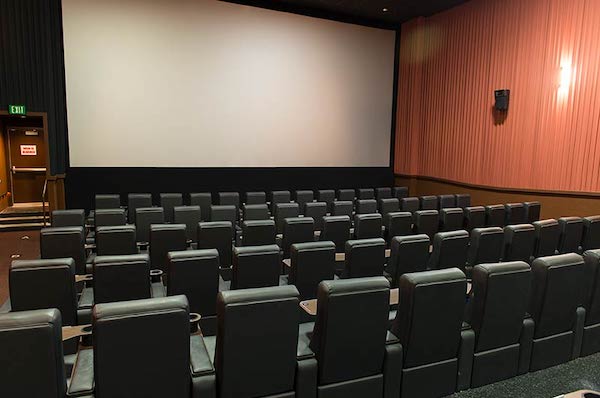
Cinemark has taken the whole recliner thing to the point that they have given up on stadium seating in their new screens in Northern New Jersey. Each auditorium has a very gently raked floor with rows of recliners, and a screen that's placed fairly high. You pretty much HAVE to recline to see the whole image. I'm not a fan. It reminds me too much of the horrid old boxes that United Artists built in the eighties.
Posted by Marcel Birgelen (Member # 6801) on 09-17-2019, 05:26 PM:
quote: Geoff Jones
I agree that this is good when it's installed properly. However, when the AMC in Broomfield remodeled their theater with recliners, they installed Plexiglas partitions that block the view in some seats in some of their auditoriums.
It's hard to judge at what height the camera was positioned, but if my view of the screen would be partially impeded by plexiglass, I'd ask my money back immediately if they couldn't provide me another seat.
Really, who comes up with this kind of stuff? I'd rather close the balcony than sell tickets to such a shit show.
quote: Frank Cox
The problem that I can see with reserved seating is that you would need someone to enforce it and I don't see how that would work in a small theatre.
There was a time when reserved seating used to be quite the standard in theaters, I think it's really the multiplex that did away with the concept of ushers due to a cost cutting measurement, which introduced the idea of free-for-all, first come, first serve seating.
Reserved seating is now often sold in conjunction with a more premium experience, but it's pretty rare to see someone checking whether you're seating yourself at your designated seat.
Those theaters primarily count on the fact that people will figure it out themselves and ask theater personnel if that doesn't work out...
Posted by Bobby Henderson (Member # 840) on 09-17-2019, 09:24 PM:
quote: Geoff Jones
I agree that this is good when it's installed properly. However, when the AMC in Broomfield remodeled their theater with recliners, they installed Plexiglas partitions that block the view in some seats in some of their auditoriums.
Yeah, a clear acrylic panel installed on top of the solid partition is a pretty stupid idea -as illustrated in your photo. I understand the motivation for installing the clear acrylic topper. It's likely there as an attemp to keep audience members from tossing pieces of popcorn, candy, pennies, used condoms or whatever onto people in the lower rows. If someone really wants to toss a Junior Mint through the air onto others below a little acrylic panel isn't going to stop that. Thankfully, none of the Dolby Cinema screens I've visited have that clear acrylic panel installed on top of those row dividers. Obviously someone at Dolby or AMC figured out the acrylic panel thingie was a bad idea and didn't build it onto a lot of subsequent Dolby Cinema installations. I don't know why AMC doesn't just remove that acrylic thing at the Broomfield location however.
A Dolby Cinema setup can't be dropped into just any existing auditorium either. Those partitions just past your feet should not be blocking the view of the screen at all. They're only supposed to block the view of the rows ahead of you (so you can't see everyone checking Facebook).
quote: Mark Ogden
Cinemark has taken the whole recliner thing to the point that they have given up on stadium seating in their new screens in Northern New Jersey. Each auditorium has a very gently raked floor with rows of recliners, and a screen that's placed fairly high. You pretty much HAVE to recline to see the whole image. I'm not a fan. It reminds me too much of the horrid old boxes that United Artists built in the eighties.
That's pretty awful. I'd be pissed if I spent extra to watch a movie in a recliner style auditorium only to walk into a room like that. It's definitely a relic of 1980's shoebox screen design. The screen is offset to fit a damned door and bright green exit sign on the left side of the image. The tall shape of the screen almost guarantees 'scope movies will be shown in TV-at-home letter-box style. Hell, I wouldn't be surprised if the image was chopped at the ends (to fill more of the screen). I've seen that kind of treatment before in such auditoriums. Every movie gets shown in flat ratio.
Speaking of green exit signs, I really think movie theater screens need something to block out the green light pollution of those exit signs. A set of curtains and movable masking would do the trick in many locations. A shadow box around the screen would solve the problem in almost any location. Imagine what a matte black shadow box could do in conjunction with RGB laser projection. That might be pretty cool.
Posted by Marcel Birgelen (Member # 6801) on 09-18-2019, 04:16 AM:
quote: Bobby Henderson
The tall shape of the screen almost guarantees 'scope movies will be shown in TV-at-home letter-box style. Hell, I wouldn't be surprised if the image was chopped at the ends (to fill more of the screen).
To the defense of the theater in question, the screen, although seemingly void of movable masking, looks like it has an aspect ratio of close to scope in its current form.
quote: Bobby Henderson
A shadow box around the screen would solve the problem in almost any location. Imagine what a matte black shadow box could do in conjunction with RGB laser projection. That might be pretty cool.
What about the $25 solution? A shadowbox around the emergency exit lights? In 90% of all cases that would solve the problem pretty efficiently.
Also, local fire regulation often doesn't allow you to entirely switch off exit lights, it often does allow you to dim it to a certain degree, but even that's seldomly employed.
Recently, I was in a theater were there was a green LED shining on me the entire time. Apparently, it was supposed to light up the isle. According to the cinema owners, it would be less irritating than more direct isle lighting and less of the light would end up on screen. While that last part might have been true, sitting in a green glow during the entire show was highly distracting.
Posted by Bobby Henderson (Member # 840) on 09-18-2019, 11:06 AM:
quote: Marcel Birgelen
To the defense of the theater in question, the screen, although seemingly void of movable masking, looks like it has an aspect ratio of close to scope in its current form.
It looks more like a flat ratio screen to me. I've seen Cinemark houses like that before. I've seen the same approach in some other theaters too. An former Carmike location not far from me in Wichita Falls has some of its smaller houses configured like that photo (complete with 'scope ratio movies being cropped at the ends). At best it could be an odd 2:1 ratio screen with all content getting trimmed to fit it. Regardless of the aspect ratio, no movie theater auditorium should have a screen arrangement like that. An off-center screen with an exit door crammed in next to it gives off the personality of screening a movie in an industrial shed. I wouldn't pay bargain theater prices to watch movies in that kind of setup. It looks awful.
quote: Marcel Birgelen
What about the $25 solution? A shadowbox around the emergency exit lights? In 90% of all cases that would solve the problem pretty efficiently.
And that solution would block off the viewing angles of the exit sign, which would absolutely violate fire codes. By law the exit signs have to be clearly visible to all customers.
As for dimming the light output of exit signs, that would have to be checked against local fire codes.
Nevertheless, light pollution from exit signs is a serious problem for bare un-masked screens. That green light bleed was one of the few complaints I had about a recent visit to a new Dolby Cinema screen installation in Colorado Springs. The green exit signs down on the lower left and right side walls were putting out just enough light to put a green glow onto the lower left and right corners of the screen. It was most noticeable at the end of the Dolby Cinema promotional snipe where the screen is all deep black with the little message "the projector is still on." Normally everything should be close to pitch black, at least on the screen. In this case the glow of those exit signs were creating a serious amount of light pollution.
A combination of curtains and masking would have blocked out some of that ambient light. A shadow box of some sort would have eliminated the problem completely. The shadow box doesn't have to be as deep as the ones used in theaters like the GCC Northpark 1-2 in Dallas (R.I.P.). A bevel around the screen maybe a couple feet deep might be enough.
Posted by Marcel Birgelen (Member # 6801) on 09-18-2019, 11:50 AM:
quote: Bobby Henderson
It looks more like a flat ratio screen to me. I've seen Cinemark houses like that before. I've seen the same approach in some other theaters too.
I'm not defending the theater layout here, I also don't like "offset screens" for example. I'm not against a "raked floor" setup though, if it's done right.
But I've seen so many screens, I do recognize a scope sized screen from 10 miles. ![[Wink]](wink.gif)
I've done some pixel measuring: it's circa 322x136 pixels. Measured on the right and simply across the width of the screen. Now, I didn't compensate for the perspective, because I was simply looking at a ballpark figure here. But if you divide 322 by 136 you come close to 2.37, which is awfully close to 2.35. You can do the exersize yourself if you want.
quote: Bobby Henderson
And that solution would block off the viewing angles of the exit sign, which would absolutely violate fire codes. By law the exit signs have to be clearly visible to all customers.
If you throw a black box around all those signs without proper design considerations, yes. But, not if you design it carefully. For a door in front of the theater, besides or below the screen (yeah, I try to avoid those like the plague, but yet many shoebox theaters have them), a properly designed shadow box around the sign will have no impact on visibility to the customers, as long as it is not too deep, yet it would block almost all light falling onto the screen.
A door close the screen in one of the side walls can have a partial shadow box, where the sign is still visible from the rows where the customers are sitting. I've actually implemented this in the past (although I didn't call it a shadow box) and it passed the fire inspection just fine. Now, you could have some local inspector which will go mental about just anything, but usually, they're just interested in keeping the safe away from harm and are willing to work with you on doing so.
In some cases, you can even get exceptions to completely dim the exit lights, if you install some modern fire detection and suppression countermeasures, like equipment that lights up the room and dimmed emergency exit lights as soon as a potential fire is detected. The initial Dolby Cinema rooms built around here got those exceptions and had to do some homework regarding their fire detection systems.
A shadow box around the screen may conflict a bit with modern theater design esthetics and also a bit with movable masking systems and curtains (although both now fall into the almost extinct species category). Also, in high rooms where people look down on the screen, it might block part of the screen. The same might be true for the auditoriums that use a curved screen and are wider at the back than at the front. There might be some merit in the shadow box design, depending on how it fits in the room, but I think it's easier in many cases to approach the problem where the light is created. Sometimes solutions are pretty simple, yet almost nobody is willing to invest time and money into this.
"Ambient Light Management" is a challenge for any auditorium showing movies, unfortunately, it doesn't get nearly the attention it should get.
Posted by Daniel Schulz (Member # 1881) on 09-18-2019, 12:55 PM:
Although I like recliners for the obvious reasons, I've found that for some movies I prefer more traditional seating, because of the crowd size. Comedies are funnier, horror films are scarier and fist-pumping rousing hero shots are more exciting when shared with 200 or 300 or 400 fellow moviegoers, as opposed to 50 or 75.
Posted by Geoff Jones (Member # 3668) on 09-18-2019, 01:45 PM:
I agree, Daniel.
Another complaint I've read about recliner auditoriums is that it can be a lot harder for groups to find seats together. Mike, do you have any sense how many of your customers tend to come in groups of 1-3 versus how many come in groups of 4-6 or more?
Posted by Bobby Henderson (Member # 840) on 09-18-2019, 02:27 PM:
Many recliner-based auditoriums seem to be geared for either individual viewers or couples, not groups. The seating in AMC's Dolby Cinema houses are usually installed in pairs, with a flip up arm rest for that "love seat" effect.
IMHO, it's a royal pain in the ass going to a movie theater with a group of people. It's all but guaranteed at least one or more people in the group will not have his/her shit together, causing delays or other issues. Reserving all the seats needed in advance could actually solve some of those problems. It forces everyone in the group to actually commit to seeing the movie and doing so at a specific time. Every time I've gone to a movie in a group of 6 or more people we've ended up with shitty seats because one or more people had to drag their feet and make sure we didn't enter the auditorium until the freaking trailer pack or even the movie itself was already in progress. I really really hate that shit.
quote: Marcel Birgelen
I'm not defending the theater layout here, I also don't like "offset screens" for example. I'm not against a "raked floor" setup though, if it's done right.
I don't have a problem with traditional sloped floor seating either. Really, I'd prefer if movie theaters could come up with a happy medium between old school sloped houses and these steep stadium seating angles. It would allow for lower ceilings, yielding two big benefits: more use of common height 'scope-shaped screens and far more effective ceiling surrounds in Atmos-equipped houses.
quote: Marcel Birgelen
I've done some pixel measuring: it's circa 322x136 pixels. Measured on the right and simply across the width of the screen. Now, I didn't compensate for the perspective, because I was simply looking at a ballpark figure here. But if you divide 322 by 136 you come close to 2.37, which is awfully close to 2.35. You can do the exersize yourself if you want.
The image Mark Ogden posted has a noticeable amount of barrel distortion in it, which makes any such exercise pointless. I'm partly basing my hunch that is a flat ratio screen on past experiences of visiting numerous Cinemark theater locations, along with others using that kind of arrangement.
quote: Marcel Birgelen
If you throw a black box around all those signs without proper design considerations, yes. But, not if you design it carefully. For a door in front of the theater, besides or below the screen (yeah, I try to avoid those like the plague, but yet many shoebox theaters have them), a properly designed shadow box around the sign will have no impact on visibility to the customers, as long as it is not too deep, yet it would block almost all light falling onto the screen.
A light blocking flange around an Exit sign is probably only going to work in odd arrangements like the one Mark Ogden posted, where the exit door is immediately to the left of the screen. Many theaters have doors and the bright exit signs positioned on side walls, turned 90 degrees from the screen. A light box around an exit sign would do little to block light from that sign from shining onto the screen, but it would obscure the viewing angle for people nearest to the wall on which the sign is positioned.
I mentioned shadow boxes around the screen, as well as curtains and masking being useful solutions before. Another solution is better positioning of the exit doors and exit signs near the screen. If the screen can't have extra fixtures like curtains, shadow boxes, etc to block stray ambient light coming from the sides then another solution would be moving the screen a bit forward so exits to the left and/or right of the screen are recessed and behind the plane of the screen.
Theater chains have to put more thought into that situation, especially if they're going to spend quite a bit extra on features like laser projection. All the extra money spent on a high dollar dual laser projection setup in a Dolby Cinema screen goes a good bit to waste if a bunch of that extra contrast is being eliminated thanks to ambient light pollution from things like Exit signs.
Posted by Marcel Birgelen (Member # 6801) on 09-18-2019, 03:57 PM:
quote: Daniel Schulz
Although I like recliners for the obvious reasons, I've found that for some movies I prefer more traditional seating, because of the crowd size. Comedies are funnier, horror films are scarier and fist-pumping rousing hero shots are more exciting when shared with 200 or 300 or 400 fellow moviegoers, as opposed to 50 or 75.
I totally agree, there is something special about watching a movie together with a sizeable, "correctly engaged" crowd. Unfortunately, the amount of theaters that can seat as many fellow moviegoers is drastically declining and the amount of shows that fill up such rooms along with it...
quote: Bobby Henderson
I don't have a problem with traditional sloped floor seating either. Really, I'd prefer if movie theaters could come up with a happy medium between old school sloped houses and these steep stadium seating angles. It would allow for lower ceilings, yielding two big benefits: more use of common height 'scope-shaped screens and far more effective ceiling surrounds in Atmos-equipped houses.
I think my favorite arrangement is a stadium seated arrangement with a shallow angle. You don't need to put the screen all the way up in such configuration and you don't need a very high room. The problem is that you need more space between rows in order to avoid other seats/other people's heads blocking parts of the screen. Now, if you put in recliners, they're going to need more space in between rows anyway.
Also, if your angle isn't too steep, you can possibly avoid implementing stairs. I know that local fire code around here requires you to provide constant isle lightning if you have hard steps, but without those you don't need any specific isle lightning at all.
quote: Bobby Henderson
The image Mark Ogden posted has a noticeable amount of barrel distortion in it, which makes any such exercise pointless. I'm partly basing my hunch that is a flat ratio screen on past experiences of visiting numerous Cinemark theater locations, along with others using that kind of arrangement.
Sure, there is some distortion in it and I didn't compensate for the perspective either, but there needs to be an enormous amount of distortion and "uncompensated skew" in it to go from circa 2.35 close to 1.85. It might not exactly be 2.35, but it's closer to 2.35 than to 1.85. I'm sufficiently confident to wage a crate of your favorite beer against it. ![[Razz]](tongue.gif)
quote: Bobby Henderson
A light blocking flange around an Exit sign is probably only going to work in odd arrangements like the one Mark Ogden posted, where the exit door is immediately to the left of the screen. Many theaters have doors and the bright exit signs positioned on side walls, turned 90 degrees from the screen. A light box around an exit sign would do little to block light from that sign from shining onto the screen, but it would obscure the viewing angle for people nearest to the wall on which the sign is positioned.
There are situations where neither a shadow box around the exit light nor one around the screen will have much effect at all. It requires some case-to-case approaches.
Doors that are sufficiently far away from the screen usually don't cause big problems with falloff on the screen, it's usually those kind of doors close to the screen. It was back in the late 90's when I made a custom "shadow box" to cover the light coming from an emergency exit sign in the side wall close to the screen that annoyed the heck out of me. We made it out of some Medium-density fiberboard which we painted black. Other rooms had their emergency exits positioned further back and due to the relative width of the walls, they were also pretty "inset" so they never really casted any noticeable direct light onto the screens.
I also remember that we put some kind of darkening foil into one very bright exit light at the back of the smallest room we had, as this would also cast some light on the screen and caused some eery glow in the entire room.
Something no shadow box will solve are those fancy LED strips they've been putting onto the steps of those stadium seated auditoriums. Maybe it would help if they would implement specific strips with some polarizers or other kind of filters that reduce the amount of light going towards the screen. I've also found the blue versions to be less obtrusive than the red ones.
In our screening room, we're switching off the exit lightning entirely, but a fire alarm automatically triggers it back on, as does a power outage. It had to be annotated and documented, but it was approved. They told me, had this be a bigger room, they would've required specific evacuation instructions prior any public viewing. Since we don't do public viewings, we don't need to do that in any case. But, if I would be building a cinema right here, I would create a small instruction video or slide show, pointing out the emergency exits in the room and put it into the pre-show and dim the exit lights completely.
Posted by Frank Angel (Member # 248) on 09-24-2019, 07:43 PM:
Wait a minute...but swaths of plexiglass? Didn't we used to rend our garments and gnash our teeth because the glass in the projection ports could potentially reflect audio back to the audience? And now there are sheets of hard, reflective plastic in across the rows? And how pray tell do those sheets imact the sound that arrives at the reclining patron's ears? I assume some of it is attenuated and reflected. Any surround sound or overhead sound from Atmos audio is going to get bounced and skewed by these...well let's just call them what they are....reflector sheets, no?
Posted by Frank Angel (Member # 248) on 09-24-2019, 07:46 PM:
Wait a minute...swaths of plexiglass? Didn't we use to rend our garments and gnash our teeth because even the small projection port glass could potentially reflect audio back to the audience? And now there are SHEETS of hard, reflective plastic in the room across the rows? And how, pray tell, do those sheets impact the sound that arrives at the reclining patron's ears? I assume most of it is randomly reflected in ways that can't be good. Any surround sound or overhead sound from Atmos audio is going to get bounced and skewed by these...well let's just call them what they are....reflector sheets, no?
Posted by Mike Blakesley (Member # 26) on 10-01-2019, 10:39 PM:
Here's a question about recliners..... on a flat (sloped) floor, how much open space is recommended between rows when the seats in both rows are reclined?
Posted by Mike Spaeth (Member # 524) on 10-01-2019, 10:41 PM:
About 18-24 inches seems to be the norm.
Posted by Marcel Birgelen (Member # 6801) on 10-02-2019, 05:07 PM:
Minimum recommended distance I've heard was 40cm, or about 16 inches, but more is better. As you can see, those suckers take up a lot of room.
It also depends on the amounts of seats in a row without an aisle in-between. If that's a lot, you probably want to widen it a bit more. It's more of a security thing. Think about it this way: The power drops out, the recliner function stops to work and there is an emergency. People still need to be able to get away if seats are reclined around them and can't be retracted.
Posted by Frank Angel (Member # 248) on 10-02-2019, 08:19 PM:
Seems like local municipalities would be eager to impose safety specs regulations on these seats, especially if without any guidelines, they could be placed in ways that could severely restrict orderly egress in cases of an emergency...or if their motors can, say, you know, crush someone's head...stuff like that. I mean, if they have all sorts of regulations about the placement of exit signs, they certainly will want to regular seat placement that can prevent patrons from getting to those exit signs.
Posted by Frank Cox (Member # 6258) on 10-02-2019, 11:21 PM:
When I was making my theatre I had to meet some regulations for minimum aisle width and minimum space between each row of seats, and maximum distance from any seat to an exit, plus minimum width of said exit.
So there are regulations for this stuff.
Posted by Paul Finn (Member # 10726) on 10-03-2019, 07:22 AM:
NFPA-101 'Life Safety Code' is a good reference and the law in many jurisdictions.
Paul Finn
Posted by Gordon McLeod (Member # 33) on 10-03-2019, 09:49 AM:
NFP101 can only be calledupon at least in Canada as long as the entire building was designed to it not the National Building code with in the same structure mixed code is not permitted
Also the 40mm(16") is to be measured with both rows in the reclined position.m Also in several locations there has been noise about wanting the firealarm to bring all seats to the upright position
Personally I dont like them I find I have yet to find one that has good lumbar support. Also I find the foam not to be as dense as some of the better fixed seats have and I suspect they will go flat quickly
Posted by Marcel Birgelen (Member # 6801) on 10-03-2019, 06:18 PM:
quote: Gordon McLeod
Also in several locations there has been noise about wanting the firealarm to bring all seats to the upright position
There have been at least two separate incidents where the automatic uprighting feature of such chairs have resulted in actual deaths, where people became stuck under the seat, while trying to get their wallet, mobile phone or other stuff from underneath.
Also, if the power goes out, those things will most likely just keep in their reclined position anyway, since they're almost all directly electrically driven. Stuff like (emergency) exit lightning is required to have batteries that last a minimum number of minutes/hours. You don't want to fit those recliners with batteries too.
Posted by Martin Brooks (Member # 1269) on 10-04-2019, 10:57 PM:
One of the problems with recliner seating is the massive reduction in seat count. If a theater is not selling out anyway, I suppose it doesn't make much difference, but if you're turning people away on weekends, then the theater is leaving money on the table. It's incredible to me that thousand seat theaters would probably be 60-70% filled on a Friday and Saturday night and now we have a lot of 75 seat theaters.
The other problem with recliner seats is that in many instances, a small theater can wind up with only 2-3 ideal seating positions. I don't bother with those theaters anymore. There's a local independent theater in my neighborhood that was pretty good before they renovated for digital (they did so very late in the game). They put in lounge seating and reconfigured the place and ruined it. They don't get my business anymore.
In NYC, the Regal E-Walk once had 3276 seats over 13 screens. It now has just 1344.
The AMC 84th Street 6 once had 2980, but later reduced to 2385. With reclining seats, it now has just 883.
In Queens, NY, the AMC Fresh Meadows 7 was originally a single-screen house with 2184 seats. It was multiplexed into 1950 seats. With lounge seating, it has just 636 across 7 screens.
Lounge seating reminds me of WALL-E. We can't go 2 1/2 hours without eating crap and we can't go 2 1/2 hours without lying down. And lately, I've found a lot of them to be broken anyway. A comfortable seat is a good idea. But I really don't see why we have to lie down. Especially when it sacrifices the ability to get a good seat at a movie theater.
I really don't see how theaters can survive for very long with so few seats. I know that AMC has claimed that revenues increased at lounge seat theaters, but I don't see how being forced to turn people away helps revenues.
Posted by Frank Angel (Member # 248) on 10-07-2019, 10:13 AM:
I know that AMC has claimed that revenues increased at lounge seat theaters
Martin, top executives who make the decisions that turn out to be major, costly mistakes usually pick and choose stats that don't make it look like those multimillion dollar decision were a massive FAIL. And as we all know, anyone can spin stats to show anything they want wants.
Has management who made the decision to replace solid, proven seats that have known reliability, relatively few moving parts and a given cost factor over time, have they actually figured in the need for the additional maintenance that these recliners will incur? The cost of stocking replacement parts? I'll bet not.
And then there's the main reason that I won't go near them and it's not because I am afraid it will crush my head...I have a firm rule that I don't stick my head into anything that has moving parts and a powerful motor. It's because of humanity. Oh, I like people alright, just not the lipid fats and hair grease and...dare I say it?...LICE...that they can leave behind, especially when they are laying down. Bet the additional cost of CLEANING hasn't been figured in for these recliners -- have they Mr. Exhibitor?! Additional cleaning and disinfecting staff? I think not.
And while another problem that I just thought of may not be any more prevalent than with ordinary seats, intuitively I feel it actually might be, so I'll just throw it out there because, no question, it's a terror and it only has to occur once to hit a theatre's business like an H-bomb; just ask the management of Regal E-Walk in Manhattan. Let me whisper the word: bedbugs. No more need be said.
Posted by Mike Blakesley (Member # 26) on 10-07-2019, 10:48 PM:
Well our existing seats have cloth covers, and all the recliner "samples" I saw at the convention had leather (or faux-leather) upholstery, so that will mostly take care of the lice/bedbug/sanitation issues. You can wipe down a leather chair with a disinfectant cloth, but with cloth upholstery you're kinda stuck with what's in there between deep cleans.
I'm not sure about the maintenance thing. Our current Greystone seats are nice and durable, but they are impossible to disassemble without using a blowtorch (as far as I can tell, anyway) so they're starting to get a little shopworn here and there, and thus, my pondering on what direction we'll go with our next batch of seats. But yeah, anything with motors and moving parts is going to need maintenance. Anybody who puts them in without taking that into consideration would be nuts.
quote: Martin Brooks
I know that AMC has claimed that revenues increased at lounge seat theaters, but I don't see how being forced to turn people away helps revenues.
I talked to several owners at the convention (individual guys, not AMC-ers) who said their business is up substantially since they put in recliners, even though they reduced their seat count.
The rationalization (as I noted in my post at the top of the thread) is to focus on the average usage, rather than the sellout count. If you're selling out 200 seats every weekend, fine...keep 200 seats. But if you only sell out a few times a year and on a typical night you have 30 to 50 people, then you're probably just as well off with 70 more-comfortable seats and adding a few more shows when you're expecting big crowds. The theory being that people will come out more often if they have a more enjoyable experience.
Posted by Mike Spaeth (Member # 524) on 10-07-2019, 11:21 PM:
The AMC you mentioned in Fresh Meadows has DOUBLED their gross revenue since cutting their seat count to a third. Certainly that makes up for a couple of extra ushers to maintain the place. Recliners are the new stadium seating. They will be expected by the customers, so either get on the bus now and get increased revenue or be forced to do it. Or, you could be like General Cinema did with stadium seating, dismiss it as a "fad" and watch your business fade away if you are in a competitive market. For a situation like Mike's it's probably not that important, but if he's planning to replace his seats, why not spend 3x per seat and buy 1/3 of them. Same bottom line (yes, there are electrical costs involved in addition), but why not give your customers a better experience if you can?
Posted by Marcel Birgelen (Member # 6801) on 10-08-2019, 05:34 AM:
What I'm wondering is, if it's really the reclining feature that attracts people, or is it just the more comfortable seating, even in upright position.
I certainly have based my choices on seating comfort in the past, especially when folding seats were still the norm and legroom was often less than your average low-cost airline.
I've personally never seen the need for recliners though.
Posted by Bobby Henderson (Member # 840) on 10-08-2019, 11:59 AM:
At first glance one would think overall ticket sales numbers would plummet big time with recliners eating a big chunk of a theater's seat count. But, I have seen theaters play games with their movie scheduling across various screens in the complex to maximize ticket sales.
Case in point: back when my girlfriend and I watched the first Kingsmen movie at Harkins Bricktown 16 in downtown Oklahoma City we intended to watch it in the big Atmos-equipped Cine Capri house. We bought tickets for that screen and paid a modest $1 premium per ticket. Well, fucking Fifty Shades of Gray was also playing that weekend. Due to all the unjustified hype for that tame, lame, wannabe soft-core POS movie it got pushed onto the Cine Capri screen at the last minute. The movie already was playing on 2 or 3 other screens, but theater management decided it needed to go in the big house too. We ended up watching Kingsmen in a smaller non-Atmos house, with a smaller screen, vertically masked picture and audio with dynamics along the lines of quiet TV speakers volume. The theater gave us a pair of comp passes, but I was still pretty pissed about the situation.
With everything being digital, it's not difficult to "move a print" to a different screen or have it playing on as many screens as one desires in the complex. Theaters can double or triple up movies past their prime onto a single screen without too much trouble in order to free up showtimes for a movie with higher than expected demand. The downside is customers have to be careful about making plans to see a movie that's already been out for a month. They may arrive at the theater to find the show has been scrubbed to make room for other shows that are selling better.
Sidebar: this is also why "analog" changeable copy signs with flat or slotted letters don't work so well for modern movie theater marquees or street signs anymore. There's just not enough flexibility. It too much of a pain to re-arrange show titles and/or times at the last minute. If the complex has a lot of screens the sign would have to be enormous to show all the necessary details. Electronic variable message signs are far more effective. Highly restrictive sign ordinances in many locations are greatly limiting what movie theaters can install on a building or out near the highway.
Posted by Marcel Birgelen (Member # 6801) on 10-09-2019, 02:02 AM:
quote: Bobby Henderson
At first glance one would think overall ticket sales numbers would plummet big time with recliners eating a big chunk of a theater's seat count. But, I have seen theaters play games with their movie scheduling across various screens in the complex to maximize ticket sales.
You've seen those dynamics yourself. The idea is to boost your average ticket sales. If a show actually sells out, they simply sacrifice another, smaller show and start filling that up. Slowly, the low-cost airline dynamics start to creep into the industry.
Powered by Infopop Corporation
UBB.classicTM
6.3.1.2