|
|
This topic comprises 4 pages: 1 2 3 4
|
|
Author
|
Topic: carpeted booths?
|
|
|
Mike Jones
Expert Film Handler
Posts: 108
From: Birmingham, MI, USA
Registered: Jul 2000
|
 posted 06-27-2001 11:53 PM


Our independent theatre is opening a state of the art 12 screen this fall, and we're installing neither carpet or tile. Instead we're putting it a rubber matting in the entire booth. Does anything have this in their place? What this will do is help cut down on sound, be easy on our feet  and absorb dust and reduce static. and absorb dust and reduce static.My booth has a low pile carpet. We vacuum it every week and if you ask me it is far better than tile. Would you rather vacuum it once a week or sweep AND mop a tiled floor probably daily? Like Randy said, my theatre has static problems too. Putting the humidifier next to the platter doesn't help much because the booth is too big. We have one projector that has tiling behind it and let me tell you it helps cut down the sound vibration SOOOO much. Like night and day. And there really is no difference that I can tell with helping or hindering static. Then again, I have never worked in a tiled booth.
| IP: Logged
|
|
|
|
|
|
|
|
|
|
|
|
|
|
Paul G. Thompson
The Weenie Man

Posts: 4718
From: Mount Vernon WA USA
Registered: Nov 2000
|
posted 06-28-2001 11:42 PM
Scott and Brad, the same can be done very easily if you have an old CFS or any other MUT that has the power spindle on the top. All you have to do is come up with a wooden or plastic disc (if the MUT's disc is not big enough) for the trailers to be wound upon. You have to wind them with the sound track down since it is basically opposite rotation of the platter. Then, take the old trailers off, and splice on the ones you just made up. Please remember, this works best if you have old trailers already on the show. Take the old ones off, and replace them with the roll you just made up. Of course, you'll have to flop your newly made roll over to match up the soundtracks. Then use the old plastic lined trash can trick to dismantle your old trailers if they are to be saved. Hold the old trailers in your hand, unwind 10 convolutions into the trash can, twist the roll, and unwind 10 more and so on. When you then wind them on a core, they will not tie themselves into a nasty knot. The convolutions will cancel each other. With proper handling techniques, you will not damage the trailers.
| IP: Logged
|
|
|
|
Paul G. Thompson
The Weenie Man
Posts: 4718
From: Mount Vernon WA USA
Registered: Nov 2000
|
posted 06-29-2001 03:45 AM
Yes, Brad. I just finished looking at that as per your suggestion. Your method is very effective, but I never made hardware to adapt to the horizontal tables. Normally, when we changed trailers, we were never going to run them again, so in many instances, I simply pulled the threading leader off the whole shebang and tossed the trailers in the trash.  But, I will admit, if the trailers are going to be used in the circuit's sub-run houses, your idea is probably the best if the booth is equipped with equipment similar to what is depicted in the pictures. With the old CFS MUTS and those worthless Strong MUTS, I found it much easier to either toss the trailers in the trash, or use the trash can technique to salvage them for "practice reels". I never had the time to fiddle with trailers that were going to be thrown in the garbage anyway. When I had projectionists use my practice reels, I came equipped with all kinds of neat stuff to make the film jump rollers, suck itself through the pay-out heads, and some tools to remove sprocket perfs from the film, and purposely be club-footed and walk through the film path, and things like that. Now those old Brenkerts sometimes outfoxed me. I could cut the film 3/4 of the way though, as well as removing 8 inches of sprocket perfs, and it would not even phase those old Brenkerts.  In my training sessions, anything that can happen in a booth I made it happen, as long as it would not damage the equipment itself. I have also been known to install a bad belt on something like a Century or a Simplex 5-Star, and while the machine was running, a razor blade applied to the belt was very effective. Then I just stood there and watch the prospective projectionist scratch his or her butt trying to figure out what was wrong, and then I would walk over to another machine and sliced the film in two, or shut a platter motor down, or trip a circuit breaker or two. Devil I was, yes! But many of my trainees became the best!
| IP: Logged
|
|
Will Kutler
Phenomenal Film Handler

Posts: 1506
From: Tucson, AZ, USA
Registered: Feb 2001
|
posted 06-29-2001 02:26 PM
Sorry guys, I did not mean to infer that I changed trailers by letting them drop on the floor! It was just a suggestion that I had come accross, and I forgot where. One good use that I can see for it is when handling threading leaders when doing trailer changes. If I needed to add a new trailer in the #1 position, I would remove the center ring, detach the threading leader, move the center ring to an unused deck, wind the threading trailer onto it, splice on the trailer, wind it on, then move it to the print and reattach. Sounds involved, but is really quite simple and only took a couple of minutes, and trailers were quite "neat and clean" when reattached to the print. The trash-can thing would come in handy to keep threading leaders of the floor when re-winding onto center ring?I have heard that Christie is comming out with a new platter design. It uses two different diameter center rings per deck. The larger diameter to be used for normal operations, the smaller diameter to be used with trailer changes. Does anyone know about this?
| IP: Logged
|
|
Brad Miller
Administrator

Posts: 17775
From: Plano, TX (36.2 miles NW of Rockwall)
Registered: May 99
|
posted 06-29-2001 02:40 PM

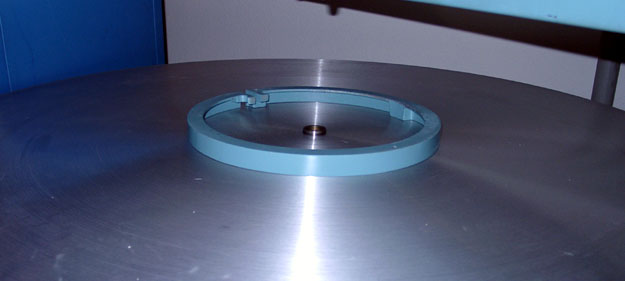
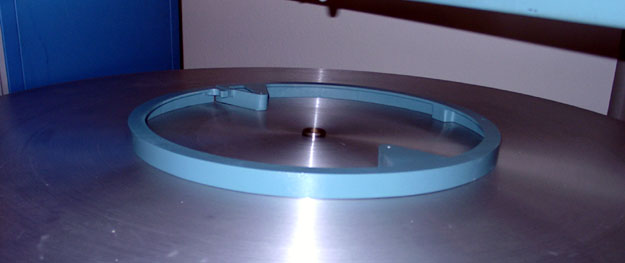
Will, you're still wasting a little bit of time in that procedure, but that's better than what most booth do. However, I still maintain that you do not need a trash can for that leader. Trash cans are for trash. The Christie item you are referring to is not a new "platter", just a new center ring. The idea is to takeup a movie onto the new 19" center ring right before you change your trailers out. This gives you TONS of room to drop in new trailers. Also convenient is loading up the feature alone (say for a screening) and taking up on the larger ring and then you will have plenty of space to drop in an entire trailer pack. Personally, I prefer the 19" center rings over the standard ones hands down for ALL use. Using them allows for a retiming of the platters to 15 1/2 RPMs, which makes it virtually IMPOSSIBLE to throw a print. It also allows for clamping of Costner-length movies with normal clamps, where the clamps would otherwise have not fit. I'll try and get pictures later if you want them.
| IP: Logged
|
|
Will Kutler
Phenomenal Film Handler
Posts: 1506
From: Tucson, AZ, USA
Registered: Feb 2001
|
posted 06-29-2001 03:24 PM
Did not mean to argue with y'all, but this is how my bosses wanted things done. Brad, you do make sense. I do not have the Christie book in front of me, but I remember reading somewhere that your style of practice helped equalize brush wear on the platter motors? But in breaking down prints, never had a problem maintaining constant/even tension or film bounce.Yes, I would like to see those platter pictures, Regards, W.K.
| IP: Logged
|
|
|
|
|
|
All times are Central (GMT -6:00)
|
This topic comprises 4 pages: 1 2 3 4
|
Powered by Infopop Corporation
UBB.classicTM
6.3.1.2
The Film-Tech Forums are designed for various members related to the cinema industry to express their opinions, viewpoints and testimonials on various products, services and events based upon speculation, personal knowledge and factual information through use, therefore all views represented here allow no liability upon the publishers of this web site and the owners of said views assume no liability for any ill will resulting from these postings. The posts made here are for educational as well as entertainment purposes and as such anyone viewing this portion of the website must accept these views as statements of the author of that opinion
and agrees to release the authors from any and all liability.
|

 Home
Home









 Printer-friendly view of this topic