|
|
This topic comprises 6 pages: 1 2 3 4 5 6
|
|
Author
|
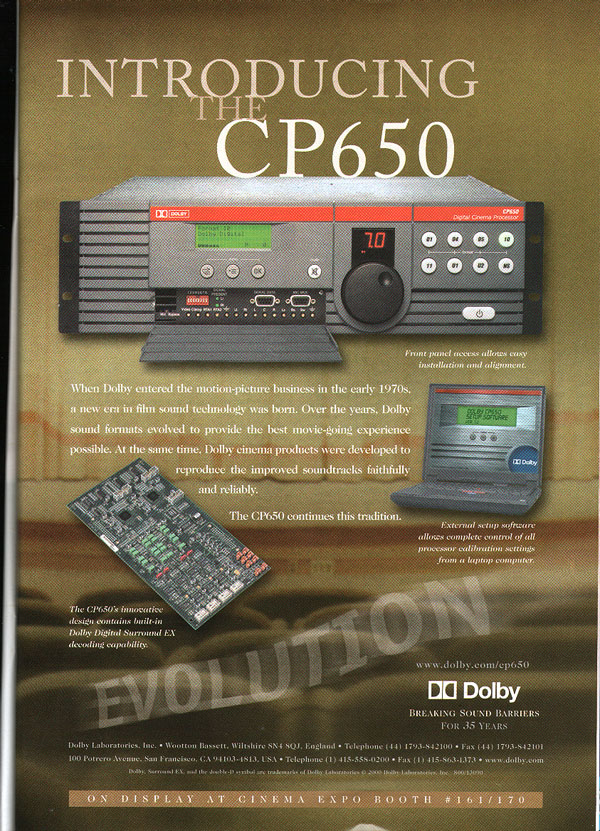
Topic: CP650??
|
|
|
|
|
|
|
|
|
John Walsh
Film God
Posts: 2490
From: Connecticut, USA, Earth, Milky Way
Registered: Oct 1999
|
 posted 06-14-2000 08:23 PM


I've run only two "new" IB features (13th Warrior and Bulworth) but that was enough to convince me that -currently- it will not fly. The shedding was terrible! And since I knew it was an IB print, I even dropped in on my nights off to ensure (with a cattle prod) the ushers were cleaning. After 4 weeks of Warrior, the shedding still built up so much, it pushed it out of focus. (Although, for two wonderful weeks it looked great.)I can't imagine what it would have look like at a place that cleans their projectors even less. Mark, is there some way you could actually measure how much weave, bouncing, etc? And what happens if you try to complain or send a print back? (What, you don't happen to have a $15,000 3-color temperature meter in your closet!) I posted a topic awhile ago (Measuring Lab Quality (for release prints) asking for a quantitative way to accept or reject a print, that can be done in the theaters. But no one seemed to have a solution. Although, maybe we should listen to Marc J. and start talking about CP650's!
| IP: Logged
|
|
|
|
Kevin Crawford
Expert Film Handler
Posts: 207
From: Sacramento, CA, USA
Registered: May 2000
|
posted 06-15-2000 01:23 AM
There really isn't alot of demand for the biamp card? My company, through the lousy advice of their equipment supplier, has gotten the biamp card for all of their 500's that are not THX. Actually, I am glad about the 650 not being biamped. Since I have not seen a monitor that can use a biamped signal for the processor. When the equipment supplier does an install, they do not feel that it is important to set up the equipment to monitor the processor output. But they never have to troubleshoot anything. Sorry, I just needed to vent.
| IP: Logged
|
|
|
|
|
|
John Pytlak
Film God

Posts: 9987
From: Rochester, NY 14650-1922
Registered: Jan 2000
|
posted 06-15-2000 06:09 AM

Building bigger or more labs to allow slower printing would likely drive print costs up considerably. Print film volume is very cyclical, with the busiest times being early summer releases and the Thanksgiving/Christmas season. Most businesses with cyclical demand size their plant and staff for the average demand, and work like crazy (overtime, multiple shifts) during the busy season.The choice of print stocks is usually made by the distributor. Kodak VISION Premier Color Print Film 2393 costs slightly more, and is usually chosen for the "look". AFAIK, most of the "Gladiator" prints were on 2393. ------------------
John P. Pytlak, Senior Technical Specialist
Worldwide Technical Services, Entertainment Imaging
Eastman Kodak Company
Research Labs, Building 69, Room 7419
Rochester, New York, 14650-1922 USA
Tel: 716-477-5325 Fax: 716-722-7243
E-Mail: john.pytlak@kodak.com
| IP: Logged
|
|
Oscar Neundorfer
Master Film Handler

Posts: 275
From: Senoia, GA
Registered: May 2000
|
posted 06-15-2000 06:29 AM
Kevin Crawford wrote:
>>Actually, I am glad about the 650 not being biamped. Since I have not seen a monitor that can use a biamped signal for the processor.<<Kevin, SMART makes a monitor that can do that, the SMART MN610 (which will even do tri-amp) and we also have the PANASTEREO CX230-EX. Both of these also monitor the ex format channels. ------------------
Oscar Neundorfer
Chief Engineer
SMART Devices, Inc. oscar@smartdev.com
| IP: Logged
|
|
|
|
|
|
Ari Nordström
Master Film Handler

Posts: 283
From: Göteborg, Sweden
Registered: Jan 2000
|
posted 06-15-2000 03:20 PM
I disagree with the opinion that the bi-amp option for the CP500 is a bad thing. At our theatre, we have the Cat 683, and never once have we regretted spending the extra money. It sounds great! It has to be said, though, that our tech said it was the first 683 card he installed--there had not been any real demand for it...  As for sound monitoring, we have two separate monitoring systems. One is tapped from the amp for the hearing impaired and thus is a centre-balanced mix. If everything seems to be working OK, this is what we normally use. The other system monitors the outputs, after the power amps, of each channel. The LF and HF for each channel can be checked separately in this way. We also use meters for each amp, which is very useful for quick troubleshooting. This monitoring system basically does the same thing that a THX booth monitor does, except that they don't provide the meters, and we have better booth speakers. Except for the lack of some 70mm sound formats (see my earlier posting on this subject), I really like the CP500.
| IP: Logged
|
|
|
|
|
|
All times are Central (GMT -6:00)
|
This topic comprises 6 pages: 1 2 3 4 5 6
|
Powered by Infopop Corporation
UBB.classicTM
6.3.1.2
The Film-Tech Forums are designed for various members related to the cinema industry to express their opinions, viewpoints and testimonials on various products, services and events based upon speculation, personal knowledge and factual information through use, therefore all views represented here allow no liability upon the publishers of this web site and the owners of said views assume no liability for any ill will resulting from these postings. The posts made here are for educational as well as entertainment purposes and as such anyone viewing this portion of the website must accept these views as statements of the author of that opinion
and agrees to release the authors from any and all liability.
|

 Home
Home







 Printer-friendly view of this topic