Film-Tech Cinema Systems
Film-Tech Forum ARCHIVE


my profile | my password | search | faq & rules | forum home
  next oldest topic   next newest topic
» Film-Tech Forum ARCHIVE   » Operations   » Film Handlers' Forum   » Finding the frameline in the end credits (Page 4)

 
This topic comprises 4 pages: 1  2  3  4 
 
Author Topic: Finding the frameline in the end credits
Stan Gunn
Expert Film Handler

Posts: 176
From: Clematis, in the hills near Melbourne Australia
Registered: Aug 2000


 - posted 03-22-2002 04:33 AM      Profile for Stan Gunn   Author's Homepage   Email Stan Gunn   Send New Private Message       Edit/Delete Post 
More damage happens at the tail of spools due to bad rewinding habits,the film must be wound firm from the start of wind.
This prevents the film slipping, thus preventing cinch marks, most spools have a certain amount of dirt in the centre,a firm wind will assist in keeping the dirt from between the layers at the start of rewinding.

Long leaders whether 25ft or 33ft will prevent cinching marks and assist in keeping unwanted gunk from between the early winding layers and keep heads and tails cleaner. Its been proven to me many times over the past 30 years.

------------------
KALEE FOREVER. CARBON ARC, THE ONLY LIGHT FOR THE STARS!
ALL PARTS FOR VICTOR AND KALART VICTOR 16MM PROJECTORS.SERVICE TO 35 AND 16MM PROJECTION EQUIPMENT.
35MM sprockets made to order.


 |  IP: Logged

Bernard Tonks
Jedi Master Film Handler

Posts: 619
From: Cranleigh, Surrey, England
Registered: Apr 2001


 - posted 03-26-2002 07:35 PM      Profile for Bernard Tonks   Email Bernard Tonks   Send New Private Message       Edit/Delete Post 
I've only skipped through, but has anyone remembered that there were frame lines throughout on the scope prints of Harry Potter and Lord Of The Rings. Why not always on every print ?

 |  IP: Logged

John Hawkinson
Film God

Posts: 2273
From: Cambridge, MA, USA
Registered: Feb 2002


 - posted 04-01-2002 11:19 PM      Profile for John Hawkinson   Email John Hawkinson   Send New Private Message       Edit/Delete Post 
It is with some reluctance that I return to this thread...

Brad, I certainly misinterpretted you with respect to whether the 25' leaders you suggest should be left on the prints permanently, and my comments should be taken in that light.

Unfortunately, as a practical matter, I don't see how we could afford to permanently add 300' of leader (25' x 6 reels x 2 ends) to each print we show. I would not feel comfortable using trailers for a variety of reasons, not the least of which would be the resultant confusion from the trailer, even were it labelled clearly as "fill" (Frank's comments notwithstanding).

We do inspect every foot of film on the rewind bench before we run it, even for sneak previews that get only one showing.

I do have to wonder at your Telluride example; we run our trailer reel before every show, and the last two items on it ("Our Feature Presentation" and DTS#1045) should be a good example of how a tail wears; yes, those pick up dirt and scratches over time, as you would expect, but they don't look anywhere near as bad as many dirt-encrusted tails of release prints we see, nor is there an obvious case of the tail looking dirtier and dirtier as the end draws near. It's really hard to know where the dirt comes from, but I agree every little bit matters.

It might be interesting to followup with studios on this issue and see just who is speccing short tails.

--jhawk


 |  IP: Logged

Leo Enticknap
Film God

Posts: 7474
From: Loma Linda, CA
Registered: Jul 2000


 - posted 04-02-2002 04:54 AM      Profile for Leo Enticknap   Author's Homepage   Email Leo Enticknap   Send New Private Message       Edit/Delete Post 
Bernard: I think frame lines are easier to spot on 'scope prints simply because the picture area extends right to its boundary. I remember that quite a lot of 1:1.85 prints had frames with an Academy aperture (presumably from the camera). The opaque area (to the naked eye in a dark scene) could easily cover 1-2 perfs, which can make life difficult finding the frame line in darker scenes.

AFAIK, the only way to guarantee a clearly visible frame line is to use an optical step printer to strike the release prints. This is slower, more expensive and the prints aren't as sharp as ones which are contact printed.


 |  IP: Logged

Steve Guttag
We forgot the crackers Gromit!!!

Posts: 12814
From: Annapolis, MD
Registered: Dec 1999


 - posted 04-02-2002 06:36 AM      Profile for Steve Guttag   Email Steve Guttag   Send New Private Message       Edit/Delete Post 
I can say that at the Uptown, we ALWAYS add film to the heads and tails (typically old previews, call it recycling!) for handling. This significantly reduces or eliminates dirt in feature. We remove the scrap upon departure from the theatre. In this way the next theatre can apply fresh scrap film to keep things clean.

Steve

------------------
"Old projectionists never die, they just changeover!"

 |  IP: Logged

Bernard Tonks
Jedi Master Film Handler

Posts: 619
From: Cranleigh, Surrey, England
Registered: Apr 2001


 - posted 04-02-2002 04:52 PM      Profile for Bernard Tonks   Email Bernard Tonks   Send New Private Message       Edit/Delete Post 
Leo, You are of course right in everything you have said 100%. However there must be an explanation out there somewhere as I can assure you that the print I had of Harry Potter had distinctive thin white framing lines throughout. Lords Of The Rings was the same except they were a darker grey but could be seen easily enough.
I did consider putting a posting out on Film-Tech at the time as I felt it was a breakthrough on an improvement with prints perhaps only from Super 35mm. I will now endeavour to visit two of my local friendly multiplexes to check this out again.


 |  IP: Logged

Leo Enticknap
Film God

Posts: 7474
From: Loma Linda, CA
Registered: Jul 2000


 - posted 04-03-2002 01:19 AM      Profile for Leo Enticknap   Author's Homepage   Email Leo Enticknap   Send New Private Message       Edit/Delete Post 
The Super 35 theory fits - if there were a gate assembly which 'flashed' a clear frame line using the printer light in the optical step printer used to enlarge the flat frames on the S35 camera neg to the anamporphic ones on an intermediate (conventional) 35mm fine grain pos, that would then be reversed to an opaque line on the internegs and then back to a clear line on the release prints.

This would certainly make it much easier for projectionists to find the frame lines. My only worry would be that because the horizontal border of a 'scope frame is so tight, then (i) there would be no leeway whatsoever for overcutting projector plates because you'd risk showing a white frame line, and (ii) the projector racking would have to be kept 100% accurate for exactly the same reason. For example, if you had a mix-and-match print of reels that had been printed head-to-tail and tail-to-head, there's a risk that the frame line position could shift during the show if you built the whole lot up onto a platter or tower roll.

 |  IP: Logged

Frank Angel
Film God

Posts: 5305
From: Brooklyn NY USA
Registered: Dec 1999


 - posted 04-03-2002 11:40 AM      Profile for Frank Angel   Author's Homepage   Email Frank Angel   Send New Private Message       Edit/Delete Post 
Leo, that's true, but that was the whole purpose of the SMPTE changing the anamorphic ar spec to 2.39. That extra bit of crop is supposed to compensate for that very eventuality -- image positioning being a tad off from reel to reel or print to print. In the old days if you cut your plates EXACTLY to the 2.35 spec, you could wind up seeing splice flashes up the wahzoo. We were running ANASTASIA (the live people verson) and I got so fed up with the flashes that I just brought in a few stage guys and we dropped the mask 4 inches, for the short fix, then cut new plates to match.

 |  IP: Logged

John Pytlak
Film God

Posts: 9987
From: Rochester, NY 14650-1922
Registered: Jan 2000


 - posted 04-03-2002 12:00 PM      Profile for John Pytlak   Author's Homepage   Email John Pytlak   Send New Private Message       Edit/Delete Post 
Standard SMPTE 195 specifies the current anamorphic projectable image area as 0.825 x 0.690 inches, an aspect ratio of 2.39:1.

------------------
John P. Pytlak, Senior Technical Specialist
Worldwide Technical Services, Entertainment Imaging
Research Labs, Building 69, Room 7525A
Rochester, New York, 14650-1922 USA
Tel: +1 585 477 5325 Cell: +1 585 781 4036 Fax: +1 585 722 7243
E-Mail: john.pytlak@kodak.com
Web site: http://www.kodak.com/go/motion

 |  IP: Logged

John Hawkinson
Film God

Posts: 2273
From: Cambridge, MA, USA
Registered: Feb 2002


 - posted 04-22-2002 04:50 PM      Profile for John Hawkinson   Email John Hawkinson   Send New Private Message       Edit/Delete Post 
Well, this is interesting.

Frank asked, "Whatever happened to those little dashes between every [fourth] sprocket that you used to see on...prints?" and John Pytlak said, "Kodak had to eliminate the inked or perforated "pinhole" framing marks many years ago, since the film edges and area between the perforations is now often occupied by digital sound data."

The print of Kate and Leopold we had this weekend was printed on Kodak 2383 (2001) stock, and has these, or something similar:
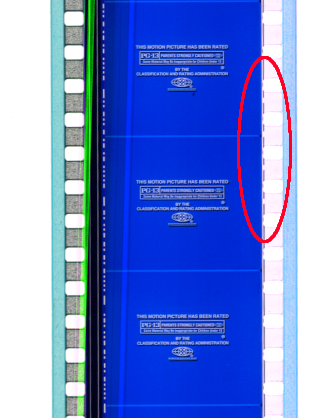
Note the region in the red circle. Those dashes last for 4 perfs and appear every 16 frames (1'), thoughout the entire print, in between the sprocket holes adjacent to the image on the side opposite the sound. In this case, they're not properly frameline-registered, so you'd have to find a frame where you can see the frameline and determine that there's an offset of 1 perforation, but it could still be useful.

So how is it that this print has them?

--jhawk
p.s.: sorry for the nasty green line. Hardware bug in the flatbed scanner I used, I'll see about getting it fixed.


 |  IP: Logged

Jan Hackett
Expert Film Handler

Posts: 148
From: Albuquerque, NM, USA
Registered: Apr 2002


 - posted 04-22-2002 06:52 PM      Profile for Jan Hackett   Email Jan Hackett   Send New Private Message       Edit/Delete Post 
Brad wrote: "Thus, nothing is needed but your eyes and a splicer"

I agree!

 |  IP: Logged

John Pytlak
Film God

Posts: 9987
From: Rochester, NY 14650-1922
Registered: Jan 2000


 - posted 04-22-2002 10:07 PM      Profile for John Pytlak   Author's Homepage   Email John Pytlak   Send New Private Message       Edit/Delete Post 
JHawk asked: "Note the region in the red circle. Those dashes last for 4 perfs and appear every 16 frames (1'), thoughout the entire print, in between the sprocket holes adjacent to the image on the side opposite the sound. In this case, they're not properly frameline-registered, so you'd have to find a frame where you can see the frameline and determine that there's an offset of 1 perforation, but it could still be useful. So how is it that this print has them?"

I suspect the dashed pattern you see is a print-through of some kind of pattern on the negative, due to the 16-frame repeat. But I don't think it is the KODAK KeyKode:
http://www.kodak.com/country/US/en/motion/products/keykode/index.shtml
http://www.kodak.com/US/plugins/acrobat/en/motion/postProduction/keykode/35mm.pdf

------------------
John P. Pytlak, Senior Technical Specialist
Worldwide Technical Services, Entertainment Imaging
Research Labs, Building 69, Room 7525A
Rochester, New York, 14650-1922 USA
Tel: +1 585 477 5325 Cell: +1 585 781 4036 Fax: +1 585 722 7243
E-Mail: john.pytlak@kodak.com
Web site: http://www.kodak.com/go/motion


 |  IP: Logged


All times are Central (GMT -6:00)
This topic comprises 4 pages: 1  2  3  4 
 
   Close Topic    Move Topic    Delete Topic    next oldest topic   next newest topic
 - Printer-friendly view of this topic
Hop To:


Powered by Infopop Corporation
UBB.classicTM 6.3.1.2

The Film-Tech Forums are designed for various members related to the cinema industry to express their opinions, viewpoints and testimonials on various products, services and events based upon speculation, personal knowledge and factual information through use, therefore all views represented here allow no liability upon the publishers of this web site and the owners of said views assume no liability for any ill will resulting from these postings. The posts made here are for educational as well as entertainment purposes and as such anyone viewing this portion of the website must accept these views as statements of the author of that opinion and agrees to release the authors from any and all liability.

© 1999-2020 Film-Tech Cinema Systems, LLC. All rights reserved.