|
|
This topic comprises 4 pages: 1 2 3 4
|
|
Author
|
Topic: Silver Paint Pen for splice ID :evil:
|
|
|
Randy Stankey
Film God

Posts: 6539
From: Erie, Pennsylvania
Registered: Jun 99
|
 posted 11-02-2002 10:09 AM


My Work Study student does not know what zebra tape is, except that it is bad. We use clear tape only. If we think we will have a problem finding a splice, such as on a print that has a bunch of splices in it, we take a black Sharpie marker and color in the edges of the splice between the sprocket holes and the edge of the film where the SDDS track would be. This is done ON the splicing tape, of course, so that when the tape is removed the inks goes along with it. He has virtually NO problem breaking down prints. It takes him about an hour to break down a print. He almost never misses a splice by more than a few feet. Mind you, he's only been working for us since the beginning of the school year. I guarantee, by the end of the year, he'll be down to 30-45 minutes and STILL doing it right. The first time we saw film with the edges painted using a white marker his comment was something like, "What stupid son of a bitch did THAT?"
| IP: Logged
|
|
|
|
|
|
|
|
Frank Angel
Film God

Posts: 5305
From: Brooklyn NY USA
Registered: Dec 1999
|
posted 11-02-2002 09:13 PM

In the multiplex I visit, the projectionist uses a red Sharpie to make a line in the white area outside the sprockets (the SDDS's geography) -- naturally not on prints that contain SDDS, but on all others. He makes the line about a foot on either side of the splice. I told him I don't like the idea of putting any marker pen to a print, but when he showed me how he did it and asked why I wasn't thrilled about it, I was hard pressed to find a reason why this would be harmful. The mark is not nowhere near the picture or sound area and it isn't a substance that can flake or transfer to other areas of the print since it dries almost instantly. And, in a pinch it does remove with film cleaner. Red Sharpie is certainly better than whiteout or shoe polish or silver paint, and it does gives an unmistakable indication where the splice is on breakdown. Occasionally he said he found prints where that area was black, but even on those, the Sharpie causes enough defraction that it still is visible as it passes. He claims that since SDDS has duel tracks, he could still put it on one side and the processor would just use the other side, if it even needed to -- the Sharpie ink is transparant, only adding color, not opacity (if that's even a word) and SDDS would still be able to read the track. I said he couldn't just assume that -- it would have to be tested to see if it is actually true. Anyone have any thoughts on whether this is a good or bad idea on non-SDDS prints? And idea if SDDS will balk at one of the tracks being tinted? As for feeling for the splice -- that works well for first run prints, but us poor rep houses often get prints that can have a dozen splices around the joint, it does become important to be able to distinguish the correct splice to break. I have gotten prints were the joint was pulled apart but at the wrong splice so you wind up with the change-over cues either on the head of the next reel or you have footage after the cues that belong to the next reel. When I do make up 6000ft reels (not often), I had been using white grease pencil on film edge -- not on the sprocket hole edge on the face of the film, but the actual thin edge of the film, i.e., making a visible circle when looking at the reel from the side. It is easily seen and it doesn't hurt the film, but most importantly, with a little film cleaner in a cotten pad, it comes off almost instantly. Then again, I sometimes wonder if it isn't better to leave it on so that the next guy doesn't have to re-apply anything more agressive....like white shoe polish. I think the combination of a red line in the outer sprocket area on non-SDDS prints and the white grease pencil on the rim of the film roll should be enough for even a blind projectionist to make easy breakdowns.
Frank
| IP: Logged
|
|
|
|
|
|
|
|
Brad Miller
Administrator

Posts: 17775
From: Plano, TX (36.2 miles NW of Rockwall)
Registered: May 99
|
posted 11-03-2002 05:44 AM
Not to nitpick too harshly here, but IMHO a true professional does not require ANY markings on the film itself. There are plenty of other ways to cheat, the "fill line" being the easiest. (This is described in "Building 101" on the tips page.) Also, if someone was breaking down at high speed and did not slow the platter down as the splice was approaching and instead opted for a hard brake, they wouldn't be working there long. I have never seen a platter MUT brake that did not cinch scratch the film. (The possible exception being the current line of Kinoton platters, which I hear do a nice job, but I haven't had the chance to play with one yet.) Before SDDS came around, I never understood why the labs couldn't put a dark colored strip on the outboard edge for reels 1, 4, 7, 10, etc and a dark colored strip on the inboard edge for reels 2, 5, 8, 11, etc and dark colored strips on both edges for reels 3, 6, 9, 12, etc. It would be GREAT edge coding. If the strips could be made in different colors, then that would truly provide positive identification.
| IP: Logged
|
|
Antonio Marcheselli
Phenomenal Film Handler

Posts: 1260
From: Florence, Italy
Registered: Mar 2000
|
posted 11-03-2002 07:24 AM
Brad,When I was working in my old one-screen theater, I've never mark the print with anything.
Now the rythm of the job is a bit faster and I must found a faster way to break down the film without damaging it. Previously I breakdown a film on a Kinoton platter, no problem with it because 1. I saw the reel change by colour's change (the light in the booth was different. Perhaps Neon light is better to see the reel change?)
2. Kinoton platter slow down very fast and if you miss the splice, you had just to switch a button and the platter started rotating in the other way. With CNR you have to 1. Re-engage the motor
2. Push "STOP" on the rewind bench
3. Wait few seconds
4. Switch to "build"
5. Push "START" Find the splice SLOWLY (otherwise you'll have to make the above list again twice). Then perform the same list upside-down. Moreover, While the platter is completely free to spin, it is VERY simple to drop film in the floor because you pull the print a bit from the rewind bench and when you raise your eyes there are meters of print on the floor while the platter is still slowly rotating... More, you speak about slow the platter down when the splice approach... Did you ever tried with a CNR?
You cannot slow down a CNR... slowly! The included Brake is useless, it takes hundreds of meters to stop the platter and usually the rewind bench stops itself faster than the platter, causing the print on the platter... dropping on the floor.
Ok, I can stop it using my hands but do you agree with me that it is not practical? Brad, The Fill Line will be the best but I've already stated that in Italy cans are different from yours! We receive the reel in this way: 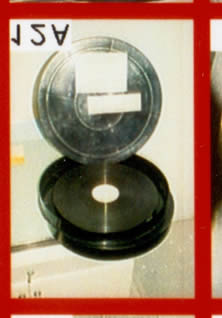 (pls sorry for the bad quality) and so it is impossible to mark the fill line since each reel are rewindes on the same platter. Brad, believe me, I would like to found an accettable solution, compatible with the multiplex life and with the "film done right".
Unfortunately CNR are, IMHO, just child's toys, with Kinoton I would not have these kind of problem. Oh, just for fun: I know a friend of mine that has 14 CNR to project films, and ONE Kinoton.... to breakdown films!!!!  Any suggestion will be appreciated. Bye
Antonio
| IP: Logged
|
|
Steve Guttag
We forgot the crackers Gromit!!!

Posts: 12814
From: Annapolis, MD
Registered: Dec 1999
|
posted 11-03-2002 11:14 AM
I don't like the grease pencil idea at all...I've seen those particles too much. Furthermore, it is wholey un-needed. I'll allow Splice Mark tape for reel joins nowadays. It is red, only 19mm wide and wont drop the digitals out. It also doesn't have a line to flash the screen. It is also available in 16mm wide (1.5 perfs on either side of the frame line) and even 8mm wide for the real daring. IMAX uses 8mm wide tape but they also use a zig-zag cut to prevent flexing at the join. Steve ------------------
"Old projectionists never die, they just changeover!"
| IP: Logged
|
|
John Pytlak
Film God

Posts: 9987
From: Rochester, NY 14650-1922
Registered: Jan 2000
|
posted 11-04-2002 01:49 PM
Brad Miller wrote: "Before SDDS came around, I never understood why the labs couldn't put a dark colored strip on the outboard edge for reels 1, 4, 7, 10, etc and a dark colored strip on the inboard edge for reels 2, 5, 8, 11, etc and dark colored strips on both edges for reels 3, 6, 9, 12, etc. It would be GREAT edge coding. If the strips could be made in different colors, then that would truly provide positive identification."I recall that Deluxe Laboratories did offer the service of color coding the edge of each reel. They used the normal edgelight in the printer to print a different color along the edge of each reel. As you note, this was before SDDS claimed that area of release prints. Long ago, labs sometimes printed the reel number (or letter) and an incrementing footage number on the printing negative, which was printed onto every print using the printer edgelight. Theatres and film exchanges could positively identify the reel number, and determine how much film was cut out at any splice. Even the numbers could be color coded for each reel by using the appropriate color filters in the printer edgelight. For example, if the edgeprint went from C-1023 to C-1035 at a splice, it was the third reel, and 12 feet of film is missing. ------------------
John P. Pytlak, Senior Technical Specialist
Worldwide Technical Services, Entertainment Imaging
Research Labs, Building 69, Room 7525A
Rochester, New York, 14650-1922 USA
Tel: +1 585 477 5325 Cell: +1 585 781 4036 Fax: +1 585 722 7243
e-mail: john.pytlak@kodak.com
Web site: http://www.kodak.com/go/motion
| IP: Logged
|
|
|
|
|
|
|
|
All times are Central (GMT -6:00)
|
This topic comprises 4 pages: 1 2 3 4
|
Powered by Infopop Corporation
UBB.classicTM
6.3.1.2
The Film-Tech Forums are designed for various members related to the cinema industry to express their opinions, viewpoints and testimonials on various products, services and events based upon speculation, personal knowledge and factual information through use, therefore all views represented here allow no liability upon the publishers of this web site and the owners of said views assume no liability for any ill will resulting from these postings. The posts made here are for educational as well as entertainment purposes and as such anyone viewing this portion of the website must accept these views as statements of the author of that opinion
and agrees to release the authors from any and all liability.
|

 Home
Home









 Printer-friendly view of this topic