|
|
This topic comprises 4 pages: 1 2 3 4
|
|
Author
|
Topic: Silver Paint Pen for splice ID :evil:
|
Brad Miller
Administrator

Posts: 17775
From: Plano, TX (36.2 miles NW of Rockwall)
Registered: May 99
|
 posted 11-05-2002 03:36 AM


Ok Antonio you're right. I keep forgetting you guys don't receive your film on reels. Let me think here...You use a split reel or flange for breakdown, right? How about buying a pack of colored markers and marking rings in alternating colors every 100 feet onto your split reel? Sure it would take an hour or two to keep packing on 100 feet of film onto your sample roll, drawing the line, packing another 100 feet of film onto the roll, drawing another line and so forth...but you could do it like this: 500' RED
600' ORANGE
700' GREEN
800' BLUE
900' BLACK
1000' RED
1100' ORANGE
1200' GREEN
1300' BLUE
1400' BLACK
1500' RED
1600' ORANGE
1700' GREEN
1800' BLUE
1900' BLACK Then when you build up the film, you could make note of the approximate footage count. Your tape on the leaders could be something like this: R1 1850'
R2 1200'
R3 1750'
R4 1025'
R5 900'
R6 1900' Then you can ballpark it to within 25 feet by looking at the colored rings during breakdown.
| IP: Logged
|
|
|
|
|
|
|
|
|
|
Steve Guttag
We forgot the crackers Gromit!!!

Posts: 12814
From: Annapolis, MD
Registered: Dec 1999
|
posted 11-05-2002 07:48 AM

CPI's "Splicemark" essentially does this. It is clear except on the edges where it is translucent. From a red reader standpoint (SDDS or Dolby) it is no different than clear tape. Now I wish they went with a white line rather than magenta. The digital tracks are hopelessly out of focus when the two pieces of splicing tape are applied (even clear) anyway. A well made splice, even with opaque tape will not drop a digital reader out. However, going to a skinnier tape will better your odds. CPI has 19mm, 16mm and 8mm tapes (all available in the splice mark configuration) in addition to the more popular 24mm. Neumade does have its 35mm and 16mm tapes if you want to try using skinnier tape with their products. I have yet to have a 16mm wide splice give up. Remember, IMAX uses just an 8mm wide tape and that film is under much more stress as it taverses it's film path. Steve ------------------
"Old projectionists never die, they just changeover!"
| IP: Logged
|
|
Jonathan Worthing
Master Film Handler

Posts: 384
From: Hereford, UK
Registered: Apr 2001
|
posted 11-06-2002 05:55 AM
Brad Our new tape product T-stripe has the wide & thin line as with or Splicemark & cross stripe across the frame, but yellow with a white backing stripe for high visability. It also has a pull-off area which is approx. 32 mm which you can use the thin line to cover the Sprockets on the non soundtrack side. Its not the most economical way to use tape but it does what you want. T-stripe is available from Jack Roe in the UK or CPI in the States.
| IP: Logged
|
|
Brad Miller
Administrator
Posts: 17775
From: Plano, TX (36.2 miles NW of Rockwall)
Registered: May 99
|
posted 11-06-2002 06:23 AM
I have a T-stripe sample here that I have been playing with. This is the first striped tape that I have seen that truly lines up properly with respect to the digital sound tracks. It's also got to be about the "brightest" yellow I've ever seen on a tape, which is excellent. However I have two beefs with it.#1 Never ever should there be a splicing tape line across the frameline so long as people are still making scope movies. Fortunately I have noticed that this tape can be used to ONLY cover the SDDS tracks, which is quite nice.  However, since this alternates with the "T" stripes, the effective length of the roll is cut down by 2/3 because half of it gets tossed alternating between the "T" lines as well as bypassing the "stop lines" and then there is of course the obvious inch that is lost during the pull. This does not make it too economical of a tape to use. A tape with nothing more than appropriately spaced horizontal lines as described above would be much more cost effective without losing any of the visibility. However, since this alternates with the "T" stripes, the effective length of the roll is cut down by 2/3 because half of it gets tossed alternating between the "T" lines as well as bypassing the "stop lines" and then there is of course the obvious inch that is lost during the pull. This does not make it too economical of a tape to use. A tape with nothing more than appropriately spaced horizontal lines as described above would be much more cost effective without losing any of the visibility. #2 My sample has horrid slitting. No matter how careful I am when making the splice, the edges are cut so poorly that it shows up on the projected image. I am told this is not the case on regular production rolls, but I need to see it just to be for sure before I can recommend it. As it is I am not happy with any marking tape on the market, but if a theater just HAS to have something, then I recommend Neumade's striped tape. If this slitting is good on the production rolls, then I will start ordering the T-stripe tape. (But will still be desiring just a "line" striped tape.  ) ) Then again about 1% of the theaters I service and work/worked at refuse to use any kind of striped or opaque tape. I have noticed that *generally* the projectionists who really bust their humps to put on a flawless presentation refuse to use anything other than clear anyway, so it probably wouldn't be worth the cost to re-design another kind of tape because those theaters wouldn't use it regardless.
| IP: Logged
|
|
Bernard Tonks
Jedi Master Film Handler

Posts: 619
From: Cranleigh, Surrey, England
Registered: Apr 2001
|
posted 11-06-2002 10:57 AM
quote:
Remember, IMAX uses just an 8mm wide tape and that film is under much more stress as it taverses it's film path.
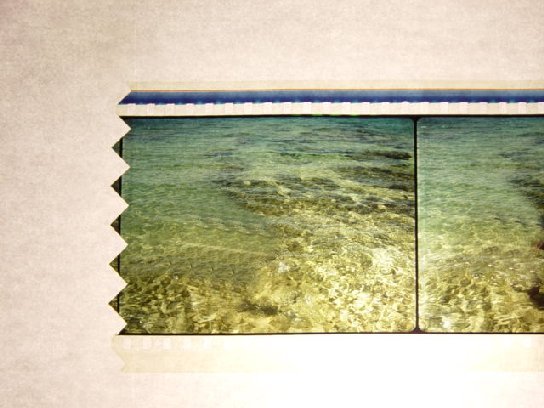
I was amazed at Bradford Imax last Sunday when the projectionist showed me the splicing technique just with 8mm tape. You can of course appreciate the strength of the join as the cut is sawtooth on a splicer costing £2,000. (over USD $3,000). Picture taken of a splice cut. I have disguised the picture area to respect copyright.
| IP: Logged
|
|
John Pytlak
Film God

Posts: 9987
From: Rochester, NY 14650-1922
Registered: Jan 2000
|
posted 11-06-2002 11:53 AM
The "sawtooth" film cut for making these tape splices is a great idea, since it helps prevent the "fold up" of the film at the splice, even with the narrow tape. Unfortunately, the same technique cannot be used for 35mm "scope" prints without the sawtooth overlap showing on the screen. (You would have only 4 x 0.1870 - 0.690 = 0.058 inches for the sawtooth pattern not to show.)------------------
John P. Pytlak, Senior Technical Specialist
Worldwide Technical Services, Entertainment Imaging
Research Labs, Building 69, Room 7525A
Rochester, New York, 14650-1922 USA
Tel: +1 585 477 5325 Cell: +1 585 781 4036 Fax: +1 585 722 7243
e-mail: john.pytlak@kodak.com
Web site: http://www.kodak.com/go/motion
| IP: Logged
|
|
Jonathan Worthing
Master Film Handler
Posts: 384
From: Hereford, UK
Registered: Apr 2001
|
posted 11-07-2002 03:10 AM
BradA few points which we would like to publish to keep the public record balanced:
1 The roll of T-Stripe that you have was probably from ShoWest - which means that it was very new and we produced a few samples to give out at the Show. The samples we produced at that time were 5m long (rather than the usual 15m) and were to display the visual characteristics of the tape. Cutting may not have been to our usual high standard for finished product.
That said we are surprised that the tape edges would be more visible than anyone else's tape including Neumade when projected at 24 frames per second. With film editing where frames can be viewed one at a time on editing equipment, 8-perf tape (38mm) is used to avoid all film edge and that is the only true answer.
2 We have taken the time and effort to make sure that the lines on T-Stripe are accurate. To this end we have a well made (copyrighted and trademarked) product which truly takes into account the soundtrack requirements. Even with SDDS, the tape should not compromise the sound in view of the staggered redundancy built into SDDS.
3 The repeat length on Neumade striped tape IS smaller at 120mm compared to T-Stripe's 134 mm BUT as the Neumade reel is 10m and the T-Stripe is 15m, it follows that one reel of T-Stripe provides approximately 112 double sided joins compared to only approx 83 from Neumade. Since T-Stripe retails for less than Neumade on a per roll basis then T-Stipe has a markedly lower cost per join.
4. The cross stripe is there because the US market prefers it. Our Splicemark product does not use a cross stripe. If placed correctly, our the T-Stripe product does not appear in the picture area at all on Flat (which is most of the time). 5. As to your personal preference for Neumade, we are really surprised that given your stated preference for technical excellence you would choose a product where the cross-stripe cuts all of the soundtracks however you place their tape. Jonathan
| IP: Logged
|
|
Brad Miller
Administrator
Posts: 17775
From: Plano, TX (36.2 miles NW of Rockwall)
Registered: May 99
|
posted 11-07-2002 03:16 AM
quote:
" As to your personal preference for Neumade, we are really surprised that given your stated preference for technical excellence you would choose a product where the cross-stripe cuts all of the soundtracks however you place their tape."
Ahem, I do not use nor endorse any tape other than clear. I believe I did state above that about 1% of theaters I have anything to do with actually request marked tape. Yes indeed, the edge slitting is extremely important to make sure that the edge lines of the splicing tape do not appear on screen. So far no other manufacturer of tape I have used has exceeded the slitting quality of Neumade's. That comment is of course based upon clear tape. I haven't bothered to do much research into the marked stuff. Your comment that you would find it hard to believe that the lines would be visible at 24 frames per second is ludicrous. Do you see specks of dirt on a dirty film? Of course you can. Guess what, that dirt is NOT in the same place on consecutive frames. Each speck is on one single frame...and yet the human eye can see it...just like a splice line. I don't know what goober came up with the current widths of splicing tape, but it really should be a full 8 perforations to prevent this. Sounds like the Splicemark tape is a better solution for people who can't run their booths without having marks at the reel joints. I haven't played with it. Have a sample?
| IP: Logged
|
|
|
|
John Pytlak
Film God
Posts: 9987
From: Rochester, NY 14650-1922
Registered: Jan 2000
|
posted 11-07-2002 06:47 AM
If marking is necessary (IMHO, it's not), the marks should not be seen on the screen or interfere with the sound. And they should NEVER be left on the print, or cause an increase in dirt level. I agree that 8-perf (1.5 inches wide) splicing tape is the best choice for 35mm prints, since the edges of the tape will fall on the framelines. Ultrasonic splices are also great for polyester prints, except that you lose two frames if you remake a splice, whereas you can peel off a tape splice without loss of continuity. ------------------
John P. Pytlak, Senior Technical Specialist
Worldwide Technical Services, Entertainment Imaging
Research Labs, Building 69, Room 7525A
Rochester, New York, 14650-1922 USA
Tel: +1 585 477 5325 Cell: +1 585 781 4036 Fax: +1 585 722 7243
e-mail: john.pytlak@kodak.com
Web site: http://www.kodak.com/go/motion
| IP: Logged
|
|
|
|
|
|
All times are Central (GMT -6:00)
|
This topic comprises 4 pages: 1 2 3 4
|
Powered by Infopop Corporation
UBB.classicTM
6.3.1.2
The Film-Tech Forums are designed for various members related to the cinema industry to express their opinions, viewpoints and testimonials on various products, services and events based upon speculation, personal knowledge and factual information through use, therefore all views represented here allow no liability upon the publishers of this web site and the owners of said views assume no liability for any ill will resulting from these postings. The posts made here are for educational as well as entertainment purposes and as such anyone viewing this portion of the website must accept these views as statements of the author of that opinion
and agrees to release the authors from any and all liability.
|

 Home
Home



 ?
? 



 Printer-friendly view of this topic