|
|
This topic comprises 3 pages: 1 2 3
|
|
Author
|
Topic: Analog Soundtrack - MONO ??
|
|
|
|
|
|
|
|
|
|
|
Stephen Furley
Film God
Posts: 3059
From: Coulsdon, Croydon, England
Registered: May 2002
|
 posted 11-30-2003 05:21 AM


Pete,
No, not Fairfield, somewhere much smaller, in central London. I've never been in the box at Fairfield, though it's very close to me, I work in the college next door. Do you know the place? It's a heck of a long throw down from the box in the Concert Hall, seats just under 2,000 if I remember correctly.
I don't know if they would want me to say where it was. If you've ever been to the place you would recognise it from the description, it's quite unusual. Two screens, Century projectors and soundheads with 6000 foot spools on Strong consoles, inverter drive at 18/24/25 fps with CP-65 and mic lines up from the stage for panel discussions etc. in one.
Single FP-20 and Westrex tower plus double band Fumeo 16mm with CP-55 and SRA5 in two. VHS, DVD and Beta SP with Sanyo video projectors in both.
I've never even seen a push pull track on a release print, though I know they did exist for a while. Dual inventory must have been just as unpopular then as it is today. In Wardour Street (centre of film world in London) there used to be a shop which sold audio equipment, cables, connectors, valves (vacuum tubes), that sort of thing. In the window there were some old glass tube type photocells, one of which was a double one. I don't know if it had been there since push pull days; the box looked old enough.
I assume push pull died out for original recording in the very early '50s, when magnetic recording became established for that purpose. I recently saw a BBC schools television programme about Malcolm Arnold recording the score for 'Hobson's Choice', that was 1953 I think (yes, there was schools television then) and that was being done on mag film. The stereo tracks for the Festival of Britain 3-D films in 1951 were mag, but I'm not sure if normal mono recordings then were. 'The Third Man' (1949) was optical. Wasn't the last version of 'Showboat' partly optical and partly mag? I think that's what the notes with the Laserdisc box said. When was push pull introduced? Sometime in the '30s? It must have had quite a short life. Fantasound was certainly push pull, and that must have been developed some time before 'Fansasia' was released in '41.
How much of an improvement did it actually make, both for original recording and for release prints? Has anybody actually got any that I could listen to?
As for playing it today, masking off half of the track could certainly be done, and would efectivly be the same as playing the optical part of a mag opt Cinemascope track.
Finding a projector with a split photocell would certainly be much easier today than it was then! You are not likely to find an amplifier with push pull inputs in a cinema today. If you put the two inputs into a CAT. 150, assuming everything was correctly aligned, you should get full output on surround, nothing on centre and much reduced output on left and right, shouldn't you? If you set up a format with decoder on, NR off and Academy filter in, and then redirected the surround output to the centre and turned the other channels off you should be able to play the track I'd have thought. Not sure how it would sound, but it should be useable if you did ever get a push pull print turn up. There is another problem though; any film released with a push pull track must also have been released with a normal single ended track, as the vast majority of cinemas were never push pull equipped. It is unlikely that the push-pull track would have been used on any re-release prints which may have been made, and if any original prints survive they would almost certainly be nitrate, and therefore hardly anywhere could now run them anyway.
| IP: Logged
|
|
Frank Angel
Film God

Posts: 5305
From: Brooklyn NY USA
Registered: Dec 1999
|
posted 11-30-2003 07:14 AM

quote:
AGA? I thought they made cookers! Come to think of it, the AGA cooker was Sweedish, wasn't it. There's no connection surely, is there?
How bout Norelco? 70/35mm Projectors and men's shavers. They also made the earliest multi-channel, component audio mixing consoles with a bevey of different modules allowing you to basically construct the thing they way you wanted it. And they made one exceptional, rack mount, dual push-pull output tube amplifier. Plus, get this, they made a full sized, three tier keyboard, electronic organ that sounded like the real thing. We had one in our big theatre with about a dozen 6 ft folded horn speaker systems in our speaker loft. Only problem was, the oscillators they used were not very stable and so a Norelco technician was always on site constantly tweaking it so it would stay in tune. We finally had to chuck it, but when it worked, it was spectacular.
How bout Singer? 16mm projectors and sewing machines (pretty natural jump, come to think of it; they use the same mechnical movement....hopefully their sewing machines were a lot better than their projectors).
Frank
[ 12-01-2003, 04:30 AM: Message edited by: Frank Angel ]
| IP: Logged
|
|
|
|
Stephen Furley
Film God
Posts: 3059
From: Coulsdon, Croydon, England
Registered: May 2002
|
posted 11-30-2003 01:33 PM
Frank wrote:
quote:
How bout Singer? 16mm projectors and sewing machines (pretty natural jump, come to think of it; they use the same mechnical movement....hopefully their sewing machines were a lot better than their projectors).
The original Pathé KOK 28mm projector of 1912 worked very much like a sewing machine, and was about as effective at damaging film. It had a saw-tooth shape device, which just moved up and down, it did not retract, like a normal claw. On the down stroke it pulled the film down, on the up stroke it just pushed the film out of the way. The case for this machine was almost exactly the same as that for a Singer sewing machine of the day.
I used to use the Singer Graflex 16mm machines long ago, lamps were short-lived and expensive, sound was poor, case locks used to fall off, they were very heavy, etc. etc. I'm talking about the old blue ones, not the slot loader. Didn't they have a shutter which could be set to either two or three blades?
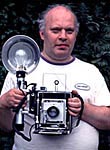
Of course, this was the same Graphlex that made the camera I'm holding in my picture, previously, Graflex inc., Folmer Graflex and originally Folmer and Schwing from Rochester, and, at one time, owned by Kodak.
| IP: Logged
|
|
|
|
Stephen Furley
Film God
Posts: 3059
From: Coulsdon, Croydon, England
Registered: May 2002
|
posted 12-01-2003 07:07 AM
Leo, I have to agree with you about the quality of the Pathé and Pathéscope projectors; oddly enough, some of their cameras were quite nicely made. After the demise of Pathéscope the Prince was still available for many years, until the early '70s I think, for about five pounds. I have a B, H, Prince, Lido and a Webo A. A few years ago I bought a 500 foot roll of film stock for them, somebody in France still buys unperforated 35mm slide film from Fuji and slits and perforates it for 9.5!
9.5mm wasn't the only format to use central perforations, there were several others, mainly 17.5mm ones around the turn of the century. Pathé didn't use it for their 17.5mm 'Rural' format though. 9.5 also had the problem, with the frame extending very close to the edge of the stock, of edge scratching, something that standard 8 and Super 16 can also suffer from.
While the projectors were terrible, some of the 9.5mm prints, especially the early ones, were of very high quality, at least the silent ones were. Optical tracks were very varyable, you tend to have to adjust the sound head alignment between each print, or even each reel, Super-8 optical tended to have the same problem, and the 9.5 tracks were usually optically printed from 35mm; some of them were even negatives; that did wonders for the sound quality!
Have you ever seen a 9.5mm colour print with very narrow frame lines, and the picture running off the edges of the stock? In the '60s Walton films were producing prints for home use on 8, 9.5 and 16mm. The black and white 9.5mm prints were printed three-up on 35mm stock with large pilot perforations down each edge of the strip as was normal for this gauge. They wanted to produce colour 9.5mm prints, cheaply. It occured to somebody that the perforation pitch of 9.5 is quite close to that of 16mm, and that a 9.5mm projector will in fact run film with this slightly longer pitch (slightly longer in everyday terms, considerably longer in terms of any normal perforation pitch tolerance), so they built a machine into which they could feed a normal 16mm print, punch new perforations, and then slit 3.25mm off each edge - instant 9.5mm print of any title in their 16mm catalogue! I don't know how they did it, given that 9.5 and 16 have the track on opposite edges, but there were even sound prints made this way, by re-perfing and slitting 16mm prints with VD tracks, setting the slitter so there was just enough of the track remaining for a 9.5mm projector to read it. Maybe they made special 16mm prints for this, or maybe they just used standard ones, and hoped nobody noticed that the image was reversed, I don't know. This machine still exists somewhere, and somebody was offering a service with it a few years ago.
Have you seen the Pathéscope 'Duplex' widescreen system? It was a sort of cross between double run standard 8 and Vistavision. Special versions of the Lido camera and one of the projectors were required for it, as was special film stock with two perforations side by side. The film ran sideways through the camera gate, exposing half of the width, then was run through again, exposing the other half. The film was then slit into two 4.75mm strips, which were run horizontally through the projector, which looked something like an Aldis Tutor 2 slide/strip projector, with a similar rotating front for standard 9.5 or horizontal duplex. It was not a success, very few were ever sold.
The East Anglian Film Archive can blow up 9.5 to 16mm, and the results can look quite good, I've run some at John Huntley shows in the past, on decent 16mm xenon machines. I also tried taking the side off a Specto projector once, putting in a 45 degree mirror, and pointing the Kalee Universal carbon arc off my 609 at it!
A few years ago somebody at the BBC made up a 9.5mm gate for one of their Cintel machines. They were only able to handle silent film, but were trying to find some way to do sound. I think the best way would be to start by forgetting about the picture, concentrate on getting the best possible reproduction of the track, and record it onto 16mm sep-mag, that could be done with just a simple mechanical interlock, and then run that in sync with the telecine.
There was even a suggestion not so long ago for a 'Super 9.5' format, but it wasn't 9.5mm wide, and it was far too silly even to describe.
These people that only work with 35mm, they don't know what life is! ![[Smile]](smile.gif)
| IP: Logged
|
|
|
|
|
|
Stephen Furley
Film God
Posts: 3059
From: Coulsdon, Croydon, England
Registered: May 2002
|
posted 12-01-2003 02:10 PM
Thanks John, I never really did understand cross mod tests, I'll read that second one on the bus going home tonight.
Leo, there have been otherwise 'lost' films which have been restored from 9.5mm prints. A few years ago there was a famous entertainer, a music hall act I think, but I can't remember his name. A few short films of his performance had been made on early sound film, but nothing survived on 35mm. A few minutes of material, copied from 9.5mm is now the only record of his work.
The 'chopped 16' prints are very easy to recognise, I think only Walton Films ever made them, though they may have exported them. They are nearly all colour whereas true 9.5mm prints are almost all black and white. There were a few Pathécolor stencil prints made early on, but they are very rare. Almost all other 9.5 colour is amateur camera material, Kodachrome or similar reversal, or Dufay, which seemed to use the same size of reseau as on 35mm, so it looked very large on screen.
True 9.5 usually has rounded corners of quite large radius relative to the frame size, and there are narrow black or clear margins at the edge of the stock of about a third of a millimetre in width. The frame lines are quite wide, usually just slightly less than the height of the perforation. The image is correctly framed.
Re-perfed 16mm has no rounded corners as the image runs right to the edge of the film, the frame lines are much narrower and much of the perforation is cut into the top and bottom of the frame. As the full height of the 16mm frame remains on the print, but some of the width of the image has been removed the aspect ratio, as viewed on the print, looks squarer than normal. As projected, a considerable amount of the image is missing, and this is often obvious, particularly on titles. Lastly, since the perforations are not at the correct pitch, I think 9.5 has one frame more per metre than 16mm, re-perf prints tend to run noisy on the machine.
True 9.5mm prints tended to have the emulsion facing the lamp, as on 35mm, though this is not always the case, but re-perf ones were obviously the same as 16mm, most often, though not always, base to lamp. Obviously, camera reversal material was always base to lamp, unless it was Dufay.
Great variation in sound quality, including clipping, was very typical of 9.5mm tracks, even from one reel to another. If the bad track you heard was noisy, maybe you were hearing one of the negative ones?
Rounded corners seem to have been a French thing. All of the Pathé formats, 9.5, 17.5 and 28mm used them, as did early 35mm French films, and french cinemas, and Gaumont ones in this country, tended to have quite large rounded corners to the screen, until the introduction of adjustable masking. On 17.5mm the rounded corners enabled a small perforation to be used in this space, enabling a larger frame size than would otherwise have been possible on this gauge. The Pathé 17.5mm projectors were also horrible things. The format was surpressed by the Nazis, and never made a come-back after the war.
Unlike 16mm 9.5 and 17.5 never really developed much. There were a few quality cameras such as the Bolex H9, and the Pathé Webo M, both rare and expensive, but nothing like the professional equipment which was developed for 16mm. 9.5 remained a home format, while 16mm went on to become an industrial/educational format in the '40s and '50s, and then the standard for television production, at least here in Europe, in the '60s. There was never an Arri 9.5 BL for example, nor a Kinoton FP-9.5. 17.5 was basically just a print down format from 35mm. 28mm was quite popular for a few years, but the introduction of 16mm killed it stone dead.
The proposed Super 9.5 was another French idea, one single Frenchman, I believe. It was intended as a widescreen television production format. I have seen a fully-dimentioned drawing of it. The idea was that slitting 3 9.5mm strips out of 35mm was wasteful, so why not just devide 35mm by three to get 11.666mm (well, it's not much odder than 55.625mm, is it?). The extra 2.166mm would all be added on one edge, so the perforation would now be somewhat off-centre, and the aspect ratio would be somewhere sort of close to 16:9, with no soundtrack needed. It was supposed to give a widescreen frame area 'close to' Super-16, (haven't I heard that phrase somewhere before?), using two thirds the amount of film. There was one article published about it. unsurprisingly, nobody showed the slightest interest in it.
I used to be a member of the British Group 9.5. I dropped out about three years ago, due to being unable to get to meetings. The London group meets every two weeks, on Saturdays, to talk and show films, somtimes on 9.5, but also on standard-8, Super-8, 16mm, 17.5mm, 28mm and 35mm. There can't be many groups that can match that range of formats!
| IP: Logged
|
|
|
|
|
|
All times are Central (GMT -6:00)
|
This topic comprises 3 pages: 1 2 3
|
Powered by Infopop Corporation
UBB.classicTM
6.3.1.2
The Film-Tech Forums are designed for various members related to the cinema industry to express their opinions, viewpoints and testimonials on various products, services and events based upon speculation, personal knowledge and factual information through use, therefore all views represented here allow no liability upon the publishers of this web site and the owners of said views assume no liability for any ill will resulting from these postings. The posts made here are for educational as well as entertainment purposes and as such anyone viewing this portion of the website must accept these views as statements of the author of that opinion
and agrees to release the authors from any and all liability.
|

 Home
Home









![[Frown]](frown.gif)


 Printer-friendly view of this topic