Film-Tech Cinema Systems
Film-Tech Forum ARCHIVE


my profile | my password | search | faq & rules | forum home
  next oldest topic   next newest topic
» Film-Tech Forum ARCHIVE   » Operations   » Film Handlers' Forum   » Threading Up a Simplex 35 (Page 3)

 
This topic comprises 5 pages: 1  2  3  4  5 
 
Author Topic: Threading Up a Simplex 35
Wolff King Morrow
Master Film Handler

Posts: 490
From: Denton, TX, USA
Registered: Feb 2004


 - posted 03-29-2005 04:34 PM      Profile for Wolff King Morrow   Author's Homepage   Email Wolff King Morrow   Send New Private Message       Edit/Delete Post 
I'll let you know tonight after work. I do know the masking lines up with the "anamorphic" border defined by the 35PA loop I used.

 |  IP: Logged

John Pytlak
Film God

Posts: 9987
From: Rochester, NY 14650-1922
Registered: Jan 2000


 - posted 03-29-2005 07:02 PM      Profile for John Pytlak   Author's Homepage   Email John Pytlak   Send New Private Message       Edit/Delete Post 
The old standard anamorphic image height was originally 0.715 inches, and later was 0.700 inches. The current 0.690 x 0.825 inch projectable area was adopted to minimize the visibility of negative splices.

 |  IP: Logged

Robert E. Allen
Phenomenal Film Handler

Posts: 1078
From: Checotah, Oklahoma
Registered: Jul 2002


 - posted 03-29-2005 09:35 PM      Profile for Robert E. Allen   Email Robert E. Allen   Send New Private Message       Edit/Delete Post 
When you are running a house that is cropping the picture (whether scope or flat) you are cheating the public out of all the director wanted them to see. So you are forced to make a decision as to where you will place the image. Ideally theatres should install the correct lenses to allow the entire frame the director wanted shown to be shown. But many houses blow it up and crop it at the same time just so they can brag about their "big screen". The public does not see the image with the same eye as a technician so it is unlikely they ever notice a boom mike in the picture. And since when has that become a problem? I spent a year working as a lighting tech in the studios and if the cinematographer saw a boom mike in the frame they re-shot it. Are they just getting sloppy these days?

 |  IP: Logged

Mike Blakesley
Film God

Posts: 12767
From: Forsyth, Montana
Registered: Jun 99


 - posted 03-29-2005 09:47 PM      Profile for Mike Blakesley   Author's Homepage   Email Mike Blakesley   Send New Private Message       Edit/Delete Post 
Even if you're "cropping the picture," why would you want to frame it down so that the top frameline is just inside the masking? Wouldn't it be better to CENTER the image vertically within your available screen? What are your screen's dimensions?

 |  IP: Logged

Brad Miller
Administrator

Posts: 17775
From: Plano, TX (36.2 miles NW of Rockwall)
Registered: May 99


 - posted 03-29-2005 09:55 PM      Profile for Brad Miller   Author's Homepage   Email Brad Miller       Edit/Delete Post 
Sorry Robert, even on the assumption that your theater is truly cropping the 1.85 image, with you framing outside of the intended area to be projected like you are, you are just making the problem even worse than it has to be given the limitations of the "cropping" that you claim is there.

The fact of the matter is that never EVER should a flat film be framed so the frameline is just outside of the masking. That is film done horribly, terribly, godawful wrong. Can someone else explain this better than I am so Robert can understand?

 |  IP: Logged

Darryl Spicer
Film God

Posts: 3250
From: Lexington, KY, USA
Registered: Dec 2000


 - posted 03-29-2005 10:19 PM      Profile for Darryl Spicer     Send New Private Message       Edit/Delete Post 
the image on a full frame flat contains dead space. that being area at the top and bottom. you only have the area between the first and fourth sprocket to work with. If the film has been hard matted the picture area in the first and fourth sprocket is black. You only have the middle area of the frame to work with in either case. Deviating from this area will result in either black or unwanted dead picture (boom mics if framed to low, the actor or actress with swim trunks on in the shower if framed to high.)

The only problem with scope is negative flash if the film is an anamorphic camera negative. Super 35 doesn't have that issue but sometimes has just a bit of black because of a slightly larger frameline.

I cinematographer is not going to reshoot a scene unless the boom mike passes the safe zone or dead area of the 1.85 or 1.66 image. With anamorphic photography there is no room for error with the boom mikes. Not sure about supper 35.

That's the best way I could think of to describe it.

 |  IP: Logged

David Stambaugh
Film God

Posts: 4021
From: Eugene, Oregon
Registered: Jan 2002


 - posted 03-29-2005 10:38 PM      Profile for David Stambaugh   Author's Homepage   Email David Stambaugh   Send New Private Message       Edit/Delete Post 
Maybe every flat feature should have the studio logo printed in letterbox format. Trainer to trainee: "See that? Make sure it's centered!!" [Wink] I cringe when one of those trailers comes up and it's not framed correctly (which happens way too often).
 |  IP: Logged

Darryl Spicer
Film God

Posts: 3250
From: Lexington, KY, USA
Registered: Dec 2000


 - posted 03-29-2005 10:40 PM      Profile for Darryl Spicer     Send New Private Message       Edit/Delete Post 
Even those are not entirly reliable. I have had those Letterbox trailers shift all over the place.

 |  IP: Logged

Brad Miller
Administrator

Posts: 17775
From: Plano, TX (36.2 miles NW of Rockwall)
Registered: May 99


 - posted 03-29-2005 10:48 PM      Profile for Brad Miller   Author's Homepage   Email Brad Miller       Edit/Delete Post 
Thank you Joe for making this...

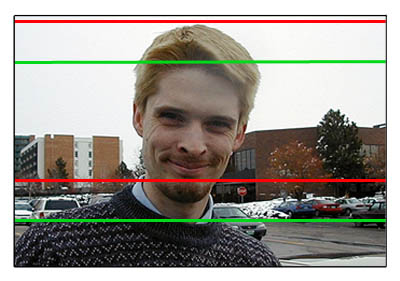
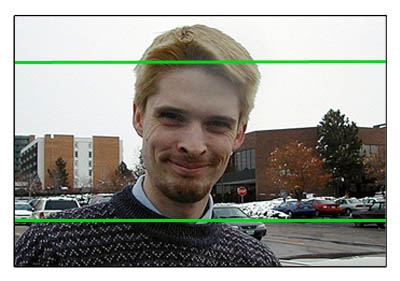
Ok Robert, here is an example of a "flat" film. The green lines represent where you are SUPPOSED to be framing.

 -

Now here is where YOU are framing, per the red lines. Notice that you are showing part of the image that is NOT supposed to be seen AND you are at the same time cropping off part of the bottom of the picture that IS supposed to be seen. To make matters worse, if indeed your theater is cropping the image too much to begin with, that lower red line will be even HIGHER, thus cropping MORE!!! [Eek!]

 -

So now do you see why what you are doing is horribly wrong?

 |  IP: Logged

Robert E. Allen
Phenomenal Film Handler

Posts: 1078
From: Checotah, Oklahoma
Registered: Jul 2002


 - posted 03-29-2005 11:28 PM      Profile for Robert E. Allen   Email Robert E. Allen   Send New Private Message       Edit/Delete Post 
So when did this process of "We'll shoot a full frame but you project only part of it" begin? Do directors really think "Oh hell, it doesn't matter if we clutter up the top and bottom of the frame because we expect the projectionist to project only the middle of the fame anyway?" For 25 years I projected (with the proper lens) all that was in the frame. I never heard of projecting only part of a frame because that's what the director expects us to do. Both cameras and projectors can be equipped with lenses and appatures to shoot and project all that's on a frame. If the frame had broad frame lines that looked like what is called "letterbox" today then the lens and appature projected all the picture sans the frame lines. As far as "film done wrong" that's apparently the opinion of some techs who have been trained in the "Lets Project Only The Center Of The Frame" school of projection as I have never heard a complaint from ONE customer.

 |  IP: Logged

Phil Hill
I love my cootie bug

Posts: 7595
From: Hollywood, CA USA
Registered: Mar 2000


 - posted 03-29-2005 11:38 PM      Profile for Phil Hill   Email Phil Hill       Edit/Delete Post 
quote: Robert E. Allen
So when did this process of "We'll shoot a full frame but you project only part of it" begin? ...
About 24+ years ago... The 35mm film camera captures a full-frame image and it's a very common practice of cinematographers and editors and labs to NOT hard-matt a full 35mm frame to 1.85, 1.66, etc. It's up to the projectionist to know how to present a good show. The image intended format is "usually" vertically centered in the frame.

Rather than being on the defensive and attacking those that speak the truth and are trying to help you Robert, you should do some research on "modern" technology and procedures of film production and presentation.

 |  IP: Logged

Scott Norwood
Film God

Posts: 8146
From: Boston, MA. USA (1774.21 miles northeast of Dallas)
Registered: Jun 99


 - posted 03-29-2005 11:43 PM      Profile for Scott Norwood   Author's Homepage   Email Scott Norwood   Send New Private Message       Edit/Delete Post 
quote: Robert E. Allen
So when did this process of "We'll shoot a full frame but you project only part of it" begin?
This was the cheap way of creating a widescreen image (1.66, 1.75, or 1.85:1) that was established in the 1950s. Instead of using wider film (e.g. 70mm) or special lenses (e.g. cinemascope), a "wide screen" image could be created by shooting normally, using a camera with 1.66, 1.75, or 1.85:1 markings in the viewfinder, then projecting the image witha shorter focal length lens and an aperture plate cut to crop the top and bottom off the image to match the markings in the camera viewfinder.

It's important to note here that _all_ film formats have "extra" image area on the camera negative (and, in most cases, the print) which is not intended to be shown on the screen. As long as your plates and lenses are set up to show the correct image area as shown on an RP40 loop, you will be showing everything that was shown to the cinematographer in the camera viewfinder (i.e. everything that he intended to be seen by the audience).

 |  IP: Logged

Manny Knowles
"What are these things and WHY are they BLUE???"

Posts: 4247
From: Bloomington, IN, USA
Registered: Feb 2002


 - posted 03-29-2005 11:47 PM      Profile for Manny Knowles   Email Manny Knowles   Send New Private Message       Edit/Delete Post 
I'll probably come across as an insensitive prick, but...

Please don't argue, Robert. You are just plain wrong on this one.

The fact is that directors and cinematographers of "flat" films (1.85:1) DO IN FACT expect you to project only a portion of the frame -- the centre portion -- as illustrated in Brad's most recent post. If you've never done it that way then you've never done it correctly. It's really as simple as that.

The SMPTE standards cited by John Pytlak predate your 25 years of experience. You owe it to your craft, your customers and the filmmakers to familiarize yourself with the standards cited by John Pytlak. Arguing won't accomplish anything. There is only one right way in this case.

I'd also like to point out that just because customers don't complain to you doesn't mean they haven't noticed the mistake. Similarly, an absence of complaints doesn't mean you did a good job.

Can anyone recall a contemporary release in the last 25 years that was shot for 1.33:1 presentation (in U.S. theatres)?

 |  IP: Logged

Scott Norwood
Film God

Posts: 8146
From: Boston, MA. USA (1774.21 miles northeast of Dallas)
Registered: Jun 99


 - posted 03-29-2005 11:56 PM      Profile for Scott Norwood   Author's Homepage   Email Scott Norwood   Send New Private Message       Edit/Delete Post 
Academy ratio isn't all that uncommon for video transfers or 16mm blowups (East Side Story and the Hank Greenberg film would be examples) and every theatre should be able to properly show the format on at least one screen. Much animation (shorts, mostly) is still done for 1.33, for example.

Even Academy has extra image area on the negative/print that isn't intended to ever be shown on the screen, however....

 |  IP: Logged

Phil Hill
I love my cootie bug

Posts: 7595
From: Hollywood, CA USA
Registered: Mar 2000


 - posted 03-29-2005 11:57 PM      Profile for Phil Hill   Email Phil Hill       Edit/Delete Post 
quote: Manny Knowles
I'll probably come across as an insensitive prick, but...
Now, who can argue with that?

 |  IP: Logged


All times are Central (GMT -6:00)
This topic comprises 5 pages: 1  2  3  4  5 
 
   Close Topic    Move Topic    Delete Topic    next oldest topic   next newest topic
 - Printer-friendly view of this topic
Hop To:


Powered by Infopop Corporation
UBB.classicTM 6.3.1.2

The Film-Tech Forums are designed for various members related to the cinema industry to express their opinions, viewpoints and testimonials on various products, services and events based upon speculation, personal knowledge and factual information through use, therefore all views represented here allow no liability upon the publishers of this web site and the owners of said views assume no liability for any ill will resulting from these postings. The posts made here are for educational as well as entertainment purposes and as such anyone viewing this portion of the website must accept these views as statements of the author of that opinion and agrees to release the authors from any and all liability.

© 1999-2020 Film-Tech Cinema Systems, LLC. All rights reserved.