|
|
This topic comprises 4 pages: 1 2 3 4
|
|
Author
|
Topic: Buying Test Loops
|
|
|
Steve Guttag
We forgot the crackers Gromit!!!

Posts: 12814
From: Annapolis, MD
Registered: Dec 1999
|
 posted 05-13-2006 07:53 PM


First off...35-PA is not different dimensionally though it is shot on BH-1866 film so it may be used with Telecine machines. I have long claimed that the film should be available in standard KS-1870 as well as BH-1866, depending on one's needs.
The magenta film is known as 35-IQ SMPTE has always packaged it as 100' of B&W and 100' of Magenta. The reason for both films is to see the difference in your projection system between the radiant energy absorbed between the two (B&W soaking up more heat than just the top layer of color film). Both films were shot in the same camera with only the allowance for the perforation difference made. Details are given in the 35-IQ (and 70-IQ) instructions.
One can splice the two together and note the difference in the focus between the two to get an idea of how much heat one is putting into the system...the closer the focus matches, the lower the heat.
As for dimensions...historically, you could not do better than the SMPTE test films...they are camera originals. The to test the camera, the image is photographed forward, then backward, then forward again to verify perfect registration on a period basis.
Why does some test film not show good steadiness? This comes down to how the film is photographed and how it is projected (true for not just test films). Cameras (and Telecines) register off of the perforations. Projectors register off of the edges of the film (laterally). What happens if the film to perforation registration is not perfect? The image moves about. Virtually all of the image unsteadiness in various batches of 35-PA can be attibuted to either mis-slitting or more commonly, skewed perforations. One has to get the film under a microscope to measure the perf to edge relationship in a perf-by-perf fashion.
Generally, the 35-IQ is a much steadier film since the polyester film came into existance. The B&W film tends to have more skewed perfs. One reason 35-PA has been so expensive (and there are many reasons) is the low-volume, high-reject rate and that it is camera original. Note, you don't get to see if your batch is good until after it is all shot and processed.
If you can buy target film for the under $2/ft price...there is a reason...it is not measured nor guaranteed to be anything and most likely a duplicated film. That is okay for checking focus, I guess but it totally and completely worthless as an alignment aid. It would be like trying to use an uncalibrated meter (and you don't know how far it is off) to make adjustments to an electrical circuit.
As to the sound test films...Dolby has definately not been producing worthy products since they went to color. The HF response on their pink noise has been horrible and inconsistant.
About the only thing they are really good for is to check Dolby Digital alignment IF you know how far off your test film is. We resorted to buying 1000' feet of it and then measuring it against reference film to come up with an offset. That has worked out quite well for us. For analog, NTAV is probably the best, after all, they were the last ones to actually make accurate stuff before (they made the twin track Cat. 69).
As for Buzz-Track...the Buzztrack that SMPTE was providing was VERY accurate, more so than it had been as it was shot in the same camera that did 35-PA and it was measured to be correct. Some didn't like the frame overlap that caused noise in the sound...personally, I liked that artifact since it provided a "blip" on both scope traces as well as an audible verification that everything was on and picking up...it was clearly different than the two tones one is listening/looking for.
Steve
| IP: Logged
|
|
Mark Gulbrandsen
Resident Trollmaster
Posts: 16657
From: Music City
Registered: Jun 99
|
posted 05-14-2006 08:01 AM
quote: Steve Guttag
As for dimensions...historically, you could not do better than the SMPTE test films...they are camera originals. The to test the camera, the image is photographed forward, then backward, then forward again to verify perfect registration on a period basis.
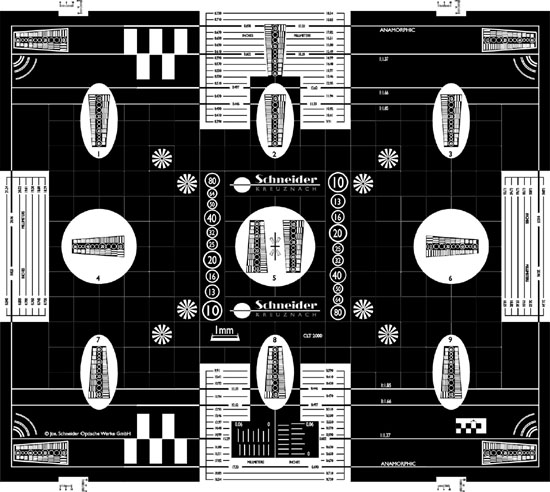
I would be willing to bet that the NTAV is as good as the SMPTE target and as accurate. It is camera original and is over 2.00 a foot cost but still below the SMPTE stuff. NTAV did their target film because a large national chain was desperate for target alignment film.
As for foreword/reverse camera exposure tests this is nothing special at all, is very commonly done.... sometimes done a bit more often for highly important cameras in use. Its also done on all film prodiction cameras after any repairs are done, before they leave the rental house(say Panavision), before any sort of important film is shot by a production crew. I've also seen it done midway during a feature production on several occasions where live action takes are going to be combined with effects shots. All in all its very S.O.P.
quote: Steve Guttag
One has to get the film under a microscope to measure the perf to edge relationship in a perf-by-perf fashion.
Actually an optical comparator with the right optics and screen overlay is the best for this sort of thing. It can be used to verify the target size/position/skew, etc., and the optical tracks size/position, etc. There are also highly accurate video optical comparators in use that increase the ability to accurately check dimensions even more over the direct view type.
Mark
| IP: Logged
|
|
|
|
|
|
|
|
|
|
|
|
|
|
|
|
|
|
|
|
|
|
|
|
|
|
|
|
All times are Central (GMT -6:00)
|
This topic comprises 4 pages: 1 2 3 4
|
Powered by Infopop Corporation
UBB.classicTM
6.3.1.2
The Film-Tech Forums are designed for various members related to the cinema industry to express their opinions, viewpoints and testimonials on various products, services and events based upon speculation, personal knowledge and factual information through use, therefore all views represented here allow no liability upon the publishers of this web site and the owners of said views assume no liability for any ill will resulting from these postings. The posts made here are for educational as well as entertainment purposes and as such anyone viewing this portion of the website must accept these views as statements of the author of that opinion
and agrees to release the authors from any and all liability.
|

 Home
Home





![[Razz]](tongue.gif) I'm not sure he was involved with that theater except for the Mega booth. The Cinema Acoustics wasn't that bad was it?
I'm not sure he was involved with that theater except for the Mega booth. The Cinema Acoustics wasn't that bad was it? ![[Big Grin]](biggrin.gif)

![[Wink]](wink.gif)



 Printer-friendly view of this topic