Film-Tech Cinema Systems
Film-Tech Forum ARCHIVE


my profile | my password | search | faq & rules | forum home
  next oldest topic   next newest topic
» Film-Tech Forum ARCHIVE   » Operations   » Film Handlers' Forum   » Is common width sometimes better? (Page 3)

 
This topic comprises 4 pages: 1  2  3  4 
 
Author Topic: Is common width sometimes better?
Dave Macaulay
Film God

Posts: 2321
From: Toronto, Canada
Registered: Apr 2001


 - posted 12-06-2005 03:57 PM      Profile for Dave Macaulay   Email Dave Macaulay   Send New Private Message       Edit/Delete Post 
"Are these for to compensate the reduced light using the flat lens on a big screen to get the lamberts up to a reasonable level..automatically?"
Being, as usual, too technical...
The lamp would be specified to light the flat image to whatever spec the owner wants; hopefully 14-16 ft-L if they're doing it right.
So actually the automatic lamp focus shifter is there to reduce the brightness of the scope image. Too bright changes the "look" of the film as much as too dim does, and bright scenes will have annoying flicker.

 |  IP: Logged

Bobby Henderson
"Ask me about Trajan."

Posts: 10973
From: Lawton, OK, USA
Registered: Apr 2001


 - posted 12-06-2005 04:11 PM      Profile for Bobby Henderson   Email Bobby Henderson   Send New Private Message       Edit/Delete Post 
I have a pretty strong dislike against common height screens. But there is something even worse: fixed aspect ratio screens.

For example, the Sikes Ten theater in Wichita Falls, TX has some smaller, narrow theaters with screens that only do 1.85:1. Even worse, the auditorium's emergency exit is off to the side of the screen. That makes the screen appear off center in the auditorium. Add to this the even worse problem of the projector throwing the image at an angle from a port that is off toward a corner of the small room. What you get is one edge of the film frame lined up properly with the edge of the screen -but then a bunch of the other end of the frame is lopped off!
[Roll Eyes]

This sort of thing is one major reason why movie theater companies should avoid building new theaters inside shopping malls.

 |  IP: Logged

John Pytlak
Film God

Posts: 9987
From: Rochester, NY 14650-1922
Registered: Jan 2000


 - posted 12-06-2005 10:15 PM      Profile for John Pytlak   Author's Homepage   Email John Pytlak   Send New Private Message       Edit/Delete Post 
quote: Dave Macaulay
Too bright changes the "look" of the film as much as too dim does, and bright scenes will have annoying flicker.

Standard SMPTE 196M allows up to 22 footlamberts for theatres, with an aim of 16 footlamberts screen luminance. With a two blade shutter (48 interruptions per second), most people start to perceive the shutter flicker in bright scenes if the open gate luminance exceeds 22 footlamberts. You can go brighter at higher frame rates or with a three-blade shutter, and in most cases, the images look very good, but not necessarily what the director and cinematographer intended. (e.g., you might see something in the shadows they don't want you to see).

 |  IP: Logged

David Stambaugh
Film God

Posts: 4021
From: Eugene, Oregon
Registered: Jan 2002


 - posted 12-06-2005 10:50 PM      Profile for David Stambaugh   Author's Homepage   Email David Stambaugh   Send New Private Message       Edit/Delete Post 
quote:
You can go brighter. . . with a three-blade shutter, and in most cases, the images look very good, but not necessarily what the director and cinematographer intended. (e.g., you might see something in the shadows they don't want you to see).


I don't understand. How would using a 3-blade shutter cause that? [Confused]

 |  IP: Logged

John Pytlak
Film God

Posts: 9987
From: Rochester, NY 14650-1922
Registered: Jan 2000


 - posted 12-06-2005 11:18 PM      Profile for John Pytlak   Author's Homepage   Email John Pytlak   Send New Private Message       Edit/Delete Post 
quote:
I don't understand. How would using a 3-blade shutter cause that? [Confused]


Going too high in screen luminance may let the audience see too much detail in the shadows. With an underexposed negative, the blacks in the print may look "milky" and you will notice the grain more. But a really well exposed scene and good print will usually look very good at higher screen luminance.

 |  IP: Logged

Monte L Fullmer
Film God

Posts: 8367
From: Nampa, Idaho, USA
Registered: Nov 2004


 - posted 12-07-2005 01:25 AM      Profile for Monte L Fullmer   Email Monte L Fullmer   Send New Private Message       Edit/Delete Post 
..silent speed projectors (16fps) also used that 3 bladed shutter to have that same 48 pulses of light.

 |  IP: Logged

Carl Martin
Phenomenal Film Handler

Posts: 1424
From: Oakland, CA, USA
Registered: Feb 2002


 - posted 12-07-2005 03:20 AM      Profile for Carl Martin   Author's Homepage   Email Carl Martin   Send New Private Message       Edit/Delete Post 
what open gate luminance would allow most people to perceive flicker if the shutter has two 100 degree blades?

 |  IP: Logged

William Hooper
Phenomenal Film Handler

Posts: 1879
From: Mobile, AL USA
Registered: Jun 99


 - posted 12-07-2005 04:32 AM      Profile for William Hooper   Author's Homepage   Email William Hooper   Send New Private Message       Edit/Delete Post 
quote: Steven J Hart
I've been looking for ideas on dressing stage area of the theater. I have almost no sense of "design"
Same here, I just have gotten to notice what's missing from the pipe batten, & why it was there by the way it looks when it's gone.

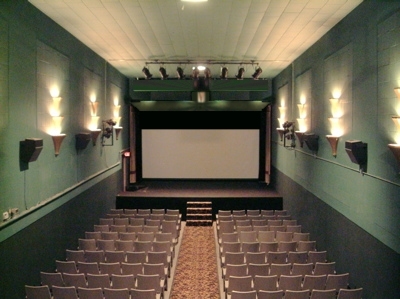
If you do it, you need to sort out how all the components work at the same time, & the only other component that may be missing is if you use top masking only for scope. Only the leading 6" or so of the side or top masking is black, the rest is something else that goes with the house decoration. Otherwise, the screen does look small & awkwardly thrown in:
 -

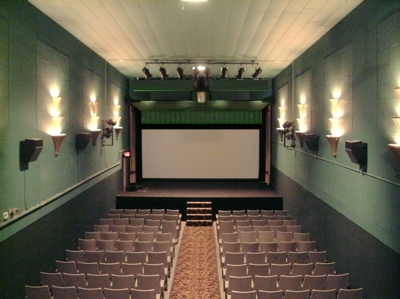
Fortunately, top masking is usually a panel, so it's easy to just apply above the leading black edge whatever fabric or whatever is going to be used. This is technically a lambrequin: a panel with fabric on top of it that sort of impersonates a drape.
 -

This panel is the only one where you can use vertical folds (pleats here, really, since they're flat). A "straight valance" with vertical folds really looks lowball over a screen because the lines run in the wrong direction. However, if you've got a valance or pseudo-prosc above it with lines running horizontally or radiating, you can go with vertical lines on a short lambrequin beneath it to get eye-busying variety & to de-empahsize the sliveriness of the lambrequin. There must be some sort of demarcation at the bottom of the decorative panel where the black edge starts; not a fringe (which is wrong for deco), I forget what they're called at the fabric store. It's just a fabric border-y thing in a roll, sometimes it looks like a few-inch-wide fabric thing, some are like soft cloth rope.

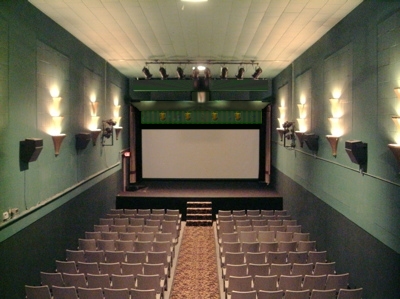
The audience manipulation part about reducing the screen size with the top masking is to tart it up somehow with some eye candy so that it becomes something new to stare at & wonder what the hell that's all about when it comes in. I personally would enoy an RCA meatball stuck in the middle of the lambrequin on the top masking, but if you'll be disguising the speaker with a single, central element already, you'll need something more horizontal in layout. In a frenchy-looking movie palace, you could put a silhouette of Phaeton joyriding or something, but in a deco house, it's all about geometric shapes. You don't want something else out of left field adding to the clutter, so I always look around to find some existing element that might can be utilized there in the star position. Just from the photo, the only shape that pops out is the silhouette of the sconces, so they could be a candidate somehow:
 -

If that works for you, go to Home Depot, buy 4 panels of sheet metal, cut them in silhouettes of the nested bowls of the sconces, spray them dark gold, & stick them on the lambrequin. I've noticed in deco houses with cast metal figures of some sort that they're almost always just silhouettes with a small bit of geometric relief: you could do the same by taking each cutout and giving it a soft vertical bend no more than 1" up the center. Don't shine a light on it, the two slightly differently facing sides will have sufficient eye-candy action in the houselight scatter.

Someone else will really need to work out the design with you, these are just the components & how they're laid out, especially considering that it must be something that works visually with your grand drape.

The missing components:
False prosc/valance thing
Lambrequin panel on top masking
(in your case) panel or something over the AC ducts

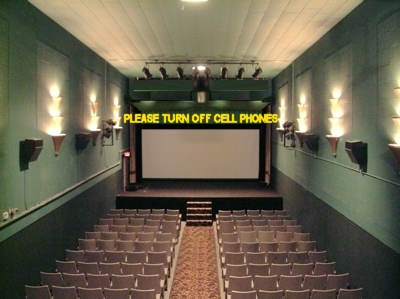
The neat thing here is that in your case, you might be able to do it all just by getting enough scrim material for all 3 components. They're all basically lambrequins, just stapling fabric to a panel & then hanging the panel. Radial pleats on the AC panel, horizontal pleats (with maybe a sort of swirly thing in the center) on the valance, vertical pleats on the top masking.

Hopefully, you & someone else can work out colors & maybe work out something better for the top masking design which isn't really setting me on fire.
 -

All right, this is starting to work for me.

 |  IP: Logged

John Pytlak
Film God

Posts: 9987
From: Rochester, NY 14650-1922
Registered: Jan 2000


 - posted 12-07-2005 05:33 AM      Profile for John Pytlak   Author's Homepage   Email John Pytlak   Send New Private Message       Edit/Delete Post 
quote: Carl Martin
what open gate luminance would allow most people to perceive flicker if the shutter has two 100 degree blades?
You still should stay in the standard SMPTE 196M range of 12 to 22 footlamberts, and aim for 16 footlamberts. Whether the blades of a two-blade shutter are 90 or 100 degrees, it's still a two-blade shutter with 48 interruptions per second.

 |  IP: Logged

Ken Lackner
Phenomenal Film Handler

Posts: 1907
From: Atlanta, GA, USA
Registered: Sep 2001


 - posted 12-07-2005 01:57 PM      Profile for Ken Lackner   Email Ken Lackner   Send New Private Message       Edit/Delete Post 
quote: John Pytlak
Standard SMPTE 196M allows up to 22 footlamberts for theatres, with an aim of 16 footlamberts screen luminance.
I thought the standard was 16 +/- 2 foot lamberts. [Confused]

 |  IP: Logged

John Pytlak
Film God

Posts: 9987
From: Rochester, NY 14650-1922
Registered: Jan 2000


 - posted 12-07-2005 10:10 PM      Profile for John Pytlak   Author's Homepage   Email John Pytlak   Send New Private Message       Edit/Delete Post 
quote:
I thought the standard was 16 +/- 2 foot lamberts. [Confused]


Screening rooms (e.g., where color timing decisions are made) have a tighter tolerance than theatres.

 |  IP: Logged

Carl Martin
Phenomenal Film Handler

Posts: 1424
From: Oakland, CA, USA
Registered: Feb 2002


 - posted 12-08-2005 01:44 AM      Profile for Carl Martin   Author's Homepage   Email Carl Martin   Send New Private Message       Edit/Delete Post 
quote: John Pytlak
You still should stay in the standard SMPTE 196M range of 12 to 22 footlamberts, and aim for 16 footlamberts. Whether the blades of a two-blade shutter are 90 or 100 degrees, it's still a two-blade shutter with 48 interruptions per second.
well, we do have a flickery screen with 100 degree shutter blades. i'm pretty certain it's not anywhere near 22 ftlamberts even in scope, though i haven't measured it. apparently the flicker is not in the lamp itself, either.

carl

 |  IP: Logged

Dustin Mitchell
Phenomenal Film Handler

Posts: 1865
From: Mondovi, WI, USA
Registered: Mar 2000


 - posted 12-08-2005 03:23 AM      Profile for Dustin Mitchell   Email Dustin Mitchell   Send New Private Message       Edit/Delete Post 
Diode?

 |  IP: Logged

John Pytlak
Film God

Posts: 9987
From: Rochester, NY 14650-1922
Registered: Jan 2000


 - posted 12-08-2005 05:39 AM      Profile for John Pytlak   Author's Homepage   Email John Pytlak   Send New Private Message       Edit/Delete Post 
If you have too much current ripple in the DC supplying the xenon lamp, the 60 Hz ripple will "beat" with the 48 Hz or 72 Hz shutter frequency, producing a very visible 12 Hz. flicker. Check for current ripple and possible causes (e.g., a bad diode, deteriorated filter capacitor, or missing leg on 3-phase).

 |  IP: Logged

Carl Martin
Phenomenal Film Handler

Posts: 1424
From: Oakland, CA, USA
Registered: Feb 2002


 - posted 12-10-2005 03:01 AM      Profile for Carl Martin   Author's Homepage   Email Carl Martin   Send New Private Message       Edit/Delete Post 
that was what i had suspected, but our union guy looked at the light (briefly) without the shutter running and said it was steady. i was surprised that a ripple would have been visually discernable without interference from the shutter.

 |  IP: Logged


All times are Central (GMT -6:00)
This topic comprises 4 pages: 1  2  3  4 
 
   Close Topic    Move Topic    Delete Topic    next oldest topic   next newest topic
 - Printer-friendly view of this topic
Hop To:


Powered by Infopop Corporation
UBB.classicTM 6.3.1.2

The Film-Tech Forums are designed for various members related to the cinema industry to express their opinions, viewpoints and testimonials on various products, services and events based upon speculation, personal knowledge and factual information through use, therefore all views represented here allow no liability upon the publishers of this web site and the owners of said views assume no liability for any ill will resulting from these postings. The posts made here are for educational as well as entertainment purposes and as such anyone viewing this portion of the website must accept these views as statements of the author of that opinion and agrees to release the authors from any and all liability.

© 1999-2020 Film-Tech Cinema Systems, LLC. All rights reserved.