|
|
This topic comprises 4 pages: 1 2 3 4
|
|
Author
|
Topic: Improve 35mm
|
Ron Curran
Jedi Master Film Handler

Posts: 504
From: Springwood NSW Australia
Registered: Feb 2006
|
 posted 03-02-2006 08:12 PM


This string was never meant to be a 70 vs 35 punch-up. 70 is superior in every way. There are producers everywhere on the planet right now who are planning to shoot film. Most are planning to frame it 1.85 or Super 35.
Get hold of them and convince them that, for the sake of future generations, they MUST change their minds and shoot in 65mm. If you succeed, we will all be eternally grateful. Please give me plenty of warning so I can get a good deal on 70mm gear.
In the production world, the film frame in the camera has become smaller. The latest Kodak In Camera magazine profiles 2.35 feature film shoots. All were Super 35. Reasons stated include, in one case, the economy of 3-perf “a 20% saving” and, with 4-perf, the preference of digital effects people for freedom to move within the frame and, in another production, the desire to use spherical lenses.
So more productions are using a smaller area of the 35mm frame for 1.85 and 2.35. I was presenting a case for increasing that. If we are talking blow ups, I would rather see one from a 5/35CS neg giving 590 square mm than a Super 35 crop of about 260 square mm.
I agree with the proposal in “The splendour of 70mm” and 65mm filming. Bring it on. Get your business model sorted out for large theatres with giant screens.
In the meantime, all I am asking is for a feasible, affordable and better 35 format for the 6000 or so productions we are likely to see before the rebirth of 65 and the digital apocalypse. One small step for mankind. Is that so unreasonable? Optimised 35 will help smaller community cinemas and the multiplexes. Who can afford the real estate to have a multiplex with twenty 60-foot screens? A mix will be necessary.
One of the big problems we face is that film capturing and projection equipment (every gauge) is too damn reliable. There is a far more lucrative future in supplying digital boxes that none of us can fix and that will be superseded every few years. It is all part of consolidation.
| IP: Logged
|
|
|
|
|
|
|
|
|
|
|
|
|
|
|
|
|
|
|
|
Monte L Fullmer
Film God

Posts: 8367
From: Nampa, Idaho, USA
Registered: Nov 2004
|
posted 03-06-2006 12:07 AM
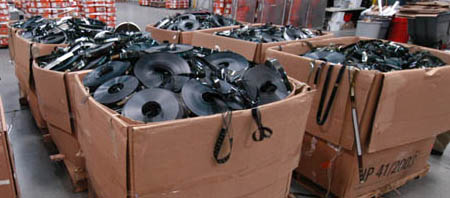
Thatsa lotsa "poly" heading back to the recyclers. A lot cheaper to stamp DVD's than to print film
Plus, with the demise of the "projectionist" and the increase of the 'booth operator', 'UsherBees', and the 'BoothClowns', this is the obvious reason for the increased interest in DC cinema.
Of this interest is that the customer, who goes to the "Goo-gooplex" are not getting the accurate and enjoyable presentation every time they attend. Also, with these growing complaints, refunds are issued, thus lost revenue is the result.
Megacompanies are screaming to find a quick and easy solution for this problem and the easy way out is for the usage of DC - instead of properly training procedures. Plus,let alone having to pay better wages for the fully trained employees which the Megacompanies don't want to do in the first place.
| IP: Logged
|
|
|
|
|
|
John Pytlak
Film God

Posts: 9987
From: Rochester, NY 14650-1922
Registered: Jan 2000
|
posted 03-07-2006 07:12 AM
quote: John Koutsoumis
Back in the good old days didn't they strike all the release prints from the camera negative?
Duplicate negatives have been used for release printing for many decades. There is great risk in using the spliced original negative for producing release prints -- damage is very likely if even one of the hundreds of splices breaks in the printer, or if a misthread causes a scratch or other damage. Although printing originals are cleaned frequently, some dirt particles eventually become embedded in the emulsion, and may not be completely removable. Yet some producers (where print runs are relatively small) will not invest in the protection duplicate negatives offer, and make release prints directly from the original negative. Today, some "Bollywood" films still do this.
Early color duplication films (like EASTMAN Color Intermediate Film 5253) were quite grainy, and produced a noticeable degradation of image quality. More recent films like KODAK VISION Color Intermediate Film 2242 can produce duplicate negatives that yield prints almost indistinguishable from direct prints --- the Kodak SMPTE presentations that introduced the new generations of intermediate film actually showed "split screen" images where most experts could not see any loss in image quality.
One of the major reasons for increased unsteadiness and loss of sharpness is the practice of using continuous contact printing for all stages of duplication, so the correct short-pitch to long-pitch perforation relationship is not maintained for all printing steps. Correct practice is to only contact print short-pitch to long-pitch films, and use a pin-registered step printer for printing the master positive to the duplicate negative. Unfortunately, ever tighter production schedules often don't leave time for labs to "do it right" on the slower step printers.
| IP: Logged
|
|
|
|
|
|
All times are Central (GMT -6:00)
|
This topic comprises 4 pages: 1 2 3 4
|
Powered by Infopop Corporation
UBB.classicTM
6.3.1.2
The Film-Tech Forums are designed for various members related to the cinema industry to express their opinions, viewpoints and testimonials on various products, services and events based upon speculation, personal knowledge and factual information through use, therefore all views represented here allow no liability upon the publishers of this web site and the owners of said views assume no liability for any ill will resulting from these postings. The posts made here are for educational as well as entertainment purposes and as such anyone viewing this portion of the website must accept these views as statements of the author of that opinion
and agrees to release the authors from any and all liability.
|

 Home
Home





![[uhoh]](graemlins/uhoh.gif)
![[Razz]](tongue.gif)
![[Big Grin]](biggrin.gif)

![[Frown]](frown.gif)
![[thumbsup]](graemlins/thumbsup.gif)
![[Cool]](cool.gif) ) i'm always left gob smacked. Pity you don't see that in the Multiplexes.
) i'm always left gob smacked. Pity you don't see that in the Multiplexes.


 Printer-friendly view of this topic