Film-Tech Cinema Systems
Film-Tech Forum ARCHIVE


my profile | my password | search | faq & rules | forum home
  next oldest topic   next newest topic
» Film-Tech Forum ARCHIVE   » Operations   » Film Handlers' Forum   » 'Fight Club' and the bastardization of projection terms... (Page 2)

 
This topic comprises 4 pages: 1  2  3  4 
 
Author Topic: 'Fight Club' and the bastardization of projection terms...
Sean McKinnon
Phenomenal Film Handler

Posts: 1712
From: Peabody Massachusetts
Registered: Sep 2000


 - posted 05-06-2008 06:16 AM      Profile for Sean McKinnon   Author's Homepage   Email Sean McKinnon   Send New Private Message       Edit/Delete Post 
The thing is (as I posted in the other thread) that not only has smoking never been legal in projection booths, but if you tried to use a cigarette to "burn" a cue onto a frame of nitrate film it would cause a fire!

I love how in the movie he splices one frame of porn into the movie and you see in the theatre a flash and hear the sound of porn, well as you all know one frame would be like nothing it would be totally unintelligable.

I HATE fight club!

 |  IP: Logged

Tim Reed
Better Projection Pays

Posts: 5246
From: Northampton, PA
Registered: Sep 1999


 - posted 05-06-2008 08:21 AM      Profile for Tim Reed   Author's Homepage     Send New Private Message       Edit/Delete Post 
quote: Frank Angel
they are words that convey distruction and words you just don;t want to associate with film.<snip>
it was the combination of those two items that "synchronized" the two machines

Destruction has nothing to do with it. It's just wrong. Period.

FWIW, the term non-sync is a hold over from the early sound days. You had sound sources that were synchronous with the film (sound on disc), and those that were not (interval music). It has nothing to do with changeovers.

Just because another projectionist understands what you're saying doesn't mean it's correct to use a particular term.

I had an early mentor who used incorrect terms, as well. He used to call cue marks "sequence dots," carbons were "rods," and capacitors "resistors". From being around so many old-school union projectionists by that time in my life (and having already been set straight on some of that by them), I knew all of that was wrong. But as he was so generously allowing me access to that particular booth, it wasn't my place to correct him. [Wink]

 |  IP: Logged

Martin McCaffery
Film God

Posts: 2481
From: Montgomery, AL
Registered: Jun 99


 - posted 05-06-2008 09:36 AM      Profile for Martin McCaffery   Author's Homepage   Email Martin McCaffery   Send New Private Message       Edit/Delete Post 
quote:
long time ago one of my mentors, instead of using the common, correct name count-own leader, he called it the sync leader,
It's been a long time since I've been in an editing booth, but I vaguely recall the head leader being called the sync leader, which makes perfect sense when editing. And you still see the word sync on some head leader on release prints, too. So at least that little quirk has some basis in reality.

Cigarette burns?!? No. Are any of the smokers here willing to actually burn some frames and post just to see how big and awful a cigarette burn would look?

 |  IP: Logged

Robert Throop
Master Film Handler

Posts: 412
From: Vernon, NY USA
Registered: Jun 99


 - posted 05-06-2008 09:38 AM      Profile for Robert Throop   Email Robert Throop   Send New Private Message       Edit/Delete Post 
When I first started an old timer objected to the words "Flat" and "scope". Instead he would label prints "cine" and "reg".
Bob

 |  IP: Logged

Mike Blakesley
Film God

Posts: 12767
From: Forsyth, Montana
Registered: Jun 99


 - posted 05-06-2008 10:47 AM      Profile for Mike Blakesley   Author's Homepage   Email Mike Blakesley   Send New Private Message       Edit/Delete Post 
My grandpa had an old Bell & Howell 16mm sound projector. It had one roller near the bottom of the film path that was referred to (in the manual) as the "snubber roller." Well, in the theatre, in my Simplex sound head, the very last roller before the sprocket sort of looks like and operates the same way as the "snubber roller" in the old Bell & Howell, so that's how I think of that roller. It'll always be the "snubber roller" to me. Although I've never taught that to anyone else (nor ever even mentioned it until now, come to think of it).

 |  IP: Logged

Frank Angel
Film God

Posts: 5305
From: Brooklyn NY USA
Registered: Dec 1999


 - posted 05-06-2008 01:04 PM      Profile for Frank Angel   Author's Homepage   Email Frank Angel   Send New Private Message       Edit/Delete Post 
Well, a lot of terms are derived from simple common useage. Is calling the "fader" a "volume control" really wrong? It's not what may be the common name but it is not wrong except in very formal settings or if you are write a book about audio. But in real life, I don't see any right or wrong with using what someone will understand if it is not contradictory. Calling a capacitor a "resistor" is wrong no matter what the circumstances. Calling a fader a "volume control" or carbons "carbon rods" may not be the more common usage, but they are easily understood and are in fact correct by definition. Actually "level control" is probably by definition the most correct.

In my youth, tinkering with Heathkits, all I have ever heard or saw in writing was "volume control." It was only when I got into a projection booth that I heard the term "fader." Which I recall thinking was quaint and not very technical and thought it must be something held over from yearlier years (the fader wall box looked like a really old piece of equipment to me). I guess "fader" flips off the tongue better than "volume control," so that is what stuck.

 |  IP: Logged

Kenneth Wuepper
Phenomenal Film Handler

Posts: 1026
From: Saginaw, MI, USA
Registered: Feb 2002


 - posted 05-06-2008 01:42 PM      Profile for Kenneth Wuepper   Email Kenneth Wuepper   Send New Private Message       Edit/Delete Post 
Frank,

It was not uncommon for there to be a single knob in front of each projector (tied together mechanically) that would, in fact, FADE the signal from the outgoing machine to the incoming projector upon making a changeover. The center position was 0 so you could save the audience from hearing the nasty sound effects if you missed a changeover cue.

In later years it is still known as the fader as it does Fade in/out one or more channels of sound.

I remember my high school physics teacher explaining a capacitor as acting to AC like the resister does to DC. I think that could be easily misunderstood.

KEN [Smile]

 |  IP: Logged

Scott Norwood
Film God

Posts: 8146
From: Boston, MA. USA (1774.21 miles northeast of Dallas)
Registered: Jun 99


 - posted 05-06-2008 02:08 PM      Profile for Scott Norwood   Author's Homepage   Email Scott Norwood   Send New Private Message       Edit/Delete Post 
What about "soundhead" vs. "sound reproducer"? I learned "soundhead," but apparently "sound reproducer" is the correct term for the device. I suppose that dubbers are technically "magnetic reproducers" as well (unless they have record heads).

The old SMPTE projectionist book makes a big deal of how the "sound track" should really be called the "sound record" (or, more specifically, "optical sound record" and/or "magnetic sound record"), but this would seem to invite confusion when the topic of Vitaphone is discussed. I have only ever heard the term "soundtrack" used (with "optical track," "digital track," and "magnetic track" variants).

Do I even dare to mention the whole 1.33 vs. 1.37 issue? The Academy frame is really 1.37:1, but everyone calls it 1.33:1; the fact that silent prints, 16mm prints, and NTSC/PAL video are all really 1.33:1 adds to the confusion.

Does anyone actually use the terms "European widescreen" and "American widescreen" to refer to the 1.66:1 and 1.85:1 formats, respectively? And is anyone else annoyed by prints that are simply labelled "flat," without an aspect ratio designation?

 |  IP: Logged

Frank Angel
Film God

Posts: 5305
From: Brooklyn NY USA
Registered: Dec 1999


 - posted 05-06-2008 02:39 PM      Profile for Frank Angel   Author's Homepage   Email Frank Angel   Send New Private Message       Edit/Delete Post 
Sure, Scott, in the art houses which get foreign prints and even those American titles in that time frame between the mid-50s and early to mid 60s, which I call the a.r. Grey Period, where the aspect ratio of Flat hadn't been firmed up, not to mention the always ambiguous ar's of films shot in VistaVision, just saying FLAT is practically useless information for us. Then again, you'd be hard pressed to find a lot of booths which play current commercial releases with anything but two formats -- Flat and Scope. For those vast majority, the actual aspect ratio numbers are just as useless to them as FLAT is to us. They can't play anything BUT Flat and Scope and no matter what the actually intended ar of the film, their Flat is what it is -- 1.85.

On the other hand, if someone can't tell if a print is flat or scope by a quick visual inspection but needs a label to tell them.....it's pretty much a lost cause from the get-go. [uhoh]

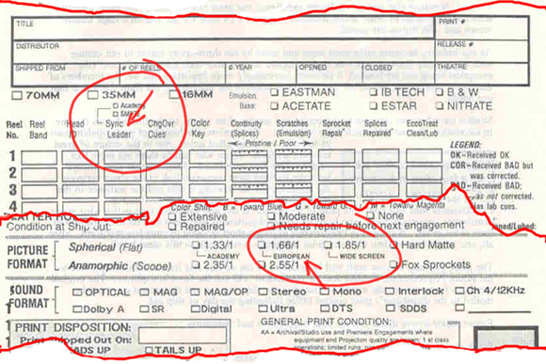
Oh and here's a snipit from the Projection Report we've been using -- it's got your 1.66 with the "European" reference and my "Sync Leader." [thumbsup]

 -

[ 05-06-2008, 10:05 PM: Message edited by: Frank Angel ]

 |  IP: Logged

Steve Guttag
We forgot the crackers Gromit!!!

Posts: 12814
From: Annapolis, MD
Registered: Dec 1999


 - posted 05-07-2008 12:22 AM      Profile for Steve Guttag   Email Steve Guttag   Send New Private Message       Edit/Delete Post 
You also have the influence of other countries on some terms. The word "FADER" seemed to gain a lot of steam in cinema with Dolby's emergence as a sound processor manufacturer.

Probably the most accurate term is "Attenuator." as that is what virtually all of them do...attenuate a full strength signal down to what you want. Even electronically with VCA...they are Voltage Controlled Attenuators.

I don't think there is a big problem with Fader, Volume...and so on as they are all "correct" terms.

Cigarette Burns is wrong on so many counts...including that I've get to find any section of the planet that ever has historically referred to cue marks as that. It was a made up term that, seemingly, only people, not in the business, picked up on and perhaps are now in the business.

As for smoking in the projection booth...other than perhaps for Nitrate screenings...it has been legal around here for seemingly forever. I remember a manager coming into the booth at the Uptown complaining to one of the projectionist to stop smoking in the booth. In an odd situation, I found myself defending the smoker (odd in that I hate smoking and HATE what it does to film...I've yet to find a booth with a smoker where the prints didn't show it). Since the Uptown booth was built to Nitrate codes...it had its own fresh air system that was NOT connected to the rest of the theatre. As such, the smoking was entirely contained with the booth and the booth's air system. It was not in a public place nor in a space that other workers had to work with the smoker while the smoking was going on. The manager backed off.

As for FLAT and SCOPE...they are some of the STUPIDEST terms to refer to formats...well at lest "FLAT" is stupid. Whereas most of the anamorphic formats had "scope" in their name, it makes some sense...but FLAT doesn't help. The aspect ratio is what they should be referred to...if 1.85 had been adopted as the name way back...that is what would be on the turrets today...not FLAT. Whereas the bulk of my theatres have at least 4 formats and many have more...FLAT as a term is wholely inadequate.

My personal peeve term is "Brain" I guess it shows who does the thinking in platter operations. Honestly...it was never a term used at the theatre chain I started in (K-B Theatres in the DC Metro area). They were always "Payout Mechnaisms" or "Centerfeeds." I do not nor will I use the term "brain" when referrng to that part of the platter and admonish any idiot that does.

SG

 |  IP: Logged

Chris Slycord
Film God

Posts: 2986
From: 청주시, 경북도, South Korea
Registered: Mar 2007


 - posted 05-07-2008 01:40 AM      Profile for Chris Slycord   Email Chris Slycord   Send New Private Message       Edit/Delete Post 
So if you get the DVD of the movie the cue mark for that "reel" and that one only is put in digitally?

 |  IP: Logged

Dustin Mitchell
Phenomenal Film Handler

Posts: 1865
From: Mondovi, WI, USA
Registered: Mar 2000


 - posted 05-07-2008 03:05 AM      Profile for Dustin Mitchell   Email Dustin Mitchell   Send New Private Message       Edit/Delete Post 
Oh, and for the record, I like Fight Club [Smile] .

 |  IP: Logged

Frank Angel
Film God

Posts: 5305
From: Brooklyn NY USA
Registered: Dec 1999


 - posted 05-07-2008 10:54 AM      Profile for Frank Angel   Author's Homepage   Email Frank Angel   Send New Private Message       Edit/Delete Post 
I always assumed that the word FLAT came about because with CinemaScope was introduced the curved screen. So for a projectionist who had been showing Academy films for years and then came this fairly substantial change to a curve screen, the Academy films before this being shown on a flat screen, it's easy to see how Scope = Curved, and NOT Scope, well, that would be "not curved," the opposite of which is flat. Why they didn't wind up referring to them as FLAT and CURVED is anyone guess; mine would be cause that would be just to damn stupid for words.

Spherical Wide Screen 1.85. -- Anamorphic Wide Screen. They have a nice sound and pretty much say it clearly, albeit they don't exactly come tripping off the tongue. I'd settle for Cropped Wide Screen 1.85 as well.

 |  IP: Logged

Robert Throop
Master Film Handler

Posts: 412
From: Vernon, NY USA
Registered: Jun 99


 - posted 05-08-2008 09:25 AM      Profile for Robert Throop   Email Robert Throop   Send New Private Message       Edit/Delete Post 
"Frank,

It was not uncommon for there to be a single knob in front of each projector (tied together mechanically) that would, in fact, FADE the signal from the outgoing machine to the incoming projector upon making a changeover. The center position was 0 so you could save the audience from hearing the nasty sound effects if you missed a changeover cue."

The WE faders operated in this manner. The early RCA literature referred to changeover switches as "faders".
Bob

 |  IP: Logged

Mitchell Dvoskin
Phenomenal Film Handler

Posts: 1869
From: West Milford, NJ, USA
Registered: Jan 2001


 - posted 05-08-2008 09:37 AM      Profile for Mitchell Dvoskin   Email Mitchell Dvoskin   Send New Private Message       Edit/Delete Post 
The person who taught me to run 35mm projectors back in the 1970's referred to 1.85 as "Half Frame Flat". Never heard it referred to that way anywhere else, but I always liked that terminology.

There is some disagreement over where the term "flat" originated. The general consensus is that it originated in the early 1950's with the commercial introduction of 3D. Flat or 3D. Cinemascope came shortly there after, "The new miracle of the screen that you can see without glasses", and of course was referred to as Scope. 3D went away, leaving flat and scope. The last film to actually be shot in CinemaScope was "In Like Flint" in 1967. All anamorphic films since then have been shot in Panavision (a prism anamorphic), although most theatres use CinemaScope projection lenses.

 |  IP: Logged


All times are Central (GMT -6:00)
This topic comprises 4 pages: 1  2  3  4 
 
   Close Topic    Move Topic    Delete Topic    next oldest topic   next newest topic
 - Printer-friendly view of this topic
Hop To:


Powered by Infopop Corporation
UBB.classicTM 6.3.1.2

The Film-Tech Forums are designed for various members related to the cinema industry to express their opinions, viewpoints and testimonials on various products, services and events based upon speculation, personal knowledge and factual information through use, therefore all views represented here allow no liability upon the publishers of this web site and the owners of said views assume no liability for any ill will resulting from these postings. The posts made here are for educational as well as entertainment purposes and as such anyone viewing this portion of the website must accept these views as statements of the author of that opinion and agrees to release the authors from any and all liability.

© 1999-2020 Film-Tech Cinema Systems, LLC. All rights reserved.