|
|
This topic comprises 6 pages: 1 2 3 4 5 6
|
|
Author
|
Topic: elevator music...
|
|
|
|
|
|
|
|
|
Harold Hallikainen
Jedi Master Film Handler
Posts: 906
From: Denver, CO, USA
Registered: Aug 2009
|
 posted 12-17-2016 11:58 AM


One station I worked for ran mono carts through an Orban stereo synthesizer to spread out the commercials a bit. Another (the one with the Somomag Carousels) ran stereo carts. I'd align the heads every week. The Sonomags were interesting machines. Sometimes they would not eject the cart and the carousel would get stuck trying to turn. The pinch roller was brought up by a solenoid pulling on a pin on a shaft. As the shaft rotated, the pinch roller would come up. But if you set the pinch roller pressure too high, the roller would not go back down when current through the solenoid was dropped. After rotating the shaft so many degrees, the pin was pretty much parallel to the solenoid core, so there was force to pull the core back out. The system would try to eject the cartridge. The pinch roller on its shaft would act like a hook and catch the cartridge as it tried to move away. The system would then not play any more carts from that machine. When one showed up in the schedule, the system would silence sense (sounding an alarm and moving on). But, if you had the Sonomag preamp gain too high, the preamp would oscillate at some frequency above 20 kHz. The silence sensor would detect this and say there's no silence, so the system would just sit there playing silence (the high frequency did not get broadcast since it was blocked by the low pass filters in the stereo generator). It was fun to get everything just right so it would play reliably.
Then there were the reel to reel decks (Revox A77). They proved reliable, but sometimes someone would put a twist in the tape so the back side of the tape instead of the oxide would played. This resulted in muffled music being played. Also, since the end of song was indicated by 25Hz on the left channel, which ends up on the right channel if you flip the tape, the song would never end. A full 10 inch reel of muffled music would play, then the system would silence sense.
Radio in the 1970s!
Harold
| IP: Logged
|
|
|
|
|
|
|
|
|
|
|
|
Frank Angel
Film God

Posts: 5305
From: Brooklyn NY USA
Registered: Dec 1999
|
posted 12-19-2016 02:52 PM
"Beautiful music" was quite a joke in the industry; when I worked for the LaBrie FM Network, it was called "easy listening" or our version, Lush Au Go-Go, and laughed our asses off (we said it sounded like a drunk stipper but of course, we were snotty, hippy-type, barely 20 year olds, so of course we thought it as old people's music. Little did we realize how fast we would get old!
And yes, Scott, that sappy, "old people's" format was very popular on both FM and AM stations during those years. There were easy listening stations in every major market...kind of the antidote to rock for old people.
What the format basically did was to take pop and rock songs and take all vibrance and sensuality and anything else that resembled excitement and life out of it so all that was left was music sludge to make it palatable for old folks; yes it was a very popular format predating "talk radio."
Lush Au GoGo was carried on, I believe, 24 stations in major markets (WLS-FM in Chicago, for one). New York had WPAT which was always a station Gene LaBrie tried to gte to buy us, but they actually had an LP library of even a sappier LPs than our format. It dominated the NY market.
LaBrie's whole idea with our Lush-au-Go-Go service was to make it more up-beat so it could get past the "elevator music" stigma to capture a more hip, slightly older but still conservative audiences. We programmed hour "shows" with 25hz pulses every block of 4 songs (not like this article in Billboard claims after every cut --
Bilboard on LaBrie Lush Au GoGo ATP - Automation Trigger Pulse
so the stations could automate announcer, commercial and news break inserts.
I must say, for the time, (late 60s to early 70s) when the FCC mandated that the broadcasters separate their FM stations from AM (up till then, they were allowed to simulcast whatever was on their AM station to their FM transmitters), simply buying a music service rather than needing to hire a whole staff and buying skads of LPs and programming a format, buying a finished service was a quick and relatively cheap way of complying with the FCC mandate.
In the beginning, LaBrie was making money hand over fist until the stations realized that they actually needed to program to their own demographic and audience tastes in order to see any real profit.
Even though we mocked the "easy listening" format, it was a VERY sophisticated format with all kinds of variables that went into the formula -- time of day, geographical location, ratio of male to female listeners, age groups, income levels and, believe it or not, whether a rock or pop song had been featured on any of the major talk shows like Johnny Carson, Mike Douglas, Phil Donahue, etc. If, say, an upbeat, brassy rock number that normally would not be allowed according to the formula was performed on one of those TV shows within a week of the show we were programming, then we could program it into a segment as long as it was couched on either side by slow-tempo, string-dominant songs so as to, what, I don't know...keep the old people's heads from exploding? Anyway, the research that went into it was quite impressive, even if the result was something none of us would ever listen to on purpose. And I must say, when we came in at night to master the programs that the day guys packaged and left for us, the whole place wreaked of pot smoke. They claimed it was the only way they could get thru 8 hours of "easy listening Lush Au Go-go".
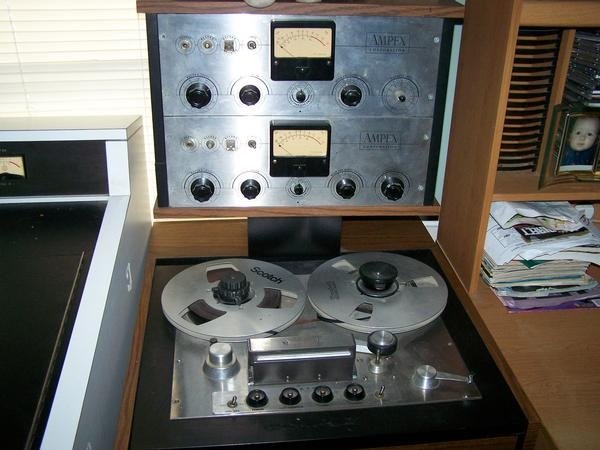
We mastered tapes on those beautiful Ampex 300 two track stereo transports at 15ips. Holes were drilled holes the head cowals so we could easily align the record head to Ampex alignment tape every night. The stations could then easily align their playback machines to the tapes we sent them, making it less likely that mono receivers would get flanging distortion. And there were X/Y scope above every machine we could see the azmuth line.
As for the dreaded pops from LPs that might have a scratch here or there, we didn't have the luxury of throwing out the disk; instead, as you recorded from the LP, you would have a magic marker in one hand -- you heard a pop, you would mark the tape as it moved past the head, then you would need to go back and find the spot and rack that pop back and forth until you were perfectly aligned, mark it, and then VERY carefully, SPLICE IT OUT -- no digital editing program to do it in seconds like you could today, but you could get it so that missing fraction of a second was not audible. I got very good at that, but every pop you heard was alike a stab in the back as it meant longer hours spent on a master hour, until finally KLH came out with a Transient Spike Eliminator that did it as good as the humans. Before that, though, I put my foot down and told the stoners in the front office that I would just reject any package that had more than to pops per LP. They knew a rejected package meant lots of extra work for them. They were pretty good at keeping the pop count down.
We also had a last ditch trick to deal with albums which had dirty noise that couldn't be eliminated with the vacuum cleaner machines we used. It was a mixture of KY jelly (I kid you not) and distilled water. You squirted that on the track that you needed to record until until all the grooves were wetted with no breaks and the stylus and capillary action held a bubble of the solution between the record surface and the needle. That reduced the friction and some of the surface noise. This method was in place when I got there so I didn't question it, but to be honest, I never thought it actually did anything significant to improve a bad sounding LP. When I got to be chief recording engineer, I stopped using it myself, but the two other guys insisted it did work. My solution was to just rejected an LP that was too noisey. We had somewhere like 4 thousand LPs so there were going to be some that were not perfect.
| IP: Logged
|
|
Scott Norwood
Film God

Posts: 8146
From: Boston, MA. USA (1774.21 miles northeast of Dallas)
Registered: Jun 99
|
posted 12-19-2016 03:15 PM
Umm...wow. Thanks for the description, Frank.
In case it isn't obvious, I find this genre of music (or "musical sludge," as Frank puts it) fascinating. I was born in the mid-1970s and just barely remember it as a mainstream radio format (often on crappy low-power AM stations), but I always assumed that it was the sort of thing that one might put on as background music at a dinner party or retail store or something, not as music actually intended for listening. I do get why the format makes sense for background music (limited dynamic range, unlike classical, and generally inoffensive and often unrecognizable), and I have an odd appreciation for it in that context.
I suppose that the modern replacement is the "classical's greatest hits" format that seems to be popular in many markets now. These are the stations that play Vivaldi's Four Seasons at least once an hour and have a very thin catalog that they play repeatedly with minimal announcing (because their listeners don't really want to learn anything about the music to which they are listening). This is perfectly reasonable for background music, but gets annoying if one listens to it for any length of time. "Real" classical stations that actually play a wide variety of material with announcers who actually know and love the music seem to be rather rare at this point.
Where all of this gets weird to me is that so much radio listening is done in cars, and I don't see either beautiful-music or classical's-greatest-hits as being especially car-friendly. I would think that most people would rather listen to news/talk or "real" music in the car. I know that I would.
| IP: Logged
|
|
Jack Ondracek
Film God

Posts: 2348
From: Port Orchard, WA, USA
Registered: Oct 2002
|
posted 12-19-2016 05:48 PM
During its heyday, "sappy" was not a word connected to the "beautiful music" format, nor was the serious application produced in rooms full of pot smoke. During the '60s, up through the late '70s, production companies, such as Bonneville (yes, the Salt Lake City folks), Schulke (Shul-kee) and TM Productions were fierce competitors for the young-to-middle-aged "housewife" market. Not only was there intense research into tempo, title, composition and commercial ratios, but some very strict contractual rules regarding acceptable tape deck models, preamp electronics, and processing and clipping levels (in Schulke's case... none). Overlap (segue) was generally not allowed. In some cases, 1 to 2 seconds of silence was required between cuts, including commercials. Some of the best technical performance came out of these FM stations, mainly because they understood how sensitive women were (are) to distortion, clipping and nonexistent dynamic range. Maintaining the format subscription involved, in some cases, mandatory submission of periodic airchecks that were reviewed by the production companys' engineers for quality and adherence to the format's "rules".
In the mid 70s, I worked as chief engineer of such a station. The format was important enough to the company that they put the automation in the engineer's office... or maybe they put my desk in the automation room! The format consistently outbilled our live, co-owned country station.
During this same period, local TV stations ran programs, aimed at the homemaker; full of recipes and tips on how to pull stains out of your (stereotypical) husband's shirts. Afternoon movies and bingo games were also popular.
Yes... the audience is old now, but it wasn't then. "Dad" may have been the breadwinner, but "Mom" ran the house and (mostly) raised the kids. She had a healthy lock on the checkbook and these formats were all about suggesting ways for her to use it.
<HAROLD>: Thanks for the memory jog about the A77 and flipping the tape. I'd forgotten about that.
| IP: Logged
|
|
Frank Angel
Film God
Posts: 5305
From: Brooklyn NY USA
Registered: Dec 1999
|
posted 12-19-2016 07:57 PM
Jack, I didn't mean to imply that the technical standards of the big stations like WPAT or our production house or any other production house using the easy listening format was less than top-draw -- you didn't get away with sloppy production when you are selling product to WLS or other the big boys.
In our studios we produced promotional music program specials for Fortune 500 companies and I can tell you, the technical quality of the work was as good as you could get. LaBrie came from Columbia Records and was a maniac for tech standards and over-all production quality.
The man who was the head technical engineer when I got there was Keith Lacy who had worked with Henry Kloss at MIT and mentored me at LaBrie. I also worked with Alan Meyerson who now mixes the scores for the biggest blockbuster films. The technical standards were top of the class regardless of whether or not any of us happened to like the musical content. It's like you get your projection systems tweaked to the best picture and sound the equipment is capable of -- you don't have to like the movie that it will be running. And of course, there was NEVER smoking of any kind in the recording studios part of the building.
As for the pot-smoking programmers in the front rooms and LP library, these weren't the engineers -- they were the music programmers and statistician who worked out those complicated formulas, and then had to choose the cuts to meet the requirements -- when women are home along, no brass (evidently women and brass or horn instruments are like oil and water, oh, and ABSOLUTELY NO saxophones...who knew), when the guys came home after 5, more percussive sounds could be mixed in. These guys could go right to an album on one of the block long floor-to-ceiling shelves, pull out an LP practically without looking what bin it was in, put it on the turntable and would know exactly what cut to play without looking at the index on the jacket. I would watch them before my shift and I was constantly in aw. LaBrie got the best talented, youngish guys (and one girl) that he could find in NYC and remember, this was the late 60s -- pot was considered by this generation much safer than alcohol and of course all of us except the girl had the Damocles Sword of the Vietnam draft hanging over our heads which could fall at any time...dulling that edge with a little friendly weed was no big deal. These people happen to be great at what they did, two of them musicologists (one a PhD I recall) from Julliard and NYU; the boss pretty much looked the other way when it came to certain of their smoking habits.
| IP: Logged
|
|
|
|
|
|
All times are Central (GMT -6:00)
|
This topic comprises 6 pages: 1 2 3 4 5 6
|
Powered by Infopop Corporation
UBB.classicTM
6.3.1.2
The Film-Tech Forums are designed for various members related to the cinema industry to express their opinions, viewpoints and testimonials on various products, services and events based upon speculation, personal knowledge and factual information through use, therefore all views represented here allow no liability upon the publishers of this web site and the owners of said views assume no liability for any ill will resulting from these postings. The posts made here are for educational as well as entertainment purposes and as such anyone viewing this portion of the website must accept these views as statements of the author of that opinion
and agrees to release the authors from any and all liability.
|

 Home
Home



![[Razz]](tongue.gif)


 Printer-friendly view of this topic