|
|
This topic comprises 8 pages: 1 2 3 4 5 6 7 8
|
|
Author
|
Topic: Worst 70mm Presentation EVER of IAMMMMMW
|
|
|
|
|
|
|
|
|
Bobby Henderson
"Ask me about Trajan."

Posts: 10973
From: Lawton, OK, USA
Registered: Apr 2001
|
 posted 02-25-2013 02:44 PM


I had been observing this part of the thread, just letting others talk. But I'll throw in these thoughts. Back in the late 1970's through early 1990's it was a lot easier for movie theaters, ad agencies and newspapers to advertise 70mm than it was for the digital sound formats that followed. The situation with the lossy compressed digital sound formats of the past 20 years (Dolby Digital, DTS & SDDS) was far more complicated, resulting in a lot of the "ads that confuse" mess. In a lot of markets the theaters, agencies and newspapers just said "screw it" and dropped all the technical info from the ads completely.
In short, a newspaper or movie theater would have to goof up on a substantially larger scale to get it wrong with 70mm listings.
Not nearly as many theaters were equipped to show 70mm. At its peak I don't think there was any more than about 1500 screens in North America capable of running 70mm. Compare that to the tens of thousands of screens that added Dolby Digital, DTS or SDDS (or combinations of 2 or 3 formats in the same booth) over the years.
In the 70mm Dolby blow-up era (late '70's thru early '90's) if a multiplex had 70mm capability it typically had it only on 1 screen. Some theaters had 2 screens capable of 70mm. Very few theaters had 3 or more 70mm capable screens. In a good year 10 or more movies would have various number of 70mm prints made. It was a great year if the number got above 20 movies with 70mm prints. Quite a few 70mm equipped screens rarely played movies in 70mm. In New York I remember seeing ads for some movies featuring only one or two 70mm prints in Manhattan theaters despite the fact dozens of theaters across the NYC metro area were equipped to show 70mm.
Far more digital sound systems were installed in the 1990's and in a far more varied manner. Some theaters would have 1 or 2 screens equipped with it while others had it on every screen. Some theaters went with just one format. Others mixed the formats around the complex or even had portable roll around carts so numerous screens could share various sound format processors. In the early 1990's I saw some theaters do THX Dolby SR analog in one room and have digital sound in another. Every movie distributor had its own philosophy on which digital sound formats it was going to support and how frequently it would be used, be it on every studio release or only on the big movies that really justified it. It was difficult to tell if some movies had any digital sound prints at all, particularly "indie" releases. The Dolby "tri" logo in use from late 1993 through early 1995 made that situation much worse. Not every movie had "single inventory" prints. In the 1992-1993 time frame not very many Hollywood movies had 5.1 digital sound mixes. But it didn't take long for the number of 5.1 audio movie releases in North America to jump from a couple dozen per year to well over 100 or more. Numerous features would be shown on more than one screen in a multiplex and not always in the same digital sound format.
Dolby NR was used on almost every Hollywood feature film 70mm release from 1976 on up through the early 1990's. Cobra, Spies Like Us and the 1990 re-release of The Sound of Music are the only movies I can think of that didn't have the Dolby name associated with 70mm mag prints during that period. From 1976 to 1994 if a Hollywood movie was going to be shown in 70mm it was almost always shown in "70mm six-track Dolby Stereo."
Regarding 70mm and auditorium size, I've personally been in modest sized auditoriums that I knew were equipped to play 70mm. Auditorium size doesn't mean anything with 70mm if the theater operator mainly installed the capability for the six track audio.
Manhattan had lots of 70mm equipped screens with all sorts of shapes and sizes. Some rooms, like the Ziegfeld or Astor Plaza, were huge. Others like the Loew's 19th East theater weren't very big at all. In Oklahoma City General Cinema's Penn Square Mall theater wasn't very big; it was tiny compared to the 1100+ seat GCC Northpark #1 screen in Dallas. The AMC Memorial Square 8 theater on the north side of OKC had a 70mm equipped screen. It wasn't a big room either. The Memorial Square 8 closed in the late 1990's when AMC opened their 24-plex nearby at Quail Springs Mall. The Penn Square Mall 10 is still open, but has changed owners a number of times (Hollywood, Dickinson and now AMC). The 70mm gear was removed years ago.
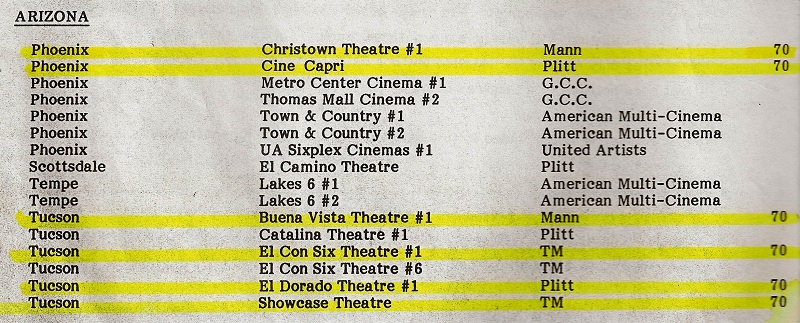
I figure if a certain theater in Tucson was advertised to have shown certain movies in 70mm and Dolby has records on the screen having a 70mm capable cinema processor then chances are the screen was indeed equipped to play 70mm.
| IP: Logged
|
|
|
|
Bobby Henderson
"Ask me about Trajan."
Posts: 10973
From: Lawton, OK, USA
Registered: Apr 2001
|
posted 02-27-2013 09:17 AM
I don't know what brand of speakers Warren is using in its auditoriums. If I had to guess I would figure they're using QSC. If not that then maybe JBL. At any rate the speakers have to be up to a certain standard of quality since all of Warren's "regular" auditoriums and "director's suites" are THX certified. Their IMAX Digital theaters are the only ones that aren't THX certified.
I do know Warren Theaters uses Dolby Digital Cinema (and Dolby 3D) gear in their non-IMAX booths. Oddly, Warren hasn't been on the forefront of installing Dolby Atmos. OTOH, very few movie productions have used Atmos up to this point. AFAIK only around 50 theaters in the US have installed Atmos on at least 1 screen, most of those in California (and not far from Dolby's offices). Perhaps Atmos will gain a little more momentum this summer.
Atmos kind of gets back to how the "ads that confuse" situation may be worse than ever.
The lossy compressed digital sound formats for 35mm film are quickly disappearing from commercial movie theaters. D-cinema uses superior yet generic uncompressed Linear PCM audio. That should simplify things, but it has rarely ever been accurately advertised. The end credits of new movies still show logos for SDDS, Dolby Digital (with their new logo screwed up) and DTS -or rather, "Datasat" Digital Sound. No mention of 24-bit 5.1/7.1 uncompressed LPCM audio in d-cinema presentations. You don't see that on the movie posters either (but the lossy digital sound formats are still there). Dolby did try to apply a "Dolby Surround 7.1" brand to LPCM 7.1 audio on DCPs, but that's not really accurate.
Have any movie posters, TV commercials or movie end credits bothered to mention Dolby Atmos? I certainly didn't see anything in the national ad materials for Brave. I kind of wonder if the term "Atmos" made it into any of the newspaper ads. Unless someone already knows about Atmos, knows a movie used Atmos in post production and knows which theaters have it installed he's not going to find the information in an easy way. I think most moviegoers that are finding out about Atmos are only doing so incidentally, not deliberately.
THX seems to have dropped off the radar scopes, even though some theaters are still going to the trouble of using the certification service.
The projection end of things is a mess. If a moviegoer wants to see a movie shown in a specific d-cinema projection format, such as 4K versus 2K, he's probably going to have to know what's installed in the booth. He's not going to find out about it in advertising. The 3D situation is also confusing. RealD and IMAX pushes their brands like crazy. Dolby 3D is rarely ever mentioned in any advertising. And then there's other systems like Xpand 3D. These systems don't all deliver the same results.
IMAX won't specify film or digital in their theater installations or how the movie is being shown. Various wannabe IMAX digital theaters (XD, ETX, RPX, etc.) aren't clear on how they're better, worse or equal to an IMAX Digital theater. Are they using 2 projectors? Are they using a better sound system than what IMAX installs? None of this is clear.
Even the movies themselves aren't clear with what's happening in camera and during post production. Was the movie shot on film? Was it shot on video? What's the native resolution of the shot footage, CGI elements and finished digital intermediate? 2K? 4K? How is the friggin' DCP encoded? One studio will deliver a 2 hour feature in 2K JPEG 2000 at a 250GB file while another studio provides a movie the same length but as only a 50GB file.
Basically there's more bullshit than ever going on with movies these days. If the movie looks/sounds good or bad it's not going to be clear just why it looks/sounds good or bad. There's more variables than ever affecting that now. One thing is certain: it costs a hell of a lot more to see a first run movie than it did a few years ago. Ticket prices are higher and snack bar prices have gone way up.
It was a hell of a lot more simple when the difference was 35mm stereo optical and 70mm magnetic.
| IP: Logged
|
|
|
|
|
|
|
|
|
|
Manny Knowles
"What are these things and WHY are they BLUE???"

Posts: 4247
From: Bloomington, IN, USA
Registered: Feb 2002
|
posted 02-28-2013 01:40 PM
Normally, I'd say "follow the money" but, in this case, I doubt that's the issue. It really shouldn't cost money to increase the sample rate. (But it wouldn't surprise me if post houses tried to charge more for it.)
The main issue is probably that Hollywood's "average" customer seems satisfied with 48kHz. You could probably bet that "nobody" knows what the "standard" sample rate is and, by extension, not knowing indicates not caring.
I agree with Bobby -- cinemas need to exhaust the limits of 48kHz first. But, having said that, I think so-called "home theatres" have a much longer way to go. (Let's face it, most "home theatres" are glorified TV Rooms.)
So, in the case of a DVD or Bluray with 96kHz audio, does that mean that the film was mastered that way? Is the home market getting better audio? Or is that the result of sample-rate conversion? In other words, is it "just marketing"?
| IP: Logged
|
|
|
|
Bobby Henderson
"Ask me about Trajan."
Posts: 10973
From: Lawton, OK, USA
Registered: Apr 2001
|
posted 03-01-2013 01:12 PM
Production wise, I'm not sure just how much it would increase costs to produce audio at 24-bit 96kHz versus standard 24-bit 48kHz (or 44.1kHz). Movies use a lot of stock sound elements, so it might force sound designers to generate more of their own stuff. Obviously they would need to be using better audio recording equipment.
The 96kHz rate would use double the amount of hard drive space used on a project. In a ProTools layout with dozens of different sound elements on the time line the 96kHz rate would double the processing work load. However, modern desktop computers are very powerful. It's hard to say just how many audio elements at 24/96 it would take to really bog down a well equipped computer. I don't know if 96kHz would or would add many hours or days of work to a sound design project.
quote: Manny Knowles
The main issue is probably that Hollywood's "average" customer seems satisfied with 48kHz. You could probably bet that "nobody" knows what the "standard" sample rate is and, by extension, not knowing indicates not caring.
96kHz is definitely more of an audiophile niche market thing. The general public hardly even cares about what qualifies as "CD quality" -severely compressed MP3 and AAC music files seem good enough for them. Most don't even realize the difference, thinking since it's all digital the quality is all the same.
quote: Manny Knowles
So, in the case of a DVD or Bluray with 96kHz audio, does that mean that the film was mastered that way? Is the home market getting better audio? Or is that the result of sample-rate conversion? In other words, is it "just marketing"?
If it was a digital recording it would have had to be originally recorded at the 96kHz sample rate. There's no need or benefit to blowing up a 48kHz recording to 96kHz. If the recording was originally from analog sources of very high quality that could be converted to 24-bit 96kHz with good results. Lots of music on DVD Audio and SACD has been mastered that way.
Most 24-bit 96kHz material on Blu-ray is concerts or other music related material. Baraka is one of the few movies I can name off hand that has a 96kHz recording.
The home market has been getting better quality audio technoloy than commercial theaters since the late 1990s. The Dolby Digital and DTS formats for home theater are better than their theatrical counterparts. They could play at higher bit rates and/or had unique features. DD theatrical played at 320kb/s; the home version did 384kb/s & 448kb/s on DVD and 640kb/s on Blu-ray. DTS theatrical played at 820kb/s; the home version of lossy could play at nearly double that rate (1509kb/s). The DVD format dumbed it down to 754kb/s, but Blu-ray has pushed it back up to the full rate. Home DTS could play 6.1 discrete audio while its theatrical version was really matrixed 5.1.
D-cinema has pulled commercial theaters back to more of a reasonably even setting with audio in home theater and on Blu-ray disc. However, more Hollywood movies have been remixed for 7.1 only for Blu-ray while their theatrical mixes were 5.1. Movie sound tracks are put together in a hurry in the last few weeks leading up to theatrical release. I'm guessing a "good enough" quality mix is getting put together for theaters. The sound crews go back and fix things and do more for the Blu-ray.
| IP: Logged
|
|
|
|
|
|
All times are Central (GMT -6:00)
|
This topic comprises 8 pages: 1 2 3 4 5 6 7 8
|
Powered by Infopop Corporation
UBB.classicTM
6.3.1.2
The Film-Tech Forums are designed for various members related to the cinema industry to express their opinions, viewpoints and testimonials on various products, services and events based upon speculation, personal knowledge and factual information through use, therefore all views represented here allow no liability upon the publishers of this web site and the owners of said views assume no liability for any ill will resulting from these postings. The posts made here are for educational as well as entertainment purposes and as such anyone viewing this portion of the website must accept these views as statements of the author of that opinion
and agrees to release the authors from any and all liability.
|

 Home
Home

 Topic Closed



![[Roll Eyes]](rolleyes.gif)
![[Smile]](smile.gif)


 Printer-friendly view of this topic