Film-Tech Cinema Systems
Film-Tech Forum ARCHIVE


my profile | my password | search | faq & rules | forum home
  next oldest topic   next newest topic
» Film-Tech Forum ARCHIVE   » Operations   » Film Handlers' Forum   » Why are there very few movies mixed in SDDS currently? (Page 3)

 
This topic comprises 4 pages: 1  2  3  4 
 
Author Topic: Why are there very few movies mixed in SDDS currently?
Bobby Henderson
"Ask me about Trajan."

Posts: 10973
From: Lawton, OK, USA
Registered: Apr 2001


 - posted 08-25-2014 04:23 PM      Profile for Bobby Henderson   Email Bobby Henderson   Send New Private Message       Edit/Delete Post 
Maybe my ears are not like those of "average customers," but the difference between Dolby SR optical and 5.1 digital is obvious. And this is observed in a theater where both analog and digital systems are properly set up. The differences in dynamic range between the optical analog and digital formats is pretty hard not to notice unless something is wrong with either one of the systems. The 5.1 discrete layout adds a more lively feeling spatial character.

It's not hard for me to tell the difference between a 2.0 digital track and its 5.1 counterpart on my home setup. The spatial characteristics are still very different even when both tracks are digital. Just recently our local ABC affiliate, KSWO-TV, finally upgraded its audio broadcast capability to Dolby Digital 5.1. They had been broadcasting their audio in 2-channel stereo for the past few years. I knew their broadcasts had changed to 5.1 as soon as I heard it. Then I looked at my receiver and saw "Dolby Digital" displayed rather than the usual "Pro-Logic," which confirmed I wasn't imagining things.

Typically "average customers" really don't know any better. Statements along the lines of "customers can't tell the difference between analog and digital" are not as impressive as they would seem at first glance. What exactly is being accomplished in the comparison if a customer doesn't know what details to look for in the first place? It sometimes comes with the cost cutting agenda of "we don't need 5.1 digital surround sound; analog stereo (or mono) is good enough."

If you're dealing with some "golden ears" types who know their stuff regarding movie sound, it's going to be tough to make optical analog sound as good as digital unless either part of the system is being deliberately compromised. I would only expect analog to perform as good as digital, and possibly even outperform it in some cases if the comparison was between 5.1 digital and 70mm 6-track Dolby SR magnetic sound.

quote: Will Kutler
A peoperly designed and installed surround system is supposed to replicate a real world enviornment. The point is not to pinpoint sound to a specific speaker.
quote: Mike Blakesley
Well, unless you're watching a movie in Atmos....then that may indeed be the point.
Actually real world audio environments have pin pointed sounds happening all the time. Right now a large format printer is making noise to my 8 o'clock position. I hear AC vent noise above my head to my right. And then there's some keyboard clicking going on just below.

The trick with movie sound is to keep attention directed at the screen. Atmos would allow a sound element to be placed at a specific point in the room. But I think the more tasteful intent with Atmos is to create a much more layered mix with lots of individual objects coming together in a more realistic sound environment. Atmos allows sound designers to mix diffuse, channel-based beds together with positioned sound objects. The positioning capability also allows for surround panning, fly by and fly over effects that are much more precise and satisfying than what a conventional 5.1 or 7.1 system can deliver.

These latest developments in movie theater sound playback make a dying or arguably dead format like SDDS even less useful. I still hope some theaters will do what they can to keep SDDS gear operational for the sake of playing some 35mm SDDS shows.

 |  IP: Logged

Terry Lynn-Stevens
Phenomenal Film Handler

Posts: 1081
From: Toronto, Ontario, Canada
Registered: Dec 2012


 - posted 08-26-2014 12:27 AM      Profile for Terry Lynn-Stevens   Email Terry Lynn-Stevens   Send New Private Message       Edit/Delete Post 
quote: Leo Enticknap
It would be theoretically possible to thread film through both Dolby digital and either DTS or SDDS on our setup
Of course it would be possible. I don't know why you would thread a DTS reader and then a basement Dolby Digital reading when running a 35mm print.

 |  IP: Logged

Leo Enticknap
Film God

Posts: 7474
From: Loma Linda, CA
Registered: Jul 2000


 - posted 09-02-2014 03:38 PM      Profile for Leo Enticknap   Author's Homepage   Email Leo Enticknap   Send New Private Message       Edit/Delete Post 
To have Dolby digital as a backup if the DTS fails (either at the timecode or disc reading stage).

 |  IP: Logged

Carsten Kurz
Film God

Posts: 4340
From: Cologne, NRW, Germany
Registered: Aug 2009


 - posted 09-02-2014 04:05 PM      Profile for Carsten Kurz   Email Carsten Kurz   Send New Private Message       Edit/Delete Post 
We did that (threading for both DTS and Dolby Digital) regularly back then when we received DTS discs regularly. However, our standard DTS+DA20 setup did not allow for this fallback path, as a valid DolbyDigital signal would always have priority over DTS.

We would have needed to develop a special logic stage to allow a DTS->DD->SR fallback. At the time we were thinking of it, DTS disc supply was already bad and our DTS drives reliability went downhill, so we abandoned the idea.

- Carsten

 |  IP: Logged

Leo Enticknap
Film God

Posts: 7474
From: Loma Linda, CA
Registered: Jul 2000


 - posted 09-22-2014 12:37 PM      Profile for Leo Enticknap   Author's Homepage   Email Leo Enticknap   Send New Private Message       Edit/Delete Post 
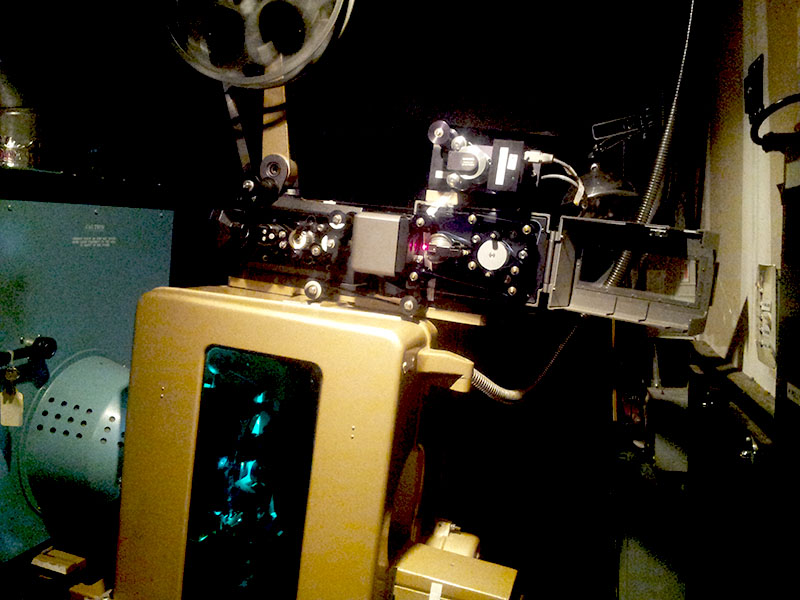
Thought about putting this in the "random pictures" thread, but here seems more appropriate...

 -

The 2002 rerelease of The Last Waltz playing in SDDS 5.1 on Saturday evening. Despite the print being a little the worse for wear (quite a bit of dust and sparkle and one or two light emulsion tramlines that came and went), there were no dropouts at any point in the show, and the audio was very impressive.

 |  IP: Logged

Sean Weitzel
Jedi Master Film Handler

Posts: 619
From: Vacaville, CA (1790 miles west of Rockwall)
Registered: Dec 1999


 - posted 09-23-2014 12:50 PM      Profile for Sean Weitzel   Email Sean Weitzel   Send New Private Message       Edit/Delete Post 
That's very cool Leo. Curious though, was the choice to playback the SDDS track due to lack of SRD or DTS (or lack of discs) or was the choice simply made based on the quality of the track?

 |  IP: Logged

Leo Enticknap
Film God

Posts: 7474
From: Loma Linda, CA
Registered: Jul 2000


 - posted 09-30-2014 11:11 PM      Profile for Leo Enticknap   Author's Homepage   Email Leo Enticknap   Send New Private Message       Edit/Delete Post 
We didn't get any discs with the print, so DTS/Datasat wasn't an option. I played reel 1 in SR-D and SDDS before the show, and to my ears the SDDS sounded significantly better - less compressed and more detail in the HF. Reel 1 played without dropping out and others looked to be in a similar condition on the bench, so I ran the whole movie that way.

 |  IP: Logged

Terry Lynn-Stevens
Phenomenal Film Handler

Posts: 1081
From: Toronto, Ontario, Canada
Registered: Dec 2012


 - posted 10-01-2014 11:08 PM      Profile for Terry Lynn-Stevens   Email Terry Lynn-Stevens   Send New Private Message       Edit/Delete Post 
I always precieved SDDS as being better than DTS and Dolby.

 |  IP: Logged

Brad Miller
Administrator

Posts: 17775
From: Plano, TX (36.2 miles NW of Rockwall)
Registered: May 99


 - posted 10-02-2014 12:42 AM      Profile for Brad Miller   Author's Homepage   Email Brad Miller       Edit/Delete Post 
Yeah Terry, but you also think the shrill sound of IMAX is better.

Since Sony can't possibly do anything normal and must override everything else, it required the SDDS installations to have the Sony player take total control over the system with it's own B-chain. Since the pink noise generator inside was high frequency deficient, it meant every single SDDS installation was improperly boosting the high frequencies. This is why so many people complained that SDDS sounded too shrill.

 |  IP: Logged

Brent Francis
Film Handler

Posts: 84
From: Toronto Ontario Canada
Registered: Nov 2008


 - posted 10-02-2014 06:30 PM      Profile for Brent Francis   Author's Homepage   Email Brent Francis   Send New Private Message       Edit/Delete Post 
Just going by experience screening check prints for commercials & trailers in the 90's... a print with a digital track always sounded fine, the same print on SDDS would SHAKE THE FLOOR AND WINDOWS of our "soundproof" booth. Eventually I had to turn levels down automatically.

 |  IP: Logged

Lyle Romer
Phenomenal Film Handler

Posts: 1400
From: Davie, FL, USA
Registered: May 2002


 - posted 10-02-2014 11:52 PM      Profile for Lyle Romer   Email Lyle Romer   Send New Private Message       Edit/Delete Post 
quote: Terry Lynn-Stevens
I always precieved SDDS as being better than DTS and Dolby.
I was told a story about a demo that Sony set up for GCC back in the 90's. They set up SDDS in an SR-D house with a remote to cut SDDS out (i.e. switch to Dolby Digital) and told the people in the demo to hit a button when they heard a switch from one format to another and indicate which sounded better.

To make it accurate, sometimes they would "switch" but not change the format so that the "click" would be heard but it went back to the same format.

The overall conclusion was that nobody could tell when they were listening to SDDS vs. Dolby Digital and neither scored sounding better.

This was a Dolby Digital setup calibrated by the regular tech and the SDDS setup calibrated by Sony.

DTS should have sounded the best because it was lossless compression but it was 16 bit, 44.1 KHz where Dolby Digital was lossy compression but 18 bit, 48 KHz. DTS also wasn't discreet LFE as it used the low end of the surround channels to store the LFE meaning the surrounds weren't full range.

When looking at Dolby Digital vs. SDDS, they were both lossy compression. Dolby AC-3 was based on Dolby AC-2 and was essentially AC-2 with cross channel bit sharing. Sony's ATRAC codec (used for SDDS) must have had a lot in common with Dolby AC-2 because they had to pay a licensing fee to Dolby for it.

 |  IP: Logged

Steve Guttag
We forgot the crackers Gromit!!!

Posts: 12814
From: Annapolis, MD
Registered: Dec 1999


 - posted 10-03-2014 06:27 AM      Profile for Steve Guttag   Email Steve Guttag   Send New Private Message       Edit/Delete Post 
In my own experiments...both with all three and those with just DTSvsDolby...by and large, the SDDS would come out on top if there was a preference. Likewise, In the Dolby/DTS comparison...Dolby would win out. DTS consistently last for those that could hear a difference. As others have noted...the overwhelmingly large portion of the people taking the challenge could not hear a difference.

To my ears, I never liked DTS' high end...it is very strident. Combine DTS with an Electro-Voice DH1 series driver (TS-9040 or TS-940 system) and I have to leave the theatre due to the pain...it has happened! People didn't believe me that I could tell that combination of nastiness. I've proven it several times.

And none of the digitals ever sounded as good a magnetic, to my ears. While not comparing the mix, True Lies was one of the cleanest, most powerful 70mm magnetic tracks I've ever heard. It was really well done. The Sound of Music remains my favorite 70mm mix, however.

 |  IP: Logged

Bobby Henderson
"Ask me about Trajan."

Posts: 10973
From: Lawton, OK, USA
Registered: Apr 2001


 - posted 10-03-2014 09:26 AM      Profile for Bobby Henderson   Email Bobby Henderson   Send New Private Message       Edit/Delete Post 
Out of the three digital sound formats for film I had the best experiences with DTS, but I suppose some of it comes down to how a given theater was set up and the mix of the movie itself. One thing is certain: I rarely ever heard DTS fault out to the optical track. I've heard distracting faults to analog more often with Dolby Digital and SDDS shows with most of those occurring at reel changes.

I rarely ever heard SDDS in a theater where the audio was properly EQ'ed. It almost always sounded fairly thin, like it lacked a lot of the mid range frequencies. I'd hear a lot more in the way of treble and (depending on the room) a dose of low end. A bunch of this was the fault of AMC's stadium seated theater designs, equipment choices and how they set it up. Heat was the best SDDS mix I'd heard in an AMC theater, but it was playing in a smaller, less echo-prone room. Mission Impossible is the only movie I watched played in SDDS within a THX certified house (the UA Galaxy 9 in Garland, TX). That show sounded good, but it still wasn't the audio quality I was spoiled to hearing across town at General Cinemas' Northpark #1 theater.

quote: Lyle Romer
DTS should have sounded the best because it was lossless compression but it was 16 bit, 44.1 KHz where Dolby Digital was lossy compression but 18 bit, 48 KHz. DTS also wasn't discreet LFE as it used the low end of the surround channels to store the LFE meaning the surrounds weren't full range.
DTS/Datasat digital sound has the least amount of data compression among itself, Dolby Digital and SDDS, but the format is still lossy, not lossless. DTS/Datasat runs at 820 kilobits per second, using the APT-X waveform codec. With the XD-10 and XD-20 players DTS had the opportunity to push lossless or uncompressed audio (and even more audio channels) with 35mm and 70mm shows, but unfortunately the scalable capability of those players went largely un-used.

SDDS literally has the highest bit rate out of the digital sound on film formats, but its 2 million bit per second data rate is divided between those two parallel digital audio tracks (one being a staggered back-up) on both edges of the film. Both digital tracks each contain plenty of error correction data.

35mm Dolby Digital had the most data compression, running at 320 kilobits per second, half the maximum bit rate level for the standard Dolby AC-3 codec. There was another 200kb/s or so of redundant, error correction data encoded on the film print. Most DVDs had DD tracks encoded at either 384kb/s or 448kb/s. Most lossy DD tracks on Blu-ray are encoded at 640bk/s. Dolby Digital Plus can go quite a bit higher and support more audio channels.

To me, Dolby Digital was prone to sounding harsh and metallic if the sound system was not well EQ'ed. I've heard it sound great in some theaters and lousy in others, bad enough to where it sounded like an over-driven optical track yet had the channel separation and low bass effects to remind you it was a 5.1 track.

quote: Steve Guttag
To my ears, I never liked DTS' high end...it is very strident. Combine DTS with an Electro-Voice DH1 series driver (TS-9040 or TS-940 system) and I have to leave the theatre due to the pain...it has happened! People didn't believe me that I could tell that combination of nastiness. I've proven it several times.
Did the painful DTS mix you were listening to happen to be an MGM/UA release? I specifically remember their movies in DTS being mixed particularly loud.

 |  IP: Logged

Steve Guttag
We forgot the crackers Gromit!!!

Posts: 12814
From: Annapolis, MD
Registered: Dec 1999


 - posted 10-03-2014 01:53 PM      Profile for Steve Guttag   Email Steve Guttag   Send New Private Message       Edit/Delete Post 
Bobby...it wasn't the mix...it was the way that DTS reproduced the high end combined with the EV DH1a driver. Both are harsh and together downright painful.

On "my" shootouts...the same pinknoise source was used to tune all three systems. DTS and Dolby shared the same EQ but I let Sony use its own (why bottleneck Sony with a potentially inferior B-chain?)...However I had discovered that Sony's PN was deficient and would have one set it up to be too shrill. This was the case on the DFP-D2000...I don't know if that was the case on the later models...I didn't notice the problem on the DFP-D2500 and they definitely don't sound too shrill at the AFI/Silver, despite the EV DH2a drivers (not the same as the nasty DH1a).

At the Uptown...when I would get some nimrod come into the booth to tell me to run the film in a particular format (usually DTS)...I would offer them the challenge...I would thread up different reels in different sound formats so there was a mix of DTS and Dolby...in the end, they always picked the Dolby or couldn't tell the difference...and it was with the SAME EQ, SAME LEVELs...Most of the time, they couldn't tell the difference.

People hear the words "compression" and immediately think the one with less is going to sound best. The truth is there are a lot of factors that go into sound (or picture) and just homing in on one aspect is not going to tell the whole story.

One of the cinema sound processor companies is trying to tell me that because their sample rate is higher than others it HAS to sound better. The problem is...in actual tests...it isn't necessarily the case.

 |  IP: Logged

Shawn M. Martin
Expert Film Handler

Posts: 175
From: Arlington, VA, USA
Registered: Feb 2012


 - posted 10-03-2014 02:17 PM      Profile for Shawn M. Martin     Send New Private Message       Edit/Delete Post 
That shit-looking Left Behind movie that opened today has the SDDS logo in the ads. I wonder if the movie itself does. I know a few recent Universal releases have it in the ads but not the actual film credits (Non-Stop comes to mind).

 |  IP: Logged


All times are Central (GMT -6:00)
This topic comprises 4 pages: 1  2  3  4 
 
   Close Topic    Move Topic    Delete Topic    next oldest topic   next newest topic
 - Printer-friendly view of this topic
Hop To:


Powered by Infopop Corporation
UBB.classicTM 6.3.1.2

The Film-Tech Forums are designed for various members related to the cinema industry to express their opinions, viewpoints and testimonials on various products, services and events based upon speculation, personal knowledge and factual information through use, therefore all views represented here allow no liability upon the publishers of this web site and the owners of said views assume no liability for any ill will resulting from these postings. The posts made here are for educational as well as entertainment purposes and as such anyone viewing this portion of the website must accept these views as statements of the author of that opinion and agrees to release the authors from any and all liability.

© 1999-2020 Film-Tech Cinema Systems, LLC. All rights reserved.