|
|
 
|
|
Author
|
Topic: Once Upon a Time ... in Hollywood 70mm/35mm release?
|
Mark Ogden
Jedi Master Film Handler
Posts: 943
From: Little Falls, N.J.
Registered: Jun 99
|
 posted 07-09-2019 08:49 AM


quote: Bobby Henderson
What the hell is going on? Are these guys on dope? I don't get it.
Someday, if I ever encounter Harvey Weinstein, I will ask him if he ever regretted the money he blew on the 70mm Super Panavision release of The Hateful Eight, one of Quentin Tarantino's least successful movies. All those projectors and lenses that he scavenged and refurbished, the print costs, the logistics, for what? This thing wasn't exactly Lawrence of Arabia. The expenditure on the theatre level as well, between $40 - 80,000 per screen, I remember reading at the time. I hope they got some of it back.
Since Harvey is a little preoccupied these days, Once Upon a Time . . . is going out via Sony/Columbia, a studio that's a little more bottom-line oriented and not as interested in indulging directors with unnecessary 70mm prints. I wouldn't be at all surprised if they brought up the matter of The Hateful Eight and it's financial performance to him when talking about this release.
| IP: Logged
|
|
|
|
|
|
Bobby Henderson
"Ask me about Trajan."

Posts: 10973
From: Lawton, OK, USA
Registered: Apr 2001
|
posted 07-09-2019 01:23 PM
quote: Terry Monohan
Once A Time was filmed on 35mm film stock. Was not shot in 65mm like Hateful 8, why bother even to blow up a 35mm scope print to 70mm just for a few cinemas to run. It may look a little better then 35mm or DCP who knows, the DTS stereo sound will be the same as the best digital multi track systems around today but probably not as good as a Dolby Atmos® cinema.
To date, none of Quentin Tarantino's movies has had a Dolby Atmos mix, including Once Upon a Time in Hollywood.
There are some benefits to projecting a 70mm print as opposed to 35mm, even if the original source is 35mm. A 5/70mm image will usually be brighter and more steady than a 4/35mm print shown on the same screen. The difference is critical when throwing the image onto large screens. Back in the late 1990's during the stadium seated theater building boom chains like Cinemark, UA and others were building some giant-sized screens but only equipping them for 35mm. I hated that practice because the projected images would often be soft and unacceptably dim. Any steadiness issues with the projector would be magnified on those screens. 5/70mm projectors and blow-up prints would have been great in those big houses. But that crap gave way to the DMR 15/70 blow-ups on IMAX. And we all know what happened from there with IMAX over the last couple decades.
I'm extremely critical of D-cinema projection regarding the 2.39:1 "Scope" format. Basically it's a digital version of 2-perf 35mm TechniScope. A 35mm 'Scope print from a film-based work flow is going to look better and a 70mm print even better still. IIRC, Once Upon a Time in Hollywood was shot on 35mm, but I don't know for certain if QT used the film-based, analog route in post production or squeezed it through a digital intermediate. If the movie was squeezed through a DI bottleneck and then output back to film I would consider the 35mm and 70mm prints a waste of time.
20 years ago I would go to some considerable lengths to catch movies I wanted to see in commercial theaters. I felt like I would be missing a lot by waiting to rent a DVD. These days I don't feel like I'm missing anything at all by skipping a movie's theatrical release. There is barely any perceptible difference between a 2K DCP shown in a theater versus watching a Blu-ray disc at home on my 65" TV set. Hell, as fast as my Internet connection is now most movies and TV shows I stream pass for Blu-ray quality.
quote: Terry Monohan
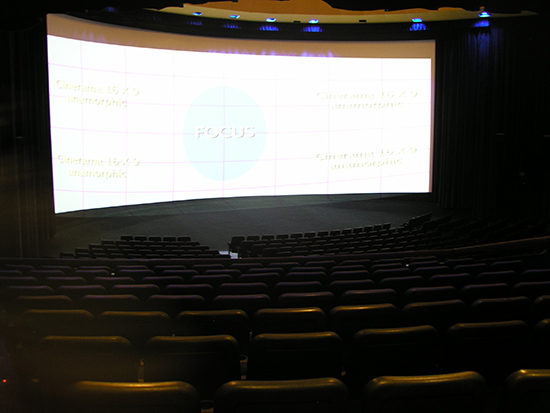
I don't seem to remember this curve up problem at the Hollywood Dome till they put in DCP projectors and It has gotten worse. I have been to many large curved screens around the USA and I don't see the keystone problem like at the Cinerama Dome on the bottom of the screen on the far right & left sides of the screen.
If you're ever in the Tulsa area check out one of the 2 "Grand Infinity" houses at the Regal Broken Arrow Warren theater. They have big D-150 style deep curved screens. But the projected image is so smile-warped (and cut off at the corners) that it makes movies all but un-watchable there. It completely killed any desire of mine to watch movies on deep curved screens. Unless they can get both the alignment and lens optics just right the movie watching experience just ends up sucking.
quote: Mark Louis
Here at Alamo we have time and again proven that there is still a great deal of public interest in 35mm and 70mm. We have consistently had higher grosses for movies we've played in those formats compared to their DCP versions.
Mark, do you know any details about where Alamo might be building new locations? I've heard rumors they were going to open a theater in the Oklahoma City area (specifically in the new Chisholm Creek development). But I've seen no official word about it from Alamo on their web site.
| IP: Logged
|
|
|
|
|
|
Marcel Birgelen
Film God
Posts: 3357
From: Maastricht, Limburg, Netherlands
Registered: Feb 2012
|
posted 07-09-2019 09:34 PM
quote: Steve Guttag
Where are you getting your print costs from on 70mm? 70mm film typically costs double 35mm (last I heard, anyway) and the length will be 25% longer so I get it being more than double that of 35mm and even a premium to handle but $20K-$30K is not numbers I've heard before.
It was an indicative number from the same guys that have done some 35mm film work for me in the past. They don't handle 70mm themselves, so it may be a misquote, but I've heard similar numbers before. Also, this was probably the price for a single copy, so the second copy might be considerably cheaper.
We don't know what Sony/Columbia Pictures will be paying for their prints, but I think even for them, the days for extreme discounts are over as even they don't order prints by the ten-thousands anymore.
quote: Bobby Henderson
There are some benefits to projecting a 70mm print as opposed to 35mm, even if the original source is 35mm. A 5/70mm image will usually be brighter and more steady than a 4/35mm print shown on the same screen.
Yes, I know I'm going "wild" here, but to be honest, I don't see much benefit for a 35mm to 70mm blowup compared to a good 4K RGB laser projection of a proper 35mm scan, even if the picture is in scope and we're losing a bunch of pixels and brightness in the process. We can also have the benefits from a full, uncompressed PCM soundtrack then, compared to compressed DTS.
quote: Bobby Henderson
Back in the late 1990's during the stadium seated theater building boom chains like Cinemark, UA and others were building some giant-sized screens but only equipping them for 35mm. I hated that practice because the projected images would often be soft and unacceptably dim.
While I agree that 35mm on such huge screens had a whole lot of issues, the lack of 70mm projection equipment can be somewhat forgiven, especially for those locations that only showed first-run content. How many 70mm releases where there back in the 1990's? I count three, of which one is a documentary.
| IP: Logged
|
|
|
|
|
|
Bobby Henderson
"Ask me about Trajan."
Posts: 10973
From: Lawton, OK, USA
Registered: Apr 2001
|
posted 07-10-2019 02:29 PM
quote: Marcel Birgelen
Yes, I know I'm going "wild" here, but to be honest, I don't see much benefit for a 35mm to 70mm blowup compared to a good 4K RGB laser projection of a proper 35mm scan, even if the picture is in scope and we're losing a bunch of pixels and brightness in the process. We can also have the benefits from a full, uncompressed PCM soundtrack then, compared to compressed DTS.
Only a tiny minority of theaters have 4K RGB laser projection. Let's not forget very few contemporary movies are fully produced in 4K resolution; most are still 2K. Of theaters that that have 4K RGB laser projection they all charge a significant up-charge on top of the normal ticket price. Meanwhile a good UHD OLED TV can deliver comparable image quality at home. Lossless surround sound has been available for the home market as well. You can crank the sound at home too if you like, unlike so many theaters that have the fader turned down to TV speakers volume. Basically it's just as easy to turn the "digital is better than film" argument around against itself. I've got digital at home. It looks and sounds just about as good as it does in the theater, but way cheaper. Why do I need to go to the theater?
Taking the current de facto post production work flows into account, I'd rather watch a 70mm blow-up of a 35mm-sourced movie that went through a 100% analog work flow than a digital TechniScope derived version of it. I might feel different about it if d-cinema audio/video standards were remarkably different from the tech available for home.
Regarding audio on 70mm, yeah DTS, Datasat or whatever it's called now is technically inferior to lossless or uncompressed surround sound. However if enough key people actually gave a damn about 70mm they could use the time code on the film print to sync up any kind of audio track, be it uncompressed LPCM or even freaking Dolby Atmos.
quote: Marcel Birgelen
While I agree that 35mm on such huge screens had a whole lot of issues, the lack of 70mm projection equipment can be somewhat forgiven, especially for those locations that only showed first-run content. How many 70mm releases where there back in the 1990's? I count three, of which one is a documentary.
The early 1990's had quite a few 70mm blow-up releases. Things didn't start falling off until the 1993-94 time frame. Nevertheless, doing 5/70mm in these new giant-screen stadium seated theaters would have been easy.
There was still a LOT of perfectly functional 70mm-capable projectors in use during the early 1990's. IIRC, over 1000 screens in North America were capable of showing 70mm in 1990. In 1995, when the stadium seated theater building boom began nearly all those projectors will still functional. But they were in traditional seated theaters that were starting to be closed to make way for new stadium seated theater "megaplex" sites. Those projectors could have been re-installed in the booths of these new theaters. DTS already had time code readers for 70mm. Infrastructure was in place to create 70mm DTS prints. If theater chains like Cinemark, UA and others building giant screen houses had simply bothered to install 70mm it would not have been difficult at all for Hollywood movie distributors to make 70mm prints for them.
The failure of new stadium seated theaters to support 70mm in mid-late 1990's had zero to do with any technical problems. It was all due to various deciders not giving a shit about 70mm and the benefits of using it. The fact that Boston Light & Sound, the Weinstein Company and Quentin Tarantino could scrounge together around 100 70mm systems just for the release of one movie illustrates just how pathetic and disgraceful that failure was in the 1990's.
| IP: Logged
|
|
|
|
|
|
|
|
|
|
|
|
|
|
All times are Central (GMT -6:00)
|
This topic comprises 15 pages: 1 2 3 4 5 ... 13 14 15
|
Powered by Infopop Corporation
UBB.classicTM
6.3.1.2
The Film-Tech Forums are designed for various members related to the cinema industry to express their opinions, viewpoints and testimonials on various products, services and events based upon speculation, personal knowledge and factual information through use, therefore all views represented here allow no liability upon the publishers of this web site and the owners of said views assume no liability for any ill will resulting from these postings. The posts made here are for educational as well as entertainment purposes and as such anyone viewing this portion of the website must accept these views as statements of the author of that opinion
and agrees to release the authors from any and all liability.
|

 Home
Home









 Printer-friendly view of this topic