|
|
This topic comprises 6 pages: 1 2 3 4 5 6
|
|
Author
|
Topic: IMAX Basics
|
|
|
|
|
|
|
|
|
|
|
Adam Martin
I'm not even gonna point out the irony.

Posts: 3686
From: Dallas, TX
Registered: Nov 2000
|
 posted 08-11-2001 07:04 PM


By popular demand ... (please forgive the crudeness  ) ) 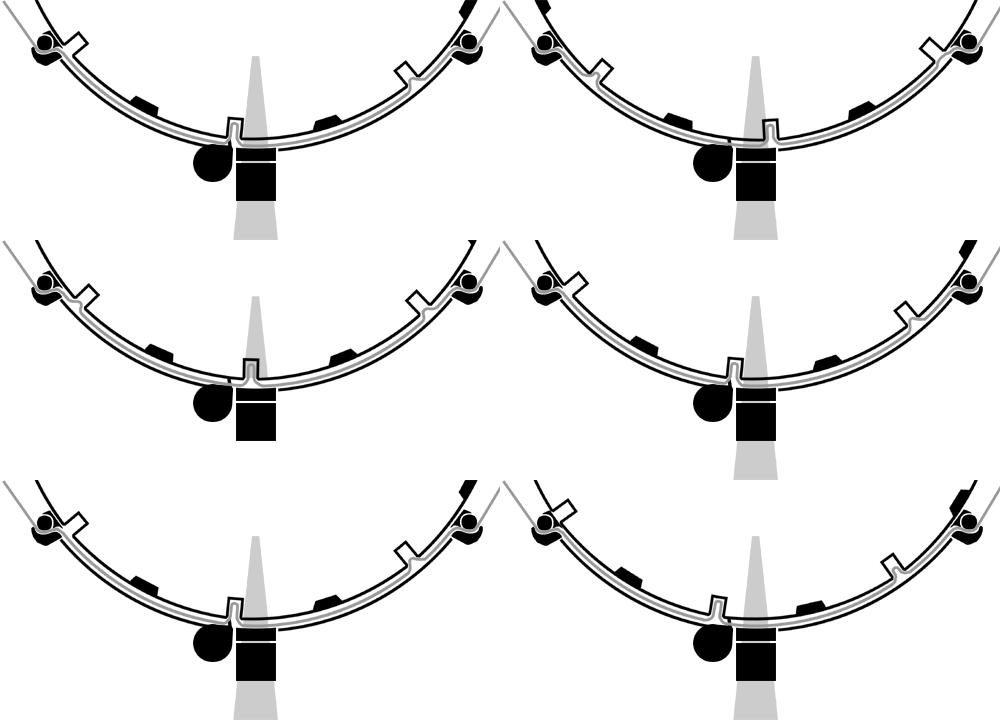 The above image is an animated gif, so Joe needs to turn on his animations. As the film enters the projector at the input sprocket, a burst of air "encourages" the film to form a loop in the rotor gap. The gap is actually a "pocket" in the rotor, so that it also acts as a shutter. As the loop approaches the aperture block, it increases in size to 15 perfs (1 frame). As it reaches the aperture block, the cam pins retract and return, "catching" the tail of the loop and decelerating the film. This aligns the perfs with the registration pins as the loop rolls across the face of the field lens, where it is sucked into place against the registration pins and projected. A flicker shutter passes across the light field and the same frame is projected again (the same effect as the bow-tie shutter in a 35mm projector). After the next frame is rolled across the field lens, the loop gradually diminishes in size as it exits the projector via the output sprocket. The film is not moved in an intermittent movement, but is looped and rolled by the rotor through the projector. Imax calls this a "rolling loop". Iwerks calls this a "lateral loop" because it is a horizontally moving loop (and Imax used "rolling loop" first). Incredibly over-simplified, but there it is. For GT-3D, take two rotors, stack them on top of each other, and lock them together with a 11.25-degree offset. The right eye projects while the flicker shutter passes the left eye. For SR-3D, take two projectors and interlock them with a PLC.
| IP: Logged
|
|
|
|
|
|
Phil Hill
I love my cootie bug

Posts: 7595
From: Hollywood, CA USA
Registered: Mar 2000
|
posted 08-12-2001 01:28 AM
Gordon is absolutely right: The deceleration cam claw's purpose is to slow down the rapidly moving film and gently set it down on the registration pins assisted by the vacuum applied to the boundary of the field flattener. Contrary to the previous mis-information, Iwerks has both 24 and 48 fps projectors and refers to it's 1570 projector as a "rolling loop" projector, which it is. Iwerks also has several 870 and 1570 cameras in both 2D and 3D configurations as well as underwater housings, helicopter mounts, etc. The linear speed of the 15 perf, 70mm film at 24fps is 337.5 feet per minute and 675 ft/min at 48fps (Like at Disney's Soarin'). That's about 3.8 and 7.6 miles per hour. Think about it.... the projector is stopping and projecting and accelerating the film at those rates while projecting a rock-solid image without damage to the film! A typical 24fps, 40 minute 1570 print is 2.5 miles long and costs about $20,000. A standard 35mm feature runs about 1.0 mph and the print costs about $1500-$2000. YIKES!!!!! >>> Phil
| IP: Logged
|
|
Jerry Chase
Phenomenal Film Handler

Posts: 1068
From: Margate, FL, USA
Registered: Nov 2000
|
posted 08-12-2001 10:12 AM

Adam, I like your illustration, but one thing missing is an indication of the size of the individual frame of film and what part of the frame gets air blown. It can be inferred, but would be more quickly grasped if detailed. The speed of the system in motion might be a little slower as well, it goes too fast to easily grasp an image mentally and process the sequence.Brad, is it possible to put Adam's illustration and explanation available for download in "manuals" or "pictures" along with a representative full size three frame segment of the film itself and image of the head?
| IP: Logged
|
|
|
|
Adam Martin
I'm not even gonna point out the irony.
Posts: 3686
From: Dallas, TX
Registered: Nov 2000
|
posted 08-12-2001 11:04 AM
Phil, not mis-information, just a misunderstanding. Actually (according to the Iwerks press release here, the Linear Loop is a technology that came with their acquisition of Pioneer Technology and is the *vertical* loop in the 8/70 projector. My bad. Click here for more on L. Ron Schmidt's linear loop systems for 8/70 and 10/70 projection.Jerry, one frame is exactly the size of the shuttered rotor gap. The edges of the shutters on the gap match the frame lines. The loop is not a full frame in size until it rolls onto the field lens and then it immediately begins to reduce as it registers and exits the field lens. As the film passes the input sprocket and enters between the rotor gap and the input stator (the guide on the non-rotor side of the film), a jet of air pushes the film against the stator while the input sprocket feeds film into the loop. (This causes a loop form into the rotor gap rather than a wad of film at nearly 6 feet per second. [There is a reason why we call them film "crashes"]) The air lasts just long enough for the loop to take shape, then the loop enlarges without any further assistance (other than being fed by the input sprocket) as it travels along the rotor. Also, I have slowed down the animation on the graphic above. You may have to refresh. Brad, if you want to post it for reference, at least let me do a better looking one on my good computer at home. I may also do one later today for the loop being formed.
| IP: Logged
|
|
Dave Macaulay
Film God

Posts: 2321
From: Toronto, Canada
Registered: Apr 2001
|
posted 08-12-2001 12:11 PM
The air jet really just helps avoid buckling at a critical point in loop formation. The projector will run without a crash with no air jet action, the print will be damaged though.
The input sprocket feeds continuously and once a loop has formed it just makes it bigger. The leading edge of the moving loop has no actual film motion, it's held stationary by the register pins. The trailing edge is moving at 337.5 ft/min as fed by the sprocket so the film is actually accelerating in the loop. When the cam pins stop this film motion, a fair shock travels through the film column from the pins to the input sprocket area - the deceleration is quite sudden and just slow enough to avoid perf damage at the cam pins. At this time a rotor gap is at the input sprocket, and the angle of the input shoe slot plus the fact there's nowhere else for the film to go means a loop forms.
The dynamics of forming the loop at speed with 70mm film produces a problem though. The edges form a very nice loop, as the film is trapped in the rotor/stator gap and at the sprocket shoe at the edges and they have little choice. The centre is not constrained though, to protect the picture area there is plenty of clearance so it contacts nothing (excluding the field lens) thus the centre of the forming loop can buckle inward because of inertia, air resistance, and just plain orneryness. The air jet just helps minimize this buckling.
If the air jet is maladjusted there is trouble. The usual problem is scratching on the airjet tube itself, showing as horizontal lines at the right of the screen picture. Overpressure or a really bad valve timing location can cause film breaks but it's unusual.
I worked on a projector where the rotary valve had failed (they tend to seize), and the local techs had "fixed" it. They actually did a good job on the valve itself, but they had it timed 180 degrees out so the air pulses were in the back right of the machine not at the input point.
They had run over a hundred passes on the print with no breaks.
Luckily they had "fixed" the lamphouse, and with ~0.5 ft-L the scratches were pretty hard to notice. They managed to "fix" the dubber too, so the sound was from a cassette started manually at some poorly defined time during the show start.
While I was working on the Omnimax system the fixers were deep inside their Spitz starball, poor thing.
This brings up the issue of Showmanship. When does "The Show Must Go On!" end? These guys had done a brilliant job against great odds of staying on screen, but the presentation was a horror.
Their situation was extreme and the consequences of not operating dire, but in a normal theatre where do you draw the line when there's a damaged print or a system failure that cripples the performance (such as bypassing the sound or a fogged/cracked lens)???
What is the customer owed when they buy a ticket? A visible picture and sound good enough to understand the dialogue - or the performance the projection system is supposed to be capable of?
| IP: Logged
|
|
Adam Martin
I'm not even gonna point out the irony.
Posts: 3686
From: Dallas, TX
Registered: Nov 2000
|
posted 08-12-2001 08:37 PM
Dave, I had to read that three times before I realized you were telling us that the air was coming out of the wrong rotor gap. Didn't they notice how much *louder* the projector was? Sounds like quite a crew.With a service contract, I would say that if there is anything endangering the print or significantly hindering the presentation, don't run the show. Without a service contract, I guess it depends on how much money your boss wants to spend/lose. In the 35mm world, I've had projectors temporarily held together with duct tape, baling wire and vice grips to keep the show on the screen. And I think just about everyone's spun a platter or two by hand for an hour to make it to the end of a show. If it comes down to the show *can't* go on, the I try to look for another option before cancelling. Switching auditoriums, cancelling a slower movie, swapping prints with a slower complex in the same circuit. Whether or not you like the manager on duty can have an effect, too.
| IP: Logged
|
|
Adam Martin
I'm not even gonna point out the irony.
Posts: 3686
From: Dallas, TX
Registered: Nov 2000
|
posted 08-12-2001 08:41 PM
Oh, and I made a prettier, more detailed animation. Hopefully, it's the final version.Look above or look below. Either way, make sure you refresh. Also, keep in mind that the rotor is moving just one frame per gap. On a GT, there are 5 or 6 frames between the input sprocket and the aperture block, depending on how you count it. I think it's the same on an SR, but it's been a while. 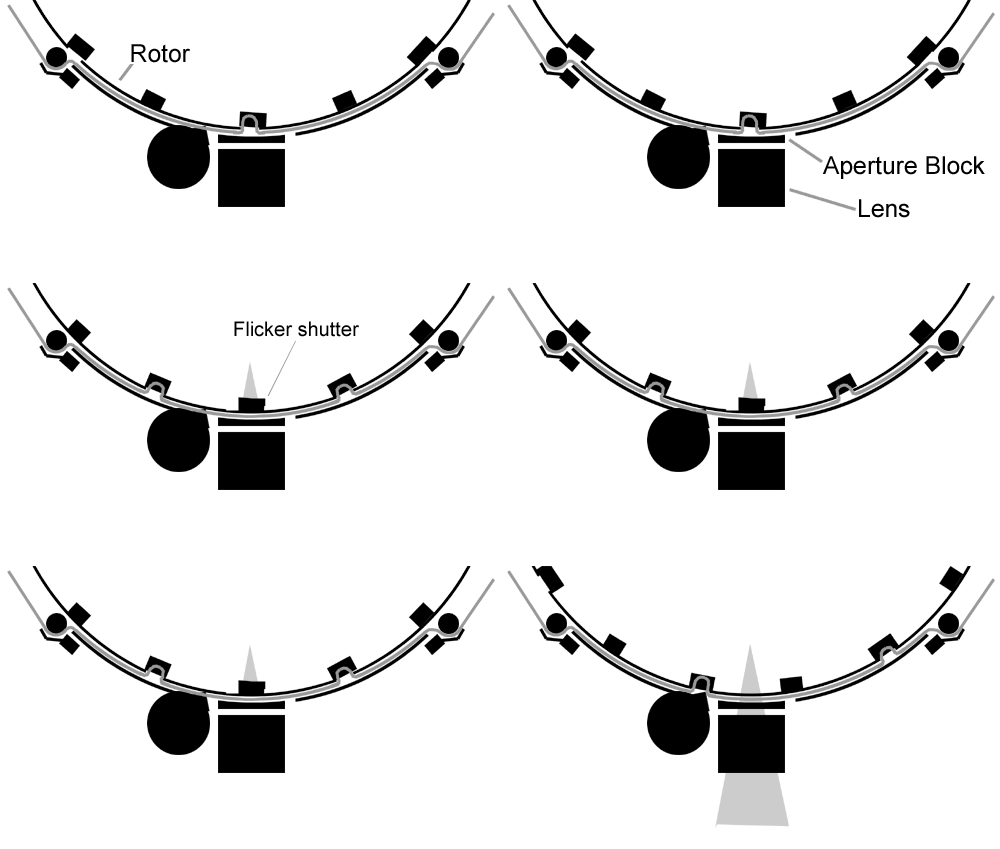
| IP: Logged
|
|
|
|
All times are Central (GMT -6:00)
|
This topic comprises 6 pages: 1 2 3 4 5 6
|
Powered by Infopop Corporation
UBB.classicTM
6.3.1.2
The Film-Tech Forums are designed for various members related to the cinema industry to express their opinions, viewpoints and testimonials on various products, services and events based upon speculation, personal knowledge and factual information through use, therefore all views represented here allow no liability upon the publishers of this web site and the owners of said views assume no liability for any ill will resulting from these postings. The posts made here are for educational as well as entertainment purposes and as such anyone viewing this portion of the website must accept these views as statements of the author of that opinion
and agrees to release the authors from any and all liability.
|

 Home
Home




 I forgot about the 4k and had absolutely no idea there was a 7k classic!



 Printer-friendly view of this topic