|
|
This topic comprises 5 pages: 1 2 3 4 5
|
|
Author
|
Topic: Blu-Ray vs DCI
|
|
|
|
|
Carl Martin
Phenomenal Film Handler
Posts: 1424
From: Oakland, CA, USA
Registered: Feb 2002
|
 posted 04-24-2007 08:34 AM


quote: Scott Jentsch
I think that it forgets the end result that I would think all of us here aspire to, which is to entertain the audience with the highest quality presentation possible.
In my humble opinion, tying oneself to a particular format (in this case, film) is a constraint which can make one lose sight of that end result. If one format delivers a better end result than another format, who cares what that format is?
i don't think "the" end result of film is entertainment. ideally there's an artistic engagement, often with entertainment as a by-product. the medium is hardly irrelevant artistically, and it's not as simple as one being better than another (though i do think film is better). film and video each have their own aesthetic characteristics, no matter how much people want to lump them together these days.
quote: Scott Jentsch
Film is a copy of a negative. HD video (whether DCI, Blu-ray, or HD DVD) is a copy of the negative (if the originating format was film, of course). In many cases, the film we get in a theater is going to be a multi-generational copy. This isn't an original Monet oil-on-canvas vs. lithograph we're talking about here, it's a lithograph vs. giclee print. Both copies of the original.
ok, you made me look up "giclee". yes, either way it's a copy. but in one case it's a copy that respects the nature of the work and in the other it isn't.
quote: Scott Jentsch
If the available film is damaged with scratches and/or discoloration, but you have a pristine copy on HD video, you're going to show the film or nothing at all? I don't agree with that position at all.
scratches are unfortunate (though aesthetically interesting in their own right) but they are localized. digitization of a film is a perversion of its entirety.
quote:
quote: Carl Martin i hope if you do that you at least advertise it as such so people know they may as well stay home and watch it on tv.
That's basically saying that a movie theater has nothing to offer its customers except for exclusive access to the content. There is no value to the "group experience" or the ambience and presentation that the theater or, in the case of a film festival, event can add to that content?
personally, i don't care about the group experience or "events", though i'm not going to say that those who do are flat out wrong. different strokes and all that. but i think it's important for the general public to be aware of what they're being shown too so they can develop their film-eye as well.
quote: Scott Jentsch
The viewing audience deserves the best possible quality that a theater can deliver. Who cares if that's from film, digital cinema, Blu-ray/HD DVD, or VHS?
i do, for one.
| IP: Logged
|
|
|
|
|
|
Ramon Lamarca Marques
Expert Film Handler
Posts: 186
From: Edgware, England, UK
Registered: Feb 2006
|
posted 04-25-2007 03:13 PM
[QUOTE Frank Angel ]And the fact that there are people who want to see this title and that there is a video copy of it available, then they can see it at home on a display that is suitable to the video source, not on a big theatre screen which is not. Rep houses do themselves no favor by making no distinction between video and film. [/QUOTE]
I agree. Once I went to see a double bill of Henri-Georges Clouzot including Diabolique and Le Corbeau, brilliant double bill but Le Corbeau was in something called high-definition Beta. They ruined my experience and it took my ages to convince the cinema manager that what they showed was not film, and that was at the Curzon Soho in Central London. Black and White in video, dreadful.
quote: Carl Martin
what a ridiculous statement! a beaten-up print isn't great, but if i come to see a film i expect to see a film. if we're talking about "classics" or 80's movies then we're (mostly) talking about works that were shot, completed, and presented on film. showing a video instead is just disingenuous, a violation of the work's aesthetics. i hope if you do that you at least advertise it as such so people know they may as well stay home and watch it on tv.
I agree completely. To preserve a work of art means to present it as close as possible as when it was created. In that sense films that never entered the digital domain should not enter it now. Both the negative and the positive in a film are important and should be preserved. It is sickening to see the BFI presenting films in digital when there are good 35mm prints available, such ignorance is what is leading me to save to buy one of those DLP projector for my home enjoyment. To see an old film in digital on the big screen is one of the most awful experiences I have had, it is cold, lifeless, it is a hybrid, good for home enjoyment but not for the magic of the cinemas. The NFT even showed South Pacific in digital when there is a brand new 70mm print, true the digital file has extra footage but nothing will get closer to a Todd-AO film than a new 70mm print. With those ignorants ruling the game, I stay at home. They even said that with the new digital file of Wizard of Oz you could see things no one had seen before. What's the point, I do not want to see more things, I want to see a 30s Technicolor film, not a monster created in a computer that belongs nowhere. And to digitalise Black Narcisus should be punished with inprisonment.
quote: Carl Martin
i don't think "the" end result of film is entertainment. ideally there's an artistic engagement, often with entertainment as a by-product. the medium is hardly irrelevant artistically, and it's not as simple as one being better than another (though i do think film is better). film and video each have their own aesthetic characteristics, no matter how much people want to lump them together these days.
Absolutely, I am fed up with people telling me that I should not notice any difference, when I do and that digital is better. They are different. And let's not forget, reality is analog, not digital, there is no sound or image digital per se (if I am not mistaken) everything has to go back to analog for us to enjoy. The converters from digital to analog with images, so far, do not satisfy me. I prefer a good print, unless we talk about computer generated films, then we might as well stay in the digital domain as much as possible.
quote:
quote: Scott Jentsch
--------------------------------------------------------------------------------
The viewing audience deserves the best possible quality that a theater can deliver. Who cares if that's from film, digital cinema, Blu-ray/HD DVD, or VHS?
--------------------------------------------------------------------------------
i do, for one.
Me to, a million times! I even care if it is a nitrate print, they are dangerous for projectionist but gorgeous, I care if it is a dye transfer print and of course, a proper 65/70 print. There are textures I will never get at home, they are beautiful, unique. Unfortunately, I do not think we are that many who really look for film. Many people do not care and this is why they stay at home and more they will stay unless there is a real revolution that again puts cinema in both its language and presentation miles away from anything related to TV. A retired cinema manager told me very wisely not long ago that a revolution in cinemas to suceed has to be as big as Cinerama was to those audiences used to black and white TV.
| IP: Logged
|
|
Frank Angel
Film God

Posts: 5305
From: Brooklyn NY USA
Registered: Dec 1999
|
posted 04-25-2007 11:35 PM
quote: Patrick de Groot
The most directors (btw I don't count George L as a director nowadays!) obvious don't have problems with digital otherwise they would certainly fight it through the media...
Not always the case. For decades network broadcasts of blockbuster scope pictures were televised in pan/scan versions, not letterboxed. Where were the directors then? I heard not a peep from any of them, and that abortion of a process was sooo gawd-awful that looking at it for just five minutes would make my nuts crawl back into my kindeys. P&S is a total, complete and utter ruination of film to the tenth power, compaired to what any DVD presentation would ever be. So don't count on big name directors to put up any fight for aesthetics when big chunks of money are waving in their faces. That whole thing about colorization was a joke. P&S was going on for years before anyone noticed color fade.
I mean, everyone including the filmmakers know the current "film done wrong" state of the exhibition industry today. So were are the directors demanding something be done about it? And why aren't they saying "No...the answer to bad film handling by ape-like creatures with colven hooves and webbed fingers (especially the webbed fingers) isn't to abandon film and go to an inferior presentation medium; the answer is to cure the known problems with the current medium. And the irony is, we all know what the problems with film presentation are -- HELLO....it's that damn gorilla in the room, NOT THE FILM.
Directors need to get the distributors of their films to be rotwiller agressive and proactive about print handling at the local level. Rather than throwing up their hands and saying that there is nothing that can be done about the physical abuse of prints, so we might as well just go with crappy 2K video -- a demonstrably worse presentation medium than film. Instead they just need to say, a print comes back looking like dog-poo, exhib pays.
As said here before, if the distribs wrote contracts that demanded a projectionist be IN THE BOOTH AT ALL TIMES when their print is running and that ANY damage will be billed back to the exhibitor (and commit to ENFORCING it), it would make quality print handling an economic imperative for the exhibitor, on equal par with such things as rotating his stale Bon-bons. Money talks; make hiring qualified, professional projectionists cheaper than the alternative.
The problem would be fixed much faster than waiting for exhibitors to buy into an inferior video technology that will then burden everyone for eons, cause you KNOW that no matter what improvements might be made in the future in this video technology, the Regals and the rest of them who have plunked down $120,000 per screen are not about to chuck those projectors out the window to buy into yet another "roll-out" of the 4K or 8K upgrades. And THAT is not a rosy picture for future movie-goers.
quote: John Hawkinson
So, Frank, what do you do when you find out 6 hours before showtime that the only print you have is crap? It would be nice to program films with perfect knowledge of print condition, but that seems very difficult to achieve.
I don't disgree; and every year it gets worse because the art house/retrospective market doesn't interest the studios -- not enough money in it. No doubt it puts the second run venue between a rock and a hard place. To tell you the truth, I don't know what the answer is, other than impress upon the film-makers (as opposed to the print distributors) to demand a certain number of "archive" prints be stored after the initial run. After all, there is no reason 2995 prints of a 3000 print run have to be band-sawed two months after the break.
We have had situations where we are doing a retrospective of a director or an actor's work and when I can't get a decent print -- or none at all -- I make no bones about telling the filmmaker that his/her distributor doesn't have a single runable print of his title. They are often very surprised and then embarrassed and then angry -- this is their creation; they assume the distributor loves it as much as they do. They usually take that anger back with them. Perhaps they will make some noise about it.
quote: John Hawkinson
Have you never substitued a DVD for a 35mm print?
We did recently when only 2 out of 3 cans showed up Made the decision easier, though.
Funny thing is, that's exactly what happened just last week to us and with a full house -- and I won't lie -- if we had a DVD copy (the film was FIRE), I admit it, I we would have told the audience the situation and let them decide if they wanted to see the DVD with the proviso that when we get the FULL print, they would be invited to see it on film. We didn't have a DVD, but I am sure most would have stayed.
Awhile back we got a print of EUROPA EUROPA, only to find there were no subtitles. We asked if they wanted us to show it anyway -- about 3/4 the house sat through it.
That said, I stick to my point that it is indeed a slippery slop; you need to be sure that you understand that no matter how pragmatic, substituting video should be vigorously avoided whenever you can.
Also, if a DVD saves your butt once, the REAL problem may not be you, but oh, that Programing Director guy's ears are going to perk up and before you know it, you'll have to continually explaining to him why you insist on making his job more difficult than it has to be. Why you want him to battle for hours on the phone to get a good print when all he has to do is make one call to clear the rights to play a DVD. And let's not forget the Accounting guy -- he's also going to come at you with guns blazing demanding to know why you want to incurr an additional $80 shipping each way for a print when you can have a DVD shipped for $4.80 Priority Mail? You will be very, very unpopular.
| IP: Logged
|
|
|
|
Cameron Glendinning
Jedi Master Film Handler

Posts: 845
From: West Ryde, Sydney, NSW Australia
Registered: Dec 2005
|
posted 04-26-2007 01:32 AM
Well Carl and Ramon, Although I do tend to agree with you and understand your passion, I am realistic enough to say that the numbers who really care about 35mm would number closer in the late hundreds to early thousands, compared to the millions who go to the cinema regularly. They want a story, an experience, some escape. These people largely do not know that 35mm films exists. Its all part of the illusion of cinema. The shared experience. If I only had a dollar for each time I've been asked what videos are we running.
The film I run today, have mostly been originated on 35mm, had their post production done inside a computer in a digital form and then is outputed or arrilasered to 35mm.
Kenneth Branagh was the last to shoot a 70mm film, It has been 10 years since that film was released in Australia. His latest film was shot on 35mm, (fuji) . His director of photography has told me that if they had had more time to test digital cameras in pre production, they would in hindsight have shot it that way.
Filmmakers are embrasing Digital.
I suspect that if a classic was remasted digitally today from the original neg, the D Cinema version could possibly be of better quality than the original era prints when new.
I personally would love to see the return of 70mm, I would even be happy with 35mm sped up to 60 frames per second. I agree that the cinema experience should be vastly superior than whats avaliable at home. 2k and Blue Ray are similar in quality in a laymans perspective.
In London I am not surprised that there is still a healthy rep market. When I briefly worked at the NFT in 94, I was shocked at how consistantly high the quality of the prints we ran were! (I also remember running nitrate there as well!)
I would suspect that Berkley also has good prints avaliable.
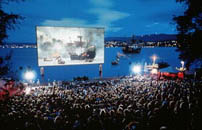
Unfortunatly Australias archieves are simply not even in the ball park. The amount of poorly duped 16mm prints that I have run to paying patrons!!! I believe that Australia only has one or two full time rep cinemas left!! The Market is now catered for by a group of outdoor summer venues where over 2 000 people will gather to see a classic under the stars.
| IP: Logged
|
|
|
|
Ramon Lamarca Marques
Expert Film Handler
Posts: 186
From: Edgware, England, UK
Registered: Feb 2006
|
posted 04-26-2007 12:33 PM
quote: Cameron Glendinning
Well Carl and Ramon, Although I do tend to agree with you and understand your passion, I am realistic enough to say that the numbers who really care about 35mm would number closer in the late hundreds to early thousands, compared to the millions who go to the cinema regularly. They want a story, an experience, some escape. These people largely do not know that 35mm films exists. Its all part of the illusion of cinema. The shared experience. If I only had a dollar for each time I've been asked what videos are we running.
I agree with you. Nevertheless, and talking about films produced before the digital era I wish they could be seen as close as possible to its original format and in that sense digital screening is too far -IMHO- to that, it lacks the feel and the warmth of film. I really find it cold. Honestly, I would feel robbed if a cinema asked me to pay to see a DVD on their screen, I would not go.
As you all know, cinema exhibitors lost a lot of money in the early 50s when people preferred their "home cinema" system and so they had to create something different (widescreen and stereoscopic revolutions). Now the scenario is even worse, sound at home can be terrific and you are in the centre of all speakers and with blue ray and a good projector I dare to say that I may have quite a cinematic experience, in any case better than any of the awful multiplexes I have next to my home. To make matters worse, there is the increased belief amongst many people that you do not have to pay any more for films (ilegal downloading from the Internet). Maybe it is time to go to a very wide aspect ratio that looks like rubish on any flat screen or create a digital cinerama with three projectors.
| IP: Logged
|
|
Cameron Glendinning
Jedi Master Film Handler
Posts: 845
From: West Ryde, Sydney, NSW Australia
Registered: Dec 2005
|
posted 04-26-2007 09:01 PM
quote: Ramon Lamarca Marques
create a digital cinerama with three projectors
I have to admit that that would at least be a step in the right direction ![[Cool]](cool.gif)
Ramon I remember reopening your local cinema in 93-94, The Bellavue. The Indian owner had formerly run a drive in another country and wanted a big screen. He had a pretty over the top 60 ft deep curved screen installed in screen 1, not bad considering the stage was just over 30 ft wide. Screen 2 and 3 were pretty bad though, I wonder whats changed over the years?
quote: Ramon Lamarca Marques
Honestly, I would feel robbed if a cinema asked me to pay to see a DVD on their screen, I would not go.
I agree that DVD is not an option unless the content is very rare, I too would feel robbed. I personally feel that Blueray/ HD could only be an option for screening classic's in cinemas for the short term, until it finds itself in the majority of peoples homes.
Here in Australia, where repetory cinema has pretty much moved away from hard top cinemas, It would be interesting to see how the public would react to this technology, to some degree it could be a fresh start and a bit of a novelty seeing an old movie inside a cinema.
I also feel that the lack of imagination of the newer cinema complex needs a mention, its fast food aproach, first release movies only, cookie cutter auditoriums . Compare that to the impressive buildings built in the original cinema boom in the early 20th century and the sense of experience that they created. I find that some of the latest complexes have improved a great deal in this aspect but perhaps a little too late ?
| IP: Logged
|
|
|
|
Peter Castle
Expert Film Handler
Posts: 220
From: Wollongong University, NSW ,Australia
Registered: Oct 2003
|
posted 04-26-2007 11:55 PM
Having started this topic with a question regarding DCI vs Blu-Ray, the various discussions have raised many interesting issues. Here in Australia, there seems to be very little interest in DCI-level digital, apart from about 10 Real-D installations that survive on pure 3D product.
However, there is a fairly active circuit of e-cinema quality screenings of art-house and foreign language material - an area where digital always seemed to have a future - that part of the cinema industry starved of 35mm prints. Many independent cinemas in Australia now screen some product from smaller independent distributors via e-cinema servers and non-DCI video projectors, mostly of no better quality than 1280 x 720 - a resolution at which most of the digital product is available at the moment. I hope that this resolution reaches that of HD (1920 x 1080) in the near future, perhaps via Blu-Ray or HD-DVD.
So why should we even consider showing such 'video' product in a cinema? Because the number of 35mm copies available across Australia (and let's include New Zealand here) is very small. Some films may only exist in film form via about 5 prints. So, if we wish to screen these movies within weeks of their release we have to consider alternatives to film.
As to whether audiences will baulk at watching 'video' quality: if the alternative is not seeing it in a cinema at all, then the answer is no. While my preference will be film, a good quality digital print can provide a similar level of audience enjoyment.
I have always considered that the picture on the screen is only part of the cinema-going experience. I find that I prefer to watch a digital presentation in an audience of 400 who cheer the sound format tags, and applaud at the end of a good show, than sit on my own (or at least feel like I am) in a multiplex theatre watching a 35 mm print of some remake or sequel or ...
It's the quality of the movie that determines most of the enjoyment.
| IP: Logged
|
|
Cameron Glendinning
Jedi Master Film Handler
Posts: 845
From: West Ryde, Sydney, NSW Australia
Registered: Dec 2005
|
posted 04-27-2007 12:38 AM
quote: Frank Angel
Didn't somewhere in the threads conclude that roughly about 50 -55ft should be the limit for a good, bright 35mm blowup? Past that, go to 70mm? Or is 55ft too conservative? I just spoke with someone who is looking to put in a 75ft width screen. Too big, no?
To be perfectly honest, I think its more to do with auditorium size. I recently went to a Drive In (first time in a decade), The 100ft wide image looked superb from about 100 ft back, second row of cars. My guess is that if your auditorium is long enough, and you don't put any seats for the first 60ft it would be awesome! I worked at a cinema recently that had a 55' screen with no seats for the first 40 ft, it was very good. The auditorium was big enough for 900 seats on 2 levels, but only had 450 seats installed, The front rows of the stalls had 100 reclining arm chairs and a premium price that was always busy.
Essentially in my opinion 35mm does not have an ability to be viewed close on a monster screen like Imax or Cinerama. But can work very well with big screens in large auditoriums designed around its limitations.
Ps the screen in the outdoor cinema that I posted above is from a swiss company called cinerent. I think its over 60ft wide and 1.85 ratio. (The largest screen I have used from them is 75' wide 1.85.) It actually lies flat until showtime when it takes 3 minutes to raise to a musical fanfair. It provides a quality picture for all its 2,000 seats, plus full multiformat digital sound. I have some digi beta footage that I shot of it raising, I will post it some day when I figure out how.
| IP: Logged
|
|
|
|
All times are Central (GMT -6:00)
|
This topic comprises 5 pages: 1 2 3 4 5
|
Powered by Infopop Corporation
UBB.classicTM
6.3.1.2
The Film-Tech Forums are designed for various members related to the cinema industry to express their opinions, viewpoints and testimonials on various products, services and events based upon speculation, personal knowledge and factual information through use, therefore all views represented here allow no liability upon the publishers of this web site and the owners of said views assume no liability for any ill will resulting from these postings. The posts made here are for educational as well as entertainment purposes and as such anyone viewing this portion of the website must accept these views as statements of the author of that opinion
and agrees to release the authors from any and all liability.
|

 Home
Home






![[Smile]](smile.gif) Woody Allen and Scorsese are two of the few who opposed the dreadful pan and scan but many said nothing.
Woody Allen and Scorsese are two of the few who opposed the dreadful pan and scan but many said nothing.


 Printer-friendly view of this topic