Film-Tech Cinema Systems
Film-Tech Forum ARCHIVE


my profile | my password | search | faq & rules | forum home
  next oldest topic   next newest topic
» Film-Tech Forum ARCHIVE   » Operations   » Digital Cinema Forum   » Article on Light issues with Digital (Page 5)

 
This topic comprises 6 pages: 1  2  3  4  5  6 
 
Author Topic: Article on Light issues with Digital
Ken Lackner
Phenomenal Film Handler

Posts: 1907
From: Atlanta, GA, USA
Registered: Sep 2001


 - posted 05-30-2011 03:26 PM      Profile for Ken Lackner   Email Ken Lackner   Send New Private Message       Edit/Delete Post 
quote: Monte L Fullmer
Yet, I've seen 2D presentations shot through a twin lens Sony unit and, to me, the picture looks real good (course, having a silver screen prob helps on the matter as well..), thus I can't see what the whoop is all about of needing to switch out lenses on these Sonys per format.
Thank. You. My point, exactly.

 |  IP: Logged

Monte L Fullmer
Film God

Posts: 8367
From: Nampa, Idaho, USA
Registered: Nov 2004


 - posted 05-30-2011 03:48 PM      Profile for Monte L Fullmer   Email Monte L Fullmer   Send New Private Message       Edit/Delete Post 
Okey, time to quit playing "dumb" ..

We all know that 2k chips resolution runs at 2048x1080 (wow, "HD" quality)

2k flat uses most of the chip with a resolution of 1998x1080 to keep within the "HD" standard.

but...when we head to "scope", things suddenly changes:

Scope (2.39:1) doesn't use all of the height of the chip but only 858 pixels high while using the full width of 2048, thus the HD standard isn't accomplished (course, this is a standard image in the chip, not compressed to use the adapters on front of the lens..)

..and why the triple flash when doing 3D: to send out both images from that one same chip.

Okey, we head to Sony's LCoS setup. Now, we are playing in 4k mode.

Flat (1.85:1) from the Sony single lens uses 3996x2160 if the file is a 4k file, otherwise it uses the same 1998x1080 - both are well into the HD standards.

Scope (this is where Sony wins) is at 4096 -the full width of their chip, but goes over the HD standard with a 1714 pixel height.

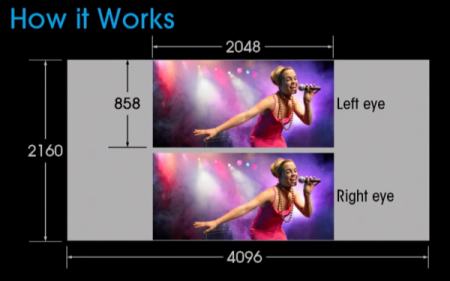
Now, to the twin lens: Since the chip is large enough to handle two, 2k resolutions stacked above one another, each lens has its own image to fire through its assigned lens. Thus with 3D, there is no triple flash, but an assigned image per each lens. With this, it's like going back to the old "over/under" of film 3D and to the current Tech3D over/under process, but just done digitally.

Someone ought to cut and paste this and return it to those writers ... 2D looks fine firing through a twin lens setup cuz each lens has it's own image to project.

"Whew"...gotta get back to work .... -Monte

 |  IP: Logged

Steve Guttag
We forgot the crackers Gromit!!!

Posts: 12814
From: Annapolis, MD
Registered: Dec 1999


 - posted 05-30-2011 03:50 PM      Profile for Steve Guttag   Email Steve Guttag   Send New Private Message       Edit/Delete Post 
Ken/Monte...care to tour around and really check to the 2D performance on the XL-S lens? That is run some resolution targets/cross-hatch and see just how unscathed the 2D image becomes. Then measure the light of the typical 2D show through them...see if the light really is up to the proper 2D version. To say it looks pretty impressive from the booth vantage point isn't really a fine gauge. I can say from the theatre vantage point, I've seen them look horrible.

-Steve

 |  IP: Logged

Monte L Fullmer
Film God

Posts: 8367
From: Nampa, Idaho, USA
Registered: Nov 2004


 - posted 05-30-2011 04:26 PM      Profile for Monte L Fullmer   Email Monte L Fullmer   Send New Private Message       Edit/Delete Post 
Oh can agree fully, Steve.

Prob why Sony first shot out of the gate with 4k, so the picture (single lens) can look better when seated more closer to the screen than with 2k where it looks the best about mid-house using the twin lens - as with the rest of the other 2k units out there.

True, you get close to the screen on a 2k movie and it's not the best to witness. Film can look better than digital at this range.

 |  IP: Logged

Dominic Espinosa
Phenomenal Film Handler

Posts: 1172
From: California, U.S.A.
Registered: Jan 2004


 - posted 05-30-2011 04:57 PM      Profile for Dominic Espinosa   Email Dominic Espinosa   Send New Private Message       Edit/Delete Post 
Monte is totally correct.
I'm personally offended by all the technical inaccuracies in the article and will be posting my response to it soon, with pictures as well once I've taken readings with the light meter.

The biggest point I can think to make is that with the Sony projector the lens change takes my operators about 10 minutes including alignment and resetting the security.

And for everyone who complains they don't have access, all you need is the super login. Ask your FSE for the password. It's not top-secret and they're not going to think twice about giving it to you. You SHOULD know it.

I'll be along in a couple of days with details and pictures of my own to demonstrate the nearly imperceptable difference between 3D lens with light fitlers, without, and 2D lens on the R220...

 |  IP: Logged

Monte L Fullmer
Film God

Posts: 8367
From: Nampa, Idaho, USA
Registered: Nov 2004


 - posted 05-30-2011 06:06 PM      Profile for Monte L Fullmer   Email Monte L Fullmer   Send New Private Message       Edit/Delete Post 
(...lol...now you know why 5/70mm presentations is still the talk of the town - it look pretty on the screen no matter where you sat..)

Sadly though, some locations were not given the option of doing the lens change on their R220/R320 units. Thus it was just easier to do the twin lens install than the single lens install.

It all goes back to the K.I.S.S. booths (can you imagine seeing a tween kid handle a Sony single lens changeover from the twin lens setup? Give him a quarter when he drops the thing or fubars up on the alignments/super settings....) so minimal can go wrong.

 |  IP: Logged

Dominic Espinosa
Phenomenal Film Handler

Posts: 1172
From: California, U.S.A.
Registered: Jan 2004


 - posted 05-31-2011 02:00 AM      Profile for Dominic Espinosa   Email Dominic Espinosa   Send New Private Message       Edit/Delete Post 
Hence why Regals policy is keep the 3D lens on and simply move the light filters.
Our policy is leave them on as well. We only swap them around because we have a back-ordered 3D lens for a screen that's upgrading.

I for one cannot perceive a difference.

When the lens is installed correctly and the installation is done correctly, the 3D lens does not need re-adjustment. The convergence stays perfect as does focus and alignment.
The only conceivable reason from a practical standpoint for bothering is that you aren't showing true 4K when you happen to have a 4K DCP on your hands.
HOWEVER the audience doesn't notice that difference anyhow because it looks good either way.

 |  IP: Logged

Dominic Espinosa
Phenomenal Film Handler

Posts: 1172
From: California, U.S.A.
Registered: Jan 2004


 - posted 06-06-2011 12:21 AM      Profile for Dominic Espinosa   Email Dominic Espinosa   Send New Private Message       Edit/Delete Post 
Counting the days till my light meter arrives...

IN the mean time, we're getting the first wave of complaints from "educated" customers. Some delightfully following Eberts advice and asking for refunds.

My favorite was one for Cave of Forgotten Dreams this week. They felt it was far too dim and MUST be because the lazy projectionist didn't take the 3D lens off.
Well, it's in a 35mm house with a month old 3K lamp on a screen that's almost too small. In fact it is overlit. Maybe it's because it was shot with consumer-grade equipment IN A FRIGGIN CAVE!!??

 |  IP: Logged

Monte L Fullmer
Film God

Posts: 8367
From: Nampa, Idaho, USA
Registered: Nov 2004


 - posted 06-06-2011 12:29 AM      Profile for Monte L Fullmer   Email Monte L Fullmer   Send New Private Message       Edit/Delete Post 
..and what's funny is that thing hanging on the front end of the twin lens SONY is just the polarizers ... and they are clear in themselves..

I'm waiting for REG and others to make a one-sheet that explains the true facts on all of this and get the story straight that one has to write up about without knowing the facts!

Brother, what an eccentric problem that Ebert created...

 |  IP: Logged

Kevin Fairchild
Expert Film Handler

Posts: 125
From: Kennewick, WA, USA
Registered: Oct 2008


 - posted 06-06-2011 01:02 AM      Profile for Kevin Fairchild   Email Kevin Fairchild   Send New Private Message       Edit/Delete Post 
Here is a screenshot from Sony's website.

 -

Even if the polarizers are removed, you are still only using half of the possible light on 2D movies.

 |  IP: Logged

Steve Guttag
We forgot the crackers Gromit!!!

Posts: 12814
From: Annapolis, MD
Registered: Dec 1999


 - posted 06-06-2011 06:08 AM      Profile for Steve Guttag   Email Steve Guttag   Send New Private Message       Edit/Delete Post 
And what if it is a Flat movie? 1587 x 858? Yeah, no quality difference there either (instead of 1998 x 1080). Or, are they so good they can withstand a zero space between pixels on aligning the two flat images (each 1080 tall) and how does one reconverge the pictures between Scope and Flat? I hear that the Sony lenses are not motorized. I don't have first hand knowledge setting them up but I do have first hand knowledge seeing the results in a "typical" theatre.

And since all Sony 3Ds are on a silver screen, if you set your light to 14fL in the middle for 2D it will STILL be too dim, unless your screen is curved (a bit). because of the distribution. The 14fL only applies when your distribution has the sides/corners at 85% of the center...which isn't going to happen on a flat silver screen.

So, for a flat movie on a Sony with the 3D lens in place, you have a scaled (down) image with less resolution, and under-lit. If alignment is off in the two images converging EXACTLY, then resolution drops further. It is an indefensible position. You are short-changing the customer by delivering an inferior image and it is NOT DCI compliant.

-Steve

 |  IP: Logged

Monte L Fullmer
Film God

Posts: 8367
From: Nampa, Idaho, USA
Registered: Nov 2004


 - posted 06-06-2011 03:54 PM      Profile for Monte L Fullmer   Email Monte L Fullmer   Send New Private Message       Edit/Delete Post 
Now, here's the interesting thing: Sony, when using 2K information, has a scaler inside that scales up the content to fit their 4K chip in single lens, 2D mode.

But still, training a booth personnel on how to do a lens change on a Sony could add up to problems that isn't needed in the first place - guess, you call it a tradeoff of sorts.

 |  IP: Logged

Jake Spell
Master Film Handler

Posts: 294
From: Johns Island SC
Registered: May 2009


 - posted 06-06-2011 04:18 PM      Profile for Jake Spell   Email Jake Spell   Send New Private Message       Edit/Delete Post 
Alright, I finally got to see a movie on the glorious SONY 4k projector. It was the latest X-Men movie, 2D movie with the 3D lens and polarizers in place.

The preshow crap looked very dim and washed out on the silver screen with the house lights up, previews weren't much better. Once the actual movie started it was bright enough, in the center, but dim around the edges. I also noticed the splothchyness of the silver screen and the BAD hot spot(no curve). It seem to be properly aligned since the picture was nice and sharp. Overall I was not impressed and find it obvious why people dont go see movies in theaters anymore.

 |  IP: Logged

Monte L Fullmer
Film God

Posts: 8367
From: Nampa, Idaho, USA
Registered: Nov 2004


 - posted 06-06-2011 05:20 PM      Profile for Monte L Fullmer   Email Monte L Fullmer   Send New Private Message       Edit/Delete Post 
..dim on the edges is prob due to the usage of the silver screen which is very directional with light - why it's best to sit high and center so most of the total reflection returns back.

And to add: would you know if this SONY had a recent bulb change? For when a high wattage digital bulb accrue some hours, they will begin to lose their color and brilliance quite easily - why of the mandated bulb changes prior to warranty.

We can definitely tell that large flat panel TV's have dominated entertainment viewing making it an unfair comparison to projected digital presentations.

 |  IP: Logged

Jake Spell
Master Film Handler

Posts: 294
From: Johns Island SC
Registered: May 2009


 - posted 06-06-2011 05:27 PM      Profile for Jake Spell   Email Jake Spell   Send New Private Message       Edit/Delete Post 
It was completly the silver screen, thats why I hate silver screens. Splotchy and that great big hot spot. I was back 4/5 and almost dead center, maybe one or two seats off. Screen was about 20 ft wide, common height

 |  IP: Logged


All times are Central (GMT -6:00)
This topic comprises 6 pages: 1  2  3  4  5  6 
 
   Close Topic    Move Topic    Delete Topic    next oldest topic   next newest topic
 - Printer-friendly view of this topic
Hop To:


Powered by Infopop Corporation
UBB.classicTM 6.3.1.2

The Film-Tech Forums are designed for various members related to the cinema industry to express their opinions, viewpoints and testimonials on various products, services and events based upon speculation, personal knowledge and factual information through use, therefore all views represented here allow no liability upon the publishers of this web site and the owners of said views assume no liability for any ill will resulting from these postings. The posts made here are for educational as well as entertainment purposes and as such anyone viewing this portion of the website must accept these views as statements of the author of that opinion and agrees to release the authors from any and all liability.

© 1999-2020 Film-Tech Cinema Systems, LLC. All rights reserved.