|
|
This topic comprises 4 pages: 1 2 3 4
|
|
Author
|
Topic: JSD 60D crossover
|
David Buckley
Jedi Master Film Handler
Posts: 525
From: Oxford, N. Canterbury, New Zealand
Registered: Aug 2004
|
 posted 01-20-2015 02:26 PM


One of the undoubted benefits of DSP based solutions, in both the drag 'n drop and fixed function variants, is that all the smarts are in software, so the manufacturer can change their mind once the product is shipped, and change things in a way that prior to the DSP revolution was just not possible.
I've done paper and setup software evaluations of a few of the cinema boxes (based on advice received on this very forum) and, of these, the JSD60 appears to the more flexible box than most others. Certainly, if our cinema is ever reborn in the digital era, the JSD60 is at the top of the list in the sound department.
Thus, given its all just software(!), and USL are well represented on this forum, couldn't the JSD60 be fixed?
| IP: Logged
|
|
|
|
|
|
|
|
|
|
Harold Hallikainen
Jedi Master Film Handler
Posts: 906
From: Denver, CO, USA
Registered: Aug 2009
|
posted 01-20-2015 09:09 PM
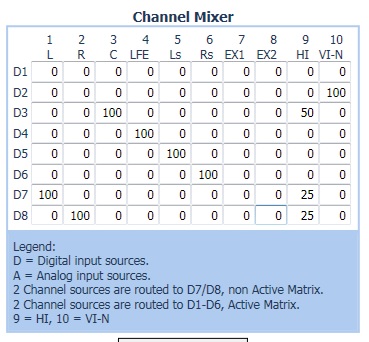
The JSD-60 can decode Dolby Digital or DTS on S/PDIF or TOSLINK inputs. It was not anticipated that there would be a need to decode the multichannel AES/EBU input since DCI specified that the media block would output PCM. The hardware has four DIR/SRC chips (digital receiver / sample rate converter). Chips 1-3 drive the DSP with L, R, C, LFE, Ls, Rs from the AES/EBU inputs. Chip 4 receives AES/EBU pair 4 which can carry HI/VI or Lrs/Rrs depending on the server routing. S/PDIF and TOSLINK drive DIR/SRC number 4. Its output can be routed directly to the DSP for stereo. As an alternative, the output of DIR 4 (SRC is disabled for this since it would mess up the binary encoded data) is routed to the optional DI-84 board which decodes Dolby Digital or DTS. It also applies an "active matrix" to unencoded (stereo) audio. The DI-84 has 3 I2S outputs carrying 6 channels back to DIR/SRC 1-3 sending the decoded L, R, C, LFE, Ls, and Rs to the DSP, just as was handled with the PCM AES/EBU input. It IS possible to decode DTS or Dolby Digital on the AES/EBU input, but, based on the description above, it is decoding AES/EBU pair 4. This is of limited usefulness, but that's the way the hardware is done. The JSD-60 is designed to be as flexible as possible at a reasonable cost. It has its limits, but should serve the vast majority of auditorium requirements.
Thanks for the comments on the JSD-60. I had a large part in its design and like the way it turned out. Coming up soon are AES/EBU outputs and BLU link outputs.
Harold
| IP: Logged
|
|
|
|
|
|
|
|
|
|
|
|
|
|
Carsten Kurz
Film God
Posts: 4340
From: Cologne, NRW, Germany
Registered: Aug 2009
|
posted 01-22-2015 03:05 PM
Actually when I read the functional diagram of the JSD60 today, I had exactly these questions, Harold. Traditionally, analog cinema processors were complex devices with multiple cascaded, more or less autonomous functional blocks. It was rather easy to decide which blocks could be bypassed in case of circuit failures, and, technically, the analog signal at the input of the processor could still be used to drive an amp, even without slit-loss compensation, NR, dematrix, EQ, leveling.
Now, with processors for DCI systems, it is not easy to decide how much sense fallback systems make. You would either have to design redundant mixing stages, or separate certain functions explicitly to enable fallback functions. Most CPs end up in D/A stages today signalwise. One would think that ultimately, a direct hardwired route from AES inputs to a separate D/A bank and a following analog mixdown/adjustment stage would be the ultimate solution for a bypass system, with an optional backup power supply only for that part. But then questions like where to put the AES/EBU receivers, SRC, etc. turn up.
Also, should a bypass system switch over automatically to save a running show, or is it sufficient if a manual bypass switch has to be activated?
Yes, apparently, power supplies fail rather often it seems. Unlike most of the processor electronics, power supplies are usually OEM sourced. Which seems to imply issues with quality control and also stocking of replacements. A cinema nearby had an early failure of the powersupply in one of USLs competitors devices. It took them 2 months to supply a replacement at the time (which was not at the beginning of the production phase for that device, it was in full sale at the time). They received a temporary replacement CP quickly, but waited 2 months for the replacement power supply and their original CP to be repaired.
But Harold - you're at the source for that kind of information - how often do USL CPs fail, and which circuit parts/subsystems fail more often than others?
BTW - I built my own backup processor from three cheap ebay S/P-DIF DACs followed by passive adjustment pots. Input and output is DB25 and fits as a plugin replacement between the cables leading from the server/MB and towards the amps. It was very cheap and we can afford to have it stuffed in a drawer even if we never need it.
It seems the JSD60 is still quite complex. I would think the design of a CP would not need much more than AES/EBU receivers,maybe followed by SRCs, followed by a single beefy DSP, and then again digital outputs and a DAC bank. Then the only thing left to bypass would be the DSP, and feeding the I/O section from a backup supply. Get's more complex if an internal crossover is used. I guess that's one of the reasons the crossover in the JSD60 is optional. If it can operate autonomously, I can be part of a bypass scheme. If it's integrated in the main DSP, it becomes hard to bypass it without major changes to the amp/speaker wiring.
Yes, external crossovers with AES/EBU inputs can compliment a backup scheme, as I depicted earlier in this thread about those cheap Behringers. But they can also be seen as additional points of failure, especially when they ARE cheap Behringers.
- Carsten
| IP: Logged
|
|
Harold Hallikainen
Jedi Master Film Handler
Posts: 906
From: Denver, CO, USA
Registered: Aug 2009
|
posted 01-23-2015 04:49 PM
Thanks for the comments, and sorry for the delay (off at ICTA and ISDCF). Because of analog input routing, routing of digital through the DD/DTS decoder, allowing for various output types (analog, analog biamp, AES/EBU, and BLU link), what starts out as a simple processor gets complicated. I've tried to make it as simple as possible. Steve's idea of swapping AES pairs 1 and 4 is VERY CLEVER. I wish I thought of that! Because the JSD-60 has an input mixer for source selection, you can do all kinds of stuff, including things we did not think of.
On bypass, the failure rates on the JSD-60 are low enough that I really can't get any meaningful data. The power supply does not seem to be any less reliable than anything else. The bypass circuitry does get a bit complicated. Bypass consists of separate digital receivers for AES/EBU inputs, TOSLINK input, and S/PDIF input, separate D/A for all these, analog switching to get the appropriate input, a digitally controlled analog volume control, balanced analog line driver, analog switches that drop the bypass analog onto the outputs. For biamp systems, there's an additional passive low level crossover for bypass use. There's a microcontroller on the front panel that controls all this stuff and also communicates with the main processor when not in bypass (reads buttons, reads fader encoder, updates LEDs, updates display, etc.). So, bypass does add considerable complexity. And, the cost is in every unit. By the time you have 15 or 20 processors in a building, it might be cheaper to have a spare than to include bypass circuitry in all those units. But, swapping out a processor takes longer than flipping the switch to off (and into bypass). However, I've seen quite a few installations where they bypass power supply is not installed or plugged in, so the benefit is lost.
Again, I really appreciate feedback from users. It helps me design stuff that is useful.
Harold
| IP: Logged
|
|
|
|
|
|
All times are Central (GMT -6:00)
|
This topic comprises 4 pages: 1 2 3 4
|
Powered by Infopop Corporation
UBB.classicTM
6.3.1.2
The Film-Tech Forums are designed for various members related to the cinema industry to express their opinions, viewpoints and testimonials on various products, services and events based upon speculation, personal knowledge and factual information through use, therefore all views represented here allow no liability upon the publishers of this web site and the owners of said views assume no liability for any ill will resulting from these postings. The posts made here are for educational as well as entertainment purposes and as such anyone viewing this portion of the website must accept these views as statements of the author of that opinion
and agrees to release the authors from any and all liability.
|

 Home
Home






![[Razz]](tongue.gif)


 Printer-friendly view of this topic