Film-Tech Cinema Systems
Film-Tech Forum ARCHIVE


my profile | my password | search | faq & rules | forum home
  next oldest topic   next newest topic
» Film-Tech Forum ARCHIVE   » Operations   » Digital Cinema Forum   » Cinema Sound Processor in Media Block? (Page 3)

 
This topic comprises 4 pages: 1  2  3  4 
 
Author Topic: Cinema Sound Processor in Media Block?
Marco Giustini
Film God

Posts: 2713
From: Reading, UK
Registered: Nov 2007


 - posted 03-03-2016 01:51 AM      Profile for Marco Giustini   Email Marco Giustini   Send New Private Message       Edit/Delete Post 
Steve,

Sure you have lots of inputs capability but not having HDMI (or SPDIF) inputs makes the system less flexible.
Yes you can buy a blu ray with analogue outputs (which means you're forced to buy those few models available that feature that output) and then you probably want some kind of audio de-embedder and converter to analogue - which is unlikely to work with HD formats and DTS - to make the system capable of dealing with anything that may come up.

I feel that to be implemented as a main cinema processor QSC should develop an HDMI board to extract and process the sound - it would also be cool if the core could do some basic video switching.

 |  IP: Logged

Anders Nordentoft-Madsen
Film Handler

Posts: 57
From: Valby, Denmark
Registered: Aug 2005


 - posted 03-03-2016 02:55 AM      Profile for Anders Nordentoft-Madsen   Author's Homepage   Email Anders Nordentoft-Madsen   Send New Private Message       Edit/Delete Post 
The Monitor default to a mix of all channels unless you chose on or more of the channels in the "solo" part of the UCI.

No, no matrix decoder. But i'm sure QSC will add one if we ask them nicely [Smile]

For most HDMI sources we use the build in HDMI port on the Barco ICMP, for other stuff (we do have some SAT boxes that cant output LPCM via HDMI) we use a small SPDIF (coax and optical) DA conterver box (DTS and DD support), that goes directly to 6 analog inputs on the amp, this works fine.

We like the ICMP's more and more. Ingest speeds are fine now, they might be a tiny bit slower that a showvault/DCP2000 but it makes up for that with faster ingest speeds under playback. Also with ATMOS support very soon (I have done beta tests) and the external input strangeness being addressed soon, they are IMHO fully up to par (and in some cases better) than other server solutions, at a cheaper price.
We use the Barco projector touchscreens for local control, but really they are rarely used.

We have been using Q-SYS for all auditoriums in the previous site that we made (9 screens) 1 auditorium with one core (atmos), the 2 screens with one core, 2 screens with one core, and lastly 4 screens on one core (with redundancy), everything has been running flawlessly for the last 6 months.

I agree with the AES67 stuff, it would also make the build a lot cheaper.

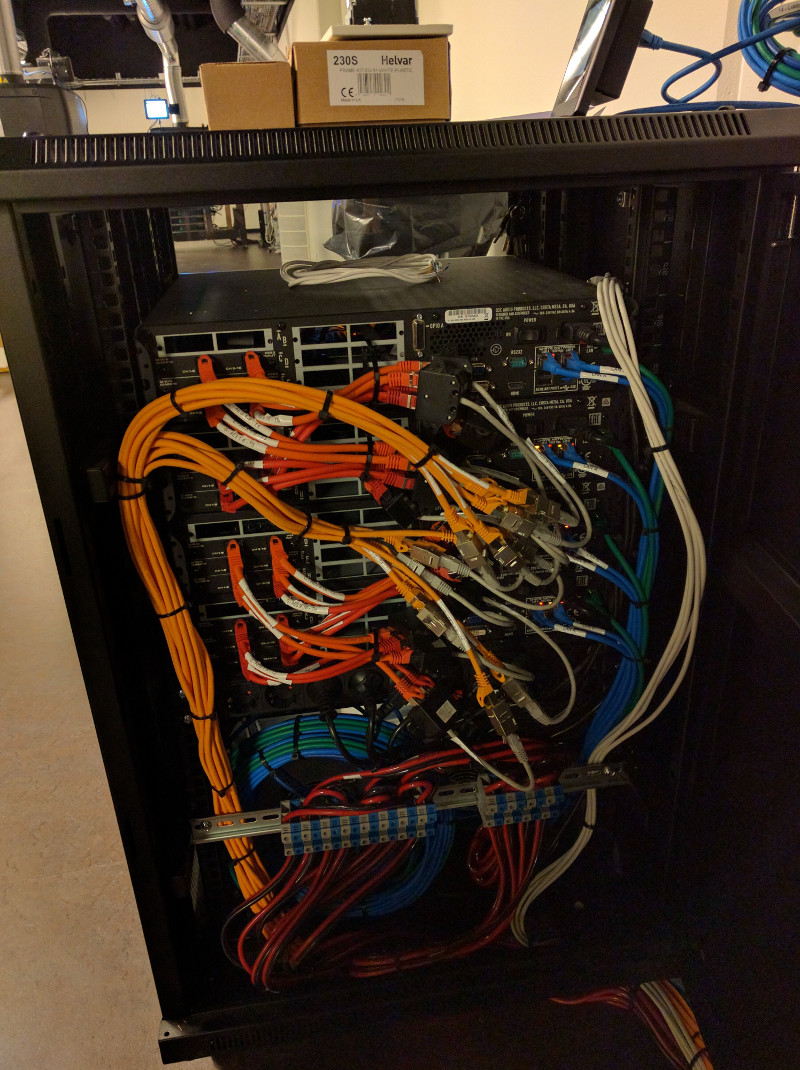
As a bonus here is a picture that makes it clear why getting rid of AES cabling would be nice [Smile]
 -

- Anders

 |  IP: Logged

Steve Guttag
We forgot the crackers Gromit!!!

Posts: 12814
From: Annapolis, MD
Registered: Dec 1999


 - posted 03-03-2016 05:52 AM      Profile for Steve Guttag   Email Steve Guttag   Send New Private Message       Edit/Delete Post 
I hear that QSC is working on a Matrix Decoder module for Q-Sys but strictly rumor at this point. This is especially true given that they are over 2-years behind on DCP firmware updates.

For me, S/PDIF audio is a waste of time now. All audio from non-Cinema is going to be on HDMI. We are an Oppo dealer so supplying Blu-Ray players that have discrete analog outputs is no big thing and the BDP-103 has two HDMI inputs that WILL decode DTS or Dolby audio. That said, the external HDMI source is relegated to LPCM or the low-bandwidth DTS/Dolby stuff. We also have access and use the Crestron HD-XSP decoder that will decode everything short of Atmos. So, audio wise, we are sort of covered now on the alternate content front.

 |  IP: Logged

Marco Giustini
Film God

Posts: 2713
From: Reading, UK
Registered: Nov 2007


 - posted 03-03-2016 07:33 AM      Profile for Marco Giustini   Email Marco Giustini   Send New Private Message       Edit/Delete Post 
quote:
we use a small SPDIF (coax and optical) DA conterver box (DTS and DD support),
Hopefully this is not the box I tried some time ago or I wish you good luck [Smile]

Why the adaptor for the AES? Do Alchemy and CIAES have different pinout??

I forgot the Alchemy can do DD and DTS on HDMI, a giant plus for a D-Cinema server. Still, I feel an AP20 gives you more flexibility for a cinema room.

 |  IP: Logged

Anders Nordentoft-Madsen
Film Handler

Posts: 57
From: Valby, Denmark
Registered: Aug 2005


 - posted 03-03-2016 08:35 AM      Profile for Anders Nordentoft-Madsen   Author's Homepage   Email Anders Nordentoft-Madsen   Send New Private Message       Edit/Delete Post 
We have tested the DA converter quite a bit and it seems to work.

The Adapter is to split the AES signal to both the main and the redundant core.

We do use AP20's in a lot of our other sites, and I agree that it is a fantastic sound processor (Dirac does wonders), but still with Qsys, we can get the job done cheaper and with a lot more flexibility, since we can do pretty much whatever we want.

- Anders

 |  IP: Logged

Marco Giustini
Film God

Posts: 2713
From: Reading, UK
Registered: Nov 2007


 - posted 03-03-2016 12:38 PM      Profile for Marco Giustini   Email Marco Giustini   Send New Private Message       Edit/Delete Post 
Of course, the redundant core! Thanks.

Is that really much cheaper than an AP20? Also considering that with an AP20 you could use cheaper amplifiers - with the QSYS you're basically stuck with the DPA, great amps but expensive.

 |  IP: Logged

Jay Wyatt
Film Handler

Posts: 33
From: Los Angeles, CA
Registered: Mar 2015


 - posted 03-03-2016 01:01 PM      Profile for Jay Wyatt     Send New Private Message       Edit/Delete Post 
quote: Marco Giustini
with the QSYS you're basically stuck with the DPA, great amps but expensive
The rear panel can take a bunch of different IO cards (8 slots). You could use:
1 slot for AES input
2 slots for analog in cards (8ch total)
5 DataPort Out OR Balanced line out Cards (20ch total)

Then you can use the cheaper DCA amps or non-Dataport amps (w/ balanced line out cards).

 |  IP: Logged

Marco Giustini
Film God

Posts: 2713
From: Reading, UK
Registered: Nov 2007


 - posted 03-03-2016 01:29 PM      Profile for Marco Giustini   Email Marco Giustini   Send New Private Message       Edit/Delete Post 
Sure, but those cards are not included with the core. I'm not sure of the price but I'm not sure they are very cheap.

Please don't get me wrong, I love the QSYS and its potential is unlimited. But it's not a cheap system.

 |  IP: Logged

Marcel Birgelen
Film God

Posts: 3357
From: Maastricht, Limburg, Netherlands
Registered: Feb 2012


 - posted 03-03-2016 01:52 PM      Profile for Marcel Birgelen   Email Marcel Birgelen   Send New Private Message       Edit/Delete Post 
Yeah, it's still quite expensive but if it allows you get around the otherwise mandatory "sound processor", I'm not sure it is that more expensive. It's definitely much more flexible. There's a lot that can be done in the budget of e.g. a CP750 or AP20.

quote: Steve Guttag
We also have access and use the Crestron HD-XSP decoder that will decode everything short of Atmos. So, audio wise, we are sort of covered now on the alternate content front.
What kind of automation interface does it offer? Is it something that can be easily remote controlled using some simple TCP commands?

 |  IP: Logged

Marco Giustini
Film God

Posts: 2713
From: Reading, UK
Registered: Nov 2007


 - posted 03-03-2016 03:10 PM      Profile for Marco Giustini   Email Marco Giustini   Send New Private Message       Edit/Delete Post 
Maybe it's not much more expensive but Anders claims it's even cheaper.

The CP750 is a basic processor but the AP20 is a much more flexible one.
The potential of a QSYS system is unrivalled but I'm wondering what kind of extra flexibility/features we need from a QSYS system which we cannot achieve with an AP20?

 |  IP: Logged

Marcel Birgelen
Film God

Posts: 3357
From: Maastricht, Limburg, Netherlands
Registered: Feb 2012


 - posted 03-03-2016 05:40 PM      Profile for Marcel Birgelen   Email Marcel Birgelen   Send New Private Message       Edit/Delete Post 
The cost saving are most likely to be found in scaling the setup across multiple rooms. You can run multiple rooms with a single core or with a dual core redundant setup, for which you otherwise would've needed a sound processor per room.

If you use your venue for movies exclusively, there is probably not much to be gained in flexibility compared to a classic sound processor setup, but if you're using your sound setup for other purposes than just movies, a Q-Sys setup offers almost unlimited flexibility in channel routing, equalization and mixing for different scenarios.

Once there is an easy way to get DCI servers to push their audio directly over Ethernet, the potential of cost savings will only increase. In the end, your sound system will essentially become an Ethernet bus to which you can add your inputs, outputs, mixing magic and control layer at will.

There certainly is a case for this, but personally, I'm not entirely sold on the idea. Not that I'm not excited about the technology itself, but because I still tend to see an auditorium as a discrete, self-contained thing. A technical malfunction in one auditorium should not lead to a problem in another.

Q-Sys can be used with redundant cores, but in the end it boils down to software and we all know that software comes with bugs. It's those bugs that also, rather often, defeat the redundant capabilities of a setup.

 |  IP: Logged

Steve Guttag
We forgot the crackers Gromit!!!

Posts: 12814
From: Annapolis, MD
Registered: Dec 1999


 - posted 03-04-2016 06:34 AM      Profile for Steve Guttag   Email Steve Guttag   Send New Private Message       Edit/Delete Post 
quote: Marcel Birgelen
What kind of automation interface does it offer? Is it something that can be easily remote controlled using some simple TCP commands?
It has a USB port and Ethernet. One can use Crestron's Toolbox and, though Crestron refuses to publish their commands (and responses)...YES one can use simple TCP commands to control it. Responses, if desired, have to be parsed to get the information you want (current volume, delay...etc.) as they are in a string based on the query you issue. So the short answer is yes, it is easily controlled.

I definitely see the "power" in a networked type audio solution like Q-Sys. With redundant cores and networks...if you can eliminate discrete sound processors, its cost effectiveness becomes more apparent. Let's say you do a 10-plex...losing $50,000 worth of discrete AP20s leaves you a bit of flexibility in getting sufficient cores and I/O to do the job. Mind you once you get into the drag-n-drop DSP world...you get a LOT of flexibility (I've done many of them)...they can evolve too easier than a purpose built box. It isn a 1:1 comparison since each system has features the other doesn't have but you get the idea. I too am less comfortable in a large networked system running the whole show since it could mean dumping sound in an entire complex at once. Even with a redundant core and network...if it has to go to the redundant system, there WILL be a drop...not long (seconds) but something that discrete systems wouldn't suffer.

I don't think it is cost effective (or necessary) for all applications either. I think the likes of JSD60s/CP750s have their place in the majority of theatres. They have the feature set that MOST cinemas need/want in one box and are cost effective. A nice thing of purpose built boxes is stability. The AP20 and DCP300s has that extra flexibility in it that many of us desire for some customers. And then there is the full drag-n-drop DSP where the sky is the limit and not limited to those that are active in the Cinema industry. There are companies like Rane and Biamp and many others that have d-n-d DSP that may do the job of a cinema processor for some venues and offer network connectivity.

One of the ways we choose sound equipment (and everything else nowadays) is from a support standpoint. That is, can we remote in and survey the situation? I really like being able to verify signal paths. I think that the USL CM-8E monitor is awesome in the fact one can LISTEN over the internet to a site. Even if there is nobody in the booth, we can remotely determine is it the processor, amp or speaker (and have done so)...all of this weighs in on what sound equipment to choose.

 |  IP: Logged

Marco Giustini
Film God

Posts: 2713
From: Reading, UK
Registered: Nov 2007


 - posted 03-05-2016 03:41 AM      Profile for Marco Giustini   Email Marco Giustini   Send New Private Message       Edit/Delete Post 
quote: Steve Guttag
.if it has to go to the redundant system, there WILL be a drop...not long (seconds) but something that discrete systems wouldn't suffer.
5 seconds according to QSC.

Yes, you're saving $50000 but if you then run 3 screens per core + redundant as in the example on this thread, then you'll need 6 cores (assuming one core does 4 screens) or 8.

My question is - I'm not really into prices - will 6 Core 500i (plus accessories) be cheaper than 10 Datasat AP10?

In this example we've seen 4 Core 500i replacing 6 standard sound processors. Again my question is: are 4 Core 500i (plus extra boards) cheaper than 6 Datasat AP20?

We should also consider the developing time to create and test the design.

Again, I want to point out that I am not questioning the QSYS system which I love [Smile]

 |  IP: Logged

System Notices
Forum Watchdog / Soup Nazi

Posts: 215

Registered: Apr 2004


 - posted 09-21-2017 04:36 PM      Profile for System Notices         Edit/Delete Post 

It has been 565 days since the last post.


 |  IP: Logged

Steve Guttag
We forgot the crackers Gromit!!!

Posts: 12814
From: Annapolis, MD
Registered: Dec 1999


 - posted 09-21-2017 04:36 PM      Profile for Steve Guttag   Email Steve Guttag   Send New Private Message       Edit/Delete Post 
Bumping this one back up. The QSYS Pro Logic decoder is a reality. Plus I really like the UCIs that Anders made!

 |  IP: Logged


All times are Central (GMT -6:00)
This topic comprises 4 pages: 1  2  3  4 
 
   Close Topic    Move Topic    Delete Topic    next oldest topic   next newest topic
 - Printer-friendly view of this topic
Hop To:


Powered by Infopop Corporation
UBB.classicTM 6.3.1.2

The Film-Tech Forums are designed for various members related to the cinema industry to express their opinions, viewpoints and testimonials on various products, services and events based upon speculation, personal knowledge and factual information through use, therefore all views represented here allow no liability upon the publishers of this web site and the owners of said views assume no liability for any ill will resulting from these postings. The posts made here are for educational as well as entertainment purposes and as such anyone viewing this portion of the website must accept these views as statements of the author of that opinion and agrees to release the authors from any and all liability.

© 1999-2020 Film-Tech Cinema Systems, LLC. All rights reserved.

