|
|
This topic comprises 4 pages: 1 2 3 4
|
|
Author
|
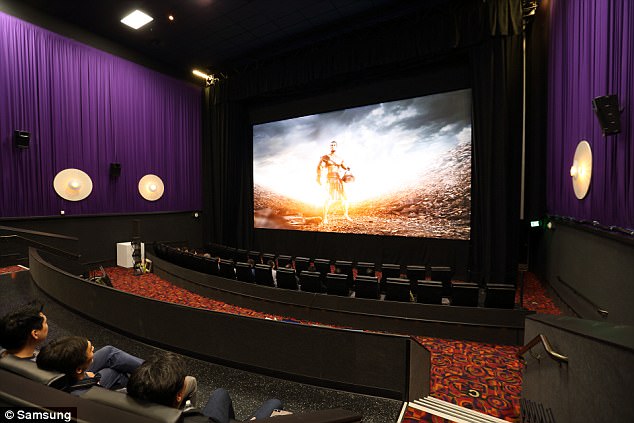
Topic: Samsung Cinema Screen introduced and demonstrated
|
|
|
Bobby Henderson
"Ask me about Trajan."

Posts: 10973
From: Lawton, OK, USA
Registered: Apr 2001
|
 posted 03-30-2017 02:38 PM


Costs have come down quite a bit, but they started at absolutely stratospheric highs. The first 14' X 48' full color outdoor digital billboards cost $700,000 to $1 million, and these were not high resolution boards either. We're talking 26mm to 35mm pixel pitches, which is pretty coarse but acceptable when viewed from a car speeding by on a freeway. Today the same size board in a tighter 19mm pitch can be bought for around $175,000. The price has gone from close to $1000 per square foot down to about $270 per square foot. And that's from reputable American manufacturers, not fly-by-night imported crap.
Outdoor LED billboards are not what I would call high resolution at all. We just installed one near Duncan, OK that measures 10' 6" tall by 36' across and has a 638 X 176 pixel layout. As you pack more LEDs into a panel you're going to be paying more and more money. The cost of all those materials scales up geometrically. There's all the individual LEDs, all the plastic and other materials in each driver board and then all the wiring to put it all together. There is a lot of pressure to bring down prices, especially with all the cheap junk coming in from China. But the prices can go only so low just from what commodities like oil and steel cost.
Even if you could get the price of each individual LED diode down to just 1¢ the LEDs in a 4K resolution jumbotron alone would cost $26,542.08. That's before you add in all the other labor and materials costs of the driver boards.
I'm just wondering what the sweet spot would be to get a LED-based movie screen into practical cost territory for a theater. It would have to at least be competitive price-wise with the price combination of a d-cinema projector and traditional screen.
| IP: Logged
|
|
Marcel Birgelen
Film God
Posts: 3357
From: Maastricht, Limburg, Netherlands
Registered: Feb 2012
|
posted 03-31-2017 02:53 AM
I've seen the first 4K giant LED screen demo a few years back on a trade show. It was pretty impressive and I immediately wondered if we would be getting close to this kind of technology being ready for movie theaters.
The positive aspects are pretty clear:
- An enormous bump in brightness and color gamut compared to Xenon based Digital Cinema.
- Since the screen itself is emmisive, maybe the first legitimate reason to entirely omit masking.
- More flexibility in seating arrangements, because there's no longer a need to account for projector placement.
- A legitimate reason to strip the booth, although in my opinion, a theater should have a booth in the back, whether there's actually a projector or not. ![[Wink]](wink.gif)
Since such a screen works well with the lights on, it would allow a theater to use the room for live events where a screen is needed. You could also show a movie with the lights on, which might be useful for certain groups like shows for small children and their parents, certain groups of disabled, etc.
So, besides the costs, it sounds all great. Unfortunately, I'm not entirely convinced:
Screen Door effect
We probably all have seen the effect of LED walls on TV. It looks great in zoomed out shots, but once the camera gets closer, the individual dots become visible, the screen door effect is as in your face as you can get and often you even see moire effects on digital recordings.
The space between pixels of most LED displays is much larger than modern DLP and LCoS will achieve. Besides that, you can still slightly defocus the image to reduce it.
I've seen some solutions for the screen door effect where they added a diffuser in front of the screen. Unfortunately that diffuser was cloudy white, but maybe you could implement some diffusing technique that keeps the off-state of the screen as dark as possible.
The screen door effect really is a serious issue, because even with a 4K resolution, it will be visible and a major distraction on larger screens and in front rows.
Acoustics
It has been mentioned several times before. But the fact you cannot put speakers behind the screen is a major problem. It also negates all the modern MDA audio initiatives, where the amount of channels not only around you, but also behind the screen is on the rise.
In my opinion, for small screens, placing the front speakers below or above the screen, will still result in an acceptable stereo image. But on any larger screen, where this technologies sweet spot will probably be, you will get a very unrealistic result.
Bobby mentioned "porous" screens and although they do exist, they will only increase the screen door effect and those pores will indeed slowly fill up with dust, so you need to clean it regularly. The cleaning process will probably be cumbersome.
Another problem might be acoustics in general, since you now introduce a large, flat and hard surface on one side of the room. Maybe you could use the reflectiveness of this "screen wall" for something useful, like pointing speakers at it and therefore counter the lack of speakers behind the screen. I'm not really sure how such a setup should look like and what the end result would be.
One resolution fits all
While with a normal screen, you at least have the possibility to zoom your image or use other image sources than your "main projector" to fill the screen, that won't be a possibility anymore with this screen. Since it is dark and not particularly reflective, it won't work as a projection surface. So, you're stuck with the characteristics of this screen wall.
Color calibration
Maybe Samsung fixed this problem, but many LED screens suffer from bad color calibration, especially between modules. Like almost any technology, it needs recalibration and since every pixel is its own light source, it needs a correct calibration on pixel level.
Maybe there is a way to automate it, with a very high resolution, calibrated camera, but unless this problem is solved, your image will probably rather quickly look like an uncalibrated Sony projector.
Durability and maintenance
Most LED walls are much more durable than any normal projection screen in regards to vandalism, so not so much worries there.
But it still remains to be seen, what the MTBF of a giant cinema wall screen will be.
Although LED walls are usually built using separate modules, you will most likely need special equipment to replace those modules in hard to reach places. Something you need to account for during construction or retrofitting.
Another concern would be long-time support. We all know how quickly vendors EOL a product those days. If you put, for example, $250K into your new, shiny screen wall, you do not want to find your investment being EOL after 5 or so years.
| IP: Logged
|
|
|
|
|
|
Jack Ondracek
Film God

Posts: 2348
From: Port Orchard, WA, USA
Registered: Oct 2002
|
posted 03-31-2017 10:07 AM

quote: Marcel Birgelen
Another concern would be long-time support. We all know how quickly vendors EOL a product those days. If you put, for example, $250K into your new, shiny screen wall, you do not want to find your investment being EOL after 5 or so years.
Excellent point, Marcel. I hadn't thought of that.
Our drive-in screens are between 39 and 67 years old, and have outlasted two former owners. Imagine, being told your screen's manufacturer no longer supports your model, or some critical chip is no longer available.
It's bad enough, worrying about that with our new projectors. Already, the company that made our 5-year-old servers has been absorbed by a former competitor.
As we did with digital, I think we'll sit back and watch others get ahead of us on this one!
| IP: Logged
|
|
Bobby Henderson
"Ask me about Trajan."
Posts: 10973
From: Lawton, OK, USA
Registered: Apr 2001
|
posted 03-31-2017 10:34 AM
quote: Marcel Birgelen
We probably all have seen the effect of LED walls on TV. It looks great in zoomed out shots, but once the camera gets closer, the individual dots become visible, the screen door effect is as in your face as you can get and often you even see moire effects on digital recordings.
The "screen door effect" is only noticeable with exposed LED displays if you're close enough to see the pixel grid. This screen Samsung is demo-ing has a very tiny 2.5mm pixel pitch. That's far tighter than the pitch you see on outdoor LED signs (16mm, 20mm, 24mm, 35mm).
Moire is not a problem with LED displays if you are looking at them with your own eyes. Flicker and moire are both problems when trying to photograph these signs. The pixel grid in the camera's imager is conflicting with the pixel grid of the LED display, if the pixel grid is coarse enough to be visible.
quote: Marcel Birgelen
It has been mentioned several times before. But the fact you cannot put speakers behind the screen is a major problem. It also negates all the modern MDA audio initiatives, where the amount of channels not only around you, but also behind the screen is on the rise.
Not being able to place speaker directly behind the screen is a big problem. However, stage speakers have been placed above & below movie screens before (many years ago AMC's put solid "Torus" screens in their "HITS" rooms). You cannot put speakers behind these giant sized LED TV sets being sold to consumers. They have to stick speakers or sound bars underneath them and/or flank them with speaker towers.
Next gen surround formats like Dolby Atmos are really only improving the surrounds. None of those formats are doing anything revolutionary with the stage channel speakers.
quote: Marcel Birgelen
While with a normal screen, you at least have the possibility to zoom your image or use other image sources than your "main projector" to fill the screen, that won't be a possibility anymore with this screen. Since it is dark and not particularly reflective, it won't work as a projection surface. So, you're stuck with the characteristics of this screen wall.
LED displays with a fixed resolution have one big advantage: the image will be in perfect focus 100% of the time. It won't matter if the display is flat or curved either. No vignetting. No uneven brightness. That absolutely cannot be said at all about most d-cinema projector setups. On-screen type from the opening credits and end credits is a dead giveaway on just how blurry many projectors are set.
If a LED display is set too bright the physical over glow of the LEDs can crush subtle details like strands of hair.
quote: Marcel Birgelen
Maybe Samsung fixed this problem, but many LED screens suffer from bad color calibration, especially between modules. Like almost any technology, it needs recalibration and since every pixel is its own light source, it needs a correct calibration on pixel level.
Maybe there is a way to automate it, with a very high resolution, calibrated camera, but unless this problem is solved, your image will probably rather quickly look like an uncalibrated Sony projector.
Jumbotrons from the late 1990's and early 2000's had more issues with color performance. A hell of a lot of improvement has taken place since then. It also cannot be stressed enough that you get what you pay for with LED signs. The cheap, imported stuff from fly by night companies isn't built to last, unlike the better products from companies like Daktronics and Watchfire. LED displays can use the entire RGB color space and have many thousands of levels of adjustment. This is important as the board ages. Individual driver board tiles are going to go bad from time to time. Stuck or dead pixels can happen, but isn't as common on high quality LED boards. Again, you get what you pay for. A new driver board has to match up with the existing tiles. Companies like Daktronics have software that allows fine tune adjustment to get the color and contrast right.
As far as life span goes, a brand new, high quality LED board should last at least 7 to 10 years. Like any piece of electronics using computer-based components it becomes difficult getting replacement components after that amount of time has passed. Companies making all the individual chips and other parts that go into the unit have long since moved on to making other newer versions of the product.
| IP: Logged
|
|
Randy Stankey
Film God

Posts: 6539
From: Erie, Pennsylvania
Registered: Jun 99
|
posted 03-31-2017 11:48 AM
For the sound problem:
I wonder whether the screen could be set away from the wall by a couple of feet so that the speakers could be placed behind the screen, reflecting off the wall. That's the way my flat screen TV works.
Maybe there could be a ring of smaller speakers around the edges of the screen which are phased like a line array. Done properly, line arrays can outperform horn-loaded systems.
About the question of cost:
Since LED displays don't need projectors, there would be a certain amount of savings that could be used to pay for the screen.
Since there are no projectors, there is no need for expansive (and expensive) projection rooms. The projection room could be reduced to the size of a large janitorial closet. Exhibitors could save a buttload of money, right there.
Screen size:
A 30-foot screen is barely bigger than a postage stamp.
But, if auditoriums were smaller, the tiny screen wouldn't be so much of an issue. For example, instead of having fifteen screens with 200-300 seats in each, there could be thirty screens with only 100-150 seats.
More screens means that exhibitors could stagger showtimes and increase turnover, allowing customers to cycle in and out of the theater on a more continuous basis instead of having big "rushes." That might allow management to get more work out of their employees because there would be less time for ushers to fool around out back, behind the dumpster.
With all of those things, flat screens could end up being a cost savings for theaters.
Yes, this would end up making movie theaters more like "Video Parlors" than "proper" theaters but I think that the exhibition industry needs to realize that the general public has begun to change the way that they consume movies and entertainment.
By this, I don't refer to the technology. I refer to the fundamental way they think about entertainment. Movies are now a "social experience." People don't want to sit in dark, cavernous rooms. They don't want to "shush" and be quiet. They want to talk to their friends about what they are seeing, as they are seeing it.
That's why there are so many people use their iPhones in movie theaters. They want to chatter to their friends about what they are seeing. Theaters that punish customers for using their phones are literally turning away money.
Now that there is a potential to have brighter displays, movie theaters don't need to be so dark. That means that a cell phone won't be as distracting as they would be in near-total darkness.
That means there is money to be made by setting up free Wi-Fi hot spots and ENCOURAGING people to use their phones. There is a lot of valuable data to be mined from customer "chatter" as they watch a movie and "bare their souls" to the internet.
My main concern about LED movie screens is about complexity. With all of these new gizmos... screens, sound systems, internet, connectivity & support systems, the logistics of running a theater would be way beyond the technical capabilities of your average person. We would need to train a whole, new generation of employees to run our theaters, then we would need to groom them to do business in a completely different way.
This could be good news for us Film-Techers. We would probably end up being more like I.T. pros than projectionists but, with proper training, we could end up making a lot more money in the process.
If it wasn't for the fact that I'm over fifty years old, now this kind of change might be enough to lure me back to the movie theater business. The problem is that it would take ten to fifteen years for this new paradigm to become common place. By then, it would be time for me to start thinking about retirement.
But, since I'm probably going to end up working until my dying day, this whole think still holds my interest. We'll just have to wait and see.
| IP: Logged
|
|
|
|
Mike Blakesley
Film God

Posts: 12767
From: Forsyth, Montana
Registered: Jun 99
|
posted 03-31-2017 02:11 PM
quote: Randy Stankey
Movies are now a "social experience." People don't want to sit in dark, cavernous rooms. They don't want to "shush" and be quiet. They want to talk to their friends about what they are seeing, as they are seeing it.
Maybe a big complex could have a "quiet" show for people who actually want to watch the movie, and a "talking" show for those people who want to jabber with their friends. I'll bet said "talking" show would be empty the majority of the time, except for teens who aren't really there to see the show anyway. When people are having a "conversation," they only want to hear the people they're talking to -- they don't want to hear other people yakking behind and in front of them. They want to hear the movie at least SOME of the time.
quote: Randy Stankey
That's why there are so many people use their iPhones in movie theaters. They want to chatter to their friends about what they are seeing. Theaters that punish customers for using their phones are literally turning away money.
They're answering texts mostly. I highly doubt most of the texts are critiquing the movie, other than to say it's good or bad. We get a lot of people who come to the lobby to use their phones....when I overhear those conversations, it's never about the movie, it's always about their kids, or their after-the-show plans, or some other stuff. Never the movie.
| IP: Logged
|
|
Marcel Birgelen
Film God
Posts: 3357
From: Maastricht, Limburg, Netherlands
Registered: Feb 2012
|
posted 04-01-2017 02:02 AM
quote: Jack Ondracek
Our drive-in screens are between 39 and 67 years old, and have outlasted two former owners. Imagine, being told your screen's manufacturer no longer supports your model, or some critical chip is no longer available.
It's bad enough, worrying about that with our new projectors. Already, the company that made our 5-year-old servers has been absorbed by a former competitor.
Like Bobby mentioned, you can probably expect 7 to 10 years on such an installation and that's also the kind of availability of parts and extended service contracts you can expect from a manufacturer. Most professional grade equipment I work with, comes with a maximum of 7 year of support and guarantee for replacement parts. Sometimes you can get more out of it, but it largely depends on where on the product life-cycle you bought it. If you buy it near the end of the life-cycle, those 7 years are usually a hard deadline if you can get such commitments at all.
After those commitments from the manufacturers run out, you're relegated to the refurb/second hand market with no guarantees at all. So, essentially you should expect a total write off and need for a replacement every 7 to 10 years. Given the expected costs of such an installation, especially for drive-in sized screens, it will probably be quite a hard sell.
quote: Bobby Henderson
The "screen door effect" is only noticeable with exposed LED displays if you're close enough to see the pixel grid. This screen Samsung is demo-ing has a very tiny 2.5mm pixel pitch. That's far tighter than the pitch you see on outdoor LED signs (16mm, 20mm, 24mm, 35mm).
That's also, because it is a relatively small screen, compared to the size of the room and to the wall-to-wall and bottom-to-ceiling screen setups which have become a staple in many multiplexes. The pixel pitch will increase rapidly on larger screens I suppose. Which also begs the question of how flexible the screen size is on those things.
In the end, you probably want to end up with a pixel count that conforms a common standard like "4K" because you probably want to avoid scaling the image, but the pixel pitch on those modules isn't endlessly flexible.
Not only the pixel pitch itself is important, the black space between them is probably even more important. And even with a small pixel pitch, you still end up with discernible pixels. With projection, you can give those pixels a smooth edge, so they blend better into their neighbors. If done correctly, it will not even noticeably change the perceived sharpness of the projected image.
I guess some transparent diffuser would probably be an adequate solution. The diffuser solution I've seen did the trick quite effectively. It will add a layer to the screen, which will cause some inefficiencies, but there should be more than enough budget left.
quote: Bobby Henderson
Moire is not a problem with LED displays if you are looking at them with your own eyes. Flicker and moire are both problems when trying to photograph these signs. The pixel grid in the camera's imager is conflicting with the pixel grid of the LED display, if the pixel grid is coarse enough to be visible.
I was only mentioning moire, because it is being caused by the rather large pixel pitch of many of those screens. If this would have been a projection at the same resolution, you would not have seen moire, but more likely a somewhat blurry, colored surface, more like a nice bokeh than a bunch of distracting "animated" patterns. It's obvious your own eyes won't see moire patterns with your own eyes on those screens. If you do, I'd consider seeing a doctor.
quote: Bobby Henderson
Not being able to place speaker directly behind the screen is a big problem. However, stage speakers have been placed above & below movie screens before (many years ago AMC's put solid "Torus" screens in their "HITS" rooms). You cannot put speakers behind these giant sized LED TV sets being sold to consumers. They have to stick speakers or sound bars underneath them and/or flank them with speaker towers.
TVs, even the giant ones, are usually sufficiently small as not to get distracted from the "off placement" of those speakers. I guess you have experienced HITS at least once? I guess you didn't really like it, did you? Also, can you imagine a "PLF-sized screen" with speakers above and below?
quote: Bobby Henderson
Next gen surround formats like Dolby Atmos are really only improving the surrounds. None of those formats are doing anything revolutionary with the stage channel speakers.
That's no excuse to make them sound bad. Also, most of those formats don't entirely ignore the front side of the auditorium. The full-spec Atmos deployment uses 5 stage speakers. The format actually supports height speakers. Auro3D uses height speakers, DTS-X supports height speakers and IMAX also has at least one height front channel in their original sound format and their newest generation also brings this channel back to their digital screens.
quote: Bobby Henderson
LED displays can use the entire RGB color space and have many thousands of levels of adjustment. This is important as the board ages.
While modern LED displays can be literally adjusted on pixel-level, there needs to be a way to automate this calibration in a meaningful way for day-to-day cinema operations. This also is important when you put a brand new module in a screen that has a considerable run-time already. That's why I proposed the idea with the calibrated high res camera. I'm not sure how workable it would be and such a camera will not be free either and would most likely require recalibration itself from time to time.
quote: Bobby Henderson
Individual driver board tiles are going to go bad from time to time. Stuck or dead pixels can happen, but isn't as common on high quality LED boards. Again, you get what you pay for. A new driver board has to match up with the existing tiles.
The problem here is primarily how you're going to replace individual tiles. You will most likely replace individual modules more often than you would replace your projection screen. Since you don't replace your screen that often, it usually is acceptable for the room to be unavailable for multiple shows, but it won't be acceptable for a single module that needs replacement. So for large screens, you probably would need some kind of movable platform that can easily be deployed for maintenance.
quote: Randy Stankey
I wonder whether the screen could be set away from the wall by a couple of feet so that the speakers could be placed behind the screen, reflecting off the wall. That's the way my flat screen TV works.
Maybe I'm missing something here. But... your TV probably doesn't cover almost the entire wall, that's why this still works quite reasonably well. If you put speakers behind the screen and point them at the wall, the sound will primarily bounce back and forth between the backside of the screen and the wall. Since the backside of the screen most likely isn't entirely flat, it will act more as a diffuser. There's also a big chance of some "nice" fat resonance. Some sound will leak along the edges of the screen, but I doubt it will be convincing.
quote:
Maybe there could be a ring of smaller speakers around the edges of the screen which are phased like a line array. Done properly, line arrays can outperform horn-loaded systems.
You could, maybe, build an array of speakers around the edges, where you point different speakers representing different channels at different positions in the auditorium. This way, you could probably achieve a mostly even distribution around the room. If done really right, it could outperform a normal three speaker stage setup. It will require quite some efforts to get it right though and also some dedication to keep it aligned properly.
quote: Bobby Henderson
If a theater operator wants to install an environment like that of a sports bar or night club they can set up something like that in the lobby or a specialty party room that doesn't have a bunch of seats pointed only at the screen. But they shouldn't expect me to be willing to pay $12-$20 per ticket to watch a movie in there. The giant screens in places like Buffalo Wild Wings often become a mere background item to people socializing. That's fine in Buffalo Wild Wings. It's lousy in a theater.
We do already have theaters where they serve full menus, so the next iteration could actually be something like a Cinema Cafe or Cinema Bar. Not that I would be a regular customer though, but maybe there actually is a market for this.
Besides the PLF trend which started a few years back, I now also see a trend of smaller rooms reemerging, just to increase the amount of movies that can be shown at any given time. A trend that I could see emerge is something like your private cinema room, which you can rent with a bunch of friends and have your movie on-demand, a lot like those private karaoke suites which became popular in Japan. There are some initiatives for this already.
| IP: Logged
|
|
|
|
Randy Stankey
Film God
Posts: 6539
From: Erie, Pennsylvania
Registered: Jun 99
|
posted 04-01-2017 11:30 AM
quote: Bobby Henderson
Any theater that encourages talking, mobile phone use, etc. while the movie is in progress will not get any of my business.
I honestly believe that is the way things are going. Bobby, you and I are "old" as far as the theater-going population is concerned. Those young, whipper-snappers want to use their phones and they ARE doing it, whether we like it or not.
The only one of us Film-Techers who has been successful at keeping people from using phones, etc., is Frank. The reason it works for him is because he lives in a town with a relatively cohesive population who all hold similar values.
I'm sorry, guys... Phones are the way of the future... like it or not.
I like Mike's "quiet show" idea. Different strokes for different folks.
quote: Mike Blakesley
I highly doubt most of the texts are critiquing the movie, other than to say it's good or bad.
They aren't "critiquing" the movie. They are chattering about it... "OMG! They just blew up the whole PLANET! This is so cool!"
Do you realize how valuable this kind of chatter would be to a movie studio? It would be a gold mine! Real-time chatter while people watch a movie? Somebody WILL figure out a way to tap into that.
quote: Marcel Birgelen
If you put speakers behind the screen and point them at the wall, the sound will primarily bounce back and forth between the backside of the screen and the wall. Since the backside of the screen most likely isn't entirely flat, it will act more as a diffuser. There's also a big chance of some "nice" fat resonance. Some sound will leak along the edges of the screen, but I doubt it will be convincing.
While I'm not certain that putting speakers behind the screen would work, I brought it up because I have had several instances of unexpected sounds that seem to come from random places in my living room which, after some thinking, I have localized as coming from the TV.
I have a basic flat screen TV. I have no home theater speakers or anything. Just the stock speakers built into the TV. I have been amazed at how sound can seem to float around the room.
I was only thinking along the lines of "If only somebody could figure out a way to do that on purpose." I am sure that, with proper phasing, timing and frequency control, it can be done and, to some extent, it is being done, today.
I've seen (heard) line arrays do some pretty funky things. ![[Smile]](smile.gif)
I'm only asking, "What if this could be refined?"
| IP: Logged
|
|
|
|
Bobby Henderson
"Ask me about Trajan."
Posts: 10973
From: Lawton, OK, USA
Registered: Apr 2001
|
posted 04-01-2017 02:46 PM
quote: Marcel Birgelen
After those commitments from the manufacturers run out, you're relegated to the refurb/second hand market with no guarantees at all. So, essentially you should expect a total write off and need for a replacement every 7 to 10 years. Given the expected costs of such an installation, especially for drive-in sized screens, it will probably be quite a hard sell.
These LED walls aren't going to make it for professional movie screen use until the cost per pixel and total cost of ownership can come down to price levels that allow the theater to make a profit. That includes the replacement cost after several years.
Companies like Daktronics try their best to standardize on certain driver board designs and stock pile as many boards as they can afford. A NOS supply (new old stock) can allow a good quality LED board to reach a 10 year life span. At that point even the best quality LEDs are going to have light output noticeably dimmer than something brand new. Anyone installing these displays, be it on a billboard, a concert stage, a sports stadium or even in a huge sports bar, you have to plan on replacing it.
quote: Marcel Birgelen
That's also, because it is a relatively small screen, compared to the size of the room and to the wall-to-wall and bottom-to-ceiling screen setups which have become a staple in many multiplexes. The pixel pitch will increase rapidly on larger screens I suppose. Which also begs the question of how flexible the screen size is on those things.
LED displays offer far more versatility in how they can be configured than any traditional movie projector or TV display. These boards are modular. The tiles can be arranged into any aspect ratio, even extreme ratios like the 58' X 1075' video ring going into the new Atlanta Falcons football stadium. The LEDs on the tiles come in a variety of pixel pitches from extremely fine, like new the Sony CLEDIS product (approx. 1.25mm pitch), to really coarse (35mm or 46mm for basic outdoor use). You could build a true 8K resolution LED board using Sony CLEDIS panels (320 pixels X 360 pixels, 15.875" X 17.875"). But you would need at least 312 panels and 5 controllers to cover the 8192 X 4320 layout. The screen would be 34' 4" wide by 17' 10.5" tall. That's not very big. A 2.5mm 8K board would be quadruple that physical size.
quote: Marcel Birgelen
Not only the pixel pitch itself is important, the black space between them is probably even more important. And even with a small pixel pitch, you still end up with discernible pixels. With projection, you can give those pixels a smooth edge, so they blend better into their neighbors. If done correctly, it will not even noticeably change the perceived sharpness of the projected image.
All of these LED boards have plenty of black between the pixels. To me the amazing thing is how they can shrink the size of the actual LEDs down to such small sizes for the high resolution boards yet maintain intense color and brightness.
Most LED boards for outdoor use have plastic louvers that stick out over each RGB LED pixel. That helps block out sunlight. High quality LEDs have brightness levels that can stand up to direct sunlight. Another important detail is keeping these boards clean. If dust is allowed to build up on them it reduces the effect of the black background and can harm perceived contrast levels during day time.
There is no need to install any sort of diffuser in front of these LED boards. The customer has to buy LED boards that are appropriate to the specific viewing distance. For a movie theater screen one would need really high resolution driver boards like what Samsung is demo-ing or the Sony CLEDIS system. For a large screen one could get away with using a 4mm pitch board and still hit 4K native resolution. Many of these boards have ventilation ports on the face as well as on the back. Any sort of diffuser would trap in heat and block air flow.
quote: Marcel Birgelen
TVs, even the giant ones, are usually sufficiently small as not to get distracted from the "off placement" of those speakers. I guess you have experienced HITS at least once? I guess you didn't really like it, did you? Also, can you imagine a "PLF-sized screen" with speakers above and below?
I saw a few movies on AMC HITS screens. The AMC Glen Lakes theater in Dallas had one. The AMC Grand 24 in Dallas had them as well. The main problem I noticed with those theaters (particularly the Grand 24) was echo. Sound reflected noticeably on those Torus screens. An LED board is not a smooth surface. I don't think sound would reflect off it as badly. A LED screen configured in common height rather than taller common width would bring speakers above and below the display closer together.
For giant screen use, driver boards would have to be designed to allow sound to travel through them. Ultimately I think that's what's going to be needed anyway, whether the boards are flat, curved or even made to build up a dome screen.
quote: Marcel Birgelen
The problem here is primarily how you're going to replace individual tiles. You will most likely replace individual modules more often than you would replace your projection screen. Since you don't replace your screen that often, it usually is acceptable for the room to be unavailable for multiple shows, but it won't be acceptable for a single module that needs replacement. So for large screens, you probably would need some kind of movable platform that can easily be deployed for maintenance.
It's not difficult at all to remove and replace a driver board that has gone bad. If the board is made by a reputable company it's not difficult or time consuming to adjust the color on the replacement board so it looks consistent with the existing boards. The theater would need something like a scissor lift to access each board.
quote: Lyle Romer
How much heat does that put out and what do they do to exhaust it? Don't the LED tiles in these displays usually each have a cooling fan? Is there noise created by those?
Every driver board has its own cooling fans, ventilation ports, etc. The newest systems don't produce nearly as much heat and noise as LED panels did 10 or so years ago. The computer technology has been getting far more powerful, which cuts down on the number of chips, IC boards, ribbon cables and other stuff going into each tile. In a perfectly quiet room you're going to hear a little bit of fan noise. I think it's along the lines of several personal computers running.
quote: Randy Stankey
I honestly believe that is the way things are going. Bobby, you and I are "old" as far as the theater-going population is concerned. Those young, whipper-snappers want to use their phones and they ARE doing it, whether we like it or not.
I see plenty of young people at theaters that ban cellphone use during the movie. I was pleasantly surprised to not see much, if any, phone use during my last couple trips to the theater (watching Get Out and Logan). Good manners aren't exclusive to middle age and elderly people. Likewise, I've seen plenty of gray haired people doing inconsiderate things with their phones. It's a stereotype that "millennials" and younger people are all ADD-afflicted, compulsive mobile phone users with no manners.
Allowing people to disrupt the movie is a bad idea. Considering the fact some theaters are selling beer and mixed drinks any efforts to enable disruptive behavior in a theater creates a bad combination and potentially violent situations.
| IP: Logged
|
|
|
|
All times are Central (GMT -6:00)
|
This topic comprises 4 pages: 1 2 3 4
|
Powered by Infopop Corporation
UBB.classicTM
6.3.1.2
The Film-Tech Forums are designed for various members related to the cinema industry to express their opinions, viewpoints and testimonials on various products, services and events based upon speculation, personal knowledge and factual information through use, therefore all views represented here allow no liability upon the publishers of this web site and the owners of said views assume no liability for any ill will resulting from these postings. The posts made here are for educational as well as entertainment purposes and as such anyone viewing this portion of the website must accept these views as statements of the author of that opinion
and agrees to release the authors from any and all liability.
|

 Home
Home





 Printer-friendly view of this topic