|
|
This topic comprises 4 pages: 1 2 3 4
|
|
Author
|
Topic: Alita Battle Angel 3d light level verification
|
|
|
|
|
Tony Bandiera Jr
Film God

Posts: 3067
From: Moreland Idaho
Registered: Apr 2004
|
 posted 01-27-2019 11:19 AM


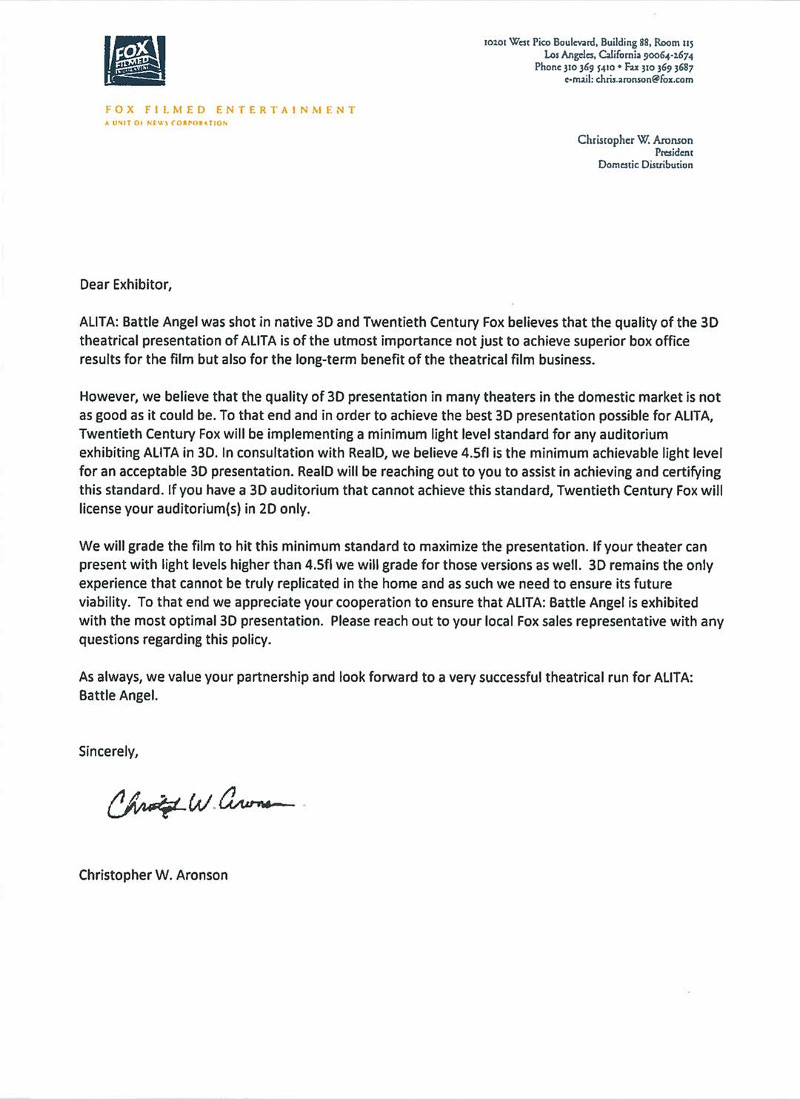
Wow. That letter really proves my point about the attitude of the studios... "...not just to achieve superior box office results for the film" (wonderful grammar there..NOT) "but also for the long-term benefit of the theatrical film business (note the use of film business, not exhibitors) It's all about the studio's greed folks.
And the total condescending tone of this: "However, we believe that the quality of 3D presentation in many theaters (wrong spelling, theatre is the correct one for cinema) in the domestic market (so I guess the rest of the 3D theatres elsewhere are perfect, right?) is not as good as it could be." Whose fault is that? Let's force super expensive projection equipment down everyone's throats, THEN make exhibs pay even more for 3D systems that are rarely used for any worthwhile films...amazing.
And the real whopper of all lies: "If your theatre can present with light levels higher than 4.5fl we will grade for those versions as well," Bad grammar aside, why are they going to go through the expense of grading for different 3D light levels? I don't know the exact costs of grading two separate versions for light levels, but I am pretty sure it isn't free, or cheap. Why not just release the low light version, and if the theatre CAN project at 4.5 or better, the image will finally be bright enough in 3D to be tolerable.
So that means at least three versions will be on the drive.... 2d, 3D under 4.5 and 3D 4.5 and up ..so now how much compression is gonna be done to fit all those on one drive? Or will there be multiple drives distributed, like in the old 35mm mono print vs. Dolby print days?
The stupidity of the studios continues to reach greater heights.
| IP: Logged
|
|
|
|
|
|
|
|
|
|
|
|
|
|
Marcel Birgelen
Film God
Posts: 3357
From: Maastricht, Limburg, Netherlands
Registered: Feb 2012
|
posted 01-27-2019 04:30 PM
quote: Carsten Kurz
Still, I can't see what's bad about a studio wanting to assure 4.5fL 3D as a minimum. That is already low enough. But we know that some screens, especially those with high-gain silver screens lit by underrated or burnt-down projectors/bulbs often achieve even less than that. Aiming at 4.5fL minimum can't be wrong.
There is nothing bad about a studio trying to assure a minimum presentation quality. But in this case, the problem is in how they're trying to achieve this.
If you want to assure consistent quality, you will need a more rigid method to implement this and keep on checking it.
The way it should be IMHO, in e.g. the case of RealD: RealD licenses technicians to do the measurement and those licensed technicians can get you a "certified" label after he/she measured your theater.
Having somebody shooting some pictures with an iPhone is total nonsense. There are dozens of iterations of iPhones, all with different lenses, sensors and software.
Also, an iPhone is not a calibrated device. It might have some kind of calibration once it left the factory, but still, there are almost infinite factors that might affect any objective conclusion.
quote: Mike Blakesley
Also "theatre" vs. "theater" -- I wish everyone would pick one and stick to it. It's the National Association of Theatre owners, but their correspondence has the word "theater" sprinkled through it. Studio onesheets are not consistent either. I don't think there is an official definition of the words.
Theater is the preferred American English way, whereas theatre is the preferred way every else where English is being used. So, I guess your choice simply depends on your primary audience. In any way, it should indeed be consistent, at least across a single publication.
NATO is an oddball thing, why they choose "Theatre" instead of "Theater" will probably remain a mystery, especially because one of the predecessors of NATO, the MPTOA, used "Theater": Motion Picture Theater Owners of America.
| IP: Logged
|
|
Martin McCaffery
Film God

Posts: 2481
From: Montgomery, AL
Registered: Jun 99
|
posted 01-27-2019 05:57 PM

quote: Marcel Birgelen
Theater is the preferred American English way, whereas theatre is the preferred way every else where English is being used. So, I guess your choice simply depends on your primary audience. In any way, it should indeed be consistent, at least across a single publication.
For the last few years I have been immersed in Trade Magazines and Newspapers from the beginning of motion pictures and before. "re" vs "er" is, and has been from the beginning, a stylistic choice.
Not only is there no right, wrong or preferred(accept maybe by the programmers behind auto-correct), I have theatre adds that spell it both ways within the same ad.
I use "re" because that is what was on the marquee when I got here.
I am, however, quite fond of "Theatorium", which achieved a degree of use in the teens, but never really caught on.
| IP: Logged
|
|
Marcel Birgelen
Film God
Posts: 3357
From: Maastricht, Limburg, Netherlands
Registered: Feb 2012
|
posted 01-28-2019 02:18 AM
quote: Martin McCaffery
Not only is there no right, wrong or preferred(accept maybe by the programmers behind auto-correct), I have theatre adds that spell it both ways within the same ad.
This seems to be a discussion we could continue for ages, which actually isn't bad, because at least I'm learning a thing or two in the process. ![[Smile]](smile.gif)
So, I did a little Googling, just a little really. I'd say that preferred depends on how often it is being used in actual publications. Apparently, someone has done a little research.
According to this research, somewhere in the later 1970's, the preferred way to spell theat{re,er} swapped from theatre to theater for American English publications.
| IP: Logged
|
|
|
|
Mike Blakesley
Film God

Posts: 12767
From: Forsyth, Montana
Registered: Jun 99
|
posted 01-28-2019 02:17 PM
Here's an graph that I found interesting. It shows the American usage of the two words. Take note that there is a huge peak in the use of "theatre" around 1930, which is the year my establishment was built. Hence it's no surprise that it was (and is) called the Roxy Theatre.
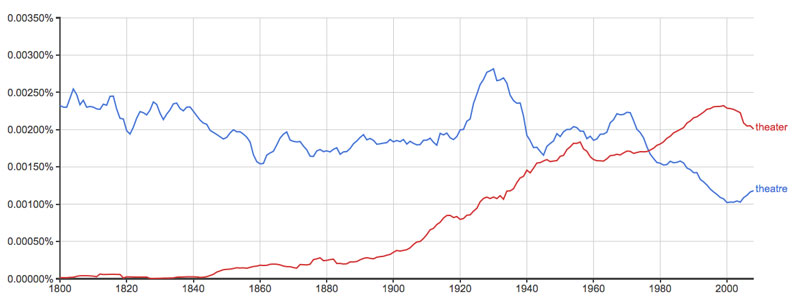
In Britain, 're' is still by far the most commonly-used version in all instances, no matter what kind of building, establishment or whatever is being discussed.
Generally I still use 're' when I refer to the Roxy, and 'er' if I use the word any other context. Ten years ago I was using 're' all the time. This is me giving into modern times...a little.
Here's an article which uses a lot of words to tell you that it really makes no difference which you use.
Writing Explained article
Theatre vs. Theater: What’s the Difference?
The words theatre and theater can be confusing to writers because it’s not immediately clear which word is the better choice — or if there’s a “better” choice at all. Are these just variants of the same word? Do they have different meanings or different functions within a sentence?
In today’s post, I want to address each of these questions so that you will never again have to second-guess yourself.
Theatre and theater are both nouns that mean a building, room, or outdoor structure for the presentation of plays, films, or other dramatic performances.
quote:
The auditorium of the theatre, which will open in Spring 2017, will be designed by Steve Tompkins and Roger Watts of Haworth Tompkins. –The Guardian
While London is fortunate in its heritage of Victorian and Edwardian theaters, relatively few new theaters of scale have been built in London in the last hundred years. –New York Times
They can also refer to the activity or profession of acting in, producing, directing, or writing plays.
quote:
What caused you to go into theater?
I have been in love with theatre even since I was a child.
You’re probably still wondering, “Okay, so when do I know which one to use and when?”
For the most part, there is no demonstrable difference in sense or function between them. There are, however, important dialectal differences to consider, which I will outline below.
When to Use Theatre
Theatre is by far the preferred spelling in British English in all senses of the word, plays, buildings, the art form, etc. The graph (above) illustrates just how deep the preference is for theatre in British English.
Clearly, if you are a British writer, or an American writer writing to a British audience, the correct spelling for you is theatre.
Part of a writer’s job is to know who his or her audience is. If your audience unanimously uses one spelling over another, you, as a writer, should take note of this to more effectively communicate to them.
This preference is not only borne out in popular usage in Britain, but popular British style guides like Fowler’s also list theatre as the preferred spelling in British English.
When to Use Theater
Theater is the preferred spelling in American English for all senses of the word, as the below graph illustrates.
Most American usage guides agree with this. Garner’s and The AP Stylebook both list theater as the preferred spelling. It is interesting to note, however, that theater has become the preference in American English only in the last 50 years or so, which makes some people reluctant to accept its spelling.
Others have attempted to distinguish between theatre and theater, with theatre being an art form and theater being a building where theatre is performed. None of these, however, has caught on and none is borne out in actual usage.
Unless theatre is used in the proper name of a building, production company, etc., theater is the correct spelling in American English. Some examples of theatre in proper names, the American Ballet Theatre, the Muncie Civic Theatre, etc.
These same preferences equally apply to the cinema as they do live theater. You should, therefore, write movie theater in America and movie theatre in Great Britain.
It is interesting to note, however, that movie theater is primarily a North American phrase. In Great Britain, they typically say, “We’re going to the pictures.”
| IP: Logged
|
|
|
|
|
|
All times are Central (GMT -6:00)
|
This topic comprises 4 pages: 1 2 3 4
|
Powered by Infopop Corporation
UBB.classicTM
6.3.1.2
The Film-Tech Forums are designed for various members related to the cinema industry to express their opinions, viewpoints and testimonials on various products, services and events based upon speculation, personal knowledge and factual information through use, therefore all views represented here allow no liability upon the publishers of this web site and the owners of said views assume no liability for any ill will resulting from these postings. The posts made here are for educational as well as entertainment purposes and as such anyone viewing this portion of the website must accept these views as statements of the author of that opinion
and agrees to release the authors from any and all liability.
|

 Home
Home




![[Wink]](wink.gif)
![[Roll Eyes]](rolleyes.gif)
![[evil]](graemlins/evil.gif)


 Printer-friendly view of this topic