Film-Tech Cinema Systems
Film-Tech Forum ARCHIVE


my profile | my password | search | faq & rules | forum home
  next oldest topic   next newest topic
» Film-Tech Forum ARCHIVE   » Operations   » Ground Level   » I get to see a carbon arc setup! (Page 4)

 
This topic comprises 7 pages: 1  2  3  4  5  6  7 
 
Author Topic: I get to see a carbon arc setup!
Charles Greenlee
Jedi Master Film Handler

Posts: 801
From: Savannah, Ga, U.S.
Registered: Jun 2006


 - posted 07-04-2006 03:37 AM      Profile for Charles Greenlee   Author's Homepage   Email Charles Greenlee   Send New Private Message       Edit/Delete Post 
Generator? I guess running standard current through a power conditioning circuit wouldn't work? Too much power for that? How does it work then? You use the house curent to drive a motor, and then the motor would turn a generator rated at the proper power requirements?

 |  IP: Logged

Stephen Furley
Film God

Posts: 3059
From: Coulsdon, Croydon, England
Registered: May 2002


 - posted 07-04-2006 03:43 AM      Profile for Stephen Furley   Email Stephen Furley   Send New Private Message       Edit/Delete Post 
Xenons weren't common over here until the tripling of existing cinemas; I suppose most of this happened between the late '60s and mid '70s.

ABC had a lot of sites with Philips projectors and converted magnarcs, with horizontal lamps. which seemed to work reasonably well. The original Ross machines were long gone at most of te ABCs.

The first xenon I saw in a cinema was at an Odeon, I can't remember which, sometime in the '60s I think it must have been, I was quite young at the time, where the original BTH lamphouses had been fitted with three electrode vertical lamps. The result was horrible, the colour was poor, and the light was uneven, and different for each projector. I asked to speak to the projectionist after the show, and was shown the new experimental setup. He told me that they had already had one lamp explode. I think there were a lot of problems with those early makeshift conversions; rectifiers with excessive ripple, poor lamps, and problems with both optics and cooling, in lamphouses which weren't designed for use with the vertical xenon lamps. Things have come on a long way since then.

 |  IP: Logged

Robert Throop
Master Film Handler

Posts: 412
From: Vernon, NY USA
Registered: Jun 99


 - posted 07-04-2006 09:22 AM      Profile for Robert Throop   Email Robert Throop   Send New Private Message       Edit/Delete Post 
[QUOTE]That unit was a monster - had a good 15bhp motor and the generator part had windings pretty big with the current heading towards a ballast section to keep things on the steady side.
The Stanley in Utica still has one of the original Westinghouse generators from 1928. It's rated at 25kw-250 amps continuous at 100 volts. It's driven by a 39 hp motor at 440 volts 3 phase.
There were originally 2 generators but one died some years ago. We now have a pair of rectifiers for backup but they are seldom used.
Bob

 |  IP: Logged

Stephen Furley
Film God

Posts: 3059
From: Coulsdon, Croydon, England
Registered: May 2002


 - posted 07-04-2006 09:44 AM      Profile for Stephen Furley   Email Stephen Furley   Send New Private Message       Edit/Delete Post 
The generators at the Loew's Jersey are still in place, at least they were the last time I went 'upstairs' there, but are not in use. I suspect that they've probably been out of use since the '50s at least for the projectors, since the Ashcrafts were originally installed. I don't think I've ever seen a cinema that was still using generators, though I've seen quite a few disused ones.

 |  IP: Logged

Richard Fowler
Film God

Posts: 2392
From: Ft. Lauderdale, FL, USA
Registered: Jun 2001


 - posted 07-04-2006 12:25 PM      Profile for Richard Fowler   Email Richard Fowler   Send New Private Message       Edit/Delete Post 
Motor generators are electric drive motors on the available current driving a suitable D.C. generator + a ballast to bring it to proper voltage. I had an indoor 500 seat cinema and a drive in with a partner in the early 1970's. we preferred using the generators since their output was more stable than the typical Tugar / selenium rectifiers in use. I remember having to disassemble and remove the armature for service to a motor shop....200+ pounds [Frown] When xenon started to become popular Kneisley had voltage converter kits to allow existing rectifiers and motor generators to be used for xenon use....I remember installing a few of these.

 |  IP: Logged

Rick Raskin
Phenomenal Film Handler

Posts: 1100
From: Manassas Virginia
Registered: Jan 2003


 - posted 07-04-2006 02:17 PM      Profile for Rick Raskin   Email Rick Raskin   Send New Private Message       Edit/Delete Post 
The first houses I worked were running Peerless lamps with Hertner M/G sets controlled with TransVerter boxes. One genset ran active while the other was for standby emergency use. We'd rotate the gensets about once a month to even out use. What I liked about generators was that the inertia of the flywheel would make them immune to fluctuations in line voltage. They did however, produce a slight dimming when the inbound machine's lamp was struck. I worked other houses that used Strong Futura II lamps with Strong Bi-Power rectifiers. These seemed to be somewhat prone to line voltage changes. As evening hours approached and people began putting more load on the electrical grid we would have to speed up the carbon feed motors to compensate. During the afternoon hours the reverse was true. I would imagine that power control systems have more than made up for that flaw by now, although Xenons would not have as much of an issue with line fluctuations as would carbons.

 |  IP: Logged

Dave Barker
Film Handler

Posts: 2
From: Nashville, IL / USA
Registered: Jun 2006


 - posted 07-04-2006 02:54 PM      Profile for Dave Barker   Author's Homepage   Email Dave Barker   Send New Private Message       Edit/Delete Post 
Hey guys,
New user here, been running projection since 1986 @ Nashville Illinois' "State Theatre". Up until 1992 we were running the carbon arcs and yes it was a rythm most of the time. Back then the reels were a bit more balanced in time so you had an idea how much carbon rod you needed for each reel. Nerves would tighten up if you got ahold of a rod that wanted to burn faster which meant going "lights out" before the next change over. Didnt happen often but a few times remember dousing the lamp, opening the lid, advancing the carbon with pliers, and restriking without stopping the print. Hated doing that even with a small crowd but it was better than waiting for the inevitable. We still have the carbon arc heads (x6) and power supplies (x4) which 1 pair im sure still function. The big thing was finding a supplier for the carbons. We still run dual Simplexes from the late 40's but Im glad at set up and tear down because platters seem to be alot more work prepping.

 |  IP: Logged

Rick Raskin
Phenomenal Film Handler

Posts: 1100
From: Manassas Virginia
Registered: Jan 2003


 - posted 07-04-2006 03:36 PM      Profile for Rick Raskin   Email Rick Raskin   Send New Private Message       Edit/Delete Post 
Hi Dave, and welcome. As you probably have seen by now there is a wealth of knowledge here. Post a question and I dare say someone will have the answer or go looking for it. Enjoy your time browsing. How about some pictures of your booth and theatre?

 |  IP: Logged

Monte L Fullmer
Film God

Posts: 8367
From: Nampa, Idaho, USA
Registered: Nov 2004


 - posted 07-04-2006 04:24 PM      Profile for Monte L Fullmer   Email Monte L Fullmer   Send New Private Message       Edit/Delete Post 
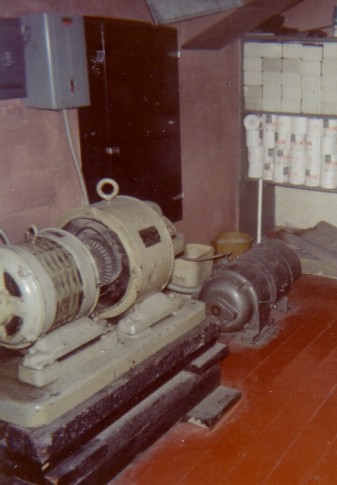
This pict if of the theatre I worked at for quite the time - the generator/janitor supply room, which was next to the booth. The large unit was an old Westinghouse, and the smaller grey unit was an General Electric.
 -

Behind the big generator setup, on the other side of the wall, was the ballast assembly for this unit. The panel behind the smaller generator unit held the switching knives to go between the two units.

Both units sat upon corkboard and rubber sheets to absorb the vibrations that these two units emitted so it wouldn't travel down into the auditorium since this room and booth was actually situated underneath the balcony floor - and the booth floor was above the main auditorium ceiling.

The Large unit had the 15bhp motor and the smaller unit was a 7bhp motor unit - which was far more stable than the older unit. But, once every other week on a shift, I would switch between the two units...

Our rod size were 6mm and 7mm rods when this pic was taken.

Later on, the company who owned this theatre decided that I needed more light on the screen. Thus my rod size went up to 8mm and 9mm .. and the smaller generator unit didn't have the current output to handle these larger rods. Thus, rectifiers were installed in that smaller generator's place.

Yet, the large generator unit could easily handle those larger rods with no problems. Thus, I would rotate from rectifer to the large generator unit once a week.

-Monte

 |  IP: Logged

Tim Reed
Better Projection Pays

Posts: 5246
From: Northampton, PA
Registered: Sep 1999


 - posted 07-04-2006 04:47 PM      Profile for Tim Reed   Author's Homepage     Send New Private Message       Edit/Delete Post 
quote: Frank Angel
There was only a single generator and when you would strike the second arc while the other lamphouse was still lit, the light would dim a bit on it but it wouldn't go out and for the minute or two while you were waiting for the motor/sync cue, both lamps were burning.
Frank, MG sets were designed to run both lamps. Also, if striking the incoming lamp caused the other to dim, either the generator voltage wasn't being run high enough, there was a problem with the ballast, or both. [Smile]

Btw, where are your radio spots?

 |  IP: Logged

Charles Greenlee
Jedi Master Film Handler

Posts: 801
From: Savannah, Ga, U.S.
Registered: Jun 2006


 - posted 07-04-2006 09:28 PM      Profile for Charles Greenlee   Author's Homepage   Email Charles Greenlee   Send New Private Message       Edit/Delete Post 
You're right, platters do take a bit to set up, but once the print's built, it's just thread and play. No change overs, no rewind,. You just wrap and tuck, puck, strap, or whatever your house prefers, the tail thread it up again (set the payout/rewind switches if your platter doesn't autosense) However, I'd suspect that this'd make a lazy projectionist think that he can walk away, and only come back when he hear the display unit buzz telling him it's finished. While technically, he'd be right, you really need to remember to check periodically on the print, something easy to forget with platters.

[ 07-05-2006, 09:41 PM: Message edited by: Charles Greenlee ]

 |  IP: Logged

Paul Gordon
Jedi Master Film Handler

Posts: 580
From: Ottawa, Ontario, Canada
Registered: Aug 2005


 - posted 07-05-2006 08:30 AM      Profile for Paul Gordon   Author's Homepage   Email Paul Gordon   Send New Private Message       Edit/Delete Post 
I can see a few advantages to setting up a carbon arc setup today though.. the lamphouses you can get for next to nothing, the rods for free, and you don't need 3-phase power. For someone setting up a theatre for part-time shows or summer runs it would be a big cost saver.

 |  IP: Logged

Steve Guttag
We forgot the crackers Gromit!!!

Posts: 12814
From: Annapolis, MD
Registered: Dec 1999


 - posted 07-05-2006 08:42 AM      Profile for Steve Guttag   Email Steve Guttag   Send New Private Message       Edit/Delete Post 
quote: Paul Gordon
I can see a few advantages to setting up a carbon arc setup today though.. the lamphouses you can get for next to nothing
Same goes for xenon if you are talking about similar age or even a decade or two newer

quote: Paul Gordon
, the rods for free
Most of which are junk or of questionable quality unless you find some olden UCARS

quote: Paul Gordon
and you don't need 3-phase power.
Xenons do not require 3-phase power...larger ones are advised to for high-reactance rectifiers. With switchers, you can pretty much run what you have so long as power-in = power-out.
quote: Paul Gordon
For someone setting up a theatre for part-time shows or summer runs it would be a big cost saver.
Not too likely. Carbons lamphouses are big and bulky..to get a good light the draft has to be set just right. Depending on how big the system is to be, a xenon based system will be in and out faster and cheaper.

About the only thing carbons have going for them is that their light is much better than Xenon (quality of the light...continious spectrum, matches sunlight pretty well).

 |  IP: Logged

Stephen Furley
Film God

Posts: 3059
From: Coulsdon, Croydon, England
Registered: May 2002


 - posted 07-05-2006 09:33 AM      Profile for Stephen Furley   Email Stephen Furley   Send New Private Message       Edit/Delete Post 
No risk of explosion, though that's much reduced with modern xenons anyway.

You can run carbons for a few minutes, put them out and re-strike without wastage; useful for 2k spools, short extracts of film diring events like lectures and on-stage interviews etc, of for a machine that just gets used to run a few minutes of ads or trailers every few hours.

For very occasional use, somewhere that only runs film once or twice per year, it's probably cheaper to buy a few more boxes of carbons than to convert to xenon.

Most of the cinema rectifiers i've seen, except the smallest, have been three phase, whether for carbon or xenon. Just about any cinema would have three phase power available anyway, so it's not likely to be an issue, except possibly for portable equipment.

If you have a large stock of carbons available there's no problem, but new ones are very expensive, if you can find good ones. Morganite and Ship haven't been made for years; I think the only ones you can get here now are Marble. I had some that seemed ok, but others have had problems with them.

[ 07-05-2006, 10:57 AM: Message edited by: Stephen Furley ]

 |  IP: Logged

Charles Greenlee
Jedi Master Film Handler

Posts: 801
From: Savannah, Ga, U.S.
Registered: Jun 2006


 - posted 07-05-2006 09:56 PM      Profile for Charles Greenlee   Author's Homepage   Email Charles Greenlee   Send New Private Message       Edit/Delete Post 
And, if you truely can't get a 3-phase line put in, or access to one on a traveling bit. There are convertors. The work similar to the way you say the carbon arc suppy's do. They take in standard line voltage, 120V 60HZ single phase, use it to run a motor, which in turn, turns a 3-phase generator. I've read that's a idea Fantasia's roadshow used in 1940's, for that exact reason. There are units available today, probably more effecient I'd hope. From what I understand, it's still the most effective and efficent way to convert 1-phase to 3-phase.

 |  IP: Logged


All times are Central (GMT -6:00)
This topic comprises 7 pages: 1  2  3  4  5  6  7 
 
   Close Topic    Move Topic    Delete Topic    next oldest topic   next newest topic
 - Printer-friendly view of this topic
Hop To:


Powered by Infopop Corporation
UBB.classicTM 6.3.1.2

The Film-Tech Forums are designed for various members related to the cinema industry to express their opinions, viewpoints and testimonials on various products, services and events based upon speculation, personal knowledge and factual information through use, therefore all views represented here allow no liability upon the publishers of this web site and the owners of said views assume no liability for any ill will resulting from these postings. The posts made here are for educational as well as entertainment purposes and as such anyone viewing this portion of the website must accept these views as statements of the author of that opinion and agrees to release the authors from any and all liability.

© 1999-2020 Film-Tech Cinema Systems, LLC. All rights reserved.