|
|
This topic comprises 3 pages: 1 2 3
|
|
Author
|
Topic: First US Theatre With LED Screen
|
|
|
Marcel Birgelen
Film God
Posts: 3357
From: Maastricht, Limburg, Netherlands
Registered: Feb 2012
|
 posted 04-23-2018 01:01 AM


quote: Steve Guttag
They are starting at 4K resolution, yes they can play 2K but none are native 2K.
Well, according to the article, there are also 2K versions: It offers a 17-ft. screen that can play 2K resolution, standard or high dynamic range, 7.1 surround sound, and offers a Blackmagic DaVinci Resolve color grading system. Samsung hopes to add its screens in more post houses.
Yes, 17 ft. isn't really a large screen and maybe the configuration is only available for production facilities, but that also somehow feels backwards.
quote: Mike Blakesley
We are running 4kw. I guess the biggest benefit I could see from Laser would be not having to replace bulbs, but what's the lifetime of a laser system?
The claims I've been told vary between 20k and 50k hours @100%. The problem obviously is, nobody is willing to give you a hard warranty on such an extended period.
Also, nobody is telling you exactly what those numbers represent. Are those averages? If so, what is the expected standard deviation?
The oldest systems in place I know off, are about two years of age now, they're not showing any noticeable degradation on the light output yet.
| IP: Logged
|
|
Jack Ondracek
Film God

Posts: 2348
From: Port Orchard, WA, USA
Registered: Oct 2002
|
posted 04-23-2018 09:12 AM

quote: Leo Enticknap
For the Barco DP4K-30L that was installed at the Egyptian while I worked there, we were told 30,000 hours running at 100% power, with no dropoff in lumen output. Likely longer if the laser diodes were not being run on "maxed out" power. That's roughly 10-12 years in a typical multiplex pattern of usage (running for 12 hours or so a day), and obviously a lot longer if you're playing shows for fewer hours a day/week.
They're heading in the right direction, but I don't think we're quite yet ready to push the "commit to buy" button.
Our DP2K-32B is rated at 33,000 lumens with a 6,500 watt bulb, running full-out. We get about half-life out of any bulb we've put in the machine before the drop-off is beyond its CLO function to keep up and our foot is planted firmly to the floor. That means we're getting roughly 250 hours +/- before we need a fresh bulb to keep up. At average prices, given we're a drive-in with a 3.5 to 4.5-hour night, that puts us at an ongoing cost of about $3,300/year for bulbs.
According to spec, the DP4K-32L comes out of the gate at "up to 28,000 lumens" and loses "less than 20% (during a life of) 30,000 hours". So... by the time this machine hits max-hours (about 60 years at my place, or well beyond the point that I'm interested in much of anything), we're down to 24,000 lumens.
This assumes the machine runs that long at full power. The tech companies I've talked to believe these numbers are only good if you keep the machine at %50 output or less, which most certainly puts its performance beneath that of what we now have. The Barco spec sheet is silent on this point.
By ignoring the urge to run our bulbs to warranty, and instead, changing them at about half-life, our -32B gives us performance I consider to be "on the lower half of pretty darned good". I'd like to push that evaluation up a bit, but I don't think we're quite there yet...
Our -23B machines easily get to warranty. I don't see laser penciling out on that size unit... ever. I'd like to see myself running that model until they quit making xenon bulbs or the traces come off the circuit boards... but you never know about this stuff.
A LED screen for a drive-in? Oh... hahahaha... good one! Just let me pull my wallet out and... ummmmm.. nope. OTOH, we wouldn't have to worry about the sound... already got that figured out.
The notion that LED will be the "great disruptor" and will, eventually, replace conventional projectors and screens may well happen... but probably so will the Jetsons' flying cars, and you and I won't live long enough to see that. Remember, it wasn't that long ago that a huge percentage of the exhibitors in our country were squawking about upgrading their readers with a $700 LED replacement... and it took the studios' participation (and some crowd funding) to get much of the digital conversion accomplished. A year or two before the big chains fully converted, at least one of them was still putting 35mm installations in their new builds.
| IP: Logged
|
|
|
|
|
|
|
|
Bobby Henderson
"Ask me about Trajan."

Posts: 10973
From: Lawton, OK, USA
Registered: Apr 2001
|
posted 04-23-2018 02:14 PM
quote: Terry Monohan
Now let's see If they can come out with a way larger screen like 85 feet and have It curved.
How about something like this?
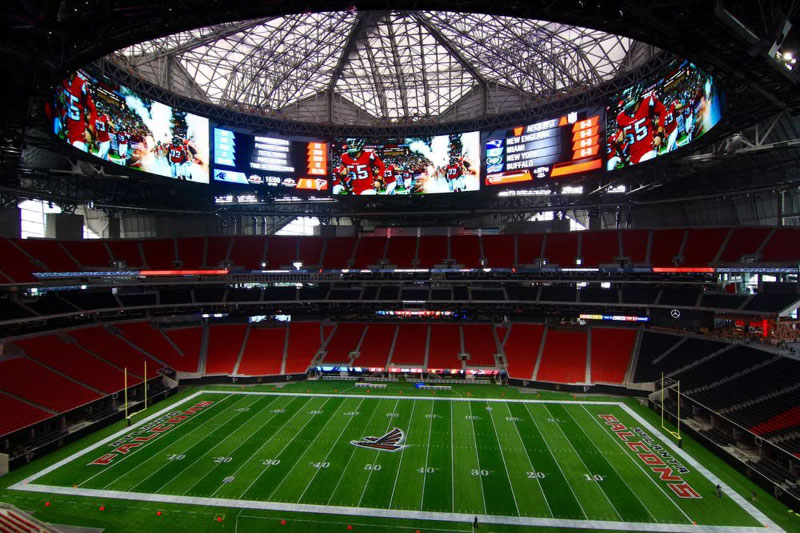
That's the Mercedes Benz Stadium 360° halo board. It's 58 feet tall, 1075 feet in circumference, roughly 62,350 square feet in size. Resolution of the board is 21512 X 1152 pixels.
LED-based displays have been customized to follow curves or fit unusual shapes for many years now. The Colorado Rockies baseball stadium has a new 8369 square foot LED display with the top edge of the screen following the jagged mountain shape of the team logo. The LA Dodgers had a hexagonal-shaped LED display tailored to the shape of their old outfield scoreboard. The NASDAQ sign in Times Square not only follows the cylindrical curve of the building's SE corner, but it also has holes in it for building windows. Las Vegas has many customized LED sign installations following curves, unusual shapes or even filling large letters.
Cost is the main limitation with LED displays. It's physically possible to build a giant sized dome screen theater with a LED-based screen. Pixel pitches can scale down as tight as 1.2mm between pixel centers. But who could shoulder the outrageous cost of such a thing?
quote: Mike Blakesley
I'm curious why a 35-foot screen is $500,000 to $800,000, yet you can buy an LED seven-foot screen TV (complete with a tuner and crappy speakers) for under $3000.
The reason is because you're making an apples to oranges comparison. There are lots of physical differences between a large LED-based sign and a small consumer product TV screen. These LED signs have individually manufactured, high intensity LEDs assembled into the driver board tiles. Each pixel will have at least 3 or 4 individual LEDs. The faces of each board have louvers separating the rows of individual LEDs. The insides of these tile boards all have their own electrical and computer-based components, connecting cables, etc. TV sets are not made like that at all.
| IP: Logged
|
|
|
|
|
|
|
|
|
|
|
|
Marcel Birgelen
Film God
Posts: 3357
From: Maastricht, Limburg, Netherlands
Registered: Feb 2012
|
posted 04-23-2018 07:11 PM
quote: Mike Blakesley
Ok, thanks for that explanation. But TV set pictures are outstanding...why can't they just make a big theater screen using the same process as a TV set, only bigger? If a cinema screen is going to be compared to a big TV, why not just make it that way?
Your average LCD screen isn't really sufficiently bright for outside application. You might remember that when you try to look at your phone when the sun is hitting it.
So, LCD technology is out for this purpose, no matter how you scale it.
Then, the only alternative is OLED. OLED is already pretty expensive and when you go big, there is no real advantage over OLEDs compared to "traditional LEDs".
The problem here is that current LED walls are still not really a mass-manufactured product like normal "consumer screens". Also there, you'll notice that only the common resolutions are real cheap. If you're looking for an LCD based screen with an odd resolution or configuration, it will become extremely expensive quite easily.
Like I mentioned in my previous post: If they can figure out to make LED wall modules like they produce current screens, much like microchips are being made and they figure out a way to reduce the amount of material required for such a module, the price could drop dramatically. I don't see any reason why we couldn't create an IC-like surface populated with multi-color LED arrays. It will just take a while to get it right and to get it ready for mass-production.
There is a huge potential market out there, so I think it will be only a matter of time once mass-manufacturing of standard "LED wall" modules start to get hold.
| IP: Logged
|
|
Frank Angel
Film God

Posts: 5305
From: Brooklyn NY USA
Registered: Dec 1999
|
posted 04-23-2018 08:20 PM
[QUOTE] That is not really the intention and working of Atmos. Look around in an ATMOS auditorium. Notice how MANY speakers you see?/QUOTE] Carsten, I get that, so what if you surrounded the perimeter of the screen, above, below and on both sides with speakers, wouldn't applying the object-based processing principal be used to locate sound points pretty much anywhere across the screen surface? I mean, it can locate sounds above and blow the screen with just the standard L,C,R and some height speakers...if there were more of a concentration of speakers around the perimiter around the screen, seems intuitive that a processor could create the same kind of phantom location across the screen as it creates phantom sounds at locations in the middle of the theatre where there are no speakers. After all, with only three speakers behind the screen in a 5.1 or 7.1 system, we are presumably creating the illusion that voices are moving across the screen in places where there are no speakers. Having speaker systems above, below and on either side of the screen..maybe dozens of speakers surrounding this Jumbotron LED screen frame seems like enough location points to be able to create the illusion that voices are coming from the middle of the screener anyplace else the processor wants to place them.
| IP: Logged
|
|
Lyle Romer
Phenomenal Film Handler
Posts: 1400
From: Davie, FL, USA
Registered: May 2002
|
posted 04-23-2018 09:02 PM
quote: Mike Blakesley
why can't they just make a big theater screen using the same process as a TV set, only bigger?
Probably has a lot to do with production yield. LG was happy to exceed 85% yield on their OLEDs. Throwing out 15% when producing theatre sized screens will drive costs up a lot.
Also, manufacturing technology will have to be developed to seamlessly join strips of OLED display together. It wouldn't be cost effective to try and develop equipment that can produce 15+ foot sizes in the narrowest dimension. No way the tooling to produce consumer sized screens can produce those sizes.
You'd also need some kind of cleanable/changeable protective coating. This is a challenge if the screen is also perforated for sound (pretty much removes changeable from the equation because you'd have to get the perfs to line up again). You can't have some idiot throwing food or drink at the screen able to ruin a $100,000+ screen
Then, compared to the LED display, if you get a bad pixel or segment, the whole thing will need to be replaced vs a single module.
When it becomes cheaper to use OLED for giant displays and billboards than LED, that's when it will make sense for theatre screens. If a company like Daktronics is making huge OLED displays for other applications, it will be a no brainer to make them available for theatres.
I think it will take a specialty company like that to develop things like joining OLED panels into a single display.
| IP: Logged
|
|
|
|
All times are Central (GMT -6:00)
|
This topic comprises 3 pages: 1 2 3
|
Powered by Infopop Corporation
UBB.classicTM
6.3.1.2
The Film-Tech Forums are designed for various members related to the cinema industry to express their opinions, viewpoints and testimonials on various products, services and events based upon speculation, personal knowledge and factual information through use, therefore all views represented here allow no liability upon the publishers of this web site and the owners of said views assume no liability for any ill will resulting from these postings. The posts made here are for educational as well as entertainment purposes and as such anyone viewing this portion of the website must accept these views as statements of the author of that opinion
and agrees to release the authors from any and all liability.
|

 Home
Home






 Printer-friendly view of this topic