Film-Tech Cinema Systems
Film-Tech Forum ARCHIVE


my profile | my password | search | faq & rules | forum home
  next oldest topic   next newest topic
» Film-Tech Forum ARCHIVE   » Community   » Film-Yak   » Glen Cinema Disaster of 1929 (Page 3)

 
This topic comprises 3 pages: 1  2  3 
 
Author Topic: Glen Cinema Disaster of 1929
Tim Reed
Better Projection Pays

Posts: 5246
From: Northampton, PA
Registered: Sep 1999


 - posted 02-03-2005 08:04 PM      Profile for Tim Reed   Author's Homepage     Send New Private Message       Edit/Delete Post 
Thanks, Leo. I've checked several online bookstores, in hopes that I could avoid overseas shipment. At about $77 USD, and who knows how much shipping, I don't see that I'll be able to own a copy any time soon.

 |  IP: Logged

William Hooper
Phenomenal Film Handler

Posts: 1879
From: Mobile, AL USA
Registered: Jun 99


 - posted 02-04-2005 03:13 AM      Profile for William Hooper   Author's Homepage   Email William Hooper   Send New Private Message       Edit/Delete Post 
quote: Hugh McCullough
Fireproof meant that they had to be made of Oak, and be able to resist fire for at least 30 minutes.
In the USA, approved fireproof doors were tin-clad. It is strange from this experience to see wooden fire doors, even oak. The doors were also self-closing, & tied into fusible-link & manually-operated mechanisms like the porthole shutters.

Continue plugging your site, it's excellent, very interesting & informative.

Can you put a name to this sound head? This is a test for Gordon McLeod.

Modern cue marker A much nicer unit than the common US Clint Phare marker. Who is the manufacturer? Scott Norwood must have one to terrify casual onlookers in the booth.

Typical roof void construction in 1930s theatre Are those wooden rafters over steel trusses? I can't think of any 1925-1955 USA theatre attic I've poked around in that had wooden rafters.

quote: Bernard Tonks
In all the cinemas I worked in during the nitrate film era, the fused link above the projectors as with manual operation also released open the very large skylight windows centre of the projection room and rewind room for the fumes to escape.
I have never seen this in projection booths in US theatres. It's always a flat ceiling of poured concrete about 4" - 6" thick. Sometimes there are windows in the booth, UL fireproof, not self-closing. I assume the functional idea of them is thes same as of the skylight/hatches in the roof of a stage house: The are tied to the fire curtain, so that when the fire curtain is dropped, the hatches in the roof open, extracting smoke & preventing it from entering the auditorium.

 |  IP: Logged

Hugh McCullough
Expert Film Handler

Posts: 147
From: Old Coulsdon, Surrey, UK
Registered: Jan 2003


 - posted 02-04-2005 05:16 AM      Profile for Hugh McCullough   Author's Homepage   Email Hugh McCullough   Send New Private Message       Edit/Delete Post 
William Hooper said

quote:
Modern cue marker A much nicer unit than the common US Clint Phare marker. Who is the manufacturer?

Typical roof void construction in 1930s theatre Are those wooden rafters over steel trusses?

The cue marker was made by Premier, but I think they went out of business a few years ago.
The wooden rafters are supported at each end by steel girders riveted to the upright, and angled girders that support the main flat roof. This was also supported by the 3ft thick outside walls.

 |  IP: Logged

Dick Vaughan
Phenomenal Film Handler

Posts: 1032
From: Bradford, West Yorkshire, UK
Registered: Jul 2000


 - posted 02-04-2005 05:24 AM      Profile for Dick Vaughan   Author's Homepage   Email Dick Vaughan   Send New Private Message       Edit/Delete Post 
Philip Rigby and Sons who make Premier equipment are still around.

From BKSTS website

quote:
PHILIP RIGBY & SONS LTD
Philip Rigby and Sons Ltd manufacture and supply a large range of Premier precision film equipment, splicers, rewinders, synchronisers, spools, splicing tapes, film cleaning systems etc – in fact, everything for film. They also have a range of items for audio and video.
philiprigbysonsltd@btinternet.com


 |  IP: Logged

Bernard Tonks
Jedi Master Film Handler

Posts: 619
From: Cranleigh, Surrey, England
Registered: Apr 2001


 - posted 02-04-2005 06:17 AM      Profile for Bernard Tonks   Email Bernard Tonks   Send New Private Message       Edit/Delete Post 
quote: William Hooper
I have never seen this in projection booths in US theatres. It's always a flat ceiling of poured concrete about 4" - 6" thick. Sometimes there are windows in the booth, UL fireproof, not self-closing. I assume the functional idea of them is thes same as of the skylight/hatches in the roof of a stage house: The are tied to the fire curtain, so that when the fire curtain is dropped, the hatches in the roof open, extracting smoke & preventing it from entering the auditorium.
That is correct, the same as a live theatre / cinema stage house.

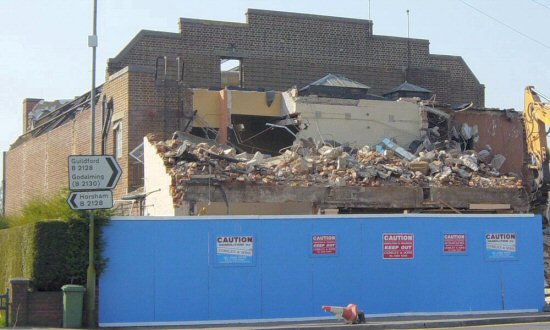
Here is a picture of the skylights for the projection room and separate non-sync room. There was also a skylight over the rewind room but that was demolished just before this picture was taken.

 -

 |  IP: Logged


All times are Central (GMT -6:00)
This topic comprises 3 pages: 1  2  3 
 
   Close Topic    Move Topic    Delete Topic    next oldest topic   next newest topic
 - Printer-friendly view of this topic
Hop To:


Powered by Infopop Corporation
UBB.classicTM 6.3.1.2

The Film-Tech Forums are designed for various members related to the cinema industry to express their opinions, viewpoints and testimonials on various products, services and events based upon speculation, personal knowledge and factual information through use, therefore all views represented here allow no liability upon the publishers of this web site and the owners of said views assume no liability for any ill will resulting from these postings. The posts made here are for educational as well as entertainment purposes and as such anyone viewing this portion of the website must accept these views as statements of the author of that opinion and agrees to release the authors from any and all liability.

© 1999-2020 Film-Tech Cinema Systems, LLC. All rights reserved.