|
|
This topic comprises 3 pages: 1 2 3
|
|
Author
|
Topic: Recording LPs on a PC
|
|
|
Michael Schaffer
"Where is the
Boardwalk Hotel?"

Posts: 4143
From: Boston, MA
Registered: Apr 2002
|
 posted 03-30-2005 05:02 AM


To be honest, I have never been a big fan of the "Living Stereo" recordings. Not necessarily because of the RIAA curve (I didn't know about this before), the ones I heard (mostly Reiner/Chicago albums) I found very good for their time, but not exactly breathtaking. This may be in part because I am not very interested in Reiner's sterile approach and the clean but unidiomatic sound of the CSO. But I also never found them to sound extraordinarily great in terms of definition, clarity, spacing and placement. They are definitely very good for their time, but were outdone spectacularly by some of Decca's best recordings only a few years later (mostly the ones made under the supervision of John Culshaw in Vienna), some (but not very many) of DGG's early 60s efforts, and easily paralleled in their time by EMI's finer recordings, both stereo and mono.
Columbia also made some very fine early stereo recordings, mostly in LA with the LA Philharmonic billed as "Columbia Symphony".
I don't know why stereo recordings were not made earlier. Maybe many engineers didn't feel comfortable with the technique, or labels thought the market wasn't ready for them yet.
The earliest stereo recording I know is this here
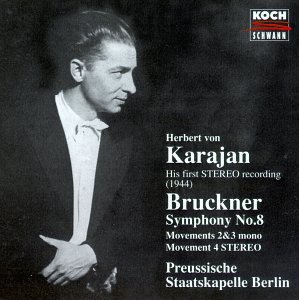
I don't know if it is the earliest ever made, probably not, but I don't know of any earlier ones.
This recording was begun in June 1944 (as if they didn't have other problems at that time) and had to be stopped because of wartime shortages. By the time recording sessions were resumed in September of the same year, the stereo recording technique was ready, and so the last movement was taped in stereo. It sounds amazingly good - for the time -, and it is interesting to compare the leap of sound quality between movements 2 and 3 and the stereo 4 (the tapes of the first are lost). Unfortunately, I do not know what kind of equipment they used.
| IP: Logged
|
|
Leo Enticknap
Film God
Posts: 7474
From: Loma Linda, CA
Registered: Jul 2000
|
posted 03-30-2005 05:25 AM
quote: Michael Schaffer
don't know why stereo recordings were not made earlier. Maybe many engineers didn't feel comfortable with the technique, or labels thought the market wasn't ready for them yet.
Suggested reading; more suggested reading.
quote:
Unfortunately, I do not know what kind of equipment they [the Nazis] used.
As with Agfacolor, the Nazis invested heavily in magnetic tape recording R & D. The 'Blattnerphone' wire recorder was in use by German broadcasters from 1929, and in 1934 BASF successfully developed a technique for coating ferric oxide onto a diacetate base. During WWII, BBC technicians monitoring Nazi 'black' propaganda broadcasts couldn't work out how speakers managed to travel across the country (i.e. to the places at which the broadcasts originated) so quickly: because the signal quality was much higher that was possible from an acetate phonograph (disc) broadcast, they assumed that the broadcasts had to be live. They had no idea that the Nazis had developed tape recording so far. More info and references are here.
As far as Living Stereo goes, if you've only heard the CD rereleases try and get to hear an LP or two. I've got both the LP and the CD of the Chicago SO/Reiner Also Sprach Zarathustra: the CD is sterilised. OK, the tape hiss is gone, but so is a lot of the reverb and the ambience of the hall. The LP is much punchier and the Chicago brass section really does blast out of the speakers. That having been said, I'm not a big Reiner fan either. Like most post-60s Karajan, his performances seem characterless.
| IP: Logged
|
|
Stephen Furley
Film God
Posts: 3059
From: Coulsdon, Croydon, England
Registered: May 2002
|
posted 03-30-2005 06:09 AM
Leo, if I'm not mistaken, wasn't the Blattnerphone a steel tape machine, similar to the slightly later Marconi-Stille, with spools about size of 35mm film spools on towers?
I've never heard a wire recorder, though I have seen a few, including one which contained a record player, with the turntable acting as the take-up spool for the wire. Wasn't wire also used for 'black boxes' in aircraft until replaced by solid state digital systems in fairly recent times.
There's a man who tours round various shows, I've seen him most recently at the steam show at the Isle of Wight Steam Railway in August, with various 'talking machines'. He had an Edison Phonograph, which I was quite impressed with, considering the small diameter of the cylinder, and the fairly low speed that it turned at; it didn't sound much worse than a 78.
He also had something that I've never seen elsewhere. It was a wartime machine, anout the size of a large tape recorder from the '50s, which recorded on 35mm film. It wasn't an optical recorder, it actually cut a groove in the film, which was in an endless loop of about 300 feet, feeding from the centre, and taking up on the outside. The cutting head slowly moved across the width of the film, recording many tracks. I don't know what the total recording time was, but I think it would be several hours. I wouldn't care to guess how the machine coped with a splice in the film, of which there must have been at least one. The grooves looked about the same size as those on a 78.
From the same sort of era, how about the machine which mechanically recorded an optical track on 17.5mm dye coated film. I can't remember the name of the thing at the moment, but the BBC used it for a while, and it was said to be quite sucessful. I think supplies of film for it dried up during the war.
There were certainly some good portable (just!) wartime German tape machines, I've heard one working. I think the main cotribution that they made to the technology was the development of high-frequency bias. I think this technology came into the hands of Ampex after the war, and things developed rapidly; by 1956 the first 2" quad video recorder was on sale, if you could afford over $20,000 for it, the BBC didn't buy one until about five years later, having first experimented with their own VERA (Video Electronic Recording Apparatus) system.
I have some very good music recordings, both classical and jazz, made in the mid '56s to early '60s, released on either LPs or CD. A little bit of hiss, but nothing objectionable.
| IP: Logged
|
|
Michael Schaffer
"Where is the
Boardwalk Hotel?"
Posts: 4143
From: Boston, MA
Registered: Apr 2002
|
posted 03-30-2005 07:18 AM
quote: Leo Enticknap
They had no idea that the Nazis had developed tape recording so far.
I don't know much about the background of the people who worked on these projects, some of them may have been party members, but I doubt that "the Nazis" as such developed tape recording to any degree. They were a political party which controlled the country, not an R&D facility. And they weren't in power in 1929 (that happened in 1933), so I guess they had nothing to do with the "Blattnerphon" either. At that time, they were more into donning brown shirts and storming communist party gatherings. I am a little surprised somebody as widely read as you doesn't know that difference.
Apart from the above mentioned recording from 1944, the only other early multichannel audio projects that I know of are the projects undertaken by RCA in the early 30s when they transmitted a concert from Philadelphia (?) to New York (?) - I don't recall the exact time and place and details -, and of course more film-related, "Fantasia". It would be interesting to learn more about other projects such as these.
quote: Stephen Furley
I think this technology came into the hands of Ampex after the war, and things developed rapidly; by 1956 the first 2" quad video recorder was on sale
Wasn't Ray Dolby also involved in that project as a young engineer?
| IP: Logged
|
|
Bruce McGee
Phenomenal Film Handler

Posts: 1776
From: Asheville, NC USA... Nowhere in Particular.
Registered: Aug 1999
|
posted 03-30-2005 07:46 AM
This is interesting. The red RCA reel to reel tape. I have about 90 rolls of this tape. Most are pre-recorded 2-tracks from around 1957-1968. The rest are valuable family recordings of long-gone relatives that I made. I have an Ampex AG-440C 2-track deck, and a Technics 1500 that has a 2nd head-set for 4-track stereo.
None of the RCA tapes exhibit 'sticky shed' problems, Ditto for all the rolls of Scotch 111, 206, 207, etc.
Around 1976, I bought a load of Ampex 456 'Grand Master' 1/4" tape for my archives. I dubbed several of my worst RCA tapes (splicy edited masters) to the new Ampex tape, and shelved the originals, never to be heard again... until...
Around 1996, I was making copies of tapes of relatives for my cousins. I discovered that most of my Ampex tape is now gooey and sheds like crazy, while my RCA, etc. tape was perfectly fine. I had to use my RCA masters on several of these recordings. I remade a bunch of splices!
Eventually, I heard about baking the rolls of master tape in a small electric oven set on 'warm' for 4-6 hours. This 'dries' the bad tape enough to get me one good pass to make a new copy. It never gets hot enough to warp or damage the reels.
As for recording LP's, I WISH I had a Technics 1200 series turntable. As is, I made-do with a rebuilt Sony turntable that I bought new in 1976. It is adequate. I recorded most of my best albums to tape when I bought them, so I have beautiful copies of alot of my stuff... 2000 albums total.
When I was a kid, back when the earth cooled, I was told that Germany had really come along way with magnetic tape when the Allies 'liberated' it in the late 1940's.
| IP: Logged
|
|
|
|
|
|
|
|
Stephen Furley
Film God
Posts: 3059
From: Coulsdon, Croydon, England
Registered: May 2002
|
posted 03-30-2005 01:58 PM
Wasn't it Telefunken that did the development on magnetc recording in Germany?
Magnetic recording itself, though not in a practical form, goes back a long time. I beleve the orgnal intended applcation was as an office dictating machng, but until the development of the triode valve (I'm not going to get involved in the arguments as to who invented that), there was no way to amplify the signal from it to a usable. By the start of the war the technology was still at the level of a few dictating machines, and wire recorders, plus things like the Marconi-Stille machine, using metres of steel tape per second, which had to be welded together if it broke (I bet that did wonders for the sound quality as the splice ran through!) By the end of the war the machines being produced in Germany were certainly practical, if rather heavy and bulky by todays standards. I think the contribution by Ampex was more in manucacturing and marketing of a product than in the technological development of the process, as far as audio recording was concerned. Where Ampex did development was iin extending the technology to video recording. I am not aware of any pre-war non-film video recording process, except dor a few 30-line disks recorded, but I don't think played back, by Baird. Some of these survive, and have now been replayed, the results are on the web somewhere. Obviously, these were purely experimental.
In 1940 magnetic recordng was hardly used; by the early '50s it had almost totally replaced both direct disk cutting, and optical film recording for original recording of sound. Within just a few more years, it was being widely used for both video and data recording, though obviously for professional use, not in the home. A very rapid development of a technology which had remained almost unused for many years.
A couple of sites on early sound recording:
http://www.bbctv-ap.co.uk/tapes.htm
http://www.acmi.net.au/AIC/BLATTNER_STILLE.html
There was a machine which reproduced optical sound from glass disks. It was used by the GPO (General Post Office) which used to run almost all of the Brtish telephone system (one city had ts own). By daling 'TIM', later '123' you could get a speaking clock. Ths would say:
"At the third stroke it will be three twenty-six and forty seconds" Beep Beep Beep.
"At the third stroke it will be three twenty-six and fifty seconds" Beep Beep Beep.
"At the third stroke it will be three twenty-seven precisely" Beep Beep Beeep.
etc.
The machine consiisted of a long, slowly-rotating shaft, on whch were mounted several large glass disks. The first one had a recordiing of "At the third stroke it will be" other dsks had several concentric tracks for the hours, minutes and seconds, and a reproducing head would step in to read each track in turn. This thing found its way into the Science Museum in London, and it used to facinate me when I was young, I would stand and watch it for ages. I suspect that like most of the interesting stuff in the museum it has now been removed from public display.
| IP: Logged
|
|
Monte L Fullmer
Film God

Posts: 8367
From: Nampa, Idaho, USA
Registered: Nov 2004
|
posted 03-30-2005 02:11 PM
quote: Phil Blake
I have successfully tranferred many Lps to my Pc hard drive as mp3s....
..and that's the other side of my audiophile hobby - MP3 archiving of analog sources. I use AudioCatalyst, from Xing (now Realworks has this) for my audio "crunching". Then these MP3's are stored on CD's for the archive purposes. I've had this program right after the MPEG-Layer 3 format was introduced. Playback, I used Winamp's latest version.
Right now, I'm beginning to restore an AMPEX 300 transport.
Back on tape reproduction. Posts have been made of the 2track tapes, yet these were the "in-line", or "stacked" tapes. When 2track tapes FIRST came out, these were the "staggered" variety. (to the curious on this) Staggered is where each track had its own head and the heads were spaced an inch and a quarter apart.
I have a deck that I modified that has this head arrangement and I have a good deal of "staggered" tapes.
The grand master of this collection is the first RCA Victor stereo recording for consumer use, and that be the Zarathustra conducted by Reiner and the CSO. Now, one might think of dynamics with the 2track playback, but the playback with staggered is about double in strength. I send a CD of this transfer to my audiophile friend back east and he was shocked how this CD sounded compared to his LP and 2track "stacked" copy of the same Zarathustra/Reiner piece. He would take this CD to stores and use it as a demo CD to test out CD players. Even the store personnel were shocked on what came off of that CD.
Yes, I've heard the BMG "Living Stereo" of the Zarathustra, and I agree-just a loss of quality in that playback. This tape is prob a second generation copy from the original session tape, and duped in "real time" instead of the usual 4x dupe speed on later releases, esp. with the 4-trk releases from all of the recording companies.
-Monte
| IP: Logged
|
|
Leo Enticknap
Film God
Posts: 7474
From: Loma Linda, CA
Registered: Jul 2000
|
posted 03-30-2005 03:15 PM
quote: Monte L. Fullmer
..and that's the other side of my audiophile hobby - MP3 archiving of analog sources. I use AudioCatalyst, from Xing (now Realworks has this) for my audio "crunching". Then these MP3's are stored on CD's for the archive purposes.
Wearing my archivist's hat (it's what I do for a living), I hope you mean 'archiving' for access rather than preservation. MP3 is an 'asymmetric lossy compression' format, meaning that, in order to save file space (and, for playback, processing power), information is discarded which the encoding algorithm thinks the human ear won't detect. For convenience of playback that's great, but if you're relying on an MP3 file to preserve your original recordings into the future in as good a quality as possible, that isn't generally considered a good idea. For one thing, when a better encoding format comes along, you'll always be able to transfer your original again... if you kept and preserved it.
quote: Monte L Fullmer
Yes, I've heard the BMG "Living Stereo" of the Zarathustra, and I agree-just a loss of quality in that playback. This tape is prob a second generation copy from the original session tape...
Here is a scan from the sleeve notes in my copy of the reissued 'Zarathustra' CD:
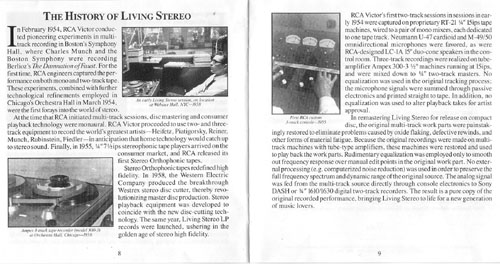
Because of the 500 pixel width limit, that text probably isn't legible. But it says (second page, bottom paragraph):
quote: (my emphasis)
In remastering Living Stereo for release on compact disc, the original multi-track work parts were painstakingly restored to eliminate problems caused by oxide flaking, defective rewinds, and other forms of material fatigue. Because the original recordings were made on multi-track machines with tube-type amplifiers, these machines were restored and used to play back the work parts [I presume that by 'work parts' the author means what I would call 'original elements']. Rudimentary equalization was employed only to smooth out frequency response over manual edit points in the original work part. No external processing (e.g. computerized noise reduction) was used in order to preserve the full frequency spectrum and dynamic range of the original source. The analog signal was fed from the multi-track source directly through console electronics to Sony DASH or 3/4 inch 1610/1630 digital two-track recorders. The result is a pure copy of the original recorded performance, bringing Living Stereo to life for a new generation of music lovers.
Comment on the last clause of the last sentence: ![[puke]](graemlins/puke.gif)
Even if that's right, subjectively and to my ears, the CD sounds sterile and uninteresting compared to the LP. Maybe the RIAA EQ on the LP is making the recording sound the way I'm expecting to hear it - I don't know.
| IP: Logged
|
|
Michael Schaffer
"Where is the
Boardwalk Hotel?"
Posts: 4143
From: Boston, MA
Registered: Apr 2002
|
posted 03-30-2005 10:16 PM
Actually, while party propaganda certainly benefitted from and encouraged the development of new media technologies, AEG, Telefunken, IG Farben (later BASF), among others, had enough commercial incentive and also enough funds to pursue such R&D programs themselves. Due to the historically grown de-centralistic nature of the country and the long musical traditions, Germany has had and still has by far the largest density of opera houses and orchestras, and then also public radio stations (the first ever radio orchestra was founded in Berlin in 1923), so the demand for and the market for music and theatre and related media products was always very big. A lot of the key developments had been made before the NSDAP even came into power. It wasn't a "highly secret" technology anyway - AEG took their K2 machines on tours around the world in 1938 to show it to potential investors and development partners. It was also shown to G.E., but they failed to see the potential.
| IP: Logged
|
|
|
|
Monte L Fullmer
Film God
Posts: 8367
From: Nampa, Idaho, USA
Registered: Nov 2004
|
posted 03-31-2005 04:34 AM
quote: Leo Enticknap
MP3 is an 'asymmetric lossy compression' format, meaning that, in order to save file space...
Yes, I know that Mp3 encoding has the downside of the "lossy compression" - where it throws out bits to save space. But, I have an audio program (actually my CD burning software) that 'explodes' these Mp3's back to the WAV format to be made back into Audio CD's. To me, it sound good, but I know, in the world of the tradeoff, one can't have both. Yes, I just do archiving, not preservation. If I was to "preserve", I would make an audio copy of the CD.
There are actual audio compression formats out there that I've yet to try that is of a "non-lossy" compression. I do belive that OGG VORBIS is one of these formats, but don't quote me on that one.
quote: Leo Enticknap
Even if that's right, subjectively and to my ears, the CD sounds sterile and uninteresting compared to the LP...
Ain't this the blessed truth of all of the BMG "LS" CD's that I had and still have. Course, once again, analog is of the true waveform only with limited dynamics, whereas digital that have great dynamics, is just a bunch of "ones" and "zeros" stacked next to one another making a squared off sinewave-flattening the top of the peak of the analog waveform.
Course, you know that BMG took over quite a few labels, and Victor was one of them. I think when BMG took over Victor that, in the early 90's, when these CD's came out they didn't have the knowledge to reproduce a good CD from "production" masters that they prob used in these "LS" releases. Yes, they claim using "session masters" in their dupes, but using equipment that couldn't reproduce the sould correctly and this technology was relatively new. And some "session" masters were of the 3-track variety. Did they mix these 3 tracks down to 2 correctly?
A good example:
I know that the LSC-2341 Saint-Saens Organ Symphony/Munch on the BMG "LS" CD isn't the best sounding CD because of the use of the "production" masters (and proof there in the SACD site that the original session masters were recently found, thus the BMG "LS" release probably came from the production masters..).
Shoot, even the 4trk open reel of the Saint-Saens can send the CD back to its momma with one beating.
One needs to listen to the Classics issue of these "Living Stereo" releases, in both LP and "45" EP form.
CD's aren't the golden answer to all audiophile questions, but it's a good second.
Then, you play your CD's and suffer "CD" rot!
-Monte
| IP: Logged
|
|
|
|
All times are Central (GMT -6:00)
|
This topic comprises 3 pages: 1 2 3
|
Powered by Infopop Corporation
UBB.classicTM
6.3.1.2
The Film-Tech Forums are designed for various members related to the cinema industry to express their opinions, viewpoints and testimonials on various products, services and events based upon speculation, personal knowledge and factual information through use, therefore all views represented here allow no liability upon the publishers of this web site and the owners of said views assume no liability for any ill will resulting from these postings. The posts made here are for educational as well as entertainment purposes and as such anyone viewing this portion of the website must accept these views as statements of the author of that opinion
and agrees to release the authors from any and all liability.
|

 Home
Home






 Printer-friendly view of this topic