|
|
This topic comprises 9 pages: 1 2 3 4 5 6 7 8 9
|
|
Author
|
Topic: A380 - world's largest pasenger aircraft - makes maiden flight
|
|
|
Leo Enticknap
Film God

Posts: 7474
From: Loma Linda, CA
Registered: Jul 2000
|
 posted 04-28-2005 03:11 PM


quote: Mark Gulbrandsen
The other thing it leaves out is how many survived from eachh crash. All in some cases too none in other cases. Things like a crash where a plane couldn't stop and overshot the end of the runway and geaer that won't loock down are commonly survived by all. Of course there are those catatrostpjic crashes like UA 232 and the Concorde.
That list defines an 'incident' as an event which causes at least one fatality - but I agree entirely; that criterion could be misleading, too. The number of fatalities per incident on that DC-10 list ranges from 2 to 346. So that way of ranking airliner safety (by number of 'incidents') would favour large widebodies over smaller capacity planes. For example, it would take 20 Saab 340s to fall out of the sky to kill as many people as the total loss of one fully-loaded 747. I'd guess that if you recalculated that list and ranked the aircraft in order of the proportion of accident fatalities to flights completed, it would look very different.
quote: Mark Gulbrandsen
With the high number of L-1011's still in the air I have to wonder if that plane isn't the safest one out there. One has not gone down since the early 70's. The DC-10 has by far the worst safety record of all U.S. made planes imho although there doesn't seem to be any bad mishaps in the last decade.
Which in both cases seems to suggest that the older a plane gets, the safer it gets. That list would seem to support that, too: as a general rule, the higher the number of flights an aircraft type has completed, the higher its safety ranking is. Learning from experience, perhaps? The 727's handling characteristics, the DC-10 's cargo door and the Airbus fly-by-wire software were all implicated in a spate of accidents during the first few years of those aircraft being in revenue earning service. But then the faults were identified, fixed and most of the accidents thereafter were not directly attributable to the aircraft.
So maybe the one thing these statistics can tell us is that, as a general rule, the older a plane is the safer it is? In any case I can't say that I worry too much about what sort of plane I get whenever I fly somewhere. Needless to say, it's a case of who offers the cheapest ticket! But as the last intercontinental flight I took was in fact on a DC-10, maybe I was unsuspectingly doing the right thing!
| IP: Logged
|
|
|
|
|
|
|
|
Will Kutler
Phenomenal Film Handler

Posts: 1506
From: Tucson, AZ, USA
Registered: Feb 2001
|
posted 04-28-2005 07:56 PM
Mark mentioned the famous ghost plane...the L10-11 that crashed in the Florida Everglades. Many parts from that plane were recycled and put back into service. For quite some time, every plane that recieved those parts had ghost sitings of one of the filght-crew members. The ghost reportadly prevented some other crashes. However, many people reportadly had the crap scared out of them by that ghost. All of the gost-associated parts were eventually removed from service, and the ghost seemed to have disappeared.
On another note, I have been a licensed aircraft mechanic since 1988 or thereabouts. My experience spans everything from Pipers and Cessnas to 727s, 737s, 747s, C141s, C5s, etc.
Ohhhh do I have my share of maintenance war stories...some that would turn ya off to flying! Over the years, my sense of integrity has often been at odds with some other "philosophies" on how maintenance should be performed. But having that sense of integrity has often come at a "political" price! But I have no regrets...I am just greatful for the lessons my parents and teachers have instilled in me!
| IP: Logged
|
|
|
|
|
|
|
|
Bill Gabel
Film God

Posts: 3873
From: Technicolor / Postworks NY, USA
Registered: Jan 2002
|
posted 04-28-2005 09:41 PM
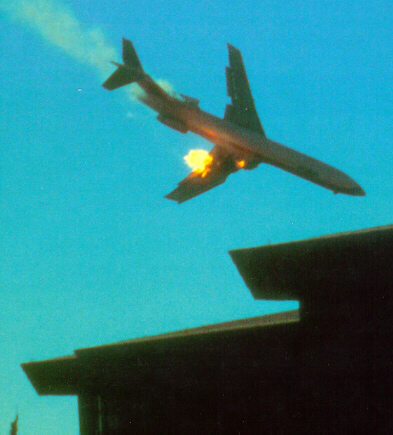
Of the 5 lost L1011s none were from engine problems.
- Dec. 29, 1972 Eastern Airlines (Crash) 100 dead of 176
Aug. 19, 1980 Saudi Airlines (electrical fire) 301 dead from smoke inhalations after returning to airport. Doors jammed.
Dec. 23, 1980 Saudi Airlines (tire exploded in wheel well), 2 dead rapid decompression over Arabian Gulf.
Aug. 2 1985 Delta Airlines (Crash) Dallas/Fort Worth,microburst induced windshear, 134 dead of 163 + 1 on the ground.
May 3, 1986 Air Lanka (Bomb) Columbo, Sri Lanka, 16 dead at the gate.
| IP: Logged
|
|
Paul Mayer
Oh get out of it Melvin, before it pulls you under!

Posts: 3836
From: Albuquerque, NM
Registered: Feb 2000
|
posted 04-28-2005 10:55 PM
Late to the party as usual. Been rather busy these last two weeks, subbing for two instructors in the aviation department, which has meant commuting out to Boulder City for night classes, three hours each way on the city bus, plus early-morning day classes all this week at my home campus, the Western High Tech Center. Fortunately tomorrow is the last day of this--I'm pooped.
On to the A380. It's a hell of an achievement for Airbus. Though I have never cared for their engineering attitude of minimizing the pilots' presence in the control loop of their fly-by-wire airplanes (even if the statistics show that 80% of airliner accidents involve pilot error in some way), I've come to respect Airbus' business acumen. They are a formidable competitor, as the current US vs. EU Boeing vs. Airbus subsidy wars illustrate. Boeing has fallen to #2 in market share for two years now, no longer dominating the airliner market. The cross-pond subsidy lawsuits are about to start flying unless the two sides get back to talking.
The new aircraft is an amazing accomplishment. Over the next year or so it will fly an extensive test regimen to cover all corners of its flight envelope. It will be interesting to see how it does at max all-up weight, 1,200,000 lbs for the pax version, 1,300,000 lbs for the freighter (!), plus things like max range, best cruise speeds, and fuel burn. The only other thing flying at these weights is the Antonov An-225 and only one of those was ever built. Like many new designs this one has had its share of early problems with drag and getting the empty weight down to meet spec. But it's flying now and that is a good thing.
Early (and now outdated) A380 joke:
Q: Why did the A380 cross the road?
A: Because it couldn't fly over it. ![[Big Grin]](biggrin.gif)
As of this week, Airbus has 151 confirmed orders for the A380 and needs about 100 more to recover its $13 billion USD R&D costs. They project a worldwide market of around 1200 aircraft. Boeing didn't see a big-enough market for this size of aircraft at all. It'll be interesting to see over the next few years who read the market correctly.
Boeing is proceding with its 787 Dreamliner and is filling the order book rather nicely, enough so that Airbus, which didn't see a market for that aircraft, is now going to develop a competing model, the A350. Boeing is also going to compete against the A380 with a new double-deck version of the 747. Indeed, we live in interesting times.
As for Jurassic jumbos, I was a big fan of the L-1011 and hated to see it ultimately fail in the market. It was an innovative design in many ways: first use of triple-spool high-bypass engines, first US airliner to offer autoland capability as standard equipment, and its unique flight controls when in the landing configuration (control column controls the spoilers instead of the elevators during approach and landing, similar to how glider descent rates are controlled).
L-1011 monikers:
Swamp Buggy
Trifarce
Tritanic
Vibratron
Lockheed's biggest mistake with the airplane was to commit to only one, at the time unbuilt, engine type. Development problems and cost overruns on the RB-211 engine (a great story in its own right) drove Rolls Royce into bankruptcy and delayed L-1011 production to the point where McDonnell Douglas achieved an insurmountable market lead with their DC-10. In the end the market for three-engined widebodies just wasn't big enough for both designs. Which was too bad--the retired L-1011 captains I've known at ANA and TWA loved the airplane. As did I, even though I only got to fly the simulator for it just once.
| IP: Logged
|
|
|
|
|
|
|
|
David Buckley
Jedi Master Film Handler
Posts: 525
From: Oxford, N. Canterbury, New Zealand
Registered: Aug 2004
|
posted 04-29-2005 03:22 AM
quote: Mark Hajducki
It would be better to calculate fatalities per passenger journey (or passenger mile), which would be the chance that any one passenger would die due to an aviation incident during the journey.
Fatalities are measured per million departures rather than by the passenger mile because the risks in an airline flight are not linear along the distance of flight, and dont change much with the length of flight, but mostly accumulate at the beginning and at the end. There are of course exceptions where planes just fall out of the sky in midair, but they are exceptions.
quote: Mark Gulbrandsen
Airbus's risks are certainly alot higher!! The Europeans seem to go that route for what ever reason... like the Concorde.
For many many years Concord/Concorde was the safest aircraft flying, with zero fatalities. Admittedly the number of passenger depatures was quite low. One crash with those low departures numbers turned Concorde from the most safe to the least safe aircraft in fell swoop.
If you were partisan you could split Concord and Concorde as two different but related breeds of aircraft, and claim that Concorde was the safest aircraft ever flown with no fatalities in the marque's entire flying career.
The other thing to keep in perspective is that even the "least safe" by those list aircraft are pretty dammed safe, and even if you fly a lot in the worst plane on the list you are really unlikely to end up as a fatality. Unless of course, you go up in a cessna or other toy plane, for which the ATSB incident records speak for themselves...
| IP: Logged
|
|
|
|
All times are Central (GMT -6:00)
|
This topic comprises 9 pages: 1 2 3 4 5 6 7 8 9
|
Powered by Infopop Corporation
UBB.classicTM
6.3.1.2
The Film-Tech Forums are designed for various members related to the cinema industry to express their opinions, viewpoints and testimonials on various products, services and events based upon speculation, personal knowledge and factual information through use, therefore all views represented here allow no liability upon the publishers of this web site and the owners of said views assume no liability for any ill will resulting from these postings. The posts made here are for educational as well as entertainment purposes and as such anyone viewing this portion of the website must accept these views as statements of the author of that opinion
and agrees to release the authors from any and all liability.
|

 Home
Home







![[Wink]](wink.gif)
![[thumbsup]](graemlins/thumbsup.gif) . Those not familiar with the man behind Lockheeds engineering team should see this link......
. Those not familiar with the man behind Lockheeds engineering team should see this link......


 Printer-friendly view of this topic