Well, funny that you mention it. Actually, I own all of the copies that have bean projected. On one hand it's because it's my dream project and I have always wanted to own a film cinema since there's basically three in Spain right now, and they only screen film in really rare occasions. But on the other other hand (and more truthful), the only two distributors that actually rent film nowadays in Spain ghost me as soon as I told them that I was not a commercial cinema. So, yeah, sadly, no problem there. Thank god, Spain is a really small territory and since 99% of our copies are dubbed they are quite cheap (cheap meaning less than 500€, but you know film, cheap it's not a great word for the hobby) since people in latin America have their own dubs there's no one outside of the country looking for this 35mm copies. So, again, it's usually cheap, and I can afford buying one or two copies a month. Of course I need two jobs to keep this up hehehe, film is bottomless money sucking machine, but hey, it's good and I love it.
Hope you have a great day, Javier
-
I'm hopeful someone will have some they can sell ya. But word of caution. It highly depends on your film sources if "wet cleaning" is even permitted in your loan agreement. Most contemporary archives in the US do not want you to do so anymore without asking, they have their reasons, even though many prints would benefit from it.Leave a comment:
-
Hello everyone. I've bean running a little cinema club in Madrid, Spain since february projecting only 35mm copies of films. As any film collector will know, quite some of them are quite nasty and would thank a clean with a bit film guard. I'm looking for a kelmar film cleaner but I can't find any in my local market. If any or you know where to buy one or have one for sale I would be interested. Especially if you are in European territory, postage can get really expensive.
Have a magnificent day, JavierLeave a comment:
-
Seems this was the last thread I was sharing my servicing efforts on our kelmar table.
Since then the belts have been replaced, spindle angles matched up via bearing mount adjustments, mounts re-aligned, and re-secured (at least one bolt was missing and one had pulled through the table laminant, fender washers to the rescue).
Last night during a comedy show I started down the path of fine-tuning bent shafts causing slight run-out on our existing 35mm spindle adapters. I got our keyed ones (that were the most abused) to within the same 3-4 thou tolerances I was measuring on the rarely used red ones with the extra pin drive.
This was primarily to test an approach I'll use to also check our Strong reel arm spindles, and hopefully get some of the bent spares back into usable category. As for the Kelmar Table, I still have to convince management to pull the trigger on a replacement clutch side (to loose the reverse motor unit), but last conversation management was realizing it is justified at least.
Ohh and in other good news... on my day off, my TD and co-worker retired the Goldberg rewind to the anti-booth!!! All that talk about how prone to print damage those things are finally sunk in, they even did it without me being present to suggest it! I think starting to handle LoC prints also had something to do with a slight improvement in taking advice, but getting parts ordered is still and uphill climb.
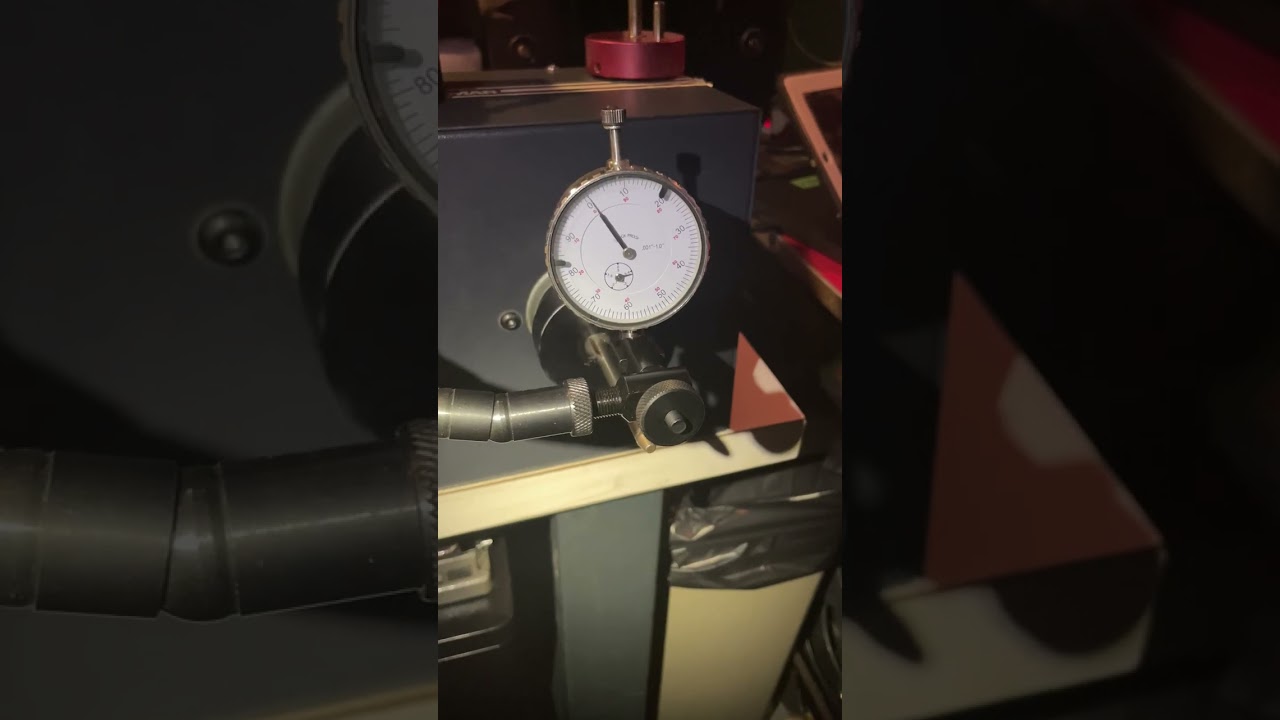
Now that spindles have been trued, I suppose I should revisit the bearing mount adjustments to match angle. But I think I did that last time with our 1/2in 70mm spindles, so not bent at all.Last edited by Ryan Gallagher; 05-01-2025, 11:08 AM.Leave a comment:
-
-
It's not crazy, but I think the ultimate solution is to educate the folks who hold the purse strings about the importance of maintaining your projection equipment. They need to invest in the tools required to do the job. A working rewind table that won't damage film, reels that aren't badly bent or wobbly, and basic projector maintenance are the bare minimum, not some lavish expenditure. They need to budget for equipment maintenance, just like they budget for the cost of shipping prints.
Leave a comment:
-
-
So maybe our ideal is two new regular 35mm keyed, and if we are feeling spendy add one extended key specifically for plastic/plated rewinds. A finger hole one is appealing but i'd have to check that all our cast house reels support that. I know we don't have a majority that support the dog pin, just the split reels and non-cast ones but I'll look, cause yeah those are much nicer.
I'll consider owning my own spindles if I can't get them to bite... but I've already got a mountain of personal tools in our booth.
Retiring the goldberg auto rewind seems a winnable argument. But not sure about getting a clutch side for our kelmar table. Would it be crazy to jerry rig a clutched feed reel arm there instead if I can't convince them the kelmar clutch is worth it? We do have a spare set of 35mm reel arms. I consider our rewind improvements a higher priority than getting the 70mm mag head upgraded, cause rewind handling affects all film we touch. 70mm mag can wait, it's pretty rare for us.
Noted on the advice not to take up onto split reels. We haven't done it during my term, was just curious what is advisable.
I may temporarily install my personal HFC manual rewinds in place of the goldberg. That would at least leave us with two functional rewind stations. That table used to have some ancient vintage neumade rewinds... but they have been retired to the back room parts museum along alongside our RCA vintage tube amps (which I want to clean up some day).Leave a comment:
-
One problem with the extended key spindles is that some house reels don't have keyways that extend through the entire reel. Easy enough to check your reels for that if you're considering buying one, but it's an unpleasant surprise if you have a full reel that needs to be rewound ASAP and you find when you go to mount it that it won't fit on the spindle.You do not have permission to view this gallery.
This gallery has 1 photos.Leave a comment:
-
Extended-Key Kelmar spindles often need to be filed to work with typical Goldberg Cast Aluminum 20-minute reels. Their key is wider and taller than a standard spindle key. They were designed to work with the plastic shipping reels that used a sheet-metal key on each side of the reel. Those sheet metal keys would cut through the standard key. Still, if sized right, they will FAR outlast the standard spindle. Also, use dog-pin spindles if the reel has the appropriate hole in them. I've get to have one of them fail. Kelmar may still have the finger-hole drive spindles too though they were pricey and inherently not balanced. They don't have any key issues (don't have any keys) and won't work with split-reels or flanges.Leave a comment:
-
I fill in at a theater that used to thoroughly abuse their equipment, including shearing the keys off of the spindles because they regularly cranked the motor power to 100. A projectionist there got his machinist friend to rekey two of them for free, but they ended up not fitting all of the house reels. One didn't work very well at all and was relegated to the parts drawer. He put the other one into service, but he would be trying to file the key down on the fly when he needed to use a reel that didn't fit. Not good. I would bring old spindles of my own when I worked there until I finally got them to order new ones. They are a bit pricey though. I believe the last time I bought a set the standard 35mm spindle was $140. If you have a machinist who owes you a favor it wouldn't hurt to try to have them rekeyed, but it might be more trouble than it's worth. If you have to pay for it, you're probably better off just buying a brand new spindle.
With regard to taking up on a split reel, you shouldn't do it. The clutch will be calibrated for house reels, so the tension will be too high if you're taking up on a split reel that has a lower mass and a small hub. Just rewind it twice. An E series Kinoton is designed to take be able to safely take up on cores as small as 2" but that's the exception.
In terms of rewinding during the show, plenty of people do it but that doesn't mean it's the best practice. Since you already have two projectionists per show, take advantage of that and divide the work.
The Goldberg WILL scratch prints. It should not be kept in service simply as a matter of convenience. It's great to have a second rewind station, but make a hand rewind station instead.
The standard Kelmar table takes a 3L260 belt. I don't know if the dual-drive version is different but I would guess not. The size may be printed on the currently installed belts (although it may not still be legible). I second Brad's recommendation to dump the "reverse" head and replace it with a clutch. In the meantime... I sound like a broken record here, but hand rewinds are the easy way out.
Leave a comment:
-
Get rid of the dual-motor Kelmar table. It's a recipe for film damage. There is NO ADJUSTMENT AT ALL for winding tension. Even Kelmar admitted "it is what it is". With Kelmar still in business though, contact us (or another Kelmar dealer) and we can see what they would charge for just the left clutch side and then you could mount it on your table in place of the left motor.Leave a comment:
-
So did a bit of service to the kelmar station today. Could definitely justify a couple new 35mm keyed spindles (extended key if we are buying), as well as maybe belts. Not bad but you can feel some vibration still on the motor acting as the clutch at certain speeds (after servicing).- Noted that one mount had definitely shifted slightly out of alignment, and they had slightly different offsets from the table edge. (Corrected, and added fender washers where I could.
- Opened them up, cleaned (fair bit of belt shed inside).
- Checked belt pulley alignment, nothing wrong there.
- Checked belt tension.
- Swapped the lesser used motor brushes from the reverse motor over to the forward motor. Still had 1/2in of brush on the more used pair.
- Put covers back on then...
- Checked if the spindle tilts matched (using non-bent/repaired 70mm spindles), they differed by .3 to .5 deg. Adjusted one of them and now they are within .1 deg.
Perhaps someone can confirm these are the correct belts?
belt2.jpgbelt1.jpg
Did some test winds. Using good house reels I was able to get a very respectable wind, almost as good as with the guide roller in use. If either reel is not so good the guide roller still gets us there. Seems improved, with room for more improvement with new spindles and maybe belts. Perhaps bearings. If we get fully tuned up then the Goldberg can go bye bye.
wind-test.jpgLeave a comment:
-
Our kelmar table does need a little TLC. It's a bi-direction one but we generally avoid the reverse because the clutch tension on the normal forward motor it would have to free-spin seems to high to avoid cinching. We've never adjusted or investigating servicing it in my term, it's always been "is what it is" to everyone up here since the old-timers left. So definitely overdue.
The guide roller certainly helps. Spindles are straight-ish but have certainly been bent and repaired a couple times. We are also on our last two 35mm spindles that have not had the key wear to the point of coming loose (no doubt from the booth abusing the auto-stop features at higher speeds). Wear to the spindle hole on our house reels (or house reel condition in general) is probably as much to blame as any bench issue for less than ideal rewinds. We've sorted them by flange/warp quality, but I have not involved spindle hole wear to that quality ranking yet.
The split reel approach is good advice, however that requires picking up some better condition (less warped) split reels. As is we mostly avoid the ones we have due to condition and favor a plastic split reel when the need arises.
Is it worth having the spare 35mm kelmar spindles re-keyed? Or if they have obviously been bent and straightened in their past lives, just retire them and try to get new ones from kelmar?
If we get the kelmar bench tuned up i'll take into advisement retiring the Goldberg auto. Though it certainly was handy on the occasional print we need to ship tails out. Two rewind stations utilized for each reel as they came off the projectors.
That raises a question. If it's so important to monitor rewinds per this whole conversation, do most people save them until after the film? Or rewind as you go? Because we staff the booth with 2 for film screenings (one to juggle all the DCI/preroll/backup stuff)... we maintain the option to have monitored rewinds regardless of when we do it. Obviously this only applies to locales where shipping heads out is the norm.
If you needed to ship tails out on cores, would you use a good condition split reel for takeup? Or stick to house reels and do the extra rewinding steps?Leave a comment:
-
They were using a Kelmar type of table. As I tried to explain previously, if you take a reel that is tails out and rewind it so it becomes heads out and do not touch the clutch adjustment during the rewind, when you are finished the heads out reel will have the tail end wound looser than the head end. This is a problem for all the cinch scratch reasons I tried to explain earlier, but it's the table almost all theaters have, so you just have to work with it.
That being said, there is always a point during the rewind where you can develop a "fault line" on a Kelmar table because the tension is increasing throughout the entire rewind. That is the point where such a slip and fold mid-reel could and does sometimes happen.
Our rewind tables have electronic backtension and a dancer arm roller that controls the current being fed into the supply spindle's motor. The end result is we select a winding tension and as the rewind is happening, the electronic clutch is slowly decreasing the amount of backtension so every single wrap in the reel is wound with exactly the same tension. That's the right way to do it.Leave a comment:
Leave a comment: