I saw this video on you tube and was fascinated by this design of platter. I’m trying to be smart and understand why Kinoton use this design and if there are advantages over the constant circle approach, but I’m not that smart. Can anyone throw light onto this?
-
-
The nuance appears to be that once it's loaded into the top platter with the unique design, it's capable of looping, which I don't think is possible on traditional circular platters. It continuously feeds from the core but the outer bands are able to move inward... instead of being stuck at their size and leaving no room to land more film on the outer ring. Those teeth contraptions are part of the automation it seems.
Towards the end there is a good sequence showing film both feeding and taking up onto just the top platter.
I got pretty confused at the very end of the video when it shows film going onto the bottom circle platter too... but I backed up and noticed there was a fade cut, they must have opted to show a tiny bit of their de-spool last show sequence, like how they showed the first show build up. I'd have to rewatch closely to understand where and how he actually splices and separates the head and tail. lol.Last edited by Ryan Gallagher; 01-14-2026, 01:06 PM. -
Its an endless loop. I didn't watch the video to see if they covered it in there but the way it works is you build the show normally on one of the normal decks and you could run normally between those decks if you wanted or needed to. The whole point was the endless loop so you didn't need an operator to re thread between shows.
To go into endless mode you would thread the normal platter through the projector normally but instead of coming back to the normal deck you would 'take up' on the endless deck. The endless deck has some sort of metering and packing device that may or may not have been shown in the video that then loads the film usually on to some sort of special core ring like thing(s). Christie used long 'bean bags'.
Your first show would run normally as the film was being loaded onto the endless deck. At the end of the show your automation would shut things down including the motor before the tail ran through the projector. At that point you pulled out what ever the core ring thing was and spliced the tail to the head and in theory never had to touch it again till the end of the run on that screen. Note the in theory. Anyone that got to work with these I'm sure would agree with that statement. I'm sure in a museum running a shorter film with much better environmental control and likely a highly trained and caring person checking in from time to time they were great but when you toss them into your 90's mall plex with the goal of not having any skilled person up there.......
For the last show you would break the splice you made and re route it from the metering loading device to a standard deck and ring. The endless deck at this point just becomes a regular deck paying out more or less like normal. Then you do the process all over again for the next title. It was sort of a pain and took some extra skills to make sure the tensions and such stayed correct but you could run a split where one ran on the regular decks and the other was on the endless deck. If your schedule was every other you may just used the endless deck more along the lines of a over complicated regular deck but if one title repeated say 3 times and just the late show was different you would usually run the repeater in endless mode and the one timer as standard.
For the US and I presume North America Christie seemed to have what market there was for the things. Potts also made a version but I don't think it it ever sold in any real numbers. No idea how many Kinotone sold but presumably if you were in Europe and wanted such a system that is the one you would buy? I never heard an actual number of how many were out there but I would be surprised if there were more than 100 in the US, IF someone said there were less than 50 I could believe that too.
I only ever worked on and saw the Christie's and if you had someone that truly cared and understood them and took care of them (and kept the whole booth and everything in it spotless) they worked fine and were not that hard on film. But as I said earlier, the sales pitch was save money by cutting down on your skilled labor so you can guess how clean things tended to be and how close anyone even looked at all the extra components and adjustments there were.Comment
-
I would have never guessed they even tried to use them in plexes to "automate" away some show sequences... I would have assumed special venue museum and amusement park loops!
The video comments agree they were not the nicest to film. Just based on the teeth devices and the "moving" a pile of film relative to itself... seems like opportunity for some scratching. Maybe if you had a film-cleaner in line and kept everything lubridated and a spotless booth.Comment
-
We've seen them and talked about them, here, before. To summarize, they aren't very gentle on the film and they were originally meant for special venue applications.
I would never want to work in a googolplex theater where twenty of these things are running at the same time!Comment
-
Thinking it about it a bit more the circuit I was doing work for easily had 50 of em at their peak and ranged from 4 to I think 16 screens. And I remember hearing the one here was the 2nd largest customer, the large one was west coast based and I remember hearing they were in that 50-100 screen count range at the time So maybe 200?
I'm sure when they first came out many circuits both small and large got a demo unit and tried it or went to a site to see and talk to those that had tried em. I know there were years where the vendors had them at the conventions too. Obviously the vast majority of the people decided it was better for them for various reasons to stay with conventional platters.
I just watched the video and ya the process is pretty much the same as it was with the Christie and presumably the Potts. I remembered one had that track claw conveyor just didn't remember which one it was, looks like the Kinotone so those didn't need any sort of 'ring' to get them loaded like the Christie did.
Quick search tuned up a short video of the Christie version. They don't show the whole process or all the parts but you can see the metering / packing arm thing. That arm ran on what was basically a timing belt that was glued to the bottom of the deck. That is what provided that cam profile and then the drive for the sprocket to do the metering of the film. You had to have that metering sprocket system because you didn't have the fixed ring like you did in a regular platter. The film isn't being pulled onto the platter its just sort of being squirted out and then its up to other devices to get and keep it in the right places.
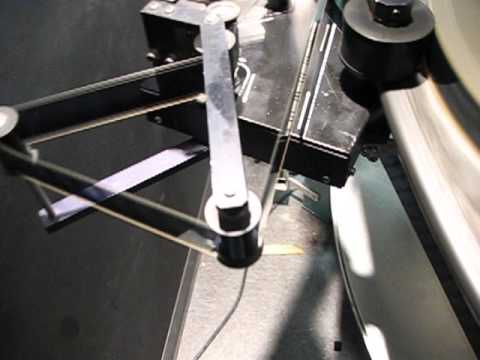
Comment
-
-
Stay far, far away from a continuous loop platter! They are hard on film. The only continuous loop system that worked reliably and didn't scratch the film was the bifilar loop system Brad mentioned. Or a loop box if the film is short enough.Comment
-
TJ's video shows one of the earlier revisions of the Christie ELF platters. The early ones were extremely temperamental and would frequently lay the film on one huge "cusp" (as the inventor, Clark Crites called it) instead of the three equal size cusps. It was also hyper sensitive to humidity changes and was a train wreck with mylar stock. The latest iterations were improved with the help of a chief projectionist at a Los Angeles based art circuit, which used them in most of their locations (except mine, a 4 plex that had Alpha Platters until some time after I left, when they finally got ELFs. But they still suffered from sensitivity to humidity changes.
I kinda agree, but also disagree, with Tim's assertion that they were hard on the film. The later ELFs were actually not bad on the film really. That Kinoton platter appeared to be very brutal with those pusher claws. The Elf relied on the eccentric "cam" and the lay down arm to lay the film one layer at a time, so the film basically "sucked" itself inward as a new layer was added. The deck had custom rubber mats affixed to provide the needed friction and support for the film. I tested with a piece of artist's tape once, attaching it as a flag on the peak of a cusp so I could see if it stayed centered on said peak as it moved inward. It did, with very minor lateral displacement.
Now as with any film handling system, the probability of scratching the film rose exponentially if the booth (AND projector) was NOT KEPT CLEAN. At one special venue where I had a clean booth and did regular cleanings of booth, projector and platter deck, I ran hundreds of full cycles ( A cycle being Qty. 6, 22 min. prints, built up as one endless loop) with only the tiniest of very minor scratches and a small amount of dirt. I ran a Kelmar film cleaner with FilmGuard once each week through a full cycle of prints. The aforementioned chain was hit and miss, as cleanings weren't done regularly so many shows had dirty or scratched prints.
The main issue was regular cinemas tried to use the endless loops to eliminate the need for projectionists on a daily basis, and have them only on hand for builds and tears. That backfired spectacularly as they still needed at least a spot check to catch any developing malfunctions. They also made changing out trailers an absolute nightmare.
Still, in my special venue the ELF was a joy to work with, and it allowed us to let "non projectionist" techs to run shows on my days/shifts off, without much risk to the film.Comment
-
Wasn't a video I shot and what I can see of the rest of the booth I don't think it was one of the locations I serviced, I just found it doing a search.
I do remember the name Clark coming up and mention of the projectionist at 'the other circuit' coming up with some improvements. I don't think Clark was the guy I met. There was someone from Christie that came one time to install some updates and I was the local guy sent to drive, assist, and learn. That guy really didn't seem to know anything about them other than what someone had instructed them to do to install this specific thing. I don't even remember what it was. I also don't remember if that was before or after I basically embedded myself in one of the locations and spent several days running and watching them to figure out what sort of things worked and what didn't and what was important and what wasn't. Everyone seemed to have their thing or their way. Some of those things turned out to be real but many didn't.
I forgot about the single bump issue. That was always fun. IF there was someone paying attention you could see it starting to happen before it started causing film damage and show loss. It generally took several shows to go from the balance 3 bumps to the single so its not like it would happen during a single showing.
I was common for me to be walking though the booth to get to what ever else it was I was supposed to be fixing and see that going on. If it was a longer movie and went on long enough the bump would hit the payout plate in the center which stood up on an extension post so the film would be under the plate and touching the post. This meant that when the bump came around the film had to be forcefully yanked outward and dragged over the side of the plate. At some point you would get a splice that would catch or a tangle going on and you got a pretty normal wrap except no easy fix once you get all the damaged film out.
If you noticed it starting to happen you would finish that show and before the next show break the film and take up the next show onto one of the regular decks, hopefully you were not running a split in that screen at the time. This would unload the elf deck so after that show and it was clear you would clean the deck paying close attention to the raised corner sections of the rubber pads that were sort of acted like the ring sections between the bumps. If it was a long run or the place wasn't generally clean those pads and areas would get glazed and they had to be kinda tacky to do their thing. Once it was clean out come the bean bags and you thread it up in loading mode and the next showing loads up and hopefully forms the 3 nice bumps.
If no one caught it or cared and it did wrap part way through the movie it was really fun. You would clean up the wrap part but then instead of just splicing it back together you had to kinda just start shoving the film around to try and reduce the bump enough that it would kinda clear the payout or if you had help just remove the payout completely and become a human payout that didn't have to be in the center of the platter. You needed help because you were kinda stuck there at least till the bump was reduced so someone else had to run the projector AND control the speed of the deck using the MUT. Even if you were able to get the clearance to get the payout back in you still would use the mut since the fingers would be whipping around so much at first you would risk making things worse.
So at that point you are now taking up the last half of the movie on one deck and that show ends. You still have the first half the movie on the elf deck at this point so you break it at the usual spot and now thread what is the start of the next show to the other hopefully empty deck. The bump will be a lot smaller now so it should unload / payout normally you just may what to use the battery trick which was to take like a D, C, or 9V battery and stick it on the payout plate to limit how far the finger can move to keep it from extreme speed changes. You just keep an eye on it and keep moving it in further as you get more film off the platter. Works on regular platters too if they are the the multi speed type.
Once that half of the movie runs through you have a short intermission while you splice on the 2nd half that is on the other deck. Once that show is done you can then do the cleaning and reload process. Its just that easy. You just need a full time person with above average skills so you can eliminate an average person from payroll. Oh ya and the machine cost more to start with. Trailer changes suck. Moves suck. Splits suck. Average length movies suck. Long movies really suck. Presentation probably could be better too. Why didn't these things catch on?
Comment
-
I'm curious as to cinch scratches on the Loop-O-Matic. You are feeding two layers of film in, which means they have to rub on each other, at some level. That is the problem with all loops. With loop platters, the rubbing is continuous since the outside of the pack has to makes its way to the inside. The Loop-O-Matic doesn't have that particular issue. But on the wind in it looks like it would.
I'm curious if anyone has any experience with the Kinoton ST-2000E. It seemed to have a bit of a different approach to getting the film to move inwards instead of the "beater" roller. They had these fingers that would periodically come up and draw the film inward. So, the film would take up, somewhat normal, on some outer posts and then, periodically, the fingers would take the outer portion inwards:
image.png
Comment
-
Is the ST-2000E different than the Kinoton in the OP video? The video you linked is the same source footage it seems, just re-mixed! Although there is a bit more footage in the 2nd half of the booth activities.
I called them teeth because they looked scary, but finger conveyor is probably a better conceptual term. ;-) I would think any time you are moving a stack of film into a deeper curve like that there is some film on film movement, i'm sure they designed it to be as minimal as possible. Seems like the Kinoton advantage would be the film stack builds with minimal "pressure" needed, until it's time to move the curves inward anyway. The outer posts also have to withdraw at the time the stack move is triggered, that doesn't seem too friendly either, but only on a handful of frames.Last edited by Ryan Gallagher; 01-16-2026, 01:07 PM.Comment
-
I believe the OP used a link to a YouTuber that used the original footage that was not their own.Comment
-
Thank you all for chipping in on my question. I find the evolution and design solutions to the entire cinema presentation of analog film very engaging and to hear from those responsible for it.Comment


Comment