-
-
It's my understanding that dosbox has more of a "play the games" focus, while dosemu is a compatibility layer that runs dos directly on Linux so it's more of a general utility program.
For example, it's not too difficult to set up dosemu to output postscript, so you Wordperfect and print "perfect" documents directly to a pdf file or to your printer in a fully transparent manner.
You can do something similar with vice as well, though in that case you get either a text file or a bmp file. Here is a sign that I printed a couple of days ago to put on my front door over Christmas:
christmas-closed.png
It looks pretty snazzy printed on paper.
I made this using the Commodore 64 version of the Printmaster program running on vice. I get a kick out of using "obsolete software" for this kind of thing.
One shortcoming of fs-uae is that it currently has no provision for printer output, so while you can edit a file using Amiga Wordperfect or Ami Write you can't print it. So far, anyway.Comment
-
in a hundred years.
you have 2 options. a faded piece of cellulite film.. an engineer needs to some how build a scanner to turn it into digital, restore it in some way trying to reverse the degridation.. time frame for work. months plus. result, a less then perfect representation of the original directors intent.
or handed a DLT20 or other modern storage tape it would have been transitioned to over the years.
a general software engineer would have pristine file to play in days. grab the open source code used to make it. compile on modern equipment. extract images/sound. add to a MP4 or whatever hit play.
or. as mentioned, knock up a VM of a machine that can install dcp-o-matic player and have it playing in hours.
the issue is atorage and costs.
environment for film. critical and expensive. mag tape or whatever by then. less critical, far cheaper.
size of archive. DLT tape today is 1/10 to 1/30 the size. so far cheaper to store.
DLT needs renewal every 30 years..
so storage wise. even with the issue to rewrite the DLT every 30 years the real costs is in your storage over the long period and as DLT with 1/20th or better then a film then you would expect DLT storage to the cheaper.
but at the end of the day digital results in a an exact copy of the original as it was produced by the director.
if you think digital won't be around in 100 years then you're looking at a dystopian future and looking at an old film that will be the least of our problems.
Comment
-
And drm, which is a major factor that works against digital archives.the issue is atorage and costs.Comment
-
The Video Game History Foundation would disagree with you.

Comment
-
Archives definitely get encrypted content.
To be clear, I do believe digital will be around. How can it not be. I don't think anything we have in 2025 will be in use or even usable in 2125. Perpetually transferring all prior content to the latest version of storage will remain a massive expense and an opportunity to lose content.
As for film...in 100-years, with current storage techniques, how faded will it be? How will 100 year technology fare at taking it to pristine of the era and beyond? I suspect rather well Again, making something that can work with film is so primitive as to be a non-issue. I don't know if they make separations of all content, but they have done it for important content. So long as they QC the separations to know that they really have all three primaries, you have another level of preservation is tough to beat. Again, if you believe current archivists, they think they have a 1000-year lifespan on film now. Do I believe them? Not really has there are always situations that weren't factored in...but that is for the future people to deal with.
However, I have no reason to think that digital will have anything going for it when it comes to long-term survivability. Too many times people think the format of the day is how things will be but they are all short lived.
Then again, Netflix might own it all and just destroy it "because."Last edited by Steve Guttag; 12-15-2025, 09:20 AM.Comment
-
Starting with an essentially human readable medium, that will not be a particularly formidable task. The scanners used by professional archives today typically cost between the low and high five figures, depending on capabilities and options. That cost has declined by around 70-80% since the Cineon scanner first appeared in the late 1990s. If (and understood that this is a big if) a nitrocellulose or cellulose acetate (all variants: di-, tri-, and propionate) film element went into atmospherically optimal storage before reaching stage 2 decomposition on the FIAF scale, accelerated aging tests suggest that no significant deterioration will take place, either to the base or to most emulsions (addressing Steve's point about dye fading) for several centuries.Originally posted by James Gardiner
That is an assumption that history tells us it is not safe to make. Furthermore, if the content of that tape has been format migrated, the process may have been done suboptimally (analogous to a camera negative being lost to decomposition, and a 16mm release print is now the best surviving element), losing image and/or audio information in the process. If access to the original is then lost and the suboptimal transfer (either by physical media copying, transcoding one file format to another, or a process involving both) is all you have left, there goes the original director's intent. The big advantage of film combined with passive conservation is that as long as you maintain that cool and dry vault, you stand a very good chance of retaining access to the content in a similar condition to when it was new: no further proactive preservation work is needed.Originally posted by James Gardiner
In contrast, take a look at this. For each of the 1980s, '90s, and '00s, he lists likely around 100 different physical media forms, and even I can think of some that he missed. In many cases, the playback machines were likely only manufactured in the high hundreds or low thousands of units. I would speculate that recovering the data from some of these media in a century's time will be a lot more difficult and expensive than scanning film, and in some cases, simply impossible.Comment
-
Yes. The core issue is that digital archives must be actively maintained. Data needs to be migrated to new storage media and formats roughly every 20–30 years. You can’t put digital files on a shelf for 100 years and reasonably expect them to still be readable in the way film often is.
That said, maintaining film at an acceptable image quality requires extremely expensive environmental control. If you’re going to that level of effort and cost, you may as well be doing it digitally, where you retain perfect fidelity rather than managing gradual analog degradation.
If someone stores film in a garage for 100 years and accidentally finds it, you’ll probably still see an image — just not a good one. Digital media in that scenario would almost certainly be unreadable. But that’s accidental survival, not intentional archival, and I don’t think those scenarios are relevant when we’re talking about preservation strategies.
From what I understand, proper archives typically store both the DCDM and an unencrypted DCP. This was discussed at an ISDCF meeting, from memory.
Ultimately, the most universal storage format is ones and zeros. I’ve even seen research into using film purely as a carrier for digital data, because many archive requirements today — including digital intermediates and associated metadata — simply can’t be preserved as images on film. Once content is data, the archive must also include the code and documentation needed for future decoding. That, to me, is the purest form of archival.
I hope the long-term digital storage problem is properly solved in the near future. Almost everything is created digitally now — we have to solve this. And once we do, film as an archival medium will no longer make sense, except where the original work itself was film-originated.
Comment
-
(https://www.theregister.com/2025/12/...emory_crystal/)
After decades of research and development, humanity finally has a data storage medium that will outlast us.
The 5D Memory Crystal stores data by using tiny voxels – 3D pixels – in fused silica glass, etched by femtosecond laser pulses. These voxels possess "birefringence," meaning that their light refraction characteristics vary depending upon the polarization and direction of incoming light.
That difference in light orientation and strength can be read in conjunction with the voxel's location (x, y, z coordinates), allowing data to be encoded in five dimensional space.
And because the medium is silica crystal, similar to optical cable, it's highly durable. It's also capacious: The technology can store up to 360 TB of data on a 5-inch glass platter.
SPhotonix, a company formed last year to commercialize the technology, estimates that even at 190 degrees Celsius, voxels cut in silica crystal should last 13.8 billion years, the estimated age of the universe, barring some mishap – which seems inevitable at that time scale.
While none of us will be around to verify that claim, silica crystal is vastly more stable than magnetic or electronic methods of data storage. Even alternative optical storage technologies like optical discs are only expected to last 5 to 100 years, though M-DISC advertises a lifespan of 1,000 years.Comment
-
That's quite some list and it reminds me of this video...
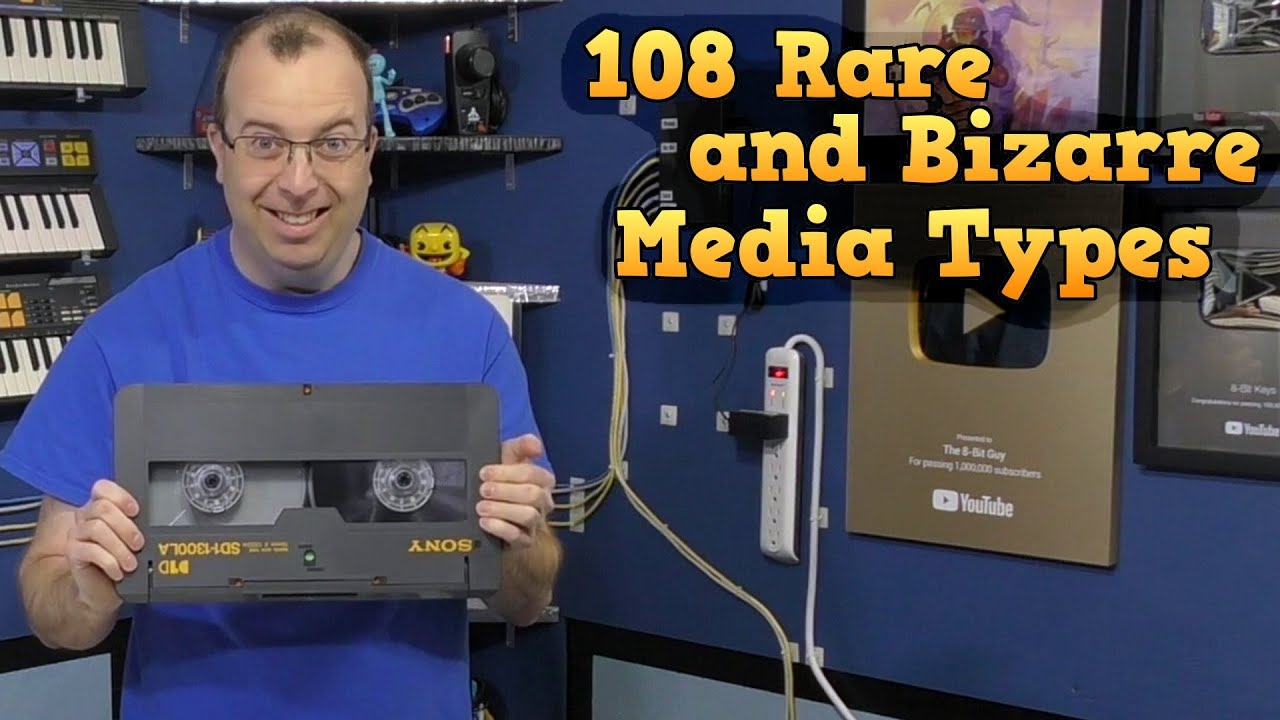
Keep in mind that it's nowadays already increasingly difficult to get some content from a simple VHS tape, one of the most prolific types of media of the 1980s and 1990s up to the early 2000s. The equipment capable of reading those formats is slowly decaying away and it's increasingly hard to keep it operational. While still analog, something like VHS and its sub formats is certainly not a simple format to decode, especially without proper instructions.
As for digital media: Getting the data off of the storage medium is just step one, afterwards, it's important to make sense of the data, which may involve multiple layers of complexity, starting at the file system of the storage medium, going up to the codec in which the content is eventually saved... Imagine to have to reverse-engineer a highly complex codec like H.265/HEVC without proper instructions... It took decades of evolution to just build that codec, with proper documentation...Comment
-
Nice video! I did a prototype system in the 1980s that used the stringy floppy. I think I still have the code I wrote for it (MC6800 assembly).Comment
-
Interesting. I noted that a great number of storage media is described in the video as a "market failure".
If the equipment all around you on a daily basis is reviewed like this many decades from now, what would be considered a "market failure"?
I once thought about how to preserve a message so that it might get to someone far in the future (50,000 years)? That comes down to carving it in stone. Then you have the language issue. Could it be read? Pictures are helpful but some of the ancient stone carvings we have found all over the place contain pictures of things that we cannot interpret. Maybe it starts with Math. That being a universal language of sorts. But... I digress.
I once thought that some movies really shouldn't be preserved or even made at all in the first place. I don't think that way these days. But, commercials (and even memory of their existence) should be deleted from the human record.
Comment
-
Hi all:
Following up from the comments above. What this reply does not do:
—comment on the issue of cost of the conversion to digital. This is sorta beyond question, vs. how long projectors last, etc. and has been dealt with eloquently in many responses
—refer to what will happen post-nuclear armageddon, in terms of film vs. digital. Or what happens, 10,000 years after that, when earth (and the movie vaults) are re-discovered. Yeah, film might be better then, but . . Call me optimistic, but I’m assuming that life (and technology) as we know it will continue on its current, *continual* path. (In other words, not leaping forward 100 or even 25 years.)
What it *will* do is address the archival issue, something that I believe is entrenched in misguided received wisdom that is simply not true. This has been touched on in various responses, but I want to elaborate on this, and bring in some first-had experience.
I’ve been deeply involved in digital archiving since 1997, when I first started mixing movies to files. Have never lost one file, ever. Behind me on my desk are the DLT-IIIXT stems (on three tapes) of “Out of Sight” from 1998, which I can still restore to this day, although of course I have already migrated them, and today it all exists in multiple places safe and secure.
For clarity, I'm talking about today, 2025, moving forward. Negative anecdotes re: the first 25 years of digital picture and sound finishing are not of interest to me because 99% of the time such “points” are merely that, anecdotal, or are false equivalencies. I’ll see you that, and I’ll raise you what happened in the 20th century with film masters.
File formats? This is a non-issue: movies are finished these days with image sequences of either TIFF/DPX/OpenEXR files. These formats are all open, and are anything-but proprietary. As are the Broadcast Wave sound files. DCPs and IMPs are also open. The only format that resembles proprietary is ProRes, which although technically owned by Apple, no one in the archiving community that I know of is worried that they won’t be playable. Encryption is not a factor; of course DCPs need to be preserved unencrypted.
LTO is rock solid reliable, and has been since the beginning. (There was a little bump in the road for LTO-9, but LTO-10 has addressed those bumps.) I’ve sheparded Steven Soderbergh’s archive since the beginning, and we’ve been salting everything away to LTO—7, and now -8—since 2017, and over 200 TB of material has passed multiple checkum verifications, with another 250 TB being archived this year for the complete picture and sound remastering of movies whose IP has reverted to him.
The company that does our archiving, Digital Bedrock in Los Angeles, has backed up, and done SHA-512 checksum verification for, over 62 million files, and never had an error in eight years. We make four, geographically dispersed, sets of tape.
The mike-drop issue with film vs. digital is sound. You can talk about shine a flashlight through it, that means nothing for sound.
I’ve been researching and writing a magnum opus on movie archiving for the last eight years, and whenever I interview a photochemicalphiliac (!!!) I ask them this simple question: What are you going to do about sound? This is what I hear:
(silence)
Please don’t tell me any variation of optical or PIQL. Or, help me Jesus, 35mm mag. And of couse, said flashlight really means nothing for picture, either.
BTW, the title of the book is Solving the Digital Dilemma, which is of course a riff on the Academy’s misbegotten, piece-of-shit 2007 paper The Digital Dilemma. Among the canards that they put forth (which has been accepted as received wisdom) is the issue of cost. As someone who was bidding out digital intermediates from 2000-2007 (their first years, leading up to the paper’s publication), I can state wit h first-hand experience that their numbers are completely out of whack. We did a 4k DI of Ocean’s Twelve in 2004, were billed $16,000 to make two LTO sets of the data, and a few years after that migrated the stuff for $5,000. In 2021 we remastered it from those tapes, and all is good. The Digital Dilemma said, in 2007, “$12,500 per year.” They were full of shit but everyone ate it up.
FIlm projection in 50 years?The folks here at Film-Tech are the Obi-Wan Kenobi last hopes for that. in 50 years? Everyone is gone, equipment is in short supply (and that’s VERY optimistic), what skilled theater techs and projectionists remain are in similar short supply, so what are we talking about? I estimate that at that point there will be only 50 places in North America where one can truly expect film projection to be more than a shadow of its late 20th century peak. Even today it’s so much less good…this point is clear to all here and needs no further explanation. You guys are forgetting just how much you know!!!
So you can project film in a few theaters? That doesn’t speak to the full-resolution picture and sound masters. Nor does it take into account multiple sound versions (stems, dubbed stems and printmasters, etc) and subtitles. And if we’re talking about taking said film masters (original camera negatives or YCMs or ..) and re-scanning them to be able to see them on TV or in theaters, you’re merely kicking a cost down the road.
The issue is not how lowering the bar as to what will be *possible* (the old trope “I can always build a projector” or shine a flashlight through film), but what is both *probable* AND desirable. DCPs (for theaters) and IMPs (for home viewing), things with ones and zeroes are way north of probable.Comment


Comment