|
|
This topic comprises 5 pages: 1 2 3 4 5
|
|
Author
|
Topic: platter systems
|
|
|
|
|
|
|
|
|
|
|
Martin Dean
Film Handler

Posts: 11
From: Duluth, MN, USA
Registered: Aug 2002
|
 posted 08-22-2002 05:07 PM


Well having seen numerous places with towers or platters I would say that both have there good sides. The towers are certainly more usable in smaller spaces and in theory are simpler to use (assuming the operators control tension correctly). Platters treat the film better in my opinion as there is less weight sitting on the film and there is less chance of damage due to impatient operator rewinding at the speed of light. And I have always found that the top and bottom drive sprockets last a lot longer on a platter system than a tower system.As for platters being more difficult with respect to changing ads etc, then I will disagree. With a bit of forethought, and the right equipment it is possible to change ads in seconds on a platter. In order to make up ads for platters I modified a 6000’ spool to handle platter take up rings. I simply removed one side of the spool, drilled two holes for the platter take up ring plates and we could make up the ads on the rewind bench. As for changing the ads, all you had to do was make sure you inserted a spacer into the film as it wound onto the plate after the end of the ads and when the old ads were removed at the end there was plenty of space to insert your new ad reel. There are also lots of other little tricks that make using a platter easy, allowing ads to be put in when you have forgotten the sponge, or how to deal with a situation where you stop and want to rewind the film slightly, but I will refrain trying to explain for safety’s sake. The longest thin I ran was a French Art Film double bill that left about ¾” on the edge of the plate. We inserted black leader between the two to allow for an intermission, although on a least one occasion it was forgotten and the whole thing just ran through. In my first venue we ran changeovers on 6000’ reels and due to a lack of reels and no budget (this was a student film society in London) we used the extended spokes technique (i.e. bits of card taped on like Peter was suggesting) to ensure we could get that seven reeler on only two reels (polyester was still uncommon at the time). I believe both systems, if used with care, in the correct situations will do the job.
------------------
Martin Dean martinidean@charter.net
| IP: Logged
|
|
Paul G. Thompson
The Weenie Man

Posts: 4718
From: Mount Vernon WA USA
Registered: Nov 2000
|
posted 08-24-2002 04:28 AM
Here is a beautiful machine... 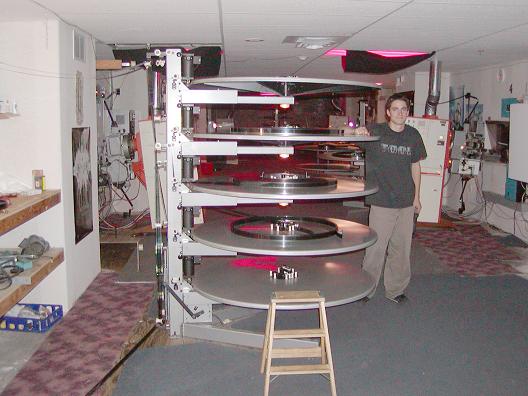 Two-speed Micro-switches on removable pay-out heads. Brad, this is a Xetron XNR-535 1984 vintage platter. I bought two of them for Cinema 5 in Mount vernon. Upon the final closing of Cinema 5, I transplanted them to River City Cinemas in Post Falls, Idaho. I took this picture yesterday. It is one of the most trouble-free platters I ever worked with. The projectionist in this picture will be joining us on Film-Tech very soon. The upper platter might looked warped. Since the out-riggers are adjustable, the projectionist (Byron Bridges) and I were able to "true it up" with minimal effort after this picture was taken. 
| IP: Logged
|
|
Brad Miller
Administrator

Posts: 17775
From: Plano, TX (36.2 miles NW of Rockwall)
Registered: May 99
|
posted 08-24-2002 04:50 AM

Sorry Paul, but the mere fact it is a microswitch design by default means to me that it can not be a beautiful machine (or a good one either). I've never met a microswitch platter that I did not want to bash to death with the nearest fire extinguisher. (Ok so it's a bit of an exaggeration for comic effect, but they still suck.)By the way, I have had the chance to play with some of Strongs's SCDC platters this week and I am exceedingly impressed with their payout design! (Not the actual design of the brain, but the manner in which the speed of the platter pays out the film.) Now if only they would fix my other issues with the machine they would have one damned impossible to beat platter. Until then though the rating remains a solid F!
| IP: Logged
|
|
Paul G. Thompson
The Weenie Man
Posts: 4718
From: Mount Vernon WA USA
Registered: Nov 2000
|
posted 08-24-2002 04:55 AM
Brad, you have to see these things feed film. For a micro-switch platter, they feed almost as good as the AW-3.  Inside those pods, they have big dog-bone resistors that can "fine-tune" the feeding almost right down to a gnat's butt. If you saw these Xetrons well-tuned and running, I am sure you would at least give them a grade of E! When Xetron came out with these machines, they used magnetic reed switches. Those failed very quickly, and were re-fitted with very light-pressure micro switches. Those switches were so sensitive that, if someone were to blow on the pay-out control, it could actuate or de-actuate the the switches because of the mechanical advantage of the pay-out control arm. When the the variable dog-bone resistors were set up properly, the pay-out just seemed to "float." No violent whipping, jerking, or anything like that we see today with micro switch platters. Just smooth......If these old Xetrons ever threw a print, it was because they were grossly out of adjustment. Just like the AW-3 (if set up properly) it would almost be impossible for the early-to-mid 1980-vintage Xetron's to throw a print. Xetron had two other problems, one was with the with the drive wheels. That was solved with a new style. The other problem was the pay-out head locating pins could fall out. A good machine shop would correct that. After these improvements, they just ran and ran and ran just like a swiss watch. Three problems with design upon introduction? Hmmmm...not too bad considering all the feeble attempts other manufacturers tried to make a good machine! No LED's, SCR's, Triacs, DC power supplies, blinking lights, phase controls, or other electronic crap that usually fails on a Friday night during a full house was present in that machine. All it had was lots of wires, huge over-rated radio transmitter resistors, a variac, and switches. But, I will admit, much has happened in the platter industry that makes some of today's platters a little better - but not as long. The AW-3 is a fine machine, but it has too much electronics in it to do the job. I want something that I can fix if it dies, just like an old Chevrolet, Ford, or Chrysler without having to buy a $200.00 part and waiting a minimum of 24 hours to get it, or calling a tow truck. To hell with all this computerized crap! I like to fish stuff out of my junk laying around in the booth and have the machine running in 10 minutes.
| IP: Logged
|
|
|
|
Paul G. Thompson
The Weenie Man
Posts: 4718
From: Mount Vernon WA USA
Registered: Nov 2000
|
posted 08-24-2002 07:17 AM
Let's see how they perform in 10 years when all the capacitors dry up, and all the LED's start loosing their brilliance. Let's weigh out the maintenance and reliability costs then. I personally don't go out and buy the hottest thing on the market. Personally, I wait for a while and see how they do. When they prove themselves over a period of time, then I will buy it. The true test is going to be in the "Long Haul" - not just one or two years. Example....Phase controls. They start losing it in about two years or so. Time will tell.
| IP: Logged
|
|
Frank Angel
Film God

Posts: 5305
From: Brooklyn NY USA
Registered: Dec 1999
|
posted 08-24-2002 05:36 PM
Well said, Paul. Words of wisdom that someone should certainly apply to DLP!
And you said about platters: >No LED's, SCR's, Triacs, DC power supplies, blinking lights, phase controls, or other electronic crap that usually fails on a Friday night during a full house was present in that machine. All it had was lots of wires, huge over-rated radio transmitter resistors, a variac, and switches.<
Yup. I use the simplest of all film trasport systems so far: the reel-to-reel transport -- it never threw a print, never had a brain-wrap, no wires, no resistors, variacs or switches. Only thing to adjust is a felt pad and the lenght of a piece of rollothane. Simplicity itself. And of course, a well maintained human being to make change-overs.
| IP: Logged
|
|
Steve Guttag
We forgot the crackers Gromit!!!

Posts: 12814
From: Annapolis, MD
Registered: Dec 1999
|
posted 08-24-2002 06:06 PM
Far be it from me to argue against the reel-to-reel concept!As to the SCDC...I'll take one of them over the XNR platter any day and twice on saturday..Furthermore, I'll be willing to wager the SCDC will still be standing tall 10 years later. The SC part of the SCDC is the "self-calibrating" part. We have been installing them for years and not ONE has needed any calibration nor repair part whatsoever. Thus far, even the drive tires have been going strong (no pun intended). The XNR, depending on vintage will throw a print due to its jerky operation at the end...the motors have more torque than they need for such lightweight decks. The microswitches are definate wear items as are the cheeseball phone plugs. Another silly part of the XNR is that the "rest" position for the centerfeed has the payout in its "slower" speed postion (film itself has to push one microswich to the off position). I have modified the only two XNRs we have to have two slip rings on the power resistor so both top speed and low speed can be set. Also I have a series resistor in line to take the torque out of the motors...since doing this...no more thrown prints. Steve ------------------
"Old projectionists never die, they just changeover!"
| IP: Logged
|
|
Paul G. Thompson
The Weenie Man
Posts: 4718
From: Mount Vernon WA USA
Registered: Nov 2000
|
posted 08-24-2002 09:25 PM
Steve, mine came with the slip rings as you describe. It may have been a factory modification, or someone took yours off and you put them back on. You have to remember - these machines are close to 20 years old now, and like I mentioned, there are better things out there now although it takes more money to keep them running. After the factory recommended changes in mine were installed over a 1 year period, I never bought any parts to support the machine. We didn't need to. When we sold to Plitt, Plitt's crew ran them into the ground. When Plitt went bankrupt and we got our theatre back, the platters were really beat to a pulp. Busted spindles, (his people must have used them as a step ladder), warped discs, broken pay-out heads, you name it. All was due to negligence on the projectionist's part for about a 8 year span. It costed us about 100 bucks to get all the spindles refurbished, and another 25 bucks or so to repair the smashed pay-out heads. Try to beat that that with an electronic Strong or Christie. By looking at the condition of those platters when we got the theatre back, I'll bet it would have costed close to $1000.00 or more to get an electronic Strong or Christie back on their feet again. 
Like I mentioned before, let's see how many dollars it takes to keep the the SCDC machines running like new 10 years from now. Until it proves itself, I'll settle for a new AW-3R, a 1984 Xetron, or a late-model micro-switch Strong/Potts machine. If and when the SCDC machine proves itself to be a simple machine that will run for years without investing a ton of money to keep it running, then I will be happy have and use them, but not until then. You are correct. Some Xetron vintages are crap. Total crap indeed because of those old style drive pucks that would separate, and those funky reed switches that were a disaster from the day one. I think it was 1985 or 1986 Xetron changed the entire design, (probably to keep up with Christie) and really produced a hunk of raw garbage. Mine were 1984 vintage. By the way, what else don't you like about them? But remember, they are old, and compare them with shit that hit or was in the market at the same time. There was tons of that stuff - like Potts, CFS, Eprad, AW-2's, and some other off-the-wall stuff that never really took hold. Throw in the old ORC's that used a 10-turn potentiometer on the pay-out, and the old Drive-In Manufacturing Company that built the LP-270 (which really was not that bad of a machine.) What else was out there then, besides the AW-1 and Simplex Air Platter? I don't think Strong had one then, did they? This reminds me of the EMD Diesel Engines. The current 645 V-16 EMD engine block comes from 1938 technology, and it is essentially the same block used today. They know....if they have something good, why change and screw it up? Washington State Ferries, for the most part, use 1938 EMD technology. Whenever they try to make it better, all they accomplish (it seems) is ramming the dock because some stupid SCR failed or their computer program controlling the propulsion system crashed. I am old-fashioned. I was not born with a push button or a computer keyboard hanging out of my butt like the kids in the mid 60's and beyond... I am not opposed to new technology. I will just wait until it proves to be reliable, dependable, and yet be relatively inexpensive to maintain.
| IP: Logged
|
|
|
|
|
|
All times are Central (GMT -6:00)
|
This topic comprises 5 pages: 1 2 3 4 5
|
Powered by Infopop Corporation
UBB.classicTM
6.3.1.2
The Film-Tech Forums are designed for various members related to the cinema industry to express their opinions, viewpoints and testimonials on various products, services and events based upon speculation, personal knowledge and factual information through use, therefore all views represented here allow no liability upon the publishers of this web site and the owners of said views assume no liability for any ill will resulting from these postings. The posts made here are for educational as well as entertainment purposes and as such anyone viewing this portion of the website must accept these views as statements of the author of that opinion
and agrees to release the authors from any and all liability.
|

 Home
Home




 A gets kid gets caught jumping over a turnstile in the subway and he gets hauled off by cops and spends a night in jail for theft of service -- a $1.50 token. Same should be applied to a projectionist who deliberately robs a print of essential roadshow elements. Cops marching the SOB right out of the projection booth in handcuffs....and never mind protecting his head as he gets into the police car either.


 Printer-friendly view of this topic