|
|
This topic comprises 6 pages: 1 2 3 4 5 6
|
|
Author
|
Topic: NORTH BY NORTHWEST VistaVision?
|
John Hawkinson
Film God
Posts: 2273
From: Cambridge, MA, USA
Registered: Feb 2002
|
 posted 08-03-2002 07:13 AM


Here's a more managable (width-wise) version of Evans' diagram.--jhawk p.s.: Brad, I know it's over 550 pixels, it looked terrible any
smaller. Let me know if I should have used a link instead of an inline image...
| IP: Logged
|
|
Frank Angel
Film God

Posts: 5305
From: Brooklyn NY USA
Registered: Dec 1999
|
posted 08-03-2002 01:16 PM

Well, that's a bit disillusional -- so even in a horizontal presentation of VV, they were not getting anything near CinemaScope's original 2.55:1. I mean, it's nice to get good resolution via larger negative geography, but the resulting 1.66 could hardly be considered a scope-like wide screen and no competition for Fox's system. And Perspectasound directional mono was no competiton for 4trk mag true stereo. Certainly not worth all that trouble of turning a Century projector side-ways! And Evans and John, thanks for the diagram. Unfortunately, it has ratcheted my awe of VistaVision down a few notches. They did an aweful lot of designing and twiddling mostly out of pride so they didn't have to license CinemaScope from Zanuck. I still love the name, though -- and the cool animated graphics with the big V and the center wipe of the rest of the logo. They just should have saved it for something a little more dramatic than 1.66. And even though they could crop VV to to get a 1.85 screen image, hey, theatres didn't need VistaVision to play the cropping game. And I agree, NORTH BY NORTHWEST would have been claustraphobic in 1.85. 1.66 looked fine. Now the next question is, do you think the NBN print still had the Perspectasound cues in the soundtrack?
| IP: Logged
|
|
|
|
|
|
|
|
Stephen Furley
Film God
Posts: 3059
From: Coulsdon, Croydon, England
Registered: May 2002
|
posted 08-03-2002 03:05 PM
There are a few things that I noticed about the Vista drawing, firstly, the projector aperture is offset slightly left, relative to the camera one, I cannot read the dimenion on the drawing, but it is not by much, was this to reduce the risk of seeing neg splices?Secondly, the projector aperture is just about centered vertically, on both the film, and the camera aperature. This I find surprising; space would be needed above the image for the track on an 8 perf print, but why loose an almost equal amount from the lower edge on the printer? I thought the intention was that Vista could be used at anything from 1.66 to 2.0. Again, I cannot read the dimensions, but it looks as if 1.66 would exceed the height of the printed frame. On top, bottom and left edges, there is little overlap between the printed and projected frames, but much more between the camera and printer. Why not print a slightly larger frame, and give a bit more margin for error, in filing the plates, and framing the print in the projector?
| IP: Logged
|
|
Stephen Furley
Film God
Posts: 3059
From: Coulsdon, Croydon, England
Registered: May 2002
|
posted 08-03-2002 04:15 PM
Frank said:Well, that's a bit disillusional -- so even in a horizontal presentation of VV, they were not getting anything near CinemaScope's original 2.55:1. I mean, it's nice to get good resolution via larger negative geography, but the resulting 1.66 could hardly be considered a scope-like wide screen and no competition for Fox's system. And Perspectasound directional mono was no competiton for 4trk mag true stereo. Certainly not worth all that trouble of turning a Century projector side-ways!
And Evans and John, thanks for the diagram. Unfortunately, it has ratcheted my awe of VistaVision down a few notches. They did an aweful lot of designing and twiddling mostly out of pride so they didn't have to license CinemaScope from Zanuck. I still love the name, though -- and the cool animated graphics with the big V and the center wipe of the rest of the logo. They just should have saved it for something a little more dramatic than 1.66. And even though they could crop VV to to get a 1.85 screen image, hey, theatres didn't need VistaVision to play the cropping game. I have to disagree with you on this. Vista at between 1.66 and 2.0 is certainly a less wide ratio than Cinemascope at between 2.35 and 2.66, depending on the version. Whether this is a disadvantage is a matter of opinion. There are some films which are suited to a very wide ratio, but I feel that they are a minority. The 1.37 Academy ratio does look somewhat square, my prefference for most films would be somewhere between 1.5 and 1.66. This falls at the lower end of the Vistavision range. Vista used a much larger negative area than Cinemascope, and the difference shows, even on a 4 perf reduction print. Vista avoids the use of anamorphic camera lenses, early versions of which had disadvantages, the 'mumps' effect, for example, and generally lower image quality. I feel that Vista gives visably better image quality than scope, on a 4 perf print, other things being equal. In projection, Scope does have a somewhat larger frame area than a Vista 4 perf reduction; how much depends on which version of Scope (Sep-mag, mag stripe only or optical, with or without mag), and the ratio at which the Vista is being shown. This avantage is however offset by the use of an anamorphic projection lens, with reduced image quality, and loss of light. Modern anamorphics are rather better than those in use the the time when Scope was introduced, but this was a significant disadvantage at the time. To show Vista in its reduced form, a cinema needed new aperture plates, lenses, and wide screen, at relatively low cost, and would see a significant improvement in picture quality. To show Scope, in its original form, a cinema needed new aperture plates, new sprockets, new anamorphic lenses, dreaded 'miracle mirror' screen, magnetic penthouses, mag pre-amps, new amplifiers and speakers. In many cases new arcs were needed to achieve an acceptable screen brightness. All this was expensive. The sound qualiity at its best, could be much better than the mono optical from Vista. To install Perspecta, the cost was not a great deal less than mag, no penthouses, mag pre-amps or surround speakers, but everything else required for a stereo system still needed, plus an integrator and power supply, at close to $1000 I think. There is no doubt that Cinemascope had the better sound system, but at much higher print cost. After a few years most people heard Scope with mono optical sound; most also heard Vista the same way. I have a Perspecta card which fits in a Dolby processor, and have heard various films through it. I also heard 'Forbidden Planet' at the Loews Jersey Theater in April, using the original integrator installed there. While there is no doubt that Cinemascope's stereo sound was better, Perspecta can sound surprisingly good. It can also sound absolutely dreadful if done badly, which it seems it often was. For those lucky enough to hear magnetic presentations, Scope wins on the sound. I have seen two large format presentations of Vista, 'Vertigo' in 70mm, and a few badly faded minutes of an original 8 perf print of 'Battle of the River Plate. The quality, apart from the fading of the original print, and a few scenes in 'Vertigo' where there had been restoration problems due to the condition of the original elements, was superb. Frank, if you haven't seen a large format presentation of a Vista film on a large screen you are missing something, try to do so. I am a fan of Vista, in my view, it was a better format than Scope, and I regret that it didn't last longer, and that more flms weren't made in it.
| IP: Logged
|
|
John Hawkinson
Film God
Posts: 2273
From: Cambridge, MA, USA
Registered: Feb 2002
|
posted 08-03-2002 06:38 PM
Brad Miller said, "The FAQ is very clear on this, as well as the use of linking to an outside server when the image is not time sensitive."Indeed, Brad has changed the FAQ recently, adding new rules prohibitting PNG images, lowering the max inline image width from 575 to 550, and discouraging inline images via IMG tags (as opposed to those submitted via email). Wow, it's disconcerting when the rules change, especially when penalties are specified (!). Sorry about that, all! --jhawk
| IP: Logged
|
|
Brad Miller
Administrator

Posts: 17775
From: Plano, TX (36.2 miles NW of Rockwall)
Registered: May 99
|
posted 08-03-2002 06:56 PM
John, Here I go again having to explain myself to you because of your attitude. Please read carefully. This is my site and my rules. I fund it 100% and you do not. As such, I have every right in the world to change things and/or modify any policy on this site as I see fit. The png things was added today because I am tired of having to convert your png files to gif or jpg format. All other policies have been in place for some time now. Even at that, you still gave complete disregard to the restrictions and posted an image that was WELL OVER the previous restriction of 575 pixels. (That was changed to 550 pixels when the website switched over to a left column frame design.) I am very tired of your smart assed emails to me and cracks made on the forum. The fact that you can not address any concerns via email and instead post them on the forum is not acceptable. By your posting such things here, it forces me to reply to you here. We have been over this before and I have been more than accommodating despite your attitude that in some way you are better than everyone else. You have had this sort of attitude since you became a member and it will stop now if you want to continue to participate. I know other members reading this won't fully understand what I am talking about in regards to your attitude because they are not privy to private emails, but again this does not matter in the decision. I will now play the Soup Nazi for the second time with you. 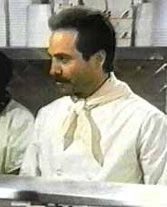
"No posting. Come back 1 month." You may send me a friendly reminder in 30 days if I forget to turn you back on. If you choose to send me yet another insulting email or continue to post with this sort of attitude in regards to the rules of this website when you return, there will not be a third "Soup Nazi warning". Save your fingers. I do not want to hear from you for the next 30 days in any form.
| IP: Logged
|
|
|
|
Frank Angel
Film God
Posts: 5305
From: Brooklyn NY USA
Registered: Dec 1999
|
posted 08-04-2002 12:46 AM
No, Stephen, unfortunately I haven't seen a real VV presentation, much to my regret. I missed the 70mm restoration of VERTIGO. And naturally I would be totally gung-ho in favor of the use of larger film negative for shooting, any time any where, such as VV and when Fox was headed in the same direction with CS 55. And I have always been a fan of that "still germinating idea" of ISCOvision (or was it ISCOscope) which allows a much larger negative area and print area to produce 1.85. I think the thing that is a little unnerving to me about VV is the fact that it allows such latitude in projection. Either a film was shot to be projected at 1.85 or it wasn't. Either it was 1.5 or it wasn't. I am the anal retentive type that wants to project any film at the precise AR that it was composed in, whether or not there may be more image in the frame than is on the screen. Although I must admit that I find I am forever being tempted (most times I resist) to play 1.85 films at 1.66, only because I am so attracted to the idea of less magnification, less grain and more light (the way prints are high-speed printed today, every little bit helps). But this idea that a VV film could be played with any aspect ratio from 1.5:1 to 2:1 seems to fly right in the face of being true to the filmmaker's composition. I mean, on all those unmatted 1.85 prints that we get that have image out to full frame, seems it would be just as haphazard to say, oh, just run it in whatever you have handy....1.66, 1.75, 1.85 or 2.1. These all can't be right. Yes, they did suggest a "preferred" projection ratio (I remember seeing this on the reel bands years ago -- a minimum, a maximum and a preferred AR was given), but that just seems to me to be a little to imprecise; they shouldn't be suggesting anything -- they should be saying, this print should be projected at 1.85:1, period. What does it matter if there was an open camera aperture in the filming? The director and cinematography had only one frame size in mind when they composed their shots; why give the theatres a choice of three or four? I mean, I understand that when shooting a film the VV format allows the director to choose a variety of aspect ratios -- very nice; they can use VV if they want a 1.66 film or a 1.85 film, but when they go to strike prints, there should be no equivocation about what aspect ratio it needs to be projected it in. See what I mean? To let the theatre decide seems too undisciplined.
Frank PS -- Suppossedly I have a B&L CinemaScope 55 anamorphic. It has a very large rear element and it was supposed to be used on Century and Simplex wide barrel lenses for CS 55 prints. And even though this is an old lens, it focuses like nothing else, including my ISCOs and Schneiders. There is no racking back and forth trying to see which is on the money....you just turn the focus knob and all of a sudden it is IN. No mistaking that precise point. Plus they have very good contrast, although maybe not quite as good as the newer ones, but only by a hair. I love these lenses. Yes, we have all heard about the problems with early CS shooting and projection anamorphics, but this lens proves to me that whatever the first generation problems were, they resolved them pretty quickly.
| IP: Logged
|
|
Frank Angel
Film God
Posts: 5305
From: Brooklyn NY USA
Registered: Dec 1999
|
posted 08-04-2002 01:07 AM
Hey Ken, you said: >Alfred Hitchkock hated projectionists.<>Look at the print of VERTIGO and see what Alfred did during each changeover. I covered the port window except for the very right top corner. Two can play at that game.< I will have to check that out. But tonight I ran OUR SONG which had this at a change-over: Reel 2 about to end....you see the Sync Start cues (some folks call them motor cues), then the screen goes totally BLACK. Then picture is back on the screen for a shot that lasts perhaps 2 second and then Change-over cues. So, you see the first cue and boom, you've got a black screen. First instinct -- "holy geez, I missed the first cue." And you slam down the dowser and hit MUTE. Naw, you didn't miss anything; the editor was just playing with you, or he was wasted when he cut that reel's change-over point. It so happened that the director was in the house for this screening and I wanted to make bring this to his attention, because this picture probably won't be playing many platter houses. Best way to bring it to his attention was to actually slam that dowser down, but professionalism is a hard thing to fight. So I just left a big note in the can for the poor slob who gets this print 15 minutes before it has to go on the screen and doesn't have time to prep it.
| IP: Logged
|
|
|
|
Stephen Furley
Film God
Posts: 3059
From: Coulsdon, Croydon, England
Registered: May 2002
|
posted 08-04-2002 02:45 AM
Frank said: quote:
No, Stephen, unfortunately I haven't seen a real VV presentation, much to my regret. I missed the 70mm restoration of VERTIGO. And naturally I would be totally gung-ho in favor of the use of larger film negative for shooting, any time any where, such as VV and when Fox was headed in the same direction with CS 55. And I have always been a fan of that "still germinating idea" of ISCOvision (or was it ISCOscope) which allows a much larger negative area and print area to produce 1.85.
I thought of CS 55, and almost mentioned it, when I made my post yesterday. I decided not to, as the post was getting rather long, I do have a fault of rambling on longer than I should, and I am trying to keep my posts shorter. CS 55 has certain similarities with Vista, it used a large negative area, with a widescreen ratio, and was intended mainly to be presented as a normal 35mm 4 perf reduction. Of course, I never got to see the proposed 55.625 6 perf print format, but I have seen both titles as 35mm prints, and they looked very good. The CS 55 neg was very large, about 1.4 times the area of a 65mm 5 perf frame, I think, and not far short of a 8-70 special venue frame. CS 55 had the advantage of a larger frame and a better sound system than Vista, but the disadvantage of needing special stock, slitters, perforators, processors, splicers and other equipment. The wider aspect ratio of Scope is a matter of personal preference, therefore neither has an absolute advantage over the other. There were too many formats around in the '50s, and clearly not all were going to survive; unfortunately, we now have no large format system in use for 'normal' i.e. not special venue cinema. There has been no 65mm since 'Hamlet', and no sign of any more to come. Did you see 'Hamlet' in either 35 or 70? I am not a great fan of Shakespeare, and left at the end of the show still unsure what some of it was about, but, visually, it was quite stunning, even in 35mm, as was the 35mm re-release of "West Side Story" a few years ago. I wish somebody would fish some of the large format films out of the vaults, make good 35mm prints, and get them into the best cinemas with the best presentation, with possibly a few 70mm prints being made for the largest screens. With modeern stocks, even the tiny neg areas of flat 1.85 and Super 35 can look good, but lage format origination looks better. quote:
they should be saying, this print should be projected at 1.85:1, period. What does it matter if there was an open camera aperture in the filming? The director and cinematography had only one frame size in mind when they composed their shots; why give the theatres a choice of three or four? I mean, I understand that when shooting a film the VV format allows the director to choose a variety of aspect ratios -- very nice; they can use VV if they want a 1.66 film or a 1.85 film, but when they go to strike prints, there should be no equivocation about what aspect ratio it needs to be projected it in. See what I mean? To let the theatre decide seems too undisciplined.
I agree. I think all films should have clear instructions as to how they are to be projected, and cinemas should keep to those instructions. I am not too worried about keeping it precise to the last decimal place, but it should be fairly close. showing a 1.85 film full screen on 1.78 (16:9) television is, I think, acceptable; Projecting a 1.66 film at 1.85 is not. Nor am I in favour of printing films in modified form, such as the Disney Academy ratio within 1.85 height prints. If a cinema is unable to show a film as was intended, or more often cannot be bothered to, they shouldn't show it. I once ran a 16mm film at a private screening, with the director in the audience. He handed me two reels each of print and track, and asked me what ratio we would be showing it in. He seemed quite shocked when I replied "well, it's your film, what ratio do you want it shown in"
| IP: Logged
|
|
|
|
|
|
All times are Central (GMT -6:00)
|
This topic comprises 6 pages: 1 2 3 4 5 6
|
Powered by Infopop Corporation
UBB.classicTM
6.3.1.2
The Film-Tech Forums are designed for various members related to the cinema industry to express their opinions, viewpoints and testimonials on various products, services and events based upon speculation, personal knowledge and factual information through use, therefore all views represented here allow no liability upon the publishers of this web site and the owners of said views assume no liability for any ill will resulting from these postings. The posts made here are for educational as well as entertainment purposes and as such anyone viewing this portion of the website must accept these views as statements of the author of that opinion
and agrees to release the authors from any and all liability.
|

 Home
Home








 Printer-friendly view of this topic