Film-Tech Cinema Systems
Film-Tech Forum ARCHIVE


my profile | my password | search | faq & rules | forum home
  next oldest topic   next newest topic
» Film-Tech Forum ARCHIVE   » Operations   » Film Handlers' Forum   » How do you thread --- and why? (Page 2)

 
This topic comprises 6 pages: 1  2  3  4  5  6 
 
Author Topic: How do you thread --- and why?
John Hawkinson
Film God

Posts: 2273
From: Cambridge, MA, USA
Registered: Feb 2002


 - posted 11-08-2008 11:28 PM      Profile for John Hawkinson   Email John Hawkinson   Send New Private Message       Edit/Delete Post 
For really long leaders, on inspection, I haul out my sync block and lay down a piece of a paper tape 5' from the start of the leader, and mark three framelines on it.

--jhawk

 |  IP: Logged

Tony Bandiera Jr
Film God

Posts: 3067
From: Moreland Idaho
Registered: Apr 2004


 - posted 11-08-2008 11:45 PM      Profile for Tony Bandiera Jr   Email Tony Bandiera Jr   Send New Private Message       Edit/Delete Post 
John, excellent idea when you have enough leader provided to do that. [Smile] Sadly, most prints I've seen don't have that.

 |  IP: Logged

John Hawkinson
Film God

Posts: 2273
From: Cambridge, MA, USA
Registered: Feb 2002


 - posted 11-08-2008 11:47 PM      Profile for John Hawkinson   Email John Hawkinson   Send New Private Message       Edit/Delete Post 
Huh? That's my solution when you have "too much" extra leader (e.g. 20 feet of clear stuff).

When you don't have a lot of extra leader, then you can frame without having to haul out lots of leader.

(Oh, is the problem here the SRD motor relay issue? Not an issue for us in our configuration, but...)

--jhawk

 |  IP: Logged

Tony Bandiera Jr
Film God

Posts: 3067
From: Moreland Idaho
Registered: Apr 2004


 - posted 11-08-2008 11:52 PM      Profile for Tony Bandiera Jr   Email Tony Bandiera Jr   Send New Private Message       Edit/Delete Post 
The issue is Brad disagrees with my threading method using a "standard" leader. [Big Grin]

See the first page.

 |  IP: Logged

Brad Miller
Administrator

Posts: 17775
From: Plano, TX (36.2 miles NW of Rockwall)
Registered: May 99


 - posted 11-09-2008 02:10 AM      Profile for Brad Miller   Author's Homepage   Email Brad Miller       Edit/Delete Post 
Actually Tony, had you read my post carefully, you would've seen that I recommended precisely what John was suggesting above when you have a print with tons of clear leader at the front before usable framelines appear. Just mark a few frames about an arm's stretch from the tip of the leader and you're good to go.

Also, no studio will get angry because you added extra leader to a print. You aren't cutting the film anywhere. That is the stupidest argument I think I've ever heard on these forums. [Roll Eyes]

Regardless, the film should ideally never be handled closer than 25 feet from the first (or last) frame on the reel. Obviously reality prevents that in most circumstances, but regardless the fact of the matter is that every time the film is handled, it gets just a little bit more wear to it at and near that spot where it was handled, and every time the film runs, that section...even if only slightly dirty...migrates to the next layer of film. That's how it works, and is precisely why you can tell on an older print that you are approaching the reel change well before the cue marks appear.

If you only run a print a time or two (and especially if the print wasn't brand new to begin with), then I don't expect for you to be able to see what your practices are doing.

I do firmly agree with you though that the condition of the shipping cans and lack of tape to secure the leaders down are serious problems though. That is why for years when I used to work regularly in booths I would ship prints out with each reel individually wrapped in a small trash liner and about 8 inches of tape on each reel to secure the leaders.

 |  IP: Logged

Jim Cassedy
Phenomenal Film Handler

Posts: 1661
From: San Francisco, CA
Registered: Dec 2006


 - posted 11-09-2008 10:35 AM      Profile for Jim Cassedy   Email Jim Cassedy   Send New Private Message       Edit/Delete Post 
quote: Tony Bandiera Jr
If using DTS, I then thread the extra sprockets and film capstans and DTS reader (mounted where the old 4-track mag goes).
I've got one booth with a 35/70 JJ where the DTS reader is mounted on
top of an SDDS reader which mounted on top of the original 37/70 mag penthouse.

I have to keep an old milk crate next to the projector so
I can reach that roller way on top

( and I betcha didn't know old milk actually came in crates! [Smile] )

 |  IP: Logged

John Hawkinson
Film God

Posts: 2273
From: Cambridge, MA, USA
Registered: Feb 2002


 - posted 11-09-2008 10:48 AM      Profile for John Hawkinson   Email John Hawkinson   Send New Private Message       Edit/Delete Post 
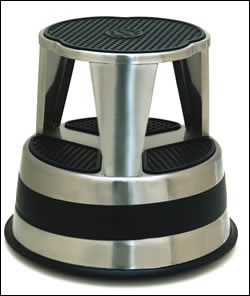
For our shorter projectionists, we have one of these:
 -

A "Rock Stop" or "Kik-Step" (trademarks both). Rolls when there's no weight on it, but when you step on it, the wheels disengage and it stays put. Quite handy.

--jhawk

 |  IP: Logged

Joe Redifer
You need a beating today

Posts: 12859
From: Denver, Colorado
Registered: May 99


 - posted 11-09-2008 11:12 AM      Profile for Joe Redifer   Author's Homepage   Email Joe Redifer   Send New Private Message       Edit/Delete Post 
That's space-age technology, there! Just look at the color of that metal. We are forced to use a metal cage to stand on when we want to reach high places.

 |  IP: Logged

John Hawkinson
Film God

Posts: 2273
From: Cambridge, MA, USA
Registered: Feb 2002


 - posted 11-09-2008 11:19 AM      Profile for John Hawkinson   Email John Hawkinson   Send New Private Message       Edit/Delete Post 
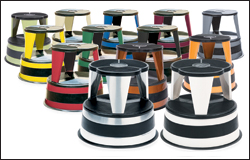
Well, gosh, Joe! It appears they're celebrating their 50th anniversary over at kikstep.com and they have all these colors:
 -

On the other hand, I suppose it's 2008, so 50 years ago is 1958, and Wikipedia says the Space Age started in 1957. [Eek!]

--jhawk

 |  IP: Logged

Damien Taylor
Master Film Handler

Posts: 493
From: Perth, Western Australia
Registered: Apr 2007


 - posted 11-09-2008 11:23 PM      Profile for Damien Taylor   Email Damien Taylor   Send New Private Message       Edit/Delete Post 
3 screens with AW3's two non operator side. I was always taught soundtrack away from tree all times and towards screen to and from projector, makes for some pretty gnarly twists. Also we use prints soundtrack down, which I heard was an old fashioned thing to do.

 |  IP: Logged

Tyler Potts
Expert Film Handler

Posts: 159
From: Anderson, SC, USA
Registered: Sep 2008


 - posted 11-10-2008 12:52 AM      Profile for Tyler Potts   Author's Homepage     Send New Private Message       Edit/Delete Post 
Strong platters with simplex projectors and soundhead, dolby in 4 houses DTS in 10 (two of those needing the discs at all times, they don't save the media). I tree up like Joe's original post and thread with the proper loop sizes as my old (past and age) certifier instructed me. The 2 projectionists I personally trained thread this way, and I think I need to hold a back to basics seminar for the 3 others. They like to immediately pull nearly all the leader to the floor, loop to the top roller above the projector, tuck the tail under the print (even though we have MANY pucks), sometimes check the flywheel to see if they're in frame, and then the worst... after threading, pulling the leader away from the platter towards them to make it take up.

 |  IP: Logged

Jim Cassedy
Phenomenal Film Handler

Posts: 1661
From: San Francisco, CA
Registered: Dec 2006


 - posted 11-10-2008 09:36 AM      Profile for Jim Cassedy   Email Jim Cassedy   Send New Private Message       Edit/Delete Post 
I tend to thread as most of the other posters here, but I have the sound track facing the front wall of the booth as it heads towards the projector.

In my particular situation which involves a number of extra rollers between the projectors & platters due to them being in seperate rooms ( ! ) this arrangement keeps only the base side of the film in contact with the rollers.

Same thing on the return side.

 |  IP: Logged

Dominic Espinosa
Phenomenal Film Handler

Posts: 1172
From: California, U.S.A.
Registered: Jan 2004


 - posted 11-10-2008 11:40 AM      Profile for Dominic Espinosa   Email Dominic Espinosa   Send New Private Message       Edit/Delete Post 
Hey, Joe. What made you crave a can of worms?

I thread same as Joe with a few variations: I open up the pad rollers and gate and such, wipe it out, turn my intermittent, then start threading.

I as well learned to pull down a few feet of film onto the floor and thread top to bottom.
After becoming a Film-Techer I started locking it in the sound head holdback sprocket (Century R3's) and threading down until I learned to thread "up".

Now I teach everyone, regardless of machinery, to thread bottom to top and be as generous as possible with the leader when building up. We also do a "running start" by motoring through the extra leader before hitting the start button.

As was already pointed out, when you learn where the framelines go you never have to readjust your loops.
I can't imagine threading any other way because this way is so much faster, accurate, and let's face it, cooler.

[beer]

 |  IP: Logged

Monte L Fullmer
Film God

Posts: 8367
From: Nampa, Idaho, USA
Registered: Nov 2004


 - posted 11-10-2008 01:43 PM      Profile for Monte L Fullmer   Email Monte L Fullmer   Send New Private Message       Edit/Delete Post 
Looks like I'm about the only one that does the soundtrack away from the screen. Simple reason why I do this is that (and I know this doesn't matter since film is film...) the film has a certain curl and it just seems to lay across the upper projector roller better if I do it this way than soundtrack facing the screen.

Plus, even though when I began working with platters in the mid 70's, it was soundtrack to the screen at first. But, it was easier for me to do away from the screen and thus continued that practice to this day.

Plus, with those who don't have any digital devices attached to their projectors, it seems that the film hits the upper sprocket rather on a distressed angle with the film being pulled down mainly by the inboard set of teeth whereas if one does it the way I do, then that sprocket is pulling down the film with both sets evenly.

It's all personal preference....

-Monte

 |  IP: Logged

Bill Enos
Film God

Posts: 2081
From: Richmond, Virginia, USA
Registered: Apr 2000


 - posted 11-10-2008 01:46 PM      Profile for Bill Enos   Email Bill Enos   Send New Private Message       Edit/Delete Post 
This stupid topic will never die. A few years ago I asked some older, I'm talking 80+ years, retired union projectionists about threading up or down. They were all taught in the '40s to thread down and to avoid the floor but it was not an issue if it touched. One of these men was part of a 4 man crew that ran one print of one of the roadshow films for a year and a half and it didn't have visible dirt or scratches at the end. That was reel to reel 70mm on Norelcos. His comment was that if the booth was clean, the floor was swept 3 times a day, and damp mopped once, touching the floor didn't matter.

 |  IP: Logged


All times are Central (GMT -6:00)
This topic comprises 6 pages: 1  2  3  4  5  6 
 
   Close Topic    Move Topic    Delete Topic    next oldest topic   next newest topic
 - Printer-friendly view of this topic
Hop To:


Powered by Infopop Corporation
UBB.classicTM 6.3.1.2

The Film-Tech Forums are designed for various members related to the cinema industry to express their opinions, viewpoints and testimonials on various products, services and events based upon speculation, personal knowledge and factual information through use, therefore all views represented here allow no liability upon the publishers of this web site and the owners of said views assume no liability for any ill will resulting from these postings. The posts made here are for educational as well as entertainment purposes and as such anyone viewing this portion of the website must accept these views as statements of the author of that opinion and agrees to release the authors from any and all liability.

© 1999-2020 Film-Tech Cinema Systems, LLC. All rights reserved.