|
|
This topic comprises 8 pages: 1 2 3 4 5 6 7 8
|
|
Author
|
Topic: Apr 2 Nitrate booth fire at the Stanford, Palo Alto
|
|
|
Monte L Fullmer
Film God

Posts: 8367
From: Nampa, Idaho, USA
Registered: Nov 2004
|
 posted 04-07-2009 12:16 AM


quote: Jack Theakston
the Stanford risked running a nitrate print when Sony has a perfectly good safety print of the film in question available for rental.
..this may not be a logical answer that you're seeking, yet, I fully understand why they did and the comments above have clarifed why the nitrate was presented - just a lot better presentation along seeing something on the screen that had that 'romantic' touch to the days of yesteryear...on how film was really presented.
I'm sure that the members of Film-Tech who have personally ran nitrate can testify to how it looked on the screen compared to the film of today...and the comparison would be just like night and day in quality.
My old booth that I was chief projectionist at still had the carbon tet extinguisher bottles hanging over the machines (which were finally removed in the mid 70's), 3/16" plate steel fire shutters above all of the portholes with the lead break in the holding chains..along with the red sand bucket( which was now in storage) still on the premises. Booth entrance doors were still tin covered along with the walls having tin under the lath and plaster, but don't know if asbestos was under the tin or not, yet, I've seen booths that were lined with sheet asbestos with tin layover.
Booth also had spare fire rollers in the parts bin for the magazines if needed.
I did find two B/W reels of nitrate at this theatre still in excellent condition - no shrinkage, decay or any abnormalities. I ran those two reels from time to time and really appreciated how the film still ran though those XL's (which still had the fire shutters in them..) and how the picture looked on the screen. Those reels disappeared one day - think the mgr took them.
Here are some nitrate samples. I found this tin of film in a theatre that was long closed. Film is in an almost prestine condition. No scratched on the stock and have both head and tail leaders still attached.
One could alway tell nitrate with the horizontal lines inbetween the sprocketholes. Safety from Technicolor took these lines and ran them vertically - in line with the sprocketholes
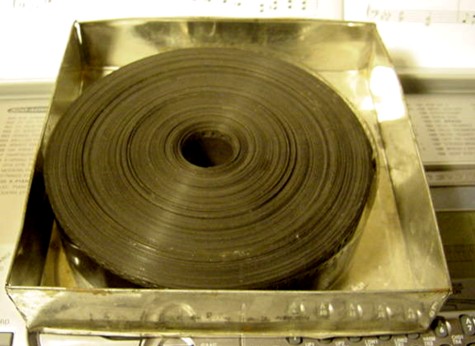
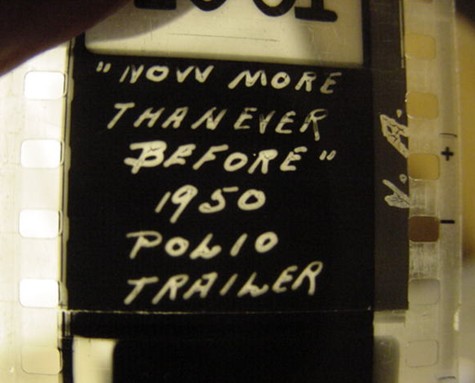
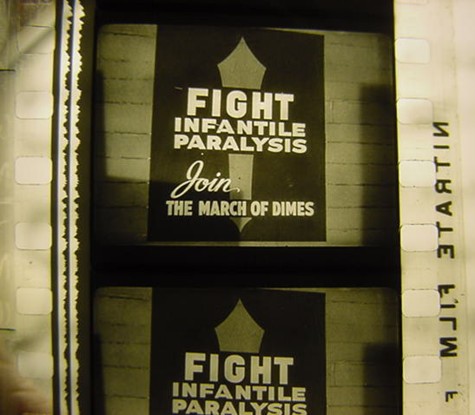
Nitrate in IB color .. sorry, didn't get this one in focus too well, but you can see the "duPont Nitrate" on the side
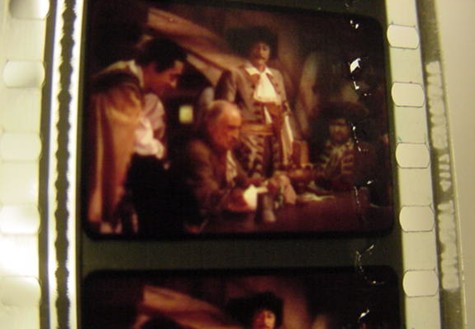
| IP: Logged
|
|
|
|
|
|
|
|
|
|
|
|
|
|
Richard P. May
Expert Film Handler
Posts: 243
From: Los Angeles, CA
Registered: Jan 2006
|
posted 04-08-2009 09:54 AM
With his permission, I am posting a memo from David W. Packard regarding the recent nitrate fire at the Stanford Theater.
This should answer many of the speculations of the last few days.
The recent fire in the projection booth at the Stanford Theatre has stimulated interest and discussion,
so I will try to explain the event and its background.
The Stanford Theatre in Palo Alto was built in 1925. For its first 25 years every film shown was
nitrate, and I am not aware of any notable event during that period. We purchased the theatre in 1987
and made major renovations and seismic upgrades (being near the San Andreas Fault). We designed
the projection booth to comply with all code regulations regarding nitrate film, and we received approval
from the local authorities to run nitrate. The booth has walls with very high fire ratings, two exit
doors, smoke and heat detectors, fire sprinklers, and metal shutters to cover the ports into the auditorium.
Nitrate reels are stored in specially designed bins.
Between 1989 and 2009 we have shown nitrate prints as part of our regular program many hundreds
of times. When we show nitrate we always have two skilled projectionists, so neither machine
will ever be unattended. We always inspect the film very carefully. Occasionally we have had splices
break in the sound head (away from the heat of the film gate) but never any serious problem.
On April 2, we were showing a Technicolor nitrate print of Cover Girl (1944). The event happened
about three minutes into the first reel. The film broke, or jammed, or somehow got stuck in the film
gate and immediately caught fire. The film below the gate continued into the take-up magazine and
was not affected by the fire. The fire traveled up the film above the gate and entered the supply reel in
its magazine. The entire reel (nearly 2000 feet) burned in the magazine.
After briefly trying to control the fire, both projectionists left the booth. The heat detectors did not
respond immediately. The fire burning in the upper reel was briefly visible to the audience through the
ports. Then the shutters closed over the ports, and the fire sprinker flooded the projector. The fire was
over within a few minutes.
When we returned to the booth, we found that fire damage was restricted to the projector and was
less than I had expected (thanks to the sprinklers). The sprinklers did not prevent the nitrate from
burning but did limit collateral damage. We use Simplex XL projectors with carbon arc lamps. After
cleaning the projector, we re-opened the theatre two days later.
The fire sprinklers continued for about 15 minutes and created an enormous flood of water that
flowed into the balcony and seeped into lower floors. The water damage was significant, though not
catastrophic.
My conclusion is that the proper design of the booth and the skill of our projectionists had their
intended effect of minimizing the damage. It appeared to me that the Fire Department had the same
opinion.
We plan a temporary moratorium on running nitrate until we evaluate whether we can take any
further steps to make the booth even safer. One idea is a panic button that the projectionist can push
to activate the sprinklers and shutters sooner. We certainly intend to install a floor drain to handle the
water from any future sprinkler event. We also believe that we can develop a way to sense a fire in the
gate and quickly and automatically cut and isolate the film in the two magazines.
Some people may wonder why we show nitrate prints at all. Sometimes they are the only print available.
But often we do it for the quality. The afternoon of the event, we had done a side-by-side comparison
(with alternating projectors) of our old nitrate print and a newly-made, nearly pristine print. A
professional filmmaker was sitting beside me, and we both felt that no one could fail to be amazed by
the great difference. This is no criticism of modern film restoration. The plain fact is that the old dyetransfer
printing process can achieve results that are not possible with current methods. We all hope
that future technology may bring back the old experience.
David W. Packard
President
The Stanford Theatre Foundation
| IP: Logged
|
|
|
|
|
|
|
|
Bill Enos
Film God

Posts: 2081
From: Richmond, Virginia, USA
Registered: Apr 2000
|
posted 04-08-2009 02:33 PM
Briefly trying to control the fire, I have been told means that one of the "skilled projectionists" opened the magazine, one of the biggest absolutely don't do's in running nitrate. It should burn inside the magazine, opening the mag. allows the fire to escape and further endanger the building and public.
My question is, After the first few minutes and the OOOOH and AAAAHH factor is over, a nitrate screening is no different than any other. It doesn't make the movie any better, won't make a bad movie good, so is it really worth the risk? My opinion says no, especially in a theatre such as the Stanford where so much else is put at risk.
| IP: Logged
|
|
|
|
|
|
|
|
All times are Central (GMT -6:00)
|
This topic comprises 8 pages: 1 2 3 4 5 6 7 8
|
Powered by Infopop Corporation
UBB.classicTM
6.3.1.2
The Film-Tech Forums are designed for various members related to the cinema industry to express their opinions, viewpoints and testimonials on various products, services and events based upon speculation, personal knowledge and factual information through use, therefore all views represented here allow no liability upon the publishers of this web site and the owners of said views assume no liability for any ill will resulting from these postings. The posts made here are for educational as well as entertainment purposes and as such anyone viewing this portion of the website must accept these views as statements of the author of that opinion
and agrees to release the authors from any and all liability.
|

 Home
Home









 Printer-friendly view of this topic