Film-Tech Cinema Systems
Film-Tech Forum ARCHIVE


my profile | my password | search | faq & rules | forum home
  next oldest topic   next newest topic
» Film-Tech Forum ARCHIVE   » Operations   » Film Handlers' Forum   » Once Upon a Time ... in Hollywood 70mm/35mm release? (Page 11)

 
This topic comprises 15 pages: 1  2  3  ...  8  9  10  11  12  13  14  15 
 
Author Topic: Once Upon a Time ... in Hollywood 70mm/35mm release?
Jean-Pierre Gutzeit
Film Handler

Posts: 43
From: Berlin, Berlin, Germany
Registered: Nov 2012


 - posted 08-04-2019 04:51 PM      Profile for Jean-Pierre Gutzeit   Author's Homepage   Email Jean-Pierre Gutzeit   Send New Private Message       Edit/Delete Post 
https://m.soundcloud.com/upintheboothpodcast/the-return-of-35mm-70mm-film-in-2019

 |  IP: Logged

Sean McKinnon
Phenomenal Film Handler

Posts: 1712
From: Peabody Massachusetts
Registered: Sep 2000


 - posted 08-05-2019 11:14 AM      Profile for Sean McKinnon   Author's Homepage   Email Sean McKinnon   Send New Private Message       Edit/Delete Post 
Bobby, I think the biggest contributor to CDS failures was overheating of the processing unit. It is quite possible that a modern design of this system would yield better results. I think SDDS was based on CDS so that should give some indication.

 |  IP: Logged

Marcel Birgelen
Film God

Posts: 3357
From: Maastricht, Limburg, Netherlands
Registered: Feb 2012


 - posted 08-05-2019 03:55 PM      Profile for Marcel Birgelen   Email Marcel Birgelen   Send New Private Message       Edit/Delete Post 
Optical digital scanners have enormously improved since the early 1990s. Every modern smartphone has one we only could dream off back then.

Also, CDS had a bandwidth of about 5.1 MBps including error correction. You could do the processing of that in software nowadays. No need for expensive, customized hardware.

You would still need the internal documentation of the CDS implementation. And why recreate CDS, if you can do something better with current tech?

I still think that if you want to bring modern digital sound to projected film, you should use a timecode based solution just like DTS. Files should no longer be on CD-ROMs, but simply digital downloads or "ingestables" like DCPs.

DTS-X could easily become the new MDA for 70mm, but with an install base so small, it's hard to convince anybody to put in the money to do it, even if the amount of R&D you'd have to put into it would be manageable. Nobody is going to invest any considerable money if your potential market is maybe 75~100 units at best.

The only reason why DCI is still a business, is because it can use existing technology as its base. Still, the customizations needed specifically to be DCI compliant make it an expensive niche.

 |  IP: Logged

Leo Enticknap
Film God

Posts: 7474
From: Loma Linda, CA
Registered: Jul 2000


 - posted 08-05-2019 04:04 PM      Profile for Leo Enticknap   Author's Homepage   Email Leo Enticknap   Send New Private Message       Edit/Delete Post 
Rather than do all this reinventing of the wheel and/or trying to resurrect flawed 1990s technology, why not simply come up with a way of synchronizing the film projector to the playback of DCP audio from a media block?

You would need some kind of a box that takes the output from the DTS timecode reader(s), and from an LTC output on the media block, processes those two streams, and then controls an AC inverter on the projector in order to keep the two in sync. I'm not enough of an electronic engineer to be able to create such a thing, but the R & D involved shouldn't be a showstopper, as far as I can see.

The only serious gotcha I can think of with such an arrangement would be the film and DCP versions were substantively different (e.g. logos on the front of one that weren't on the other), but if the release was being properly co-ordinated, it would surely be possible to avoid doing that.

 |  IP: Logged

Paul H. Rayton
Expert Film Handler

Posts: 210
From: Los Angeles, CA , USA
Registered: Aug 2003


 - posted 08-05-2019 04:06 PM      Profile for Paul H. Rayton     Send New Private Message       Edit/Delete Post 
Regarding CDS: I know that at least one or two of the original CDS 70mm demo reels still exist, in the vaults at AMPAS (the Academy). Each ran around 10 minutes. I'm not sure if AMPAS has any of the original playback equipment, but some processors were still around ... but that was ~10 years ago. I also recall that, back when DTS was still in business under their own name, one of their techs also had some of the original playing equipment, too. I haven't heard anything about any of that equipment recently, though I haven't asked anyone. It's possible something could be found. Making it work? A true "science project!"

 |  IP: Logged

Thomas Hauerslev
Master Film Handler

Posts: 451
From: Copenhagen, Denmark
Registered: Aug 2000


 - posted 08-06-2019 01:04 AM      Profile for Thomas Hauerslev   Author's Homepage   Email Thomas Hauerslev   Send New Private Message       Edit/Delete Post 
"the original CDS 70mm demo reels" = title was "Sounds Like The Real World"

https://www.in70mm.com/library/process/cds/index.htm

https://www.in70mm.com/news/2017/cds/index.htm

Plus a comment to Bobby on one of the previous pages:

"When I think of classic 50+ year old movies shot on 65mm film I think of scenes shot on big sound stages with plenty of light or outdoor scenes in bright daylight.

"LOA" was photographed on 12 ASA film stock.

 |  IP: Logged

Sean McKinnon
Phenomenal Film Handler

Posts: 1712
From: Peabody Massachusetts
Registered: Sep 2000


 - posted 08-06-2019 11:48 AM      Profile for Sean McKinnon   Author's Homepage   Email Sean McKinnon   Send New Private Message       Edit/Delete Post 
I think i've mentioned this before but I have a simple concept for how to achieve Atmos playback synced to 35 or 70mm film using all "off the shelf" type components that are readily available at plex's running 70mm and some support from the studio and Dolby.

 |  IP: Logged

Mark Gulbrandsen
Resident Trollmaster

Posts: 16657
From: Music City
Registered: Jun 99


 - posted 08-06-2019 07:47 PM      Profile for Mark Gulbrandsen   Email Mark Gulbrandsen   Send New Private Message       Edit/Delete Post 
quote: Sean McKinnon
I think SDDS was based on CDS so that should give some indication.

The CDS processor would run very hot, but if the front was left open for better air flow it could be stable. What killed most screenings was there were no fall back tracks AT ALL. They would run fine for a few days, or a dozen shows or so but then could not be reliably read back. Some of CDS and some of the people there did become SDDS.

SDDS was also a YUGE failure overall with short print life spans in many locations causing reversion to analog and back to digital and back to analog and so on. Had they put a latch in to hold it in analog once it reverted then it wouldn't have been so annoying. The 2000 readers were a big part of the problem as was getting partslike LED's, sprockets and lateral guide rollers. There was a whole year where you literally cold not get any of those parts. We finally had LaVezzi make us custom sprockets. The real down side of it was the high track wear. There was no more room left on a 35mm width of film to move it some where else. But it did sound very good the first few weeks of the runs. We finally replaced all the 2000 units with CP-650's and laid them to rest in the electronic bone year. The 3000's were a lot better until the parts for those ran out.

Syncing somethig SMPTE to DTS is very easy with the right tools.

Mark

 |  IP: Logged

Sam D. Chavez
Film God

Posts: 2153
From: Martinez, CA USA
Registered: Aug 2003


 - posted 08-07-2019 01:51 AM      Profile for Sam D. Chavez   Author's Homepage     Send New Private Message       Edit/Delete Post 
Roger Hibbard was part of the CDS team and later a senior engineer at USL told me one of the big failings was very poor depth of field. Even little particles of splicing tape could knock the film out of focus and with no backup all was lost. Very arrogant approach but they had their chance and blew it.

 |  IP: Logged

Steve Guttag
We forgot the crackers Gromit!!!

Posts: 12814
From: Annapolis, MD
Registered: Dec 1999


 - posted 08-07-2019 07:39 AM      Profile for Steve Guttag   Email Steve Guttag   Send New Private Message       Edit/Delete Post 
With SDDS, they learned to to stagger the tracks so splicing tape wouldn't take the system down since "the other" track was at a different part of the audio.

I didn't have the problems with SDDS that Mark had. We had 2000 and 3000 series systems. It was nowhere as stable as Dolby or DTS but it could be run reliably for weeks on end. The 2000 series reader was too delicate. It could be put into precise alignment but that required effort and the tiny screws were poor at holding it in alignment. Poor platter back tension (if you had an AW3 with those center roller springs that could jerk the film was more than it could overcome).

The 3000 series reader had a really terrible design with their magnetic clutch. Way too much tension (probably to combat unstable platter tension from some platters as mentioned above) that would wear the butter-like aluminum sprocket down, that was also overly expensive. The LED/Reader part was MUCH more stable than the 2000 series readers. The Reader cables were overly complicated and sensitive to hot-plugging (would damage the system.

And shame on Sony for trying to force a "dB" scale fader (which on the 2000 series took about 100 turns). dB scales only make sense internally when calibrating...they have no real-world meaning to end users that just want to make the sound a little louder or a little quieter. Percentage wins the day there.

 |  IP: Logged

Scott Norwood
Film God

Posts: 8146
From: Boston, MA. USA (1774.21 miles northeast of Dallas)
Registered: Jun 99


 - posted 08-07-2019 12:03 PM      Profile for Scott Norwood   Author's Homepage   Email Scott Norwood   Send New Private Message       Edit/Delete Post 
One of the things that Dolby got right that Sony didn't was the error counter display. It is useful to know when the digital track is marginal before it fails completely. SDDS tracks are (were?) sufficiently problematic that lab-new prints regularly fail to play properly in the format. I only ever used the 2000-series units; maybe they added an error counter later?

Anyway, I haven't touched SDDS anything since 2003-ish, and never want to see it again.

 |  IP: Logged

Steve Guttag
We forgot the crackers Gromit!!!

Posts: 12814
From: Annapolis, MD
Registered: Dec 1999


 - posted 08-07-2019 12:18 PM      Profile for Steve Guttag   Email Steve Guttag   Send New Private Message       Edit/Delete Post 
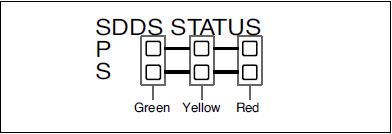
On the rarely seen DFP-D2500, they did have a display of the "quality" of the SDDS tracks...it was a simple yellow, green, red but better than nothing.

 -

 |  IP: Logged

Scott Norwood
Film God

Posts: 8146
From: Boston, MA. USA (1774.21 miles northeast of Dallas)
Registered: Jun 99


 - posted 08-07-2019 12:31 PM      Profile for Scott Norwood   Author's Homepage   Email Scott Norwood   Send New Private Message       Edit/Delete Post 
Interesting. Sony VTRs for digital formats use something similar to indicate "channel condition" (more-or-less the video equivalent to the SRD error rate, I think). Good tapes show green and marginal tapes show yellow. I have never seen a red indicator.

 |  IP: Logged

Jean-Pierre Gutzeit
Film Handler

Posts: 43
From: Berlin, Berlin, Germany
Registered: Nov 2012


 - posted 08-09-2019 06:45 PM      Profile for Jean-Pierre Gutzeit   Author's Homepage   Email Jean-Pierre Gutzeit   Send New Private Message       Edit/Delete Post 
For spatial vision, a deep-sharp photography, which also takes on the character of a relief through the art of lighting, is of formative importance, thus suggesting an immersive effect. Thank you for reply. I absolutely agree with that.
In David Lean's films is that at least since OLIVER TWIST evident.
With LAWRENCE OF ARABIA, however, I assume less of 12 ASA than rather the material type 5250 50 ASA T and 32 ASA D with Wratten 85 filters. (Maybe someone would like to research this?)

The way I saw LAWRENCE OF ARABIA in 1973, it was never the best-looking 70mm film, but always a bit grainy.

But with the bad lab's work of the last 15 years I meant blurring and false colors of the theater prints. In earlier years this was unthinkable. HATEFUL 8 and INTERSTELLAR showed slightly blurred internegatives, PHANTOM THREAD and 2001 showed a sharper grain reproduction, but even more terrible colors. Before about the years I lost my hope for improvements. With H8 the lab had done nothing right. ONCE UPON A TIME will run with only one 35mm print in Germany. And I have to ask regarding this special D.I. title: why film? We need a financial and personal change at the laboratories urgently.

 |  IP: Logged

Tyler Purcell
Expert Film Handler

Posts: 180
From: Van Nuys, CA
Registered: Dec 2015


 - posted 08-10-2019 03:55 PM      Profile for Tyler Purcell   Author's Homepage   Email Tyler Purcell   Send New Private Message       Edit/Delete Post 
quote: Jean-Pierre Gutzeit
But with the bad lab's work of the last 15 years I meant blurring and false colors of the theater prints. In earlier years this was unthinkable. HATEFUL 8 and INTERSTELLAR showed slightly blurred internegatives, PHANTOM THREAD and 2001 showed a sharper grain reproduction, but even more terrible colors. Before about the years I lost my hope for improvements. With H8 the lab had done nothing right. ONCE UPON A TIME will run with only one 35mm print in Germany. And I have to ask regarding this special D.I. title: why film? We need a financial and personal change at the laboratories urgently.
I do think the labs are partially responsible as there is basically no competition for 70mm. I think competition is critical in ANY market because it drives innovation and currently, film is one of those "art" things that doesn't need anymore innovation.

I also think filmmakers today are more attuned to digital color correction. Thus, films do look very different then they have in the past. Even photochemical finish guys like Paul Thomas Anderson and Christopher Nolan, have made their films look bland on film for purposeful reasons, it's the look they're going after.

- Hateful Eight was a mess due to lenses, so you can forget its issues.

- Interstellar was pretty bland all the way around, it was a look he was going after. It was also a 35mm anamorphic optical blow up, so yea it's going to be soft.

- Phantom Thread was very grainy, it was 500T 35mm pushed 1 or 2 stops scene depending, so SUPER noisy. It was a very crisp blow up however, thanks to no trickery and the print I saw was struck directly off the 35mm camera negative. It was however a very "bland" looking film color wise, which was the director's intent as it looks identical on Bluray.

- The 2001 Nolan Redux was great, very crisp image, but the color retention was good as well. Having seen that film many times, I can attest to how much nicer the new version was, outside of a few moments where the printer lights were setup to reduce contrast. It was not a mistake, Nolan mentioned that was the look he was going after and it brought more detail to the image in those moments, but I wholeheartedly disagreed with that. Can't blame the lab for it.

I have seen nearly all of the new 70mm releases and all of them have had their ups and downs. Dunkirk Imax was the only print I've seen in recent memory with actual lab issues. The 5 perf stuff looked like it was dragged on the floor before being blown up to 15 perf. They attributed it to the source being a dupe negative since the entire 5 perf release was done photochemically. So they would have duped those scenes to 5 perf IP, then blown them up to 15 perf IN, then used that to cut them into the 15 perf camera negative. The IMAX prints were all made from the original camera negative and the 5 perf prints were a cut IMAX negative, reduction printed directly to 5 perf prints evidently.

 |  IP: Logged


All times are Central (GMT -6:00)
This topic comprises 15 pages: 1  2  3  ...  8  9  10  11  12  13  14  15 
 
   Close Topic    Move Topic    Delete Topic    next oldest topic   next newest topic
 - Printer-friendly view of this topic
Hop To:


Powered by Infopop Corporation
UBB.classicTM 6.3.1.2

The Film-Tech Forums are designed for various members related to the cinema industry to express their opinions, viewpoints and testimonials on various products, services and events based upon speculation, personal knowledge and factual information through use, therefore all views represented here allow no liability upon the publishers of this web site and the owners of said views assume no liability for any ill will resulting from these postings. The posts made here are for educational as well as entertainment purposes and as such anyone viewing this portion of the website must accept these views as statements of the author of that opinion and agrees to release the authors from any and all liability.

© 1999-2020 Film-Tech Cinema Systems, LLC. All rights reserved.