|
|
This topic comprises 7 pages: 1 2 3 4 5 6 7
|
|
Author
|
Topic: Any turntable junkies out there?
|
|
|
Monte L Fullmer
Film God

Posts: 8367
From: Nampa, Idaho, USA
Registered: Nov 2004
|
 posted 03-18-2008 11:50 PM


..course, "Meet the Beatles" was originally released on the "VJ" label - the record company who originally signed up the Beatles to have their songs released here in the States .. in the summer of 1963.
If one has a curious bug driving them insane about record labels, one needs to chek out this vinyl label site on which record label they're wanting to do a search on.
Excellent reading .. -Monte
quote: James Westbrook
My copy of Sgt Pepper had the Apple label on it, if I recall correctly.
...you should pull it out to make sure of the label and the matrix nos, for if it had the Apple label, then it's either an inport, or a late pressing.
Capitol Records SMAS 2653 stereo, is the catalog number for this album.
Apple Records began in 1968 under an agreement with EMI, Capitol Records and the Beatles..
| IP: Logged
|
|
|
|
|
|
|
|
|
|
Monte L Fullmer
Film God
Posts: 8367
From: Nampa, Idaho, USA
Registered: Nov 2004
|
posted 03-20-2008 07:04 PM
Leo - If you think of the screams that would emit when shellac hits the floors, see what happens with cylinder recordings...with this accident ..quite funny, yet sad at the same time ..
For glorious shellac stacking and flipping, try Beecham's "Messiah" 1947 recording on RCA Victor . has 42 sides - set was in two, 11 sleeved album books-weighed over 20 lbs. Then Malcom Sargent did the same piece with Columbia (the MM-666) that garnished 19 shellacs in 1948.
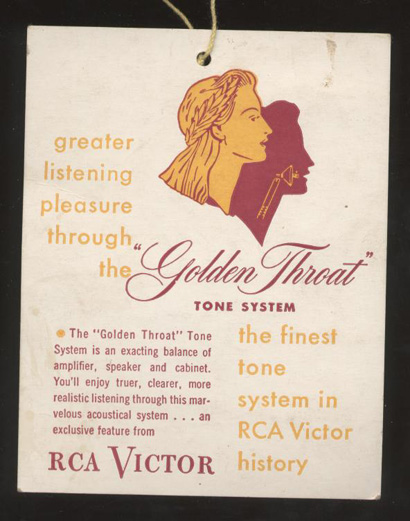
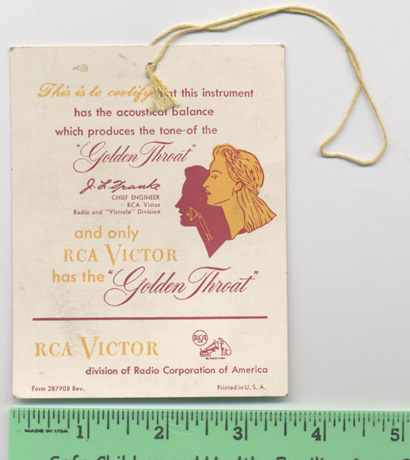
RCA came out with a console in 1942 that was like an automatic turntable that incorporated the "Magic Eye" - a system with two tonearms - one arm to play the one side and the other arm to play the other. When one shellac was finished, it would remove the shellac from the turntable and drop another shellac to continue the performance. Then, when that stack was done, it would reverse the process to play the other side of the stack. I've only seen picts of it, but what a mechanical marvel that RCA put together, along with their "Golden Throat" hi-fi concept before hi-fi was realized for shellac and then onto vinyl when the LP came out.
-Monte
| IP: Logged
|
|
|
|
|
|
|
|
Monte L Fullmer
Film God
Posts: 8367
From: Nampa, Idaho, USA
Registered: Nov 2004
|
posted 03-30-2008 02:18 AM
quote: Warren Dewey
but most of the time the final product was disappointing compared to the master mixes
Would that be due to the major steps from lacquer, master, mother, and stamper..plus the many stampers that were plated from the mothers and when that set of stampers begin to wear down from the many pressings?
Then, the RIAA "e.q." thing that had to be just right as well, but one would realize that even if the pressing was just right, the results in the home wasnt because of worn needles, sub-par amplifiers and speakers that didn't match up to the amplifiers.
I've heard that if one plays a fresh lacquer cutting, that it's just like the production master tapes - not like the session masters.
| IP: Logged
|
|
Warren Dewey
Film Handler
Posts: 28
From: monterey ca usa
Registered: Jan 2006
|
posted 03-30-2008 08:42 AM

quote: Monte L Fullmer
Would that be due to the major steps from lacquer, master, mother, and stamper..plus the many stampers that were plated from the mothers and when that set of stampers begin to wear down from the many pressings?
The most difficult transition was from tape to cut lacquer-- the mastering process. It's a big leap from a magnetized pattern on tape, which could reproduce the input signal quite well, to the physical representation formed by a heated stylus cutting a groove-- which was then reproduced by another mechanical linkage and translated back into an ac waveform.
Sometimes there would be problems in the pressing plant. It was pretty easy to tell if the stampers weren't right. But the mastering process was a lot more than just making a copy of the tape. The distortions that occurred during cutting were fairly nonlinear; it was difficult to predict what you would end up with.
A huge problem at the time was dealing with the high frequency rolloff that had to be imposed as you got closer to the center of the disc. There is less real estate per revolution to work with and top end, especially sibilants in vocals and other complex high-frequency information, would not reproduce well.
There was a lot of competition between mastering facilities, all with their own individual brands of voodoo-- Capital had a pretty good setup that used Neumann equipment. My favorite was Doug Sax's Mastering Lab-- he was also the guy that cut a lot of the direct-to-disc albums. Bernie Grundman at A&M did a great job also.
quote: Monte L Fullmer
I've heard that if one plays a fresh lacquer cutting, that it's just like the production master tapes - not like the session masters.
Usually when a project was new and you were working on the "first edition" pressings, you would use the tape of the original studio mixes. After that, the mastering engineer might make a production master based on eq, compression, level changes etc. that were decided on in the original mastering sessions.
| IP: Logged
|
|
|
|
Sean McKinnon
Phenomenal Film Handler

Posts: 1712
From: Peabody Massachusetts
Registered: Sep 2000
|
posted 03-31-2008 10:02 AM
I have a pretty crapper turn table. It is one of those all in one tuner, tape deck, phono jobs from Sanyo that I got for free from the trash (a neighbor set it out on the curb with a FREE sign on it) but the speakers are pretty big they come up to above my belly button and they sound good, it also has aux inputs (RCA) for a cd player, and video. anyways...
I have a very small collection (3 records! one is a double!) of local boston punk/hardcore bands. I have 2 "Blood for Blood" albums. One is a double album with the first record a compilation of thier more popular songs, the second record is a live recording of a benefit show for these two kids that died. I also own a record by the (former) band "Reach The Sky".
My father has a pretty nice collection of all the origional beatles albums, rolling stones albums, led zepplin, beach boys, moody blues, and a ton more origional albums from that era.
| IP: Logged
|
|
|
|
|
|
All times are Central (GMT -6:00)
|
This topic comprises 7 pages: 1 2 3 4 5 6 7
|
Powered by Infopop Corporation
UBB.classicTM
6.3.1.2
The Film-Tech Forums are designed for various members related to the cinema industry to express their opinions, viewpoints and testimonials on various products, services and events based upon speculation, personal knowledge and factual information through use, therefore all views represented here allow no liability upon the publishers of this web site and the owners of said views assume no liability for any ill will resulting from these postings. The posts made here are for educational as well as entertainment purposes and as such anyone viewing this portion of the website must accept these views as statements of the author of that opinion
and agrees to release the authors from any and all liability.
|

 Home
Home






![[Smile]](smile.gif)




 Printer-friendly view of this topic