|
|
This topic comprises 6 pages: 1 2 3 4 5 6
|
|
Author
|
Topic: The future of film ... according to (a guy at) Arri
|
Mark Ogden
Jedi Master Film Handler
Posts: 943
From: Little Falls, N.J.
Registered: Jun 99
|
 posted 07-26-2009 07:40 PM


quote:
3 chip CCD cameras require a prism to reflect the video image onto each chip. The prism itself can degrade some of the image quality. If you can remove that element somehow you can get a more pure image. For a very long time that was impossible to do well at all.
Recently, certain digital camera models like the Panavision Genesis, Arri D20 and others have basically put what amounts to 3 chip function onto a single chip die. The newest sensors can pack in so many pixels it's easier to just have some defined for red only, green only and blue only function. No more need for the prism in the optical chain.
That's neither the reason or the philosophy behind single chip cameras. The original idea behind single chip was to allow the camera to use lenses engineered for film cameras, be they Panavision, Cooke, or what have you. In order to do this, the surface of the imager must be have the same, precise location relative to the rear of the lens that the film stock would have. If the prism is in the way, the surface of the ccds are pushed back too far, and it becomes impossible to achieve back focus. That's the only design reason single chip started. Now, of course, as the imagers grow progressively larger a la the Red cameras, single chip makes economic AND design sense, as the optical head block would start to become unwieldy and prohibitively expensive. But there is no other real technical reason for it, image wise.
Modern optic blocks are engineered so well that the loss of light from the prism is negligible. The Sony F23 CineAlta, for instance, is basically 99% the same camera as the 1500 series broadcast camera, except that it has a wide-band prism specially designed for 4:4:4 that is so sensitive that passes colors that would be out-of-gamut for broadcast. No degradation going on there.
| IP: Logged
|
|
|
|
|
|
Julio Roberto
Jedi Master Film Handler
Posts: 938
From: Madrid, Madrid, Spain
Registered: Oct 2008
|
posted 07-27-2009 02:09 AM
Yeap. Quoting myself from the middle of the previous page:
quote: Julio Roberto
There are many reasons to use a single sensor in cameras over using 3. Mostly has to do with the available lenses being designed for projecting on a flat 2D surface at a relatively short distance, which gets tricky when you have to fit a prism and 3 sensors in the path. Not to mention potential light loss, etc.
Price is another reason.
Available lenses and lens designs don't quite fit a 3 large-size sensor+prism design in the optical path. Idially, brand new lenses should be design to take full advantage of 3 chips designs, which opens a whole new can of worms.
Better stick with what works and is available and try to mimic it with digital (i.e. a aprox. 35mm sized sensor design on a flat 2D surface mimicking 35mm film cameras).
3-Chips are a good way to produce great imaging blocks. They i.e. potentially triple the resolution, potentially triple the light gathering surface, which can improve sensitibity as they can also be optimized for low noise at working wavelength, altough the prims loses a tiny bit of it along the way, they also allow for more flexible and better filter/microlens designs (no more Bayer), etc, etc.
So they can be absolutely great, but pbbly quite more expensive, harder to manufacture and "inconvinient" (i.e. they are larger/heavier, more prone to alignment potential issues, to some optical distortions/reflections/polarization artifacts, would likely require totally new lens designs optimized for them to optimize their performance, etc)
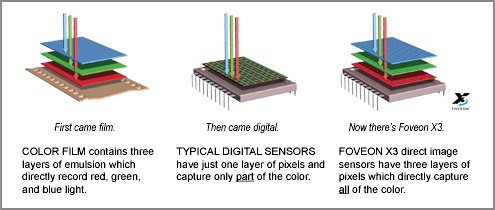
2D sensors have been manufactured (and you can buy cameras with them) very similar to the way film works, like overlapping layers that are sensitive to different light wavelenths, a lá direct imaging chips like the Foveon:
http://www.foveon.com/article.php?a=67
quote:
Finally, Foveon has combined the best of what both film and digital have to offer. This is accomplished by the innovative design of the three layer Foveon X3 direct image sensor. Similar to the layers of chemical emulsion used in color film, Foveon X3 image sensors have three layers of pixels. The layers of pixels are embedded in silicon to take advantage of the fact that red, green, and blue light penetrate silicon to different depths – forming the first and only image sensor that captures full color at every point in the captured image.
As I said, there is no reason whatsoever why a digital, with some small restrictions, can not be CURRENTLY made to look almost exactly like a 35mm film the kind we've been seen on theatre screens for the past +5 years. And soon, even those small restrictions will dissapear. Damm, we see it with still photo cameras where I don't think anybody questions digital can produce results almost indistinguishable from 35mm cameras. What makes it so hard to believe that the same thing could be done but at 24 frames per second instead of 4fps?
But, once again, if your goal is to make a movie that looks exactly like it has been shot in Kodak's Vision3 stock ... well, it would be wise to shoot it on Kodak's Vision3, as it would pbbly end up being around the same price for the time being and pbbly getting better results.
A large part of my whole point on these posts is to combat the notion the digital MUST be inferior to film and that it CAN NOT EVER be made better than film. That is not so. Digital COULD be made, if a manufacturer wanted, to surpass film for motion picture adquisition, not only to barely match it like we are seeing TODAY.
A different story is if currently it's harder or easier or more expensive or even feasible under a budget of many million dollars to get custom-made equipment to do so or how long it will take the market to make such products affordably available. Some, like me, think this won't take long at all. Others, that it won't happen for a long time (say >15 years).
| IP: Logged
|
|
|
|
|
|
Julio Roberto
Jedi Master Film Handler
Posts: 938
From: Madrid, Madrid, Spain
Registered: Oct 2008
|
posted 07-27-2009 08:49 AM
While I agree, let's not forget that TODAY, when there is virutally no "market demand" for it, you could buy not one but TWO commercial projectors that put 8K resolution on the screen with contrast and gamut and brightness (for small/medium sized standard cinema screens) to compete with film: the laser-based Evans and Sutherland and the Lcos based JVC 8K.
That is TODAY, available off-the-shelf. There are also the "experimental" ones by NHK used for demostrantions for the last so-many years.
If a manufacturer had customers willing to pay for it, I'm sure a say 16K projector could be CURRENTLY manufactured with available technology (i.e. basically just stack up a bunch of chips).
So the point is: if you want very high resolution TODAY and "sensible" prices, buy an Imax. But don't say that "Imax" is irrevocally superior to digital because a digital product could be "easily" made to leave Imax in the dust if it was ever necessary (Imax is a resolution-wasting format in my opinion, BTW, and it was only made that way because of availability of off-the-self 70mm format and the necessary space to provide a reasonable aspect ratio, but the same practical end result can be done with 70/8pef).
Again, I have the feeling that some people are grossly overestimating the (true, noise free) resolution of film, but let's not enter into that pointless discussion just yet, at least until 8K adquisition and 8K projection becomes the norm at some point in the future. Meanwhile, we can all agree that a 70mm carefully made answer print can certainly compare (or surpass) 4K projection. An 8K projector, though, it's another matter open to discussion, but quite pointless right now, altough 8K digital products exist today, and even a 28K (bayer) off-the-shelf adquisition product is expected in less than a year under $60k.
| IP: Logged
|
|
|
|
Julio Roberto
Jedi Master Film Handler
Posts: 938
From: Madrid, Madrid, Spain
Registered: Oct 2008
|
posted 07-27-2009 07:00 PM
All current DCI certified projectors MUST include support for a 48fps frame rate.
After all, that's exactly what they do with 3D films, although in that case, they swap each one of those frames three times with the one after it to help illusion of simultaneous images in 3D.
But, of course, they wouldn't need to triple swap-flash and still take the 48fps "as is". It's actually "much harder" to triple flash than not.
So, I guess, the short answer is: All DCI projectors and servers are already capable of 48fps off the shelf (from a hardware point of view although some very minor firmware tweak may be needed for proper, non-3D support)
Current Sony Lcos projectors have a limit (for non DCI content) of 60fps.
Current DLP based projectors have a limit of 144fps.
Several of current digital cameras close to 4K-level resolution can do over 60fps. Many can do up to 200fps at 2K-level resolutions.
| IP: Logged
|
|
|
|
Julio Roberto
Jedi Master Film Handler
Posts: 938
From: Madrid, Madrid, Spain
Registered: Oct 2008
|
posted 07-27-2009 07:32 PM
No matter how many reports by people that have actually tested it and are even BIG PLAYERS on the film market like Arri or Panavision, some people would still just not believe that a 1.85 native film, shot and processed in film only, when projected on the screen, has AT BEST a resolution of a little over 2K (say 2.2K).
They just don't "buy it".
A lot of people just confuse the optimal scanning resolution to (try to) obtain that "2.2K-at-best detail", which may very well be 4.4K, with the true resolution of film, without realizing that half the information in there is noise and it's only there to minimize the chance of aliasing by OVERsampling.
Fixed grids digital vs random order analog don't compare like apple-to-apples, so we can't confuse TRUE resolution of analog film expressed in "points" with digital difficulty to capture THE SAME resolution directly in "pixels" (i.e. on a CGI generated digital movie) from said film.
But a few people would just not ever give in the notion that, generally speaking, a well made 4K image (captured by say a 6K bayer camera like RED's $9750 scarlet), can easily contain significantly more true-resolution than a 1.85 35mm release print. They will NEVER believe it, so no point on showing proof after proof, measurement after measurement, test after test, and white paper after white paper.
So no point on even trying to convince them that 8K-digital (captured i.e. on a 20k bayer) can have more resolution than a 70mm (1.912" x 0.87") release print either ...
Even for cinema applications, anything above 4K would only produce any noticeable advantage to the public sitting in the first 3 rows or so of most theatres, so there is not even a need for 8K at all which, nonetheless, I'm sure will happen at some point in the not-too-distant (but not too close either ![[Wink]](wink.gif) ) future. ) future.
We'll leave the Imax discussion for later. Unless Imax dissapears, in which case, there won't be any need to talk about it anymore, except to feel nostalgic about the glory days of film's peak achivements ...
| IP: Logged
|
|
|
|
|
|
|
|
Bobby Henderson
"Ask me about Trajan."

Posts: 10973
From: Lawton, OK, USA
Registered: Apr 2001
|
posted 07-27-2009 11:41 PM
quote: Mark Gulbrandsen
Using powerful DSPs it wold actually be quite easy to shift RGB to CMY.
If that was really the case graphic artists would already have that capability with applications like Adobe Photoshop and Adobe Lightroom. The problem is that 1-button sort of thing to switch wide gamut RGB to CMYK gracefully doesn't really exist.
Any automatic, DSP controlled method in-camera will be affecting the image on a global basis. That alone can be bad.
Granted, there's lots of fancy filters and edge detection software out there, but even the best of it is not nearly as accurate as it should be. For one example, raster to vector auto-tracing schemes have had well over 20 years of development and even to this very day they all still mostly suck. Adobe Illustrator's Live Trace and Live Paint features are about as good as that technology can get. For the most accurate work you have to digitize the anchor points by hand.
There is a great deal of graphics and image manipulation work that requires human intervention and decision making where specific parts of the image must be isolated and changed separately from other parts of the image. It is takes a human brain to distinguish what parts of the image to change and other parts to leave alone or reserve for a different set of changes. Computers really do not understand how to do that accurately. Even the red eye removal tools in many software packages, including Photoshop, do not work well. You get better results retouching the image by hand.
One particular area where I've seen computers continue to fail with their automatic routines is the simple ability to detect the precise centerline of a letter form in order to create raised "prismatic" style or downward carved letters. Nothing auto-generated in the computer delivers a correct result. The areas where the letter strokes join get rounded and bowled out to something that looks laughably bad. To get a proper result, you must hand build an accurate 3D computer model. Or you have to carve the letters by hand out of any number of materials (wood, HDU, foam, etc.). Likewise, Photoshop's inner bevel filter gives off an equally bad looking effect. I chuckle every time I see it used on movie title graphics. It wouldn't be so laughable if the graphics people just applied a minor bevel instead of trying to deepen it all the way to the center of the letter stroke.
quote: Mark Gulbrandsen
As I mentioned the only changes you may see in the near future is that DPs and film production companiess will simply own their own gear and the rental giants like Panavision and Arri will very likely disappear. This has already quietly started with the Red Cam and several others.
I think it will be a pretty sad day if companies like Panavision and Arri go under because a lot of expertise will vanish with those companies. If enough experience and know-how leaves for bigger and better things it will increase the downward pressure on photographic quality into the amateur hour zone -similar to what has polluted the graphic arts industry for a couple of decades.
Some sort of camera equipment rental system will have to stay in business because it takes a lot more to fully equip something like a Red camera than just buying the imaging block and a basic starter lens. All the other gear it takes to fully complete the camera setup can cost a fortune. At least some of that equipment will have to be rented.
A regular retail outfit is good at merely renting out one part at a time. It's easy enough to contact lensrentals.com to book a 400mm f/2.8L lens to shoot super telephoto stills of a football game. More has to be thrown into the rental package when it comes to shooting a movie.
| IP: Logged
|
|
|
|
All times are Central (GMT -6:00)
|
This topic comprises 6 pages: 1 2 3 4 5 6
|
Powered by Infopop Corporation
UBB.classicTM
6.3.1.2
The Film-Tech Forums are designed for various members related to the cinema industry to express their opinions, viewpoints and testimonials on various products, services and events based upon speculation, personal knowledge and factual information through use, therefore all views represented here allow no liability upon the publishers of this web site and the owners of said views assume no liability for any ill will resulting from these postings. The posts made here are for educational as well as entertainment purposes and as such anyone viewing this portion of the website must accept these views as statements of the author of that opinion
and agrees to release the authors from any and all liability.
|

 Home
Home






![[thumbsup]](graemlins/thumbsup.gif)





 Printer-friendly view of this topic