|
|
This topic comprises 6 pages: 1 2 3 4 5 6
|
|
Author
|
Topic: The future of film ... according to (a guy at) Arri
|
|
|
|
|
|
|
Julio Roberto
Jedi Master Film Handler
Posts: 938
From: Madrid, Madrid, Spain
Registered: Oct 2008
|
 posted 08-04-2009 05:17 AM


Canon is pbbly a quite miss-managed operation. With so many branches (photocopies, printers, semiconductors, optics, photography, video) etc, there's bound to be issues.
I'm no fan of Canon (or Nikon, or any brand, really), but it has always struck me of why Canon isn't a much bigger significant player than it is.
After all, they are the only company in the world that basically makes ALL the important parts of their cameras, from optics to sensors, and not only that, but they also make the machinery to actually make the parts.
I.e. Canon is one of the top sellers of sensor and other semiconductors manufacturing machinery, including the sophisticated optics and stepper motors needed for semiconductor photolitography manufacturing equipment.
http://www.encyclopedia.com/doc/1G1-99123410.html
quote:
Canon, Inc. is one of the world's leading manufacturers of advanced step-and-repeat and step-and-scan photolithography systems used to manufacture semiconductor devices, flat panel displays and thin film heads.
Investing for your future
For several decades Canon has been in the forefront of optical technology development. Overall, Canon invests more than $1B in R&D annually. In 2001 alone, Canon registered 1,877 patents. And for each of the past seven years, Canon has placed within the top three US companies in total patents registered.
All the rest, like Nikon, depend on either third party manufacturing of their sensors (Sony) or, even Sony, depends on third party manufacturers for the actual machinery to make the sensors.
Only Canon does it all. Semiconductors (DIGIC dsp image processors), sensors (CMOS and CCD), optics (TV camera lenses, semiconductors), precission motors (scaners, photocopies), camera bodies (from their old 35mm division) ... AND also a lot of the machinery to actually make all those things. If Samsung and others weren't more competitive, they could even make their own memory chips ... RAM and flash.
Part of the problem could be the billions they lost on their bet for the "next generation" flat panel TV's based on SED technology, which is great, but pbbly will never compete with LCD in terms of price/performance and will have to be a (big) write-off on Canon's balance sheet.
From wikipedia
quote:
Canon is a manufacturer of business and consumer imaging products which includes printers, scanners, binoculars, compact digital cameras, film and digital SLR cameras, and lenses.
The Business Solutions division offers print and document solutions for small and medium businesses, large corporations and governments. These include multi-functional printers, black and white and color office printers, large format printers, scanners, black and white and color production printers, as well as software to support these products.
Lesser known Canon products include medical, optical and broadcast products, including ophthalmic and x-ray devices, broadcast lenses, semiconductors, digital microfilm scanners, and Handy Terminal Solutions.
Nikon, on the other side, it's a much smaller player with a focus on their customers, in spite of being at times number 2 in steppers for the semiconductor industry, over Canon, and although technologically they are worlds behind (sort of like Panavision and Arri in a digital world), their optics are renowned and their will to achieve top notch products is undeniable.
| IP: Logged
|
|
|
|
|
|
|
|
|
|
Bobby Henderson
"Ask me about Trajan."

Posts: 10973
From: Lawton, OK, USA
Registered: Apr 2001
|
posted 08-08-2009 02:05 AM

I haven't had to deal with Canon's service dept. (knock on wood). The big, legit bitch-fest I heard about Canon in recent years was how it handled its rebate program. A true nightmare. I was thankful I got an instant $50 rebate when I purchased a new Speedlight a few weeks ago.
With the usual Nikon versus Canon contest set aside this one thing is certain: The Canon EOS-5D Mark II has received excellent reviews overall from sites like dpreview, macworld, dv.com and more. The camera is not any piece of junk despite what any die-hard Nikon fan with the zero sum "Canon must die" game in mind can say.
I received mine a couple days ago and am pretty impressed and very happy with it. It puts my Rebel XTi to shame, and I liked that camera. Although the EOS-5D Mark II isn't as big as a Canon EOS-1Ds Mark III or Nikon D3x it still makes the Rebel XTi look pretty small by comparison.
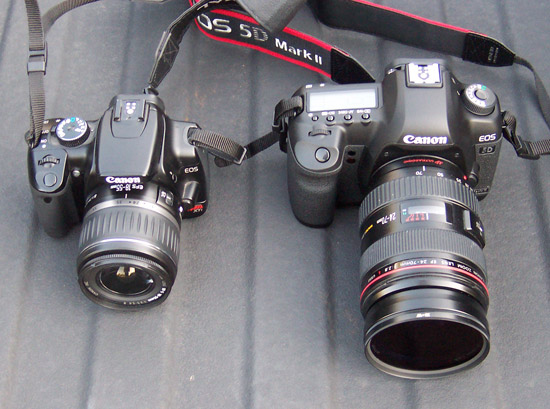
The EOS-5D Mark II feels almost twice as heavy as the Rebel XTi too. It took a little getting used to the new controls on the camera, but I got used to them and spoiled by them pretty quick (after reading the instruction manual). The menu functions are pretty slick.
The EOS-5D Mark II has been criticized for not having as fast a frame rate of the EOS-50D or one of the top of the line EOS-1D bodies. It's fast enough for my needs (landscape photography, product photography, portraits, etc.). But I'm not getting paid to stand on the sidelines of an NFL game either. The 5D Mark II has a 9-point autofocus system, which seems grossly inferior to what you get in an EOS 1D body or certain Nikon bodies. However, it is not the same 9-point system I had in my Rebel XTi either. Six invisible assist points are added. Certain points, particularly the center point, have greater sensitivity when a lens featuring a f/2.8 or larger aperture is used. Truth be told, much of the time I focus off the center point and then simply recompose for the shot I want, 999,087,007 focus points lacking be damned. I'll bet a lot of other shooters do the same thing whether they want to admit to it or not.
The camera body I received must have been manufactured perhaps only a month before I received it. It already had the latest 1.1.0 firmware installed. Out of the box it could do the 1080p/30 HD thing in full manual mode. You can even change the aperture, shutter speed, etc. while you're shooting a video clip (although the changes will be abrupt and noticeable). An image stabilized lens is definitely recommended for any handheld HD video shooting. However, I didn't do too bad with a handheld test shot using a non-stabilized 24-70mm f/2.8L lens. I think the weight of the camera body, lens and a 580EX II Speedlight helped damp out some of the camera shake. Still, get a tripod for that sort of thing.
One thing that arrived in the package that wasn't up to date: the software. The EOS Utility, Digital Photo Professional application and Canon RAW codec plug-in had newer versions available at the Canon web site. I really do not understand why Canon insists on installing Microsoft NET framework 2.0 to run its software when the NET crap is up to version 3.5. Why does it need any MS NET crap at all? I'm just pulling photos off the camera and editing RAW imagery (as an alternative to editing RAW images using Photoshop). Why does MS need to be involved in that?
Anyway, I have no ill will toward Canon gear. I got a lot of good use out of an old Canon F-1 body when I was in art school. That body was originally owned by Pulitzer prize winning photojournalist Bill Foley -a friend of my father's from days in Beirut. Foley sold that one to my dad after my father's own F-1 got stolen during a move from Virginia to New York City.
| IP: Logged
|
|
|
|
|
|
Julio Roberto
Jedi Master Film Handler
Posts: 938
From: Madrid, Madrid, Spain
Registered: Oct 2008
|
posted 09-02-2009 09:41 AM
Film still has, at least, 1 or 2 years of very good health. Nobody is denying that.
What will happen after that period of time, when the new crop of electronic 4K cameras at much lower prices show up, doesn't take too much to imagine.
Most people agree that film will NOT "mostly dissapear" for some 5 years, if not longer, and will remain a strong contender.
But the writing is on the wall. Film is NOT a thriving industry with good outlook. Certainly not in the long run and it's even bleak and uncertain in the short term.
Also, several episodes of some of the shows listed in that list as "film" have actually been done on digital cameras, such as the show "24" ...
Also, it's normal for some shows that started many seasons back on film to remain with the same look, equipment and crew, since, as they say in spanish, ... better "bad-but-trusted" than "good-and-uncertain"...
| IP: Logged
|
|
|
|
|
|
|
|
|
|
All times are Central (GMT -6:00)
|
This topic comprises 6 pages: 1 2 3 4 5 6
|
Powered by Infopop Corporation
UBB.classicTM
6.3.1.2
The Film-Tech Forums are designed for various members related to the cinema industry to express their opinions, viewpoints and testimonials on various products, services and events based upon speculation, personal knowledge and factual information through use, therefore all views represented here allow no liability upon the publishers of this web site and the owners of said views assume no liability for any ill will resulting from these postings. The posts made here are for educational as well as entertainment purposes and as such anyone viewing this portion of the website must accept these views as statements of the author of that opinion
and agrees to release the authors from any and all liability.
|

 Home
Home








![[Smile]](smile.gif)
![[Wink]](wink.gif)




 Printer-friendly view of this topic