|
|
This topic comprises 4 pages: 1 2 3 4
|
|
Author
|
Topic: Paranormal Activity blowing out Center Speakers
|
|
|
|
|
Steve Guttag
We forgot the crackers Gromit!!!

Posts: 12814
From: Annapolis, MD
Registered: Dec 1999
|
 posted 01-07-2014 05:56 AM


quote: Marco Giustini
But what happens when the customer asks for a smaller sound system? It may be different in the US but in Europe I know very few sound systems properly spec'ed to the room. Most won't break so easily and many are protected by the amps' limiters.
As Sam pointed out already...in the US people by poorly designed systems here too...remember my statement about...exhibitors have the Ghostbusters statement of "we are ready to believe you" what it comes to being able to by too small a system (pick your device...it isn't limited to sound).
However, I have never found I had to deliberately under-spec a system. If a customer says they want something smaller (and honestly, that really hasn't come up for me)...then it becomes THEIR decision and consequences for the failures...it isn't something I put upon them. Those times that it has occurred...almost without exception, they have indeed paid the consequences. If you have an exhibitor that does indeed always play their volume really low (say an "art house" yes you do have some more wiggle room there.
An amp's limiter really doesn't protect a speaker from being under-speced. A limiter will prevent an instantaneous peak from clipping an amp but if you are constantly in the limiter's active area...you'll cook your driver. A limiter is not an AGC...it hard limits the signal which is like sustaining it.
quote: Marco Giustini
I see why Dolby Digital is 2dB light than PCM, but why 5dB for the sub?
Misinterpretation. The Dolby digital track is 2dB lower on all channels than current DCinema. It is the nomograph in their technical guidelines that is 3dB low in the math. As Sam pointed out...when digital audio hit...people already couldn't believe the amount of subwoofer (speakers and amp power) that was needed...if Dolby had the real numbers back then...it would have meant doubling amplifier power yet again.
quote: David Zylstra
I find it interesting that the memo specifically mentions a common denominator of JBL 4632 speakers.
I am curious if anyone has had issues with other models?
I think you are going to find any speaker that is using a passive crossover is going to be more susceptible to this sort of damage. It is the nature of the distortion and how a passive crossover will send that to the HF driver in the system. So, if you have a system with a passive crossover and you aren't clipping the amp, saturating the crossover and keeping the levels within the capabilities of the system, you should be fine.
I generally like JBL speakers but like with every brand, there are models that I am not the biggest fan. The 4632 is one of those. In my experience, it does not tune up well...that is, it need a fair bit of tuning in order to play back with a "flat" response...there are some notable dips in it. This leaves one with the option to ignore them since the speaker just can play those frequencies or to boost the crap out of it and put the speaker at risk and also not really improve the sound. I don't think I've ever heard a 4632 sound good...they have a very nasal quality to their sound that doesn't agree with me. I've tried this speaker with numerous crossovers and amps...I've tried hand tuning it with program material and have generally spent more time on this one speaker model trying to get it to perform than any other...and it just doesn't do it for me. Oddly enough, its "economy" model, the 3632 has performed much better for me despite having "inferior" components and a similar design philosophy. JBL has sold a lot of the 4632 so clearly people have opinions that differ from mine.
I think you'll find that the reason that speaker was singled out was more to do with one of the larger chains suddenly having problems and that happened to be the speaker in their larger rooms. I highly doubt that there is any real statistical evidence to base that the 4632 is anywhere near the only speaker with such problems. It does have the right combination of elements...particularly if it wasn't tri-amped that could make it susceptible. When I heard about this issue..it was from two different techs reporting that they were off to change diaphragms due to Paranormal Activity...neither place was using the 4632.
I do come back to...if the system was properly designed...the problems would not have happed.
| IP: Logged
|
|
|
|
|
|
Steve Guttag
We forgot the crackers Gromit!!!
Posts: 12814
From: Annapolis, MD
Registered: Dec 1999
|
posted 01-07-2014 10:33 AM
Jack,
While it is possible to tune up with any fader number referenced...or to use a different pink noise reference or tune to 80dB...etc. Yes, that is possible. It is also incompetent. Our industry enjoys an actual calibrated reference point that is shared by the content creators (studios) and the exhibitor such that the level from room to room should be uniform (not that they will sound the same but the overall level should be very similar).
Knowing this, allows a great amount of control over things like headroom and noise floors. It means one can actually design a system and know how loud it could possibly get (both signal level as well as SPL). If one chooses to do their own thing...well that is incompetent and one deserves damaged equipment for showing their ignorance.
As to "7" being arbitrary...well...NO...it is not...there is a bit of history there.
First you have the way people hear and just what 3dB of difference makes because it is not uniform. Historically, if one uses a potentiometer (pot)...in order to have the fader seem like it is evenly divided it has to be logarithmic. Which means that difference between "7" and "6" is not the same, in dB, as the difference between "3" and "4". One will want the fader to be towards the upper end of its range to allow for more precise adjustment.
This became more necessary in the days of early analog "VCAs" (Voltage controlled amplifiers" If you take an older sound processor like a CP50, calibrate the faders at "7" and then move the fader to "4"...you'll find that the channels are no longer at the same levels as each other. When you are moving things in 1-2dB increments allows for less precision than when you are moving in 20dB increments.
You wouldn't want to make "10" the reference because the thought is that you may need to raise things a bit and at that end of the fader range, we are only talking about 10dB or so (maybe less) between 7 and 10. "7" enjoyed being in the sweet spot of the electro-mechanical fader, VCA tolerance and providing for adequate range.
It could be argued that in the digital world that its importance is not there as much as it once was. In fact, some have taken to using a dB scale (like QSC) where what was "7" is "0dB"...so that is reference...but note...0dB is still where 7 was in terms of headroom. I counter that the dB scale, due to being logarithmic is not intuitive to humans...it is okay if the control is a single-turn knob or a slider on a mix board because your brain can still cut up the range into equal parts...but on a multi-turn pot...there is no "feel" for if -3dB is too loud how far down should I go to make it a "little quieter." People can get their head around that if 6 is too loud that 5.5 will be a little quieter.
| IP: Logged
|
|
|
|
|
|
|
|
David Buckley
Jedi Master Film Handler
Posts: 525
From: Oxford, N. Canterbury, New Zealand
Registered: Aug 2004
|
posted 01-07-2014 09:32 PM

There's a facet that is being overlooked here.
The HF driver in the JBL 4632 is a 2426H, rated at 100W.
Pink noise (and music, generally) will has the vast majority of the energy in the LF region, and only a relatively small amount heading for the HF driver. However, there is no reason why the sound mixer can't put a 0dBFS signal purely in the HF region. On a triamped system, this would probably put the HF amp into clip, and that clipped out will go straight to the HF driver. On a passive cross, the full benefit of the amplifier (say 800w?) will head directly for that driver rated at 100W.
Either way, the driver is not going to be a happy camper...
| IP: Logged
|
|
Steve Guttag
We forgot the crackers Gromit!!!
Posts: 12814
From: Annapolis, MD
Registered: Dec 1999
|
posted 01-08-2014 07:03 AM
Oooooh...math problems...I love math problems.
Lets look at the 2426H for a moment. It is really only rated at 50-watts AES (band limited pink noise). The figure you quoted would be "program" power which is nothing more than a doubling of AES power on the presumption that the signals presented are momentary and not sustained. In the case of a movie effect, that is not always the case...for dialog, yes absolutely.
So lets look to see how much power is going to that HF driver in a sustained effect. In a 70-foot deep room (pretty typical) to have the HF component be able to play 105dB at the reference position...it would need...25.5-watts since it is on a horn that has a sensitivity with that driver of 114dB 1-watt/1-meter. So even if they wanted to contain the entire sound to the HF region, in a 70-foot room...it should survive with about 3dB to spare. If it was a 100-foot room...well we hit just above 50-watts needed. Now again, this presumed a sustained effect and no BOOST was applied to the EQ and all of the SPL was delivered from the HF section...enough presumptions to disqualify it from reality because when we set the 105dB reference, it was based on a speaker with a response from 60Hz to about 10KHz flat and then decreasing to 40Hz and 16KHz, respectively. So 2/3rds of the energy is already allotted to the LF section...so you are going to get more than 3dB more headroom.
The odds you have such a pathetic amplifier that it is going to clip out on an 8-Ohm load at 50 watts or so is not realistic either.
Looking at the passive situation...You have a MF/HF section that presents a 4-Ohm load to the amplifier and a 200-watt rating (AES)...no specifics of the crossover's handling are mentioned in the specifications. The odds you have 200-watts of amplifier power or more is very high since you will need about 525-watts for the LF section (back to our 70-foot room) and both are going to be at 4-Ohms. So you will have the amplifier you need to cause harm in the system. If you under-sized your amp then yes, more harm will be coming your way. However, if you do saturate your crossover or have any other distortion...that crossover is going to have over 500-watts behind it to feed the HF section all of the distortion it can.
In this example, the tri-amp theatre survives...the bi-amp theatre...maybe, maybe not. The potential is definitely there for harm.
Note, in the 4732 JBL changed drivers and the 2432H is rated at 85W AES so it would be less likely to fail in this situation. The moral...if you are going to buy a 3-way (or 4-way), also have that many amplifier channels to handle it. Passives are a false economy in most situations and particularly in a room expected to play the system anywhere near its limits.
| IP: Logged
|
|
|
|
David Buckley
Jedi Master Film Handler
Posts: 525
From: Oxford, N. Canterbury, New Zealand
Registered: Aug 2004
|
posted 01-08-2014 02:01 PM
quote: Steve Guttag
Oooooh...math problems...I love math problems.
Nothing wrong with your maths, Steve, not that this is actually a math problem; what is wrong is your assumption of programme material. For pink noise, with the energy being spread throughout the spectrum, your example is absolutely valid.
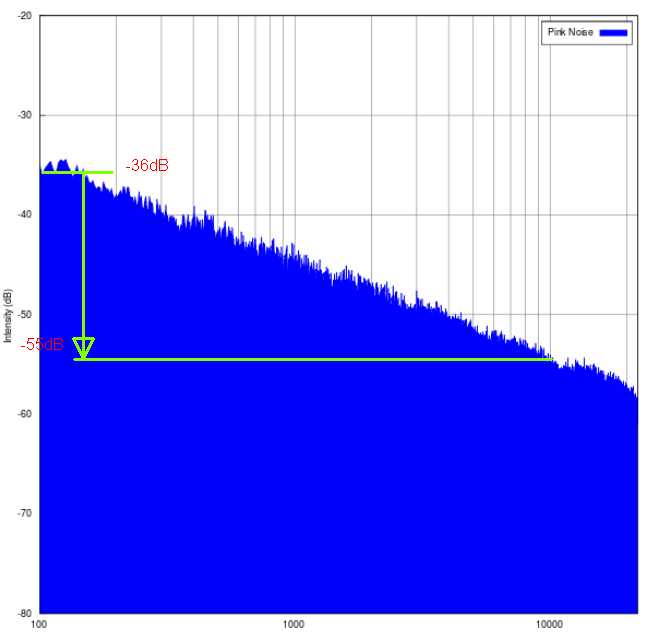
This graph is stolen from Wikipedia, and I've annotated it a bit. As it shows, with pink noise, the power required of the HF driver at 10KHz is about 20dB less than that of the LF driver at 100Hz. This is why HF drivers can have much less power handling than the LF driver, and I'm absolutely certain that this is nothing that you haven't heard a thousand times before, its established knowledge.
Although the relationship is not precise, for the kinds of programme material placed through a typical speaker unit, the spectral proportions are not a million miles away from pink noise either.
However, feed a close to full scale signal at 10KHz into the system, and all that energy will come out through the HF driver. It'll be something like 20dB higher than the normal levels the driver will experience. Given that 3dB is a doubling of power, you can see where this is going.
A chirp or clicky or whizzy sound effect can easily be mixed to deliver this level of HF energy.
And this is why on pro PA systems for live use there are individual limiters on each band of the crossover, as a loony with a synth can quite happily melt HF drivers whilst the overall levels are well below the system overload level. Busted HF drivers is not exactly an unknown problem.
| IP: Logged
|
|
|
|
|
|
|
|
All times are Central (GMT -6:00)
|
This topic comprises 4 pages: 1 2 3 4
|
Powered by Infopop Corporation
UBB.classicTM
6.3.1.2
The Film-Tech Forums are designed for various members related to the cinema industry to express their opinions, viewpoints and testimonials on various products, services and events based upon speculation, personal knowledge and factual information through use, therefore all views represented here allow no liability upon the publishers of this web site and the owners of said views assume no liability for any ill will resulting from these postings. The posts made here are for educational as well as entertainment purposes and as such anyone viewing this portion of the website must accept these views as statements of the author of that opinion
and agrees to release the authors from any and all liability.
|

 Home
Home



![[Smile]](smile.gif)


![[Wink]](wink.gif)


 Printer-friendly view of this topic