|
|
This topic comprises 4 pages: 1 2 3 4
|
|
Author
|
Topic: T.M.S. software programs (stand alone)
|
|
|
|
|
|
|
Steve Guttag
We forgot the crackers Gromit!!!

Posts: 12814
From: Annapolis, MD
Registered: Dec 1999
|
 posted 06-28-2014 07:34 AM


Greg,
I'm agreeing with you (well just about 99%). ANY connection creates a signal loss or degradation. With a patch panel, you add the IDC of the punch down and then an extra RJ45 connection so there are a couple of extra connections to each core. Then there is the method of landing the cable on the back side of the patch bay such that the cable is properly strain relieved, doesn't violate any of the Ethernet cabling rules in terms of grouping and bend radius and the fact you have the cores no longer in their twist/spacing. Some patch bays have one terminate all conductors in a line (typical of dual row)...others have one terminate half on the top and half on the bottom (typical of single row) and one should keep the conductors of different cables separated to avoid EMI.
But okay...lets say you are good at all of that. Cinemas are not typical IT rooms where I see very valid reasons for traditional patch bays.
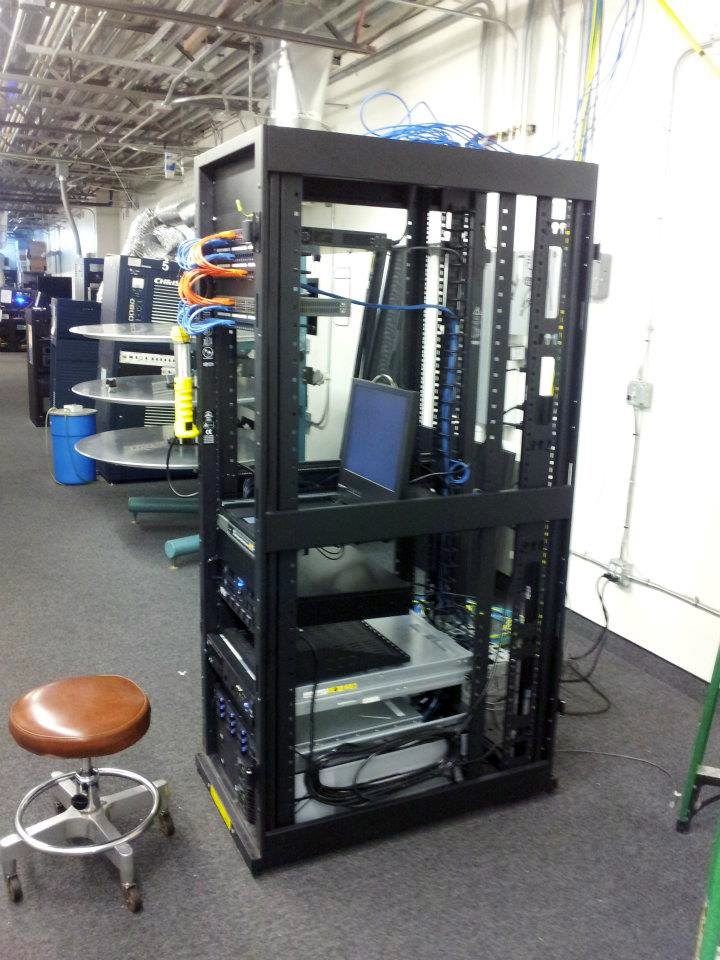
Typical cinemas are 15 screens or less. In most of the layouts I've seen (and installed), it is customary to have a switch in the pedestal or sound rack of each auditorium such that all of the auditorium specific devices (projector, sound...etc.) plug into that and from that switch, a single CAT cable is pulled to the TMS. In addition to that cable, there is a dedicated cable just for transport of the media (every server I've dealt with has at least two NICs so one can move the "media" while the other is typically used for "management." So there are two cables coming from each screen...so we are talking about 30 or fewer cables. However, those two cables are almost always landing on separate patch bays (and switches) so we are talking about 15 or less cables to keep track of. They are extremely unlikely to expand and it is also unlikely the patch system has been designed for any expansion either. Then, for logical layout, most have the patch ports as well as the ports on the switches in the TMS racks line up theatre-for-theatre. And by that, I mean that all ports in the same horizontal row line up with the theatres so if you are starting your theatres at say port "8" (but it could be any number)...they would be at 8, 10, 12, ...etc) so no cables are crossing over between patch panel and switch. So you got these 15 diagonally oriented patch cables (because there is a law that patch panels and switches can never align their ports). You patch them all up and you are done. This is a system that is VERY unlikely to change. Furthermore, unlike in a typical IT room, the cables coming in from the outside are pretty well defined and not likely to change...perhaps a few new sources (e.g. satellite feed of something). It isn't too hard to figure out what each cable is doing/coming from...proper cable labeling...something that should be done anyway. The advantage of a patch bay system just vanishes.
Yeah, the switch may change to different brand/model as things break or technology changes (but it isn't going to change too much since that would likely require a cable change too). So unless you violate cabling rules and pull your cables piano-string tight you can accommodate different port placement on the replacement switch.
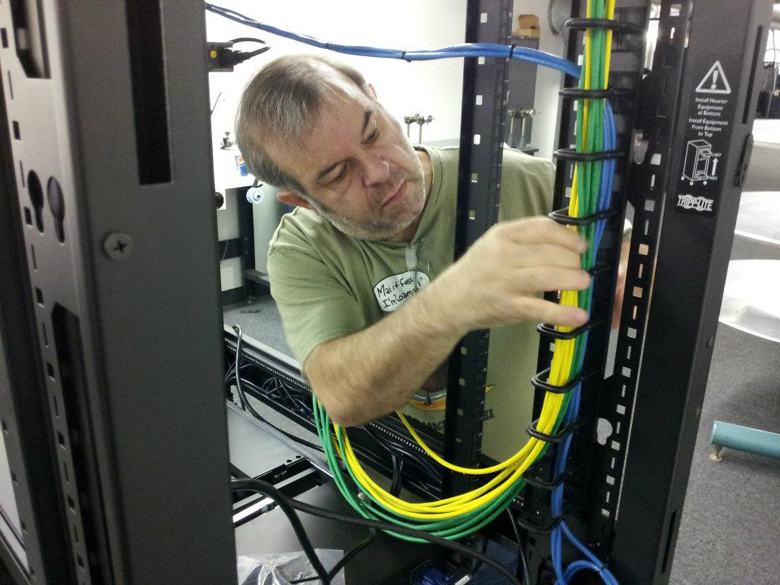
All of the dressing that Mark shows (though zip ties are frowned upon in IT since any crushing of the cable disturbs its performance) would still apply...I merely claim that you will get an equally or superior performing system by merely continuing the cable to the front via a panel like Mid Atlantic's BR1 or a cable management trough (has holes on the back, wiring trough on the front with slots to allow cables to come up to the switch). It is equally as neat and serviceable but results in a faster and superior installation with higher reliability. I think DCinema tried to mimic IT's practices with patch bays without really thinking about WHY they do things that they do and if they apply to cinema. You know, in professional audio or video, most everything is landed on a patch bay too. We never did that in cinema because not only is it not necessary, it is a point of failure with virtually no benefit for us.
| IP: Logged
|
|
|
|
|
|
|
|
|
|
|
|
|
|
|
|
|
|
|
|
|
|
|
|
|
|
All times are Central (GMT -6:00)
|
This topic comprises 4 pages: 1 2 3 4
|
Powered by Infopop Corporation
UBB.classicTM
6.3.1.2
The Film-Tech Forums are designed for various members related to the cinema industry to express their opinions, viewpoints and testimonials on various products, services and events based upon speculation, personal knowledge and factual information through use, therefore all views represented here allow no liability upon the publishers of this web site and the owners of said views assume no liability for any ill will resulting from these postings. The posts made here are for educational as well as entertainment purposes and as such anyone viewing this portion of the website must accept these views as statements of the author of that opinion
and agrees to release the authors from any and all liability.
|

 Home
Home









 Printer-friendly view of this topic