|
|
This topic comprises 5 pages: 1 2 3 4 5
|
|
Author
|
Topic: QSYS Corner
|
|
|
|
|
|
|
Steve Guttag
We forgot the crackers Gromit!!!

Posts: 12814
From: Annapolis, MD
Registered: Dec 1999
|
 posted 02-15-2019 10:55 AM


The DCP line of processors also offered bass management.
Bass Management can get tricky when you factor time alignment into it since each speaker, relative to the subwoofer will have a positional difference as well as level and you don't want to create a null.
But, like Sean, I have done non-traditional speakers (flown) and wanted to have bass-management as an option and with QSYS you can switch it in/out and decide which works best for the equipment and the venue. Here is one I recently did:
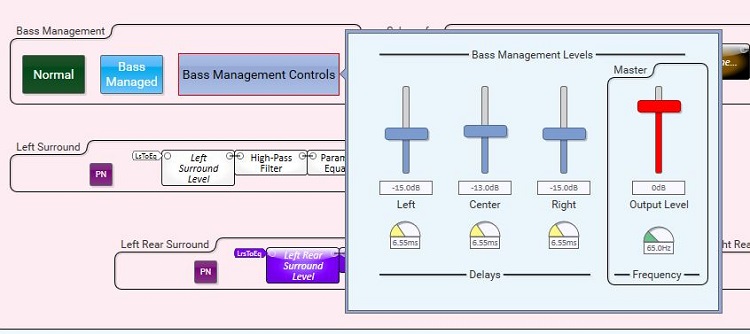
So you can quickly set the turnover frequency, level (per speaker or overall to the LFE) and any necessary delay).
I don't know if I agree with Sean on the benefits of surround LFE or not. I've had surrounds that can get down to 40Hz on their own and some people complaint that they don't hear them. If you make them mid/high centric, people notice them more even at the same SPL. I also think that one shouldn't tune surrounds to the same "X" curve as the stage. Most of what one hears from the surrounds is direct so no large-room type roll off should be applied. (and I'm sure Harold will bring up the current theory that the "X" curve has screen loss built in, but we'll leave that for another discussion). I definately push the roll off on the surrounds out further (flat to 4-8KHz and then a gentle roll). When one listens to a sweep around the room, if surrounds have the same roll as the stage, their timbre gets very dull compared to stage and it shouldn't be the case if not the opposite (they aren't playing through a sheet of vinyl).
That said, I plan to play with Surround LFE a bit to see the benefit they really bring (which I'm sure is soundtrack dependent). They are expensive and require more extensive rigging.
| IP: Logged
|
|
|
|
|
|
|
|
|
|
|
|
|
|
Leo Enticknap
Film God
Posts: 7474
From: Loma Linda, CA
Registered: Jul 2000
|
posted 02-16-2019 12:52 PM

It uses what QSC calls a "Q-LAN," which is essentially a physically independent LAN, separate from the management and media networks. All the digital audio data between the core, and input and output points (cards in the core, DCIO, power amps, etc.) travels on the Q-LAN.
The core will connect to the management network as well as the Q-LAN (and is therefore device through which the Q-Sys interacts with external, non Q-Sys devices), but only Q-Sys devices should be connected to the Q-LAN. The Q-LAN uses IPv4, but the subnet is totally different from that of the management or media networks.
The Q-LAN can be redundant: you can choose to have two of them, with separate switches and cables. There are technical specifications for the managed switches in a Q-LAN, and things that have to be configured in them, for it to work. I have these in my notes from the training, but can't remember them off the top of my head. QSC also publishes a list of known good models. The bottom line is that most enterprise grade managed switches will work, but they do have to be configured to do some managing. You could be right in that enabling jumbo packets is one of those settings - I can't remember.
One gotcha, which I found out the hard way at the Egyptian, is that the hardware in the primary and backup Q-LANs have to be of the same model in order for the automatic switching to work if one fails. Shortly after the system was installed, I got a panic phone call: all the stage channels had gone out. This system consisted of power amps for the stage channels behind the screen, and for the surrounds in the booth. The Q-LAN was redundant, with switches in the booth connected to switches behind the screen using two separate fiber runs.
To cut a long story short, it turned out that the model of fiber transceiver being different in the primary and redundant Q-LAN switches at the stage end was what prevented it from changing from the primary to the backup automatically when the power supply board in the primary Q-LAN switch at the booth end failed.
| IP: Logged
|
|
|
|
Leo Enticknap
Film God
Posts: 7474
From: Loma Linda, CA
Registered: Jul 2000
|
posted 02-16-2019 01:41 PM
I didn't install it (I was just an end user, not an installation tech, at that point, and had not done any formal Q-Sys training: I since have), but was assured that both the primary and backup Q-LANs had been tested. However, I have a strong suspicion that while they had been tested independently, automatic switching between the two had not: at least, not that specific cause of failure.
All the switches involved were of exactly the same model and hardware revision, and QSC-approved: it was just the fiber transceiver module in one of them that was different to the other three. When we replaced that with the same model as the others, we simulated the failure again with a DCP playing (by pulling the power cord from the switch that had failed, which by then had been replaced with an identical, new one), and the fallback didn't even interrupt the audio playback.
| IP: Logged
|
|
|
|
|
|
|
|
All times are Central (GMT -6:00)
|
This topic comprises 5 pages: 1 2 3 4 5
|
Powered by Infopop Corporation
UBB.classicTM
6.3.1.2
The Film-Tech Forums are designed for various members related to the cinema industry to express their opinions, viewpoints and testimonials on various products, services and events based upon speculation, personal knowledge and factual information through use, therefore all views represented here allow no liability upon the publishers of this web site and the owners of said views assume no liability for any ill will resulting from these postings. The posts made here are for educational as well as entertainment purposes and as such anyone viewing this portion of the website must accept these views as statements of the author of that opinion
and agrees to release the authors from any and all liability.
|

 Home
Home





 Printer-friendly view of this topic