|
|
 
|
|
Author
|
Topic: Upload your random pictures (part 2)
|
|
|
|
|
|
|
|
|
|
|
|
|
|
|
|
|
|
|
|
|
|
|
Stephen Furley
Film God

Posts: 3059
From: Coulsdon, Croydon, England
Registered: May 2002
|
 posted 08-24-2005 04:28 PM


Would anyone who doesn't already know care to guess the function of this rather splendid building currently, for at least the last twenty years, undergoing restoration in London. Those from this side of the water will probably recognise it.
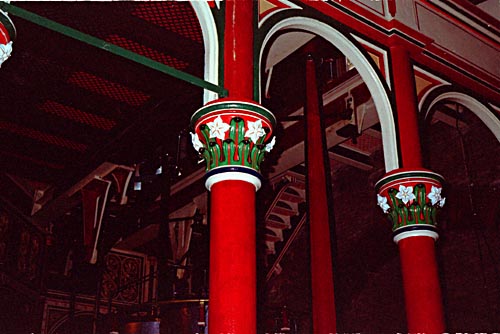
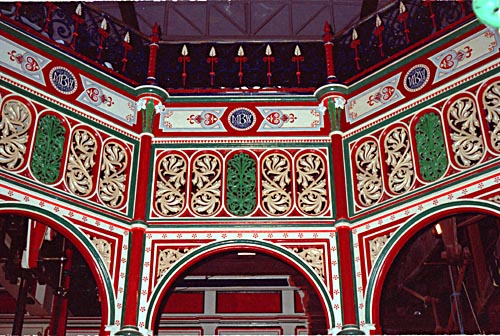
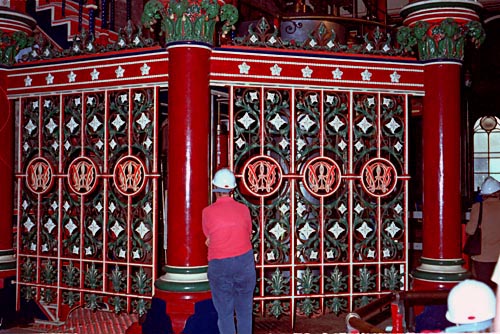
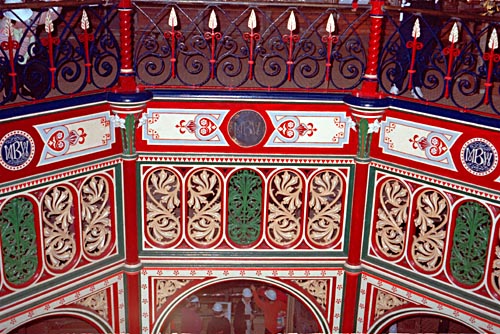
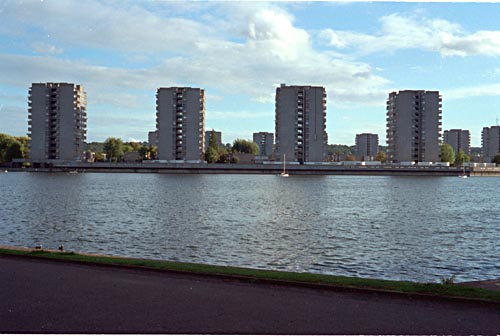
Answer at the bottom of the page, but meanwhile, not far away is this rather sinister looking estate. It looks a bit like something out of 1960s Russia, but it's not. It was used as the location for a brief shot in a famous film, and probably other less famous ones. Does anybody recognise it?
Answers:
The building is a sewage pumping station. It's situated at Crossness, on the South bank of the river Thames, to the East of London. It still contains the four original beam engines, out of use for many years. One of them was last run during flooding in 1955. They were out of regular use long before that. One engine has recently been restored to working order, though the pumps are no longer connected to it. The engine house looks very like contempory railway architecture. Crossness has a web site
here:
It's open for visits on certain days during the year, but these have to be booked in advance, except for London Open House day in September, when you can just turn up.
At Crossness the replacement Diesel and electric pumps were installed in other buildings nearby on the vast site, but at the station on the North side of the river, at Abbey Mills, the engins were removed and replaced by electric pumps in about 1930. These are still there on standby, and were in regular use until a new station was built nearby, about five years ago. Abbey Mills is an incredible building, quite different to Crossness on the outside. It's recently been partly restored, but it's very difficult to get inside the place, though I did manage it once.
It seems rather odd that they should make these places so ornate, when nobody but a few engineers would see the inside of them, but they did that sort of thing then. Crossness opened just as the American Civil War was ending.
The pictures are on Kodak Royal Gold 100 Nikon F, 35mm lens. Lit by a single No. 5 flashbulb; needed more light than my small electronic flash puts out.
The estate is Thamesmead South, built on former marsh-land. It was intended to be the answer to London's housing problems when it was built in the '60s, but the 'dream' turned into more of a nightmare, though I believe things have improved somewhat in recent years. The water is not the river, but a lake, formed from an old gravel pit.
The film location? It was where Alex lived, in 'A Clockwork Orange'
| IP: Logged
|
|
William Hooper
Phenomenal Film Handler
Posts: 1879
From: Mobile, AL USA
Registered: Jun 99
|
posted 08-25-2005 02:05 AM

There's a really Jekyll & Hyde aspect to Victorian architecture. I'm one of the people who really dislike brick, mortar, & wood Victorian architecture; the people who are really fans of it are probably also fans of Japanese movie monsters. Residential homes, factories, etc., blecch.
But outside of the brick, mortar & wood structures, all the ironwork from the era is really beautiful, often understated, & almost poetic. Lamp posts, fences, gates, that really nuts byzantine interior of the sewage pumping station, posts supporting interior ceiling beams & outside galleries, framework for car barns, staircases, etc.; they're beautiful. It's worth noting also that the exterior design of an ugly Victorian building is not predominantly functional, but handsome Victorian ironwork, whether a fence, garden chair, lamp post or whatever, *is* primarily functional.
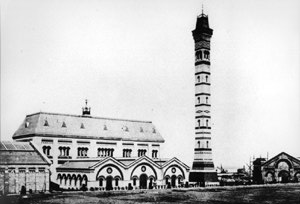
There's the bombastic, chunky, psychotic, ugly brick, mortar, & wood Victorian architectural case:
and the handsome Victorian ironwork case:
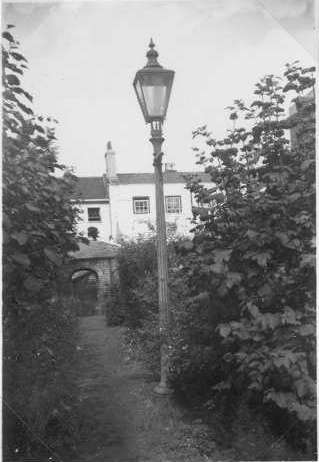

Hard to believe they're of the same parent, family, or whatever.
| IP: Logged
|
|
Stephen Furley
Film God
Posts: 3059
From: Coulsdon, Croydon, England
Registered: May 2002
|
posted 08-25-2005 04:40 AM
Wiliam, I partially agree with you. The picture you posted of Crossness seems to be a very early one; indeed the building on the right seems to be incomplete. There have been a lot of changes since then, the chimney was demolished when the steam plant was de-commishioned, the Mansard roof on the main engine house has gone, replaced at some time by a flat concrete one, the boiler house (the three-gabled low building at the front) was stripped out, and converted into workshops and facilities for staff, which it still is, plus an exhibition and display area, and small lecture room, for visitors. The main entrance Was on the opposite side of the engine house, facing the river. This can no longer be seen from the outside, as another, smaller, engine house was built on to this side in about 1900 to house additional engines while the main ones were re-built and upgraded. These were later removed and replaced by two Diesels, still there, but dis-used for many decades. I think that part of the problem with Victorian buildings is the changes that get made to them over the years; they often don't fit in with the original structure.
Another problem is that many of these buildings need a bloody good clean. Over 100 years of soot and grime make them look very dark and heavy. One wing of Abbey Mills pumping station was cleaned up, and some paint of a really horrible shade of green was replaced before the money ran out, and that wing looks vastly different to the other three. The Crystal Palace looks much better in photographs when it was first built than it does in ones taken just before it burned down, in 1936. Borough Market, near London Bridge, looks much better since it was cleaned, and the roof re-glazed. Glass roofs were intended to let the light in, but many are so dirty that they make the buildings really dark. Also, brick buildings tend to look dark in old photocraphs, due to being taken on orthochromatic plates. Of course, in the case of pumping stations, massive brickwork is necessary to support the load of the engines.
Most of Crossness doesn't look like the photos I posted; the ironwork is rusty, and the brickwork dirty. The place was in a terrible state, it's taken them over twenty years to get it back even to the state it's in now. If you look through the left and right arches in the second picture, you can see some similar engine parts, restored on the left and un-restored on the right.
One engine, and the octogon is about all that's been re-painted. If you look at the octogon, one of the 'MBW' (Metropolitan Board of Works) monograms looks rather faded; this is the best of the original paintwork which remained; the other has been re-painted to match.
On the Crossness site is a picture of Sir Joseph Bazalgette, the engineer responsible for the building of the London sewerage system. His great-great grandson, Peter Bazalgette, is a member of the trust which is restoring the place. He is a television producer, responsible for, anongst other things, the 'Big Brother' programme. A non-fan of Big Brother once remarked that 'Joseph pumped it, and Peter produces it'
William, where is your bottom picture? It looks exactly like Dulwich Park, near where I used to live.
| IP: Logged
|
|
William Hooper
Phenomenal Film Handler
Posts: 1879
From: Mobile, AL USA
Registered: Jun 99
|
posted 08-25-2005 06:15 AM
The bottom picture is Hyde Park; I pulled them all off the web.
Even cleaned up, the Victorian commercial & residential architectural styles are still sort of unappealing to me. Believe it or not, it was not localized to England, but was/is a common style in the US. Here's the Jax brewery in New Orleans:
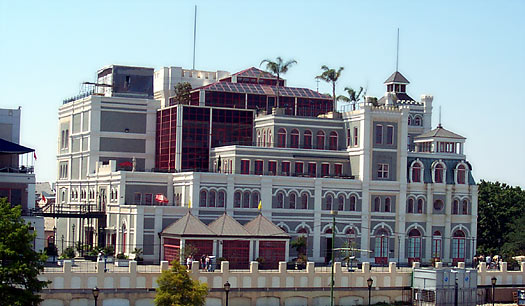
If they hadn't put those trees on the roof, it would be insufferable.
It's all a matter of taste, of course. I know folks who go nuts over Victorian commercial architecture, the more baroque the better. After admitting to dislike of the exteriors, I must also admit to really liking the interiors of Victorian commercial buildings: high ceilinged, open, very nice cast iron posts, very classical. Victorian residential interiors on the other hand to me look like horrible home furnishings landfills that it would be impossible to walk through.
| IP: Logged
|
|
|
Powered by Infopop Corporation
UBB.classicTM
6.3.1.2
The Film-Tech Forums are designed for various members related to the cinema industry to express their opinions, viewpoints and testimonials on various products, services and events based upon speculation, personal knowledge and factual information through use, therefore all views represented here allow no liability upon the publishers of this web site and the owners of said views assume no liability for any ill will resulting from these postings. The posts made here are for educational as well as entertainment purposes and as such anyone viewing this portion of the website must accept these views as statements of the author of that opinion
and agrees to release the authors from any and all liability.
|

 Home
Home

 Topic Closed

![[Wink]](wink.gif)

![[puke]](graemlins/puke.gif)



![[Mad]](mad.gif)
![[fu]](graemlins/fu.gif)

![[Razz]](tongue.gif)
![[evil]](graemlins/evil.gif)






 Printer-friendly view of this topic