|
|
 
|
|
Author
|
Topic: Upload your random pictures (part 2)
|
|
|
|
|
|
|
|
|
|
|
|
|
|
|
|
|
|
|
|
|
|
|
|
|
Stephen Furley
Film God
Posts: 3059
From: Coulsdon, Croydon, England
Registered: May 2002
|
 posted 09-25-2006 06:32 PM


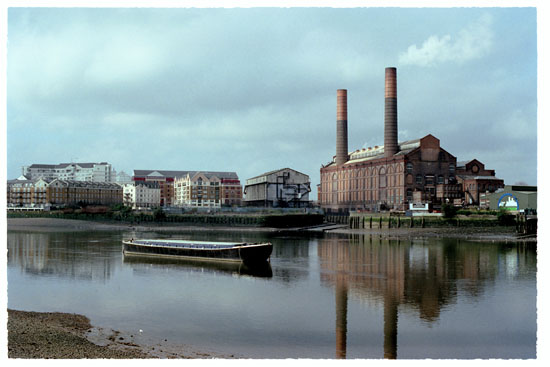
Lots Road Power Station, Chelsea, London - the end of an era.
Pentax Spotmatic F, 35mm lens, Kodak Royal Gold 100.
This is a rather sad picture for me; I took it about three or four years ago, during the final few months of operation, not just of Lots Road, but of the last conventional power station in London. For many years, possibly the whole of my lifetime, also the oldest operating station.
It was built in the early years of the 20th century to power the new electric trams in London, and later became one of three stations powering the London Underground. By the 1960s the plant then installed, not the original, was nearing the end of its life. Closure was considered, the Underground must by then have been one of very few electric railways in the World still generating its own power, but It was decided to modernise instead. Of the three stations, Neasden, was closed and demolished, Greenwich was converted to gas turbine, but Lots Road was to be equipped with new steam plant. The work started in the mid '60s, but was not completed until the early '70s, which must have made things rather difficult during the transition period, as the old plant generated at a low frequency, 33 1/3 Hz. I think, whereas the new was to be standard industrial frequency 50 Hz.
The old coal-fired boilers with chain grate stokers were replaced by Babcock and Wilcox tube wall boilers, I think they were the first of their type in Britain, fired on heavy oil. Turbines were by Parsons, I'm not sure about the alternators. A few years later the boilers were converted to dual firing, gas or light oil, but I don't think any oil was burned for several years prior to closure. The high water content of the flue gases after conversion to gas attacked the brickwork of the chimneys, which had to be partially re-built, as can be seen.
In the months before closure several visits were arranged, and I managed to get on one of them. This picture was taken on the way there, and I also took a number inside. The old control room, disused for over three decades still existed, though unlit, with two panels missing, as they are now displayed in the London Transport Museum. In the laboratory some of the reagents were still stored in etched glass bottles; it was the station chemist who showed us round. The station had its own well, from which it pumped its boiler feed water.
Three dis-used power stations survive in London; by far the most famous being Battersea, not far from Lots Road, on the other side of the river. This is the building with four chimneys, like an upturned table, above which Pink Floyd floated the large plastic pig for one of their record sleeves. Battersea was supposed to be turned into something, there were several schemes, but it has sat roofless, and with the upper section of one wall removed, for about twenty years now, and permission has recently been given for the demolition of the chimneys. Bankside survives, somewhat altered, as the 'Tate Modern' art gallery. Lots Road still stands, it is due to be converted into shops and posh flats (apartments). I wouldn't even want to think about what a riverside flat in Chelsea would cost. The bricked arches which can be seen in the boiler house wall used to be glazed, I think until the First World War, I think it is planned to open them up again.
So that's it, London no longer has any conventional power stations; there are a few very small gas turbine ones, one of which is close to where I work, but it has an output of only 49 MW. There are a couple of waste incinerators which also generate a small amount of power, but most of our power comes from the East Midlands, and Yorkshire, and some from France via a high-Voltage d.c. cable. One of the great symbols of the 20th century is extinct.
I know that there are a number of radio people here; for them, Lots Road has another claim to fame. Until the early '70s, all radio stations in Britain were operated by the BBC. The first two commercial stations to open were in London; LBC was a news station, while Capital Radio was music. Capital broadcast FM on VHF, and AM on medium wave. For many years the medium wave transmissions have been on 194 metres, but when the station first opened it used a temporary transmitter, on 539 metres, with the transmitting antenna hung between the chimneys of Lots Road; it could still be seen there for many years after it was used, but had been removed by the time the picture was taken.
| IP: Logged
|
|
|
|
|
|
|
Powered by Infopop Corporation
UBB.classicTM
6.3.1.2
The Film-Tech Forums are designed for various members related to the cinema industry to express their opinions, viewpoints and testimonials on various products, services and events based upon speculation, personal knowledge and factual information through use, therefore all views represented here allow no liability upon the publishers of this web site and the owners of said views assume no liability for any ill will resulting from these postings. The posts made here are for educational as well as entertainment purposes and as such anyone viewing this portion of the website must accept these views as statements of the author of that opinion
and agrees to release the authors from any and all liability.
|

 Home
Home

 Topic Closed

![[Big Grin]](biggrin.gif) Ahh the simple days of my feeble youth using a Bolex 16mm
Ahh the simple days of my feeble youth using a Bolex 16mm ![[thumbsup]](graemlins/thumbsup.gif) Speaking of Sea Hunt, I drive by the old Ivan Tors ( now called Gweenwich ) Studios everyday to and from home to office
Speaking of Sea Hunt, I drive by the old Ivan Tors ( now called Gweenwich ) Studios everyday to and from home to office ![[Cool]](cool.gif)




![[Wink]](wink.gif)
![[Razz]](tongue.gif)
![[beer]](graemlins/beer.gif)



![[Embarrassed]](redface.gif)


 Printer-friendly view of this topic