|
|
 
|
|
Author
|
Topic: Post your random news stories here
|
Leo Enticknap
Film God
Posts: 7474
From: Loma Linda, CA
Registered: Jul 2000
|
 posted 08-22-2016 11:59 AM


quote: Harold Hallikainen
There were several television innovations that did not work out. For example, the Interactive Video Data Service (http://mai.hallikainen.org/org/FCC/FccRules/1997/95/803/ ) was supposed to allow you to order pizza from your TV.
Something similar happened in Europe, though probably with a bit more sticking power, and most of the systems were based on TV sets that contained a 1200/75 modem, and thus provided the interactivity via a POTS line. France's Minitel, which operated from 1978-2012, was arguably the most successful, but this was probably because the government gave away terminals to every household. Britain's Prestel was similar, but was intended to be integrated into regular TVs rather than used with a dedicated terminal. It never really caught on, though, largely because of its very high cost, both for consumers and content providers.
| IP: Logged
|
|
|
|
|
|
|
|
Leo Enticknap
Film God
Posts: 7474
From: Loma Linda, CA
Registered: Jul 2000
|
posted 08-27-2016 10:38 PM
quote: Daily Wail
Mountain top could be BLOWN UP to stop freak winds which prevent planes from landing at a £300m South Atlantic airport funded by British taxpayers
It was labelled the 'worst foreign aid project in living memory': a £300 million airport funded by British taxpayers – where planes couldn't land.
Now, in a bid to solve the problem of wildly fluctuating winds at the clifftop airfield on the tiny island of St Helena, desperate officials plan to blow the top off a mountain to make the airport safer.
The drastic move is one option being discussed to counter wind shear – vicious changes in wind speed and direction – at the airport on the British territory in the South Atlantic.
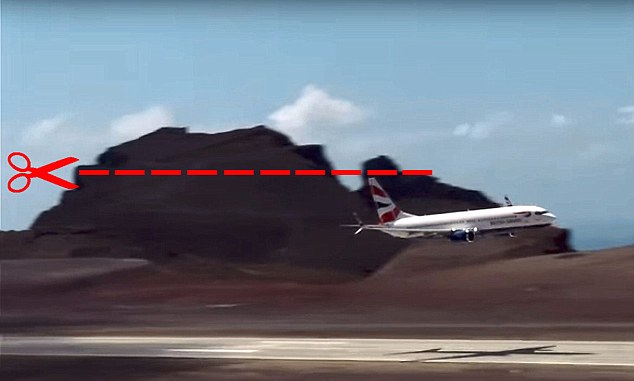
Prince Edward was due to open the airport earlier this year, but it was delayed after test flights raised safety concerns.
Authorities had hoped the problem could be fixed quickly, but engineers are now understood to be considering blowing up King and Queen Rock, a peak on the side of the northern approach to the runway, to reduce the danger risk.
This would take months and involve moving thousands of tons of rock.
Last night the Department for International Development (DFID) said it had appointed an internal expert to review the project, though it refused to confirm or deny whether dynamiting was a viable option.
The Mail on Sunday can also reveal that politicians in the UK have demanded an inquiry into the farce after a leaked email revealed a Foreign Office official admitting that continuing delays mean commercial flights will not land at St Helena before August 2017 – costing taxpayers at least £2.5 million extra.
The delay will force DFID to pay Comair, a British Airways subsidiary that won a contract to provide flights to the island, up to £1.9 million a year to cover its loss of revenue.
The island's government has said continuing to run the island's supply ship, RMS St Helena, over the period could cost at least £625,000.
Last night, Lord Foulkes of Cumnock, an ex-DFID Minister who previously branded the scheme 'the worst foreign aid project in living memory', said: 'The whole project is a real embarrassment and I have written to the chairman of the International Development Committee to demand an inquiry. The committee should discuss compensation for people who have put money into commercial interests tied to the airport.'
Michael Caine: "You're only supposed to blow the bloody mountain off!" (as a mushroom cloud engulfs the entire island)
| IP: Logged
|
|
|
|
|
|
Leo Enticknap
Film God
Posts: 7474
From: Loma Linda, CA
Registered: Jul 2000
|
posted 11-04-2016 09:27 PM
quote: Daily Wail again (sorry)
Is human POOP the future of fuel? Researchers reveal radical system to turn sewage into oil
Fuel of the future could soon be generated from a resource that's found aplenty – human waste.
Researchers have developed a way to turn sewage into biocrude oil, using a process known as hydrothermal liquefaction to produce a material similar to the petroleum pumped from the ground.
With roughly 34 billion gallons of sewage treated in the US every day, the researchers say this system could create up to 30 million barrels of oil each year.
Scientists at the Department of Energy’s Pacific Northwest National Laboratory say the technology mimics the processes that naturally produce crude oil over millions of years.
But, it does so at high temperature and pressure, allowing for much faster output.
According to the researchers, the resulting biocrude oil can then be refined with conventional petroleum refining operations.
And, they say future systems using the technology could make for sustainable wastewater operations, with zero net energy, zero odours, and zero residuals.
While it’s long been thought that sewage sludge is too wet to generate biofuel, the approach used by the researchers at PNNL solves many of the previous problems.
It eliminates the need for drying, which has been known to make such conversions energy intensive and expensive.
With hydrothermal liquefaction, human waste or even other types of wet organic products, like agricultural waste, could be broken down into simpler chemical compounds, they say.
The researchers estimate that just one person could create two to three gallons of biocrude oil in a year.
To create the material, the waste is pressurized to 3,000 pounds per square inch, and subsequently fed into a reactor system that’s heated to roughly 660 degrees Fahrenheit.
The combination of these extreme conditions causes the cells of the waste material to break down into biocrude oil and an aqueous liquid phase.
And, the biodrude oil isn't the only useful product.
The liquid phase could be treated with a catalyst to create other fuels and chemical products, the researchers say.
Along with this, the process also generates a small amount of solid material, which contains important nutrients including phosphorous, which could help to replace the phosphorous ore used in fertilizer production.
‘There is plenty of carbon in municipal waste water sludge and interestingly, there are also fats,’ said Corinne Drennan, who is responsible for bioenergy technologies research at PNNL.
‘The fats or lipids appear to facilitate the conversion of other materials in the wastewater such as toilet paper, keep the sludge moving through the reactor, and produce a very high quality biocrude that, when refined, yields fuels such as gasoline, diesel, and jet fuels.’
The researchers say that this process could also help local governments save money by eliminating the need for sewage residuals processing, transport, and disposal.
‘The best thing about this process is how simple it is,’ Drennan said. ‘The reactor is literally a hot, pressurized tube.
‘We’ve really accelerated hydrothermal conversion technology over the last six years to create a continuous, and scalable process which allows the use of wet wastes like sewage sludge.’
In an independent examination for the Water Envionmental & Reuse Foundation, the process has been hailed a potential option for treating wastewater solids, and the investigators have even said it has high carbon conversion efficiency with nearly 60 percent of the available carbon becoming bio-crude.
The technology has now been licensed to Utah-based Genifuel Corporation, and is working with Metro Vancouver – including 23 local authorities in British Columbia, Canada – to build a demonstration plant.
Officials say the pilot project will cost between $8 and $9 million, and they have plans to see a start-up occur in 2018.
According to Darrell Mussatto, chair of Metro Vancouver’s Utilities Committee, ‘If this emerging technology is a success, a future production facility could lead the way for Metro Vancouver’s wastewater operation to meet its sustainability objectives of zero net energy, zero odours, and zero residuals.’
Would you want to be anywhere near a very large container of human waste that is pressurized to 3,000 PSI?!! Should there be any pressure vessel failure, the result would be what Blaster Bates memorably described as the "Shower of Sh!t over Cheshire", only covering an entire city with the stuff...
| IP: Logged
|
|
|
|
Leo Enticknap
Film God
Posts: 7474
From: Loma Linda, CA
Registered: Jul 2000
|
posted 11-24-2016 02:23 PM
Admittedly, this isn't a very cheerful story for Thanksgiving, but I do feel the need to draw attention to it.
quote: Daily Wail (predictable, aren't I?)
Terrified driver who was decapitated in crash made an EIGHT-MINUTE 999 call as his Skoda sped along motorway at 119mph after car's cruise control 'got stuck'
A driver phoned 999 as his car sped down a motorway at 119mph after the cruise control locked, an inquest heard.
Kaushal Gandhi, 32, of Harrow, Middlesex, desperately tried to stop the out-of-control Skoda Octavia before it crashed into a parked lorry, killing him instantly.
In the eight minutes leading up to the collision, Mr Gandhi told the call handler that the cruise control had become stuck and he could not stop the car accelerating.
A recording of the panicked phone call was played to a coroner in Beaconsfield, Buckinghamshire, today.
The inquest heard company director Mr Gandhi, described as a 'meticulous' driver, speaking to the Thames Valley Police call handler as passed Junction 2 of the M40.
He said: 'My car is not coming out of cruise control...It is not letting me stop. It (the speedometer) shows 70mph but I think I am going much faster than this.'
The call handler replied: 'Can you try to control the car's speed using your gears?'
Mr Gandhi said: 'I am trying. It is not stopping at neutral.'
He tried to turn off the engine by pressing the start-stop button before continuing: 'I have kept pressing the button but all it makes is a noise, my speed is increasing.
'I think what has happened was I tried to change the mode on the car, because I was on the sports mode. I pressed a button to come onto the normal mode and then it is not allowing me to do anything.'
Mr Gandhi later said his speed had 'just gone 77mph' before the call handler asked if he had tried using the handbrake.
The driver said: 'I haven't tried it because at this speed I am not sure what will happen. I am in the middle lane right now, there is no traffic.. Do you want me to try the hand brake?'
The call handler, who was then seeking advice from a colleague, got no response to a question and the crash then happened.
The coroner heard that the phone connection was lost moments after Mr Gandhi was heard saying: 'I am just going to check that, one second... '
The call handler was then heard saying: 'Are you still there? Hello, operator, I've lost the line.'
The Skoda crashed into a lorry parked in a lay-by after the M40 merged into the A40 shortly after 3am on February 2.
Witness Robert Hague, who phoned emergency services, told the inquest the car was 'almost completely embedded in the lorry' and the roof was 'peeled back'.
Lorry driver Emma Parrot told the inquest she was thrown from her bunk with the force of the impact, adding: 'I realised immediately that anyone in the white car was unlikely to have survived.'
Martin Clatworthy, a vehicle data examiner and safety safety specialist for Volkswagen, the makers of Skoda, told the inquest that in the five seconds before the crash, the vehicle was travelling at 116mph and the accelerator pedal was fully depressed. He added there was no braking recorded.
Mr Clatworthy said: 'There is no indication that there was any error or problem with any of the electronic systems of the car in the five seconds leading up to the collision.'
Police collision investigator Andrew Evans said the faults Mr Gandhi described would have meant the Skoda suffered a simultaneous mechanical and electronic failure.
He explained that applying the handbrake could have saved Mr Gandhi's life by forcing the car's rear wheels to lock up and turn it around so it skidded backwards.
Family friend Gatinder Kaur said Mr Gandhi had been 'like a son' and a 'close and trusted friend.
Mrs Kaur said Mr Gandhi, who was born in Mumbai, India, had many interests including archery and sky diving. He had also recently reconnected with an ex-girlfriend in India after his marriage ended in February 2015.
Mrs Kaur said the breakdown of the relationship did not 'cause him any concerns', adding: 'He was on top of the world, he had everything to live for.'
The coroner said a post-mortem examination at the John Radcliffe Hospital in Oxford gave the cause of death as multiple injuries. A toxicology report showed no substances that would affect Mr Gandhi's driving in his blood at the time.
Senior coroner Cripsin Butler said that data analysis from the mangled car's airbag systems failed to provide evidence of the defects Mr Gandhi was describing to the call handlers. He recorded a narrative verdict.
This is the most important reason why I do not like automatic transmissions and will try to avoid owning or driving vehicles that have them. When I bought my current car last year, the saleswoman at the dealership looked very surprised when I asked for it with a manual gearbox, and replied that it was the first time she'd ever sold one in the nine years she'd been selling cars. I replied by citing the infamous Toyota uncontrolled acceleration problem, and pointing out that in a manual car, I'd have had the option of using engine braking and/or neutral, and the computer would have had no way of stopping me, because there is a physical, mechanical link between your foot and the connection between the engine and transmission, which you can cut in an emergency and over which it has no control.
Since buying that manual Honda, I've been laughed at many times for importing obsolete European technology to the US, but this story makes me relieved that I did.
| IP: Logged
|
|
|
|
|
|
Leo Enticknap
Film God
Posts: 7474
From: Loma Linda, CA
Registered: Jul 2000
|
posted 11-24-2016 11:34 PM
Another manual Fit owner here, and very pleased with it (especially the 42-45 MPG it typically gives me on Loma Linda - LA commutes, and the 10K miles between oil changes).
It sounds to me that what happened to the guy with the Skoda was that the software that runs the cruise control hung after it had commanded the throttle to open fully (log analysis indicating that "the accelerator was fully depressed"), and the way it interfaced with the main engine management computer did not, for some reason, allow pressing the cruise control off button to override that hung software and disconnect it from control of the car. In other words, pressing the cruise control off button asks the cruise control software to relinquish control of the throttle, and if that software isn't listening for whatever reason, it won't.
On my Fit, if you shift between gears with the cruise control engaged, it will stay engaged until the road speed drops to a certain level below where it was trying to hold it, then disengage. Example: between my home and the freeway is a steep hill in a 40 limit. With the CC pegged to 40 and in fifth gear, if I shift up to sixth at the top of the hill, the CC will remain engaged if I do it quickly enough. But if the speed drops by more than 2-3mph during the gear change, the CC will drop out. Likewise, if I put the car into neutral, the CC will hold the engine revs where they were for probably 2-3 seconds, before letting them drop to idle speed and disengaging itself.
I'm guessing that the logic algorithm in this incident car was similar, but that because the cruise control had control over the transmission as well as the throttle, and there was no clutch, once the software had hung, the driver had no way of closing the throttle or disconnecting the transmission from the engine, which are your two options for regaining control of a car that is accelerating out of control. In a manual, the clutch is your failsafe device of last resort.
| IP: Logged
|
|
|
|
Randy Stankey
Film God

Posts: 6539
From: Erie, Pennsylvania
Registered: Jun 99
|
posted 11-25-2016 11:32 AM
When I took Driver's Ed. in high school, we went over this exact scenario.
If you have a runaway situation, either because of an engine problem or because of break failure, there are three possible outcomes: You recover and drive to the nearest safe place to stop and get your car serviced. You bring the car to a controlled stop even if your car is damaged. You crash and kill yourself and/or others around you.
I have never owned a car with a manual transmission. In every one, if you step on the clutch, it trips an interlock switch that disengages the cruise control if it is engaged. That is the first thing I would do. Hit the clutch, shift into neutral and coast to a stop. If your main breaks don't work, use the hand break. The hand break should be purely mechanical but, if the hand break doesn't work, you can still steer to the side of the road and sideswipe a guard rail or something. As a last resort, you could even sideswipe or kiss bumpers with another car. That wouldn't be a good idea if the other person doesn't know what's going on. It would normally be a coordinated maneuver but it is still an option. I would assume that a police car or a rescue vehicle would be involved in a two-car maneuver like that. Better to have two cars damaged than to risk a high speed crash with the possibility of multiple people being killed or injured. You could even drive the car into a ditch or the median strip if you can. Minimizing damage would be the goal.
Alternately, you could just turn the ignition key off. Yes, you will lose power steering and breaks when the engine goes down but you should still be able to control the car well enough to stop the car safely. A 30 year old man should be strong enough to control an average sized car without power steering.
You could even just shift the car to "park" or the lowest gear. It would grind the crap out of the engine and transmission but, at least, you should be able to steer the car long enough to stop safely.
Whether you think any of these ideas are good or bad, my point is that there are at least two or three things you can do to bring your car to a relatively safe stop and it's up to the driver to pick the option that does the least damage.
When my Driver's Ed. teacher took a student out driving, I remember that he would ask each student, "What would you do if you lost your breaks or your engine went haywire?"
I don't think it was the cruise control that was malfunctioning. My first guess would be a physical malfunction of the throttle position sensor. That's a far more likely possibility that a stuck cruise control.
It sounds fishy, to me, that a grown man driving a late model car didn't have any idea what to do when his engine races out of control.
| IP: Logged
|
|
|
Powered by Infopop Corporation
UBB.classicTM
6.3.1.2
The Film-Tech Forums are designed for various members related to the cinema industry to express their opinions, viewpoints and testimonials on various products, services and events based upon speculation, personal knowledge and factual information through use, therefore all views represented here allow no liability upon the publishers of this web site and the owners of said views assume no liability for any ill will resulting from these postings. The posts made here are for educational as well as entertainment purposes and as such anyone viewing this portion of the website must accept these views as statements of the author of that opinion
and agrees to release the authors from any and all liability.
|

 Home
Home

![[Smile]](smile.gif)

![[Wink]](wink.gif)



 Printer-friendly view of this topic