|
|
 
|
|
Author
|
Topic: Upload your random pictures (part 4)
|
|
|
Bobby Henderson
"Ask me about Trajan."

Posts: 10973
From: Lawton, OK, USA
Registered: Apr 2001
|
 posted 07-29-2019 09:55 PM


quote: Leo Enticknap
Those LED billboards are a safety menace when they're by the side of a freeway. There is one in particular on the eastbound side of the 10 next to the Fairplex exit: when it's showing a bright advert (e.g. against a white background), it's so bright that it totally destroys your night vision if you look up at it during a night drive.
What you describe sounds like the company who installed the billboard didn't set it up properly. Or it has developed some kind of service issue or error in operation.
Every LED-based variable message center sign or digital billboard we install has the brightness levels controlled automatically through a timer or photo cell. When a digital billboard is working properly its brightness levels should not be overly bright at all at dusk or night. Any sign or outdoor advertising company has every reason to use these dimming systems. They cut power usage and utilities cost as well as extend the life of the LED boards.
Chances are the company who installed the sign either didn't wire up the photo cell properly or the photo cell went bad. If the system is working off a programmed timer then it might point to user error (not programming or scheduling the sign correctly). A bad photo cell can be replaced in one service call. An error with a brightness timer can often be fixed remotely within minutes. Most digital billboards have some kind of Internet connection and can be remotely programmed and monitored.
quote: Randy Stankey
Also, most LED signs or billboards change their message before people have a chance to read them.
Off-premise Digital billboards and on-premise variable message displays are two very different things even though both use fundamentally the same LED display technology. They are subject to different kinds of regulations and they require very different mindset approaches in ad design.
Most states require digital billboards to show static, non-animated imagery with hold times in the roughly 8-10 second time range. That's more than enough time for any properly designed billboard ad. IMHO, a good billboard layout should be able to communicate all its info in nothing more than a quick glance.
Businesses that install digital signs on-premise typically have more freedom with the content they can show, but it varies a great deal from one city to the next. Some cities will still require non-moving, static content and substantial hold times while other cities will allow animation and full motion video to be displayed. Then there are other cities that outright ban various kinds of signs, including any LED-based variable messsage displays. I think that's a lousy approach given the fact on-premise signage is the most important marketing tool for any business with a store front. If they can't let the public know they're there effectively that just makes it even more easy for the Amazons of the world to continue killing local businesses.
The biggest problem with on-premise digital signs is typically the on site staff there, unless you're dealing with a chain of stores. It does require some design talent, time, motivation and a decent amount of technical expertise to get the most out of a LED board. Some of the bundled ad creation software is decent. But it really takes mastering a good image editing program to compose great still images and it takes learning how to use a good motion graphics application to create all sorts of animated effects. It's either that or pay someone to create the graphics and not too many mom and pop shops want to go to that expense.
quote: Randy Stankey
LED signage makes it easy for idiots to create indecipherable, unreadable, illegible messages while advertising companies pocket the money.
It's every bit as easy to design a horrid looking, ineffective billboard ad using the old static, printed methods. LED has nothing to do with that problem. It's actually even more easy to design an ugly, illegible printed billboard because you can print text and other details at relatively microscopic sizes. There's no pixel grid to enforce minimum limits on letter sizes.
Better than 90% of shitty billboard layouts are dictated by the client. Lots of clients try to create the ads themselves. Because anyone is a "professional artist" after figuring out how to click around a little in a graphics program. The clients are the ones who demand the whole thing be a freaking phone book ad filled with all sorts of shit no one is going to remember immediately after passing it on the side of the road. They ignore our advice and clutter it up anyway. For instance, phone numbers are among the most idiotic things anyone can put on a sign, especially these days when people don't have to manually dial them into a smart phone. The sequence of numbers is instantly forgettable. Nevertheless lots and lots of business owners demand phone numbers be incorporated into a sign design.
While clients do their part to overload a billboard ad with too many elements there are plenty of no-talent hacks working at sign or outdoor companies. They take the clients requests and churn out fast, slap-dash graphics with little regard to how the end result looks. It doesn't take any credentials (such as formal training, a degree or a decent portfolio at the bare minimum) to land a graphics job in a lot of these places. Sometimes I wonder if the only requirement is a pulse and a willingness to work for cheap.
quote: Paul Finn
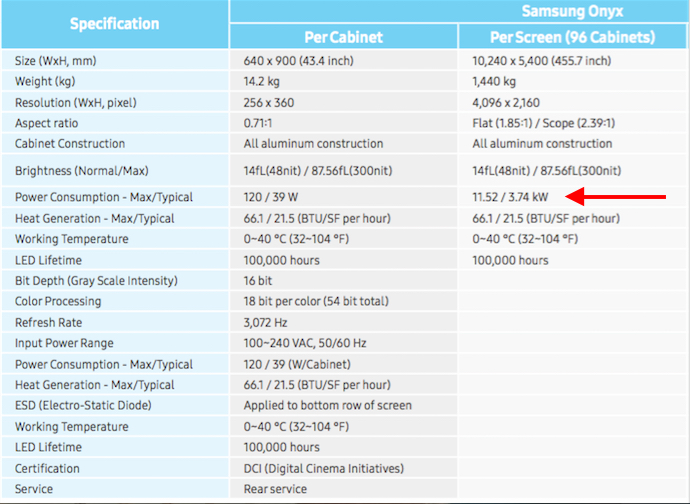
I heard a radio broadcast report yesterday reviewing a demonstration screening at a Sony facility in CA using a new Sony super micro led 16x9 foot display surface. It was stated the unit consumed 7kw (7000 watts) of power when in operation. This seems to contradict the usual led mantra of being power consumption economical. Maybe Mr. Henderson can comment on the power used by current large led high resolution display boards such as the Daktronics and Samsung Onyx systems.
In terms of electricity consumed in ratio to light output LEDs are far more efficient than other light sources like HO/D fluorescent lamps or neon. It's no contest. We have to use high wattage ballasts with traditional sign lighting approaches. Little 60 watt low voltage power supplies are used for LED-based lighting in channel letters and sign cabinets. I prefer the look of visible neon glass on certain kinds of signs. But LED is taking over everything else. The different modules and LEDs sticks cost a good bit more up front than a HO/D fluorescent lamp. But LEDs last a lot longer, use less power and require less service calls.
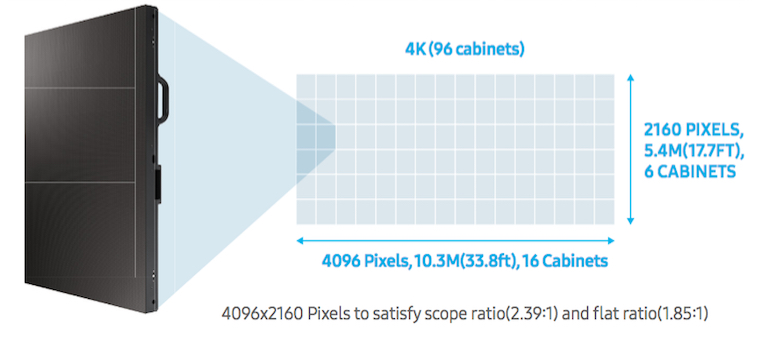
A LED-based display showing full color graphics or full motion video is a totally different kind of product. A big outdoor LED billboard has thousands of outdoor-rated LED clusters that must emit enough brightness to not get washed out by bright daylight. That's going to require more than a single 20 amp circuit to power. One of these new LED-based cinema screens literally has millions of SMD LEDs, with each pixel emitting a lot of light. I don't know the power draw on a Samsung Onyx Cinema display, but I would bet 8.8 million SMD LEDs in that kind of application would suck quite a bit of juice.
| IP: Logged
|
|
|
|
|
|
|
|
|
|
|
|
|
|
|
|
|
|
|
|
|
|
|
|
|
|
Leo Enticknap
Film God

Posts: 7474
From: Loma Linda, CA
Registered: Jul 2000
|
posted 12-09-2019 11:01 PM

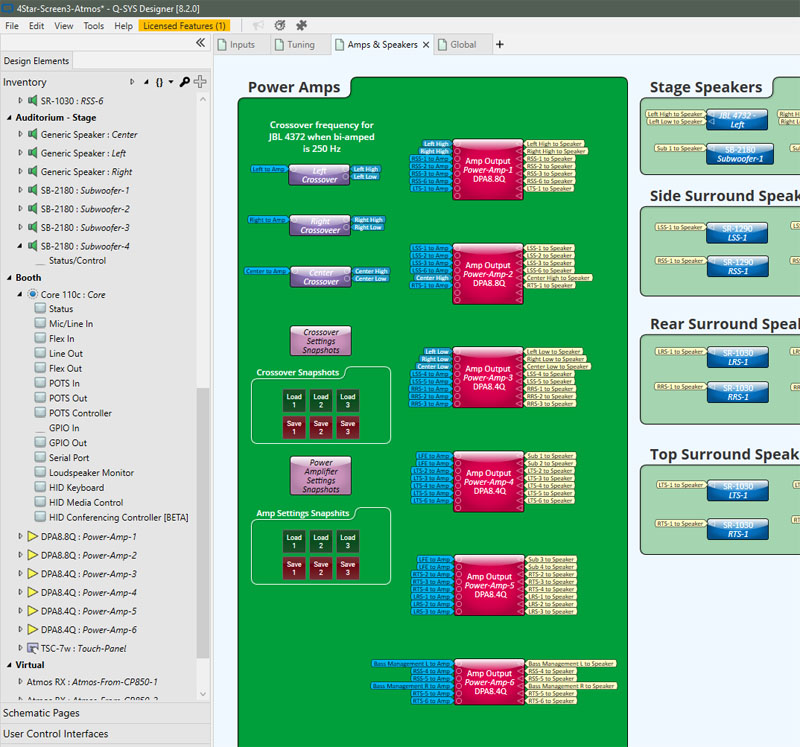
I hadn't noticed the 4732 / 4372 typo myself - was working under deadline pressure on Friday.
Before anyone asks, I also don't know why JBLs were chosen for the stage channels and QSCs everywhere else. This is an upgrade of an existing, operating screen from 5.1 to Atmos, so maybe the JBLs are already there for the stage channels, and are being recycled into the new system. I was simply given the DARDT and told to come up with a Q-Sys design in which a Core 110c effectively takes the place of the DAC3202. In other words, all the real processing work is taking place in the CP850 upstream of the Q-Sys core.
I included the amp settings snapshot bank, so that when it comes to tuning, the power amp channel gains can be adjusted in order to get the levels roughly right, and in the case of the bi-amped channels, the LF and HF roughly equal with each other, before letting the Dolby Atmos Designer autotune procedure have at it; and then those gain settings can be saved, independently of any other settings changes made to other components in the design. I also included a parametric EQ for each channel, so that I can iron out any serious rough edges in the X-curve before the autotune, to reduce the amount of judgement that the algorithm, rather than human ears, will have to apply. The crossover snapshots are so that if any tech wants to play with the crossover points in future, (s)he can use the 2 and 3 slots for temporary experimentation purposes, without losing the setting that was in use before starting.
I hadn't thought of going as far as custom voicing with the stage channels, but might resort to that if I can't get them to behave themselves when it comes to the tune.
| IP: Logged
|
|
|
|
All times are Central (GMT -6:00)
|
This topic comprises 65 pages: 1 2 3 ... 61 62 63 64 65
|
Powered by Infopop Corporation
UBB.classicTM
6.3.1.2
The Film-Tech Forums are designed for various members related to the cinema industry to express their opinions, viewpoints and testimonials on various products, services and events based upon speculation, personal knowledge and factual information through use, therefore all views represented here allow no liability upon the publishers of this web site and the owners of said views assume no liability for any ill will resulting from these postings. The posts made here are for educational as well as entertainment purposes and as such anyone viewing this portion of the website must accept these views as statements of the author of that opinion
and agrees to release the authors from any and all liability.
|

 Home
Home



![[Razz]](tongue.gif)



![[Big Grin]](biggrin.gif)


 Printer-friendly view of this topic