Help with the path of our sound

Collapse
X
 
  • Time
  • Show
Clear All
new posts
  • Ryan Gallagher
    Film God
    • Nov 2022
    • 2855
    • Austin, Texas, USA

    #46
    Originally posted by Ryan Gallagher
    The rest of the kit that is missing would be a suitable XLR to DB25 cable with dolby pinout...
    Correcting myself. Since it's AES/EBU pairs on XLR at that end, the idea of a dolby analog XLR to DB25 cable would not do it. You would need something else there that is aware or at least wired for the fact it is AES/EBU channel pairs. That might be where you need an DCI XLR to DB25 cable, and then pin map accordingly in the RJ45 adapter.

    Something like this guy doing the AES/EBU XLR to DB25 conversion.
    https://www.sweetwater.com/store/det...gisnake-4-foot

    Or maybe you could go direct to RJ45, but you might still need a custom built RJ45 patch cable to re-jig the pinout:
    https://www.bhphotovideo.com/c/produ...e_to_rj45.html
    Last edited by Ryan Gallagher; 01-12-2026, 07:25 PM.

    Comment

    • Tj Hopland
      Pro Film Handler
      • Jun 2025
      • 264
      • Minneapolis, MN

      #47
      Looks like I must have hit post instead of preview then ended up editing what I had already posted back on 43 so that is why your quote in 44 doesn't match. I didn't mean do that, hope its not too confusing for everyone.

      So the sync ports on the AJA boxes are in and out ? What's the 3rd one? The few times I had to deal with external sync stuff I seem to recall that if there were multiple things involved you needed a hub like box too. That box had an IN from what ever was the master in the system then there were outs that went out to what ever needed it. I didn't design or really learn about it, I seem to recall it came as a kit and there was a 'quick start' guide in the box that just said how to set it up and it worked.

      Comment

      • Ryan Gallagher
        Film God
        • Nov 2022
        • 2855
        • Austin, Texas, USA

        #48
        Originally posted by Tj Hopland
        So the sync ports on the AJA boxes are in and out ? What's the 3rd one? The few times I had to deal with external sync stuff I seem to recall that if there were multiple things involved you needed a hub like box too. That box had an IN from what ever was the master in the system then there were outs that went out to what ever needed it. I didn't design or really learn about it, I seem to recall it came as a kit and there was a 'quick start' guide in the box that just said how to set it up and it worked.
        There is a sync loop in, loop out (for dealing with the external clocks), but there is also an AES/EBU Sync Out, which can act as a reference clock to feed the 2nd unit (or whatever else you have).

        Comment

        • Ryan Gallagher
          Film God
          • Nov 2022
          • 2855
          • Austin, Texas, USA

          #49
          If by internet specials you mean something like this guy that claims to do a stereo pair AES/EBU output.


          Sure I expect you could stack them, (3-4 needed), but yeah the fact each pair might have slightly varying clock for it's sampling would be non-ideal. Would it still work? Perhaps? I don't know the 950's requirements as far as AES clock consistency to predict that.

          I would expect when 1-8 and 9-16 are split, you are not typically using all 16 at the same time, and if you are using all 16 they are coming from the same source, so matching clocked signal inherently.
          Last edited by Ryan Gallagher; 01-12-2026, 07:42 PM.

          Comment

          • Sean McKinnon
            Pro Film Handler
            • Jan 2020
            • 269
            • Boston (Peabody), Ma

            #50
            The cleanest way is going to be to either find a 778 or an analog to AES 3 converter. Then using a suitable quality 16 channel AES-3 Audio switch and the correctly pinned adapters feed your DCP 1-16 to on set of inputs and the CP-650 outputs (8 Channels) to the other. The output of the switch feeds the CP-950 AES in. Don't try to just switch the first 8 channels and leave the 9-16 connected from the server, that will cause issues you need to break that connection.

            Comment

            • Tj Hopland
              Pro Film Handler
              • Jun 2025
              • 264
              • Minneapolis, MN

              #51
              I'm assuming what ever solution Brian is going with is already well in motion to meet the Friday deadline and he will hopefully share the details once its done and has a few shows under his belt so further discussion is likely for curiosity and or others that may be in the same situation at some point.

              Sean, do you have any examples of the or similar products that you mentioned? I'm only casually searching and could just be looking in the wrong places and or using the wrong terms but it seems like A to D especially several channels as a stand alone unit isn't that common. Several leads I followed turned out to be D to A. Others leads seemed to be modules that plug into a mainframe sort of thing or are part of an ecosystem, not really stand alone.

              Best prospect suggested so far seems to be the AJA ADA-4 that Ryan has. Looks like those go for about $600 each so not too crazy. AJA has been around a long time and makes quality stuff and can be bought from places like B&H so easy for anyone to get. You would need 2 and I'm assuming you then get a bnc cable and connect the sync out jack on one box to the sync loop in on the other and that will keep them both in sync so the CP should not have any issues with the signals coming from 2 boxes. Did Ryan cover that when he talked about em? If not can he confirm that that is how the sync part would work?

              So that leaves the AES switch? Single pairs seem to be around but stacking 8 of those to get to 16 channels could be hard on the budget and would really kill the 'clean' aspect. Is an AES switch just mechanical or electronically emulating a mechanical switch? Or is their fancy stuff going on? I see some are listed as analog or aes so I'm assuming its more of the mechanical nature and its really the same as an analog signal as far as the wires and switches are concerned?

              Comment

              • Ryan Gallagher
                Film God
                • Nov 2022
                • 2855
                • Austin, Texas, USA

                #52
                Originally posted by Tj Hopland
                Best prospect suggested so far seems to be the AJA ADA-4 that Ryan has. Looks like those go for about $600 each so not too crazy. AJA has been around a long time and makes quality stuff and can be bought from places like B&H so easy for anyone to get. You would need 2 and I'm assuming you then get a bnc cable and connect the sync out jack on one box to the sync loop in on the other and that will keep them both in sync so the CP should not have any issues with the signals coming from 2 boxes. Did Ryan cover that when he talked about em? If not can he confirm that that is how the sync part would work?
                I think I did cover that, but yes, a single coax from the "aes sync out" on one ADA4 can feed the "sync loop in" on the other one. Perhaps not necessary but guarantees all the AD chips are on the same clock to prevent any gotchya's if the CP950 if it is picky. Note the ADA4 is a very old piece of AJA design, been around forever. A frugal person (non-integrator) would nab them for less than 120$ on ebay, that is where mine came from, plenty more listed.

                AJA ADA4 Sold Listings
                https://www.ebay.com/sch/i.html?_nkw...t=nc&LH_Sold=1

                Other than suggesting a different head processor and routing, all my other suggestions were along the lines of what someone might be able to throw together on short notice with gear that is gettable to "get by" until something better can be implemented. If you had a nice multichannel AES switch (or designed one), I suppose the ADA4s could be permanent, they are broadcast quality and easy to replace. More over they are available from lots of AV rental shops. I'm not sure I would claim any mini-converters are designed to be powered 24/7 though... but plenty are used that way. If you wanted to keep the 950 as the primary, there are probably better options for the ADs (at a much higher price point) that are rackable etc.

                I too noticed there was an Open-Gear or Evertz frame compatible multi channel AES AD card. That is more modular broadcast truck/studio gear. If you had a need for lots of other converters in your rack not a bad thought, very space efficient, but really not for our industry, and priced accordingly.

                I also struggled to find many multi-channel single unit AD offerings, and haven't even looked for an AES switch device, this one by Radial (SW8) might suit the bill, can take the A and B inputs in multiple formats, balanced xlr, unbalanced 1/4in, or DB25. Can even take a foot-switch if you want to be able to trigger it as part of a show start sequence to get off the DCI preshow. It would actually cover 1-16 if feeding it AES pairs... AES/EBU pairs can travel on most XLR routing gear as far as I understand, but that could be a false understanding... passive or relays should be fine, wires are wires, provided adquate shielding.

                Radial SW8
                https://www.sweetwater.com/store/det...-auto-switcher

                Hell, for that matter, a VERY frugal person would probably just nab a DB25 passive A/B switch, if you don't need any automation, and provided you were willing to get it into DB25 format to accommodate using it.
                https://www.cablewholesale.com/produ...40d3-17602.php

                Or this guy, if you'd rather do it in RJ45 format, very manual of course, not very integrator or automation friendly.
                https://www.cablewholesale.com/produ...40r2-01604.php

                Here is hoping Brian has a great first engagement (hopefully on film with some kind of temporary solution).
                Last edited by Ryan Gallagher; 01-14-2026, 02:46 AM.

                Comment

                • Tj Hopland
                  Pro Film Handler
                  • Jun 2025
                  • 264
                  • Minneapolis, MN

                  #53
                  Originally posted by Ryan Gallagher
                  Note the ADA4 is a very old piece of AJA design, been around forever. A frugal person (non-integrator) would nab them for less than 120$ on ebay, that is where mine came from, plenty more listed
                  This is a good tip. Also perhaps gives us an indicator that there just are not that many current applications for such a device. If there was a big demand more products would be available and a company like AJA would have likely came up with a next gen model or other variants by now and they would be really scarce and or expensive on the used market.

                  Comment

                  • Tj Hopland
                    Pro Film Handler
                    • Jun 2025
                    • 264
                    • Minneapolis, MN

                    #54
                    I was wondering if anyone still made those passive switches, looks like they do. Assuming the manual nature works for the application / use case then a cable patch would also work?

                    Something that vendor doesn't seem to clearly specify for either model is is every pin carried straight through and switched? Back in their day when these were commonly used in multi computing situations that was sometimes a catch. Like in the case of the DB25 when it was first conceived in the 60's I think some of the pins were for future or alternate applications and then by the later 80's or early 90's when these switch boxes would have been the most popular I want to say maybe 8 pins were being used out of the 25 so some of the box makers would just stick a 8 pole switch in since that's what was all that was usually needed.

                    The other pins were either un connected or were possibly carried through in parallel because they were things like grounds and shields. I also remember a few applications where there were pins flipped between the ins and out or sometimes the non selected input would have some pins shorted or run through a terminating resistor. That worked fine as long as you were just hooking 2 PC's to one modem but didn't work so good when someone decided that it would be good to use most of the pins to carry audio. Same thing with the RJ box, did they use all 8 pins or is it only maybe 4? Looking at the diagram they give they picture the internal switch which may or may not have anything to do with what's in the box. Its a stack of 3 with 3 per layer so they could switch 9 pins so I guess that probably would do all 8?

                    The other area of concern is the quality. In their day I think they tended to be pretty good for their intended job but vintage ones are gonna be 30-40 years old so depending on usage and storage conditions not likely still up to original specs. New stuff? I think we are all thinking the same thing there....... Its all a nifty idea but if manual could work building a RJ or DB patch bay thing would probably a reasonable option. I have not looked real recently but last time I did you could still buy a rack plate with DB25 holes punched in it. And RJ's are real easy, you can buy a rack plate with keystone slots then populate them with what ever you want even pick different colors and you are not limited to RJ's they make lots of different connectors in the keystone format.

                    Comment

                    • Ryan Gallagher
                      Film God
                      • Nov 2022
                      • 2855
                      • Austin, Texas, USA

                      #55
                      Usually a universal manual switch box was 1 to 1 on pin arrangement. You'd still have to build your pin correct adapter (either cable or DB25 to RJ45) etc. But yeah you'd want to make sure all pins are switched, and not just they are some specific use case like parallel printers with un-needed pins etc.

                      If you can get by without a physical switch, an XLR patch bay would be the most robust manual solution as far as build quality. But instead of patching analog audio, you'd be patching AES/EBU pairs. But at that point why not just physically swap the RJ45 connections on the 950? Unless you really were dead set on front of the rack access. Even then you could route the RJ45 connections to the front in a modular patch bay... but since the ADA4 solution involved XLR AES/EBU anyway, XLR patching makes just as much sense, perhaps. But now we are getting into permanent solution territory, and there are certainly better approaches with a budget (that are fully rackable, do what we need to do natively without glue devices, and offer automation methods).

                      Comment

                      • Ryan Gallagher
                        Film God
                        • Nov 2022
                        • 2855
                        • Austin, Texas, USA

                        #56
                        If I was MacGyver-ing a quick solution, ignoring the fact I already own the ADA4s... I would probably go the DANTE route and slap in a POE network switch and 5 Audinate AVIO devices, 3 for the 6 input analog channels, 2 to get AES/EBU output on 3 or 4pairs of XLR. All that gear is far more modern and extensible/reusable/resalable... and the price is nearly equivalent to the ADA4s at retail... ignoring the break ins/outs, of which there is are 3 or 4-XLR to RJ45 for a reasonable price too, just do your pin mapping in a custom RJ45 cable. Dante manages the sync master elections across devices... However if you needed software switching in the quick solution, you'd have to add more DANTE gear for the DCI inputs... and at that point you might as well get a QSYS box to do it all and give you an interface etc, or have QSYS become the primary processor.

                        I also trust a decent POE network switch to be happy 24/7 over the wall warts and ADA4 boxes (that get fairly warm). Both both approaches are quick AV glue device solutions... not what I would select for a DCI/35/70 booth permanent integration.

                        Comment

                        • Bruce Cloutier
                          Pro Film Handler
                          • Jan 2020
                          • 429
                          • Pittsburgh, PA USA

                          #57
                          Boy I got lost trying to read through this thread. Sucks that they make things and only after a couple of years you can't get that anymore and the next model isn't 100% compatible. Not to mention that some simple thing they then stick in a real expensive device and charge for an annual license or some monthly SaaS shit.

                          You know we can make switching boxes for anything to work as expansion modules for the JNIOR. We just never went hog wild making all kinds of random crap for areas that we know little about. The idea was to wait for customers to ask us and relate their needs. Has that happened? Nope! Not recently anyway. I get it that you can't actually talk to anybody with enough biologically wired neurons at any these great audio companies that you all depend so much on. So why would we be different? I don't know. I think we try not to be like that. Instead this afternoon our phones (still copper based) are on the fritz. We can work on that.

                          Well, I guess I lied a little. Just recently a customer who uses JNIORs for monitoring had a need. They use the Model 414. What is that? I am not sure anyone in cinema has bought one. But it is a JNIOR that has 12 digital inputs and only 4 relays. Their business uses inputs, lots of them. So they got a contract that like doubled the input requirements per JNIOR. They asked if we had an expansion module for that. Kind of like the 4ROUT but for inputs. We didn't have that.

                          We created and built 100 8DIN modules for them. It is now on the price list and in the store. That module adds 8 digital inputs to the JNIOR. We did that even though the customer said they would likely just have to use 2 JNIORs to do it (more profit in that). My point is that from hearing about the need until being able to supply them with a finished (now standard) expansion module was less than 8 weeks. I don't expect anyone else to buy one. Maybe if we had some actual marketing, but we don't.

                          I had thought that switching audio would be a logical thing. I didn't think switching relays were all that good for that directly. I mean do you really want audio inputs and outputs to go from unloaded to loaded (and the reverse) just like that? Wouldn't that blow speakers and amps? I don't know. I don't have any audio experts on staff.

                          But if you find some 40 year old crap that works but isn't available. I can take a look at it. Then maybe you can automate and not create yet another physical switch to have to get right to avoid embarrassment.

                          I know this doesn't solve anyone's need to get something up and running by Friday.

                          Comment

                          • Tj Hopland
                            Pro Film Handler
                            • Jun 2025
                            • 264
                            • Minneapolis, MN

                            #58
                            Since the original question and deadline has sort of passed I feel like its OK for us to sort of go off on tangents like Jnior especially since maybe it could lead to a product to solve the issue.

                            I had not noticed that 8 in box option but I don't look at the site/store page that often. I could see that possibly being useful in some cinema like applications especially ones in multi use venues that involve film. This 8 in box could be maybe mounted over in or near the 35mm equipment while the Jnior lives over by say the lighting system. Rather than having to run possibly 16 wires across the booth you can just run that RJ12 cable. Could also work like a smaller and more custom alternative to the control panel especially if you didn't want or need the feedback that the panel offers.

                            I don't know what's really involved in audio switching either so I will leave that to others if they know. I'm gonna guess its maybe on some levels harder than one would think so it could get expensive and not lend itself to other applications. Something to keep in mind with it likely requiring a Jnior to control it the cost of the Jnior may have to be factored in. It could be really attractive to someone that already has a Jnior or was planning on one anyway but would it sway people to the Jnior platform?

                            You mention 40 year old stuff that worked, how about the CP200? Maybe this is totally not how you would want to do it today and none of these components have modern equivelents but its maybe a start? And I also have no idea if you could switch AES with this circuit or it could only be analog. I don't know how to link to a specific page so the card we are maybe interested in is the Cat 141A and its on PDF page number 26. A note for all you young-ins, look the manual that came with the equipment had schematics with component part numbers!

                            https://www.film-tech.com/warehouse/...00DIAGRAMS.pdf

                            The 200 has several of these that were 6 channel 4 in 1 out switches or routers. Those were basically how you created the route through the processor. Going from memory it was something like the first one was the input, was it the optical preamp? mag input? Non sync input? That sort of thing. Next one down the line was are you going to bypass the academy filter and NR or are you going to route through one of em? Are you going through the matrix? You created the formats like a macro by selecting say B on the first card then C on the second sort of thing.

                            Comment

                            • Ryan Gallagher
                              Film God
                              • Nov 2022
                              • 2855
                              • Austin, Texas, USA

                              #59
                              Speaking of old stuff they don't make anymore... It seems 8 channel AD/DA mastering quality boxes were quite a bit more common in the ADAT era. This Lucid 8x8 analog to AES/EBU pairs box was one of the more popular ones, no longer made. Ebay must be listening to my conversations.

                              Lucid 88192 (legacy), there were others too
                              https://www.ebay.com/itm/326755907017

                              Having a better search term of "8 channel AD/DA" google AI was able to provide a few contemporary suggestions, but funnily enough most of them don't do AES natively, they require additional costly output modules. Most of these I had ignored because of the price, but if you were making this a permanent integration solution might be worth it:

                              ​Lynx Aurora (n) 8-TB3 8-channel AD/DA Converter with AES I/O and Thunderbolt 3 Interface, 4000$
                              https://www.sweetwater.com/store/det...urora-n-16-tb3

                              Grace Designs m701 base unit with AES upgrade option: $3000 + $750
                              https://www.sweetwater.com/store/det...udio-interface
                              https://www.sweetwater.com/store/det...-field-upgrade

                              This unit might be on the verge of retirement, and their newer stuff doesn't seem to have an AES output option?

                              RME ADI-8 Mk III, 2200$
                              https://www.prosoundgear.com/shop/pr...rmat-converter

                              Also definitely retired, a nearly 20 year old design: Mytek Digital 8x192 AD/DA, 2800$
                              https://www.proaudiosolutions.com/My.../8x192adda.htm

                              And at the top of the price bracket, the Prism Sound ADA-8XR with AES module, 11,000$
                              https://www.sweetwater.com/store/det...hannel-d-a-aes

                              Jesus, paying over 1000$ per DA channel seems a bit overkill. Here I was thinking the Evertz broadcast frame and multi AD AES card option was expensive!
                              What are people having to do AD (AES) in cinema integrations using? Cause this studio gear path seems quite expensive. Obviously having the correct head processor or QSYS negates all this mess. At least some of those get you to AES on DB25, which is a quick adapter away from a 950 connection or switch connection.
                              Last edited by Ryan Gallagher; 01-14-2026, 09:09 PM.

                              Comment

                              • Ryan Gallagher
                                Film God
                                • Nov 2022
                                • 2855
                                • Austin, Texas, USA

                                #60
                                A JNIOR that could switch AES (or any signal) is a thought.

                                As for better AES switch boxes, here is a DB25 native 16ch A/B rack device from Broadcast Devices, redundant power option, automation integration:
                                Seems to be out of stock everywhere though.

                                BDI 8/16-8D 8-Channel A/B Single Point of Failure Bypass DB25 Female Audio Switcher with Dual Power Supply Option, 1300$
                                https://www.markertek.com/product/bd...-supply-option

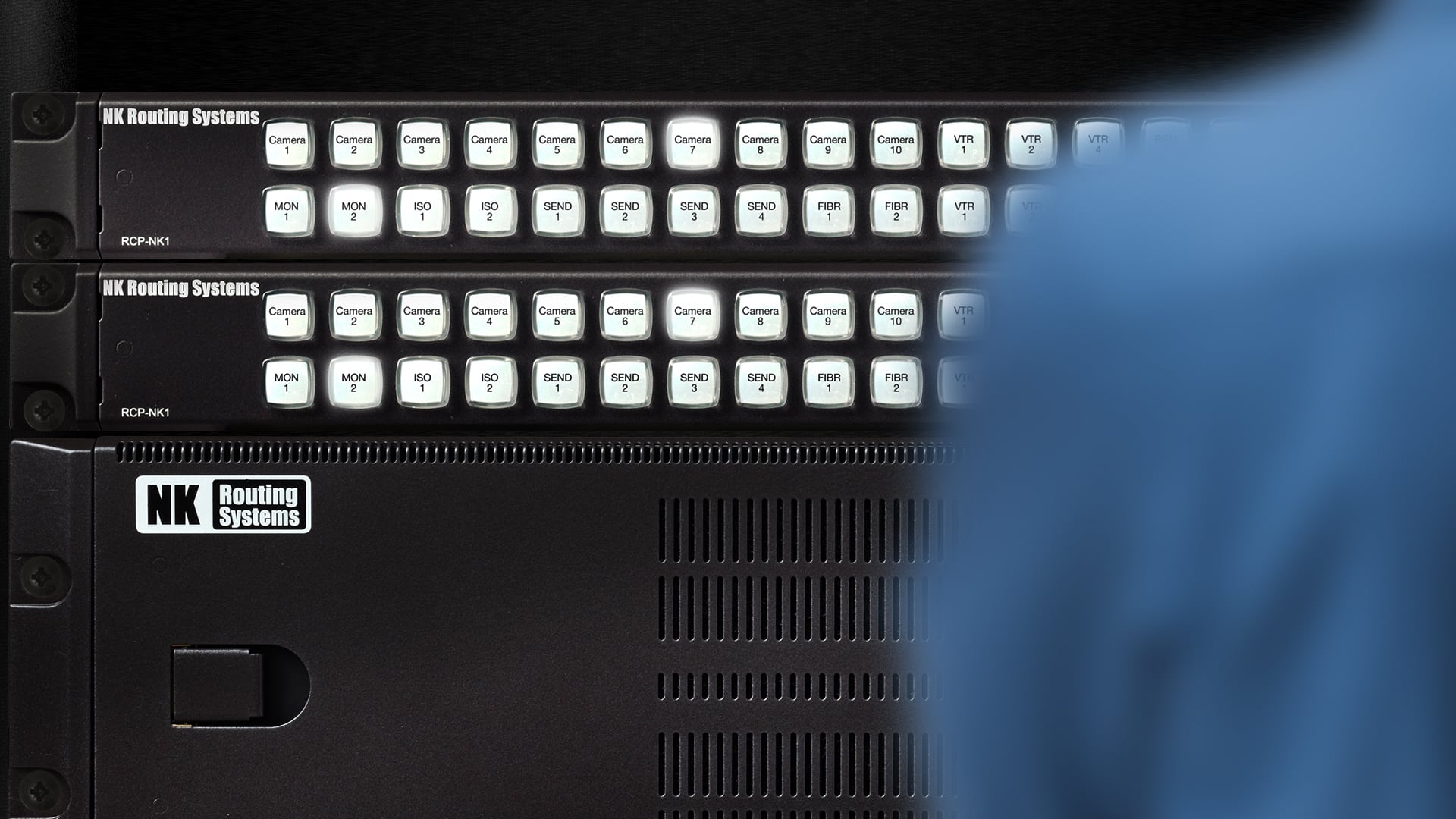
                                The broadcast world has some things actually marketed as AES routers/crosspoints on DB25. But very overkill. Ross's offering jumps from 16 inputs to 64.
                                Ross Video NK Series delivers cost-effective, high-performance routing for studios, OB vans, and flypacks—offering flexible matrix sizes, modular expansion, comprehensive format support from analog audio to 3G SDI, and seamless integration with DashBoard and industry-standard control protocols for reliable, scalable broadcast signal management.


                                It kinda feels like trying to do this "the right way" entails spending equivalent money to just replacing the CP950 with a processor more suited for a mixed DCI/Analog booth anyway, or redoing the audio with QSYS (although that is probably quite a bit more money).

                                It was a fun thought experiment though. Cause TJ and I might just be talking amongst ourselves. ;-)


                                Comment

                                Working...