Experience with color calibration between lamps and lasers, and their matching.

Collapse
X
 
  • Time
  • Show
Clear All
new posts
  • Hong Sung Hyeok
    Film Handler
    • Dec 2020
    • 54
    • Seoul, South KOREA

    #1

    Experience with color calibration between lamps and lasers, and their matching.

    I don't think I'm very good at distinguishing colors with my eyes.

    But I can feel it.
    The Christie S1, S2, S3, and S4 have a very subtle blue tint after calibration.
    The Barco S2 has a slightly pinkish tint, and I'm not sure about the SP series S4.

    Some post-production colorists are very picky about the color of the calibration results.

    But they also want to match the color between the lamp and laser.

    What's the best method?
    We use Qalif Spectro.

    The colorimeter says 0.314, 0.351, but even to my eyes, the lamp and laser feel different.

    Has anyone experienced color calibration and white point matching for the DP2K-20C and SP2K-15S used in post-production?​
  • Marco Giustini
    Film God
    • Jan 2020
    • 1168
    • Reading, UK

    #2
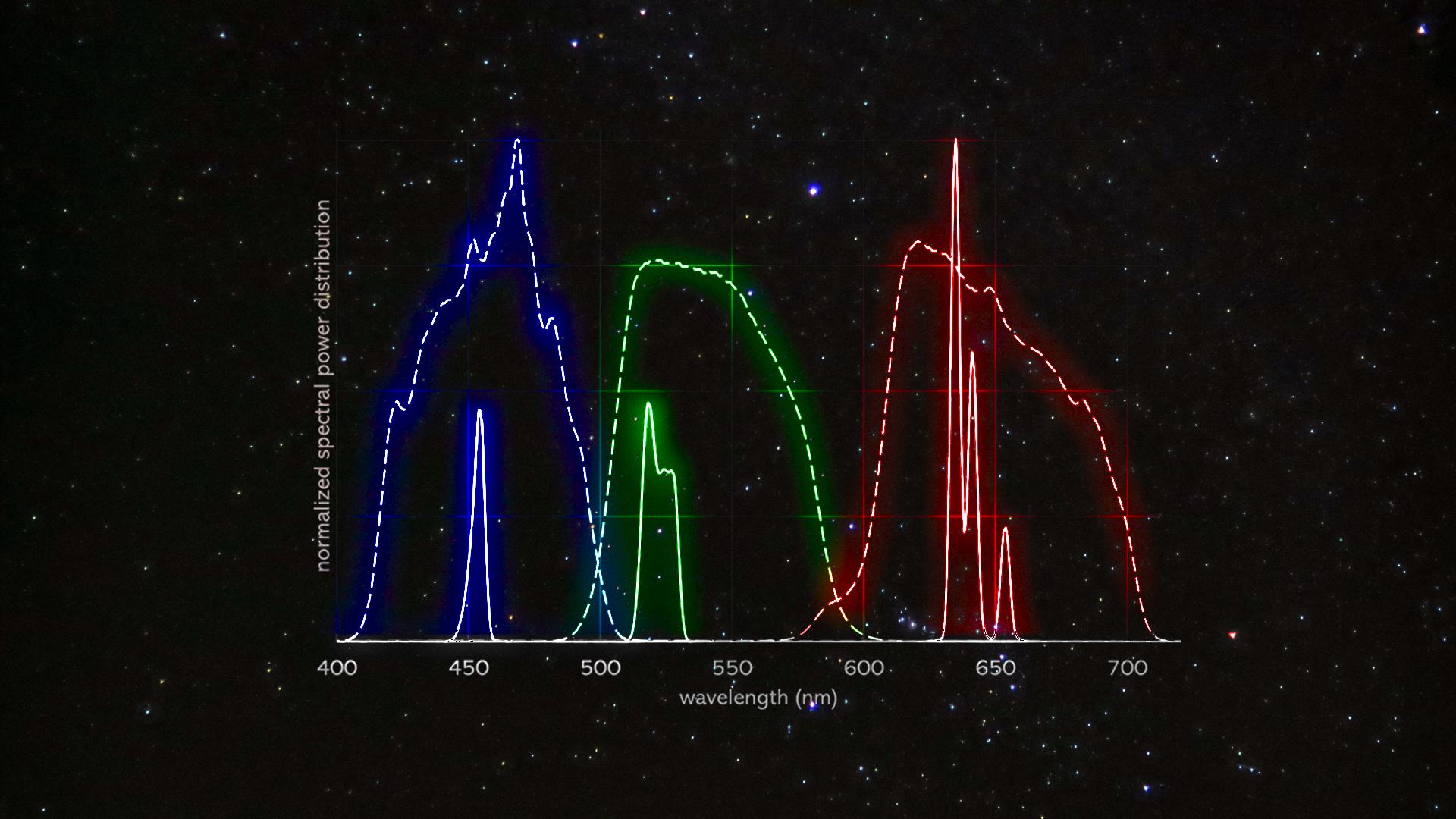
    when it comes to LASER projectors, the very narrow band of the laser primaries will cause what is called "metamerism error" - that is, each viewer will see a different colour temperature even though the tool says it's DCI colours. I experienced this myself where a 3P laser machine it looked "cold" (bluish) to me while it looked warm (reddish) to a colleague.

    This is why Laser projectors are usually not welcome in grading rooms - particularly 3P laser projectors. Barco claims to have solved the issue, I cannot confirm nor deny that.

    However, a Xenon lamp has a much broader spectrum and the metamerism error should never happen there. A 20C should look fine to everybody in the room as long as the meter is calibrated and the correction done properly. A 15S will not. To be fair, Neither a 20C nor a 15S should have a place in Post Production unless in non-critical image tasks.

    In particular, if you are comparing a Xenon with a Laser, you will see a difference. But what matters most is that what YOU will see might not be what someone else will see.

    Finally, make sure your spectrometer has a low enough bandwidth to work reliably with laser light sources. You'll need - I think - 2nm of bandwidth on your colour meter. If that is not the case, the result is going to be less accurate.

    From Christie Digital:
    wave-length.jpg

    Comment

    • Harold Hallikainen
      Film God
      • Jan 2020
      • 1071
      • Tucson AZ

      #3
      Metamersim is an interesting subject. I wrote a paper on color perception and the LSS-100 at https://www.qscaudio.com/resource-fi...measurment.pdf . As explained, there, I see our color perception as using three "bandpass filters" called X, Y, and Z. We determine color by the ratio between the outputs of these filters. Note that the X filter has a second bump at a short wavelength. This is what allows us to mix red and blue light and have it appear the same as monochromatic violet. Monochromatic violet results in output from both the X and Z filters, and so does a mix of red and blue.

      The paper above is about the LSS-100. The LSS-200 changed from using an RGB sensor to an XYZ sensor. See page 14 of the datasheet of the sensor at https://look.ams-osram.com/m/5857e14...56.pdf#page=14 for the spectral response. This response is based on special optical filters that provide the XYZ response and also compensate for the nonuniform sensitivity of the silicon sensor.

      A spectrometer measures the amplitude at a very narrow bandwidth. The measured signal at each wavelength is multiplied by a calibration constant and added to all the other calibrated outputs (at each wavelength) to yield the X, Y, and Z curves.

      Looking at the curves in the above post, we see the RGB laser outputs are at about 730 nm, 540 nm, and 430 nm. Looking at the XYZ curves in the LSS-100 paper, we see the XYZ peaks are at about 620 nm, 550 nm, and 450 nm (ignoring the second peak of the X filter). While the green laser is close (laser at 540 nm, filter at 550 nm), the other lasers are substantially off the peaks of the X and Z filters. We have person to person variation in the XYZ filters (the CIE standard is based on sampling a large number of people and averaging the results). Because the X and Z filters are on the "skirts" of the filters, slight variation in the center frequency (or wavelength) or the skirt steepness will result in a substantially different output from the filter. This results in a different ratio between filter outputs person to person, resulting in a difference in perceived color.

      I think metamerism could be reduced by using lasers that are at the XYZ filter peaks (620 nm, 550 nm, and 450 nm) instead of on the skirts of the filters. Minor variation in the center frequency of the filter would result in minimal variation of the filter output, since the slope of the filter is zero at the peak and small as we move slightly away from the center. The variation in the steepness of the skirt of the filter would have no effect on the output if we are at the peak of the filter.

      But, it appears difficult to produce lasers at the wavelengths of the XYZ filter peaks. So, we live with metamerism (and speckle).

      Harold

      Comment

      • James Gardiner
        Expert Film Handler
        • Nov 2021
        • 500
        • Melbourne, Australia

        #4
        This is an important topic for the post-production industry, and a lot has been happening behind the scenes as the reality sets in that Xenon-based digital cinema projectors are reaching end-of-life.

        I come at this from a post background myself, some people may remember the Cine-Tech-Geek videos I produced on HDR and colour science a few years back. I’ve continued to keep an eye on this space, and this is my current understanding of how the industry is likely to move forward.

        Firstly, there is a very interesting white paper from Barco titled:

        “Advancing color accuracy in cinema postproduction: results and implementation of industry study on metamerism.”

        It doesn’t appear to be easily discoverable via normal web search, but Barco will likely provide it if you ask.

        One key passage from the paper explains how their system integrates into existing workflows:
        “Implementation of the Metameric Offset Correction (MOC) can seamlessly integrate into existing workflows without requiring extensive modifications… the projector generates two calibration files: one physically calibrated to industry standards and another containing the metameric offset correction used for color-critical work.”


        ​The Barco study highlights that this variability arises from two factors:
        1. Differences in the spectral power distribution of Xenon lamps versus RGB laser sources
        2. Differences in human visual perception, particularly variations in cone response between individuals

        In practice this means that two people can look at the same image and perceive slightly different colours, especially under narrow-band illumination.
        ​
        Realistically, the industry workaround for years has been fairly pragmatic.

        Many grading environments have used Grade-1 reference monitors as the perceptual anchor for colour work. The projector is then visually matched to that reference monitor, often with adjustments made based on the grader’s own perception.

        In effect, colour transforms or LUTs end up being tuned not just to the display technology, but also to the observer’s individual rod/cone response.

        That works operationally, but it introduces an obvious problem:

        You cannot have a room full of people all seeing exactly the same image, because everyone’s eyes are slightly different.

        It’s not ideal, but with Xenon disappearing, it’s an issue the industry has to confront.
        ​
        Barco has probably done more work on this problem than any other projector manufacturer. Given that they are the largest supplier of DCI projectors globally, that’s not surprising.

        Their solution is called Metameric Offset Correction (MOC).

        Rather than changing cinema colour standards (which would be hugely disruptive), they apply a correction matrix to the projector calibration. This compensates for the perceptual shift between Xenon and laser projection while leaving the existing colour pipeline intact.

        Importantly, their testing involved side-by-side Xenon vs RGB laser comparisons, using professional colorists across multiple continents and including real film material such as skin tones, skies, and grass, all the colour-memory elements that graders rely on.

        Their research also suggests that observer perception tends to cluster into two dominant response groups, which is why the system can offer different offset profiles.

        In theory this reduces the need for a Grade-1 reference monitor as the anchor, because the projector itself can compensate for the perceptual shift.

        That’s the claim at least and I’d be very interested to hear from anyone who has implemented this in a real grading environment.
        ​
        Where this likely goes

        The reality is that Xenon is going away.
        Laser illumination will become the dominant projection technology.

        That means the industry has two choices:

        • Accept perceptual inconsistencies between grading and projection
        • Or develop systematic ways to compensate for metameric differences

        The Barco MOC approach appears to be one of the most serious attempts to address this problem in a practical way.

        Based on what I’ve seen so far, Barco probably has the strongest handle on this issue at the moment. If I were running a post facility transitioning to laser projection, they would certainly be one of the first companies I’d be speaking to about how these tools have evolved in production environments.

        But I’d also be very interested to hear direct experiences from colorists and post houses who have worked with these workflows.
        ​
        P.S. Bad form admin.
        ************ <-- this text is Cine-Tech-Geek without the dashes. Blocking my channel name from this forum.
        Last edited by James Gardiner; 03-11-2026, 03:04 PM.

        Comment

        • Dave Macaulay
          Pro Film Handler
          • Jan 2020
          • 460
          • Toronto, Ontario, Canada

          #5
          Does this apply to LED screens, with quite narrow spectra, as well?

          Comment

          • Harold Hallikainen
            Film God
            • Jan 2020
            • 1071
            • Tucson AZ

            #6
            I THINK that LEDs would have the metamerism issue if their wavelengths were not on the XUZ peaks, but, instead on the skirts. I think that the LED bandwidth is wide enough to avoid speckle.

            Comment

            • Marco Giustini
              Film God
              • Jan 2020
              • 1168
              • Reading, UK

              #7
              What I don't understand about the Metameric Offset Correction is how that could work. If I see bluish and someone sitting by me sees reddish, how can changing the projector MCGD address or even mitigate that?

              Comment

              • Steve Guttag
                Film God
                • Jan 2020
                • 3777
                • Annapolis, MD

                #8
                I agree. There is no way they can correct for metamerics. If they correct for those that see the image greenish...then those that see the image more red will see it extra red and vice-versa. Then again, since Barco has chosen to make the correction a post-production feature only behind an expensive pay per-projector, one can't really experiment with it.

                I think it more likely that emissive screens will replace projectors before this one gets solved. Emissive screens address many projection issues (but bring their own challenges for operation/upkeep).

                Comment

                • Mark Gulbrandsen
                  Film God
                  • Jan 2020
                  • 3093
                  • Nashville, TN

                  #9
                  Originally posted by Hong Sung Hyeok
                  I don't think I'm very good at distinguishing colors with my eyes.

                  But I can feel it.
                  The Christie S1, S2, S3, and S4 have a very subtle blue tint after calibration.
                  The Barco S2 has a slightly pinkish tint, and I'm not sure about the SP series S4.

                  Some post-production colorists are very picky about the color of the calibration results.

                  But they also want to match the color between the lamp and laser.

                  What's the best method?
                  We use Qalif Spectro.

                  The colorimeter says 0.314, 0.351, but even to my eyes, the lamp and laser feel different.

                  Has anyone experienced color calibration and white point matching for the DP2K-20C and SP2K-15S used in post-production?​
                  I know two Colorists out in CA that prefer to do their work with Xenon equipped projectors. They will only use Laser systems if the customer insists...

                  Comment

                  • James Gardiner
                    Expert Film Handler
                    • Nov 2021
                    • 500
                    • Melbourne, Australia

                    #10
                    It is completely understandable that we can apply a LUT on a display to ensure two viewers see the same colours. Sorry SteveG, but if you can correct colour on a display, you can correct for metameric differences as well. This is exactly what happens every day in a post-production house, where a screen calibrator ensures all displays are showing the same colours.

                    It is also worth remembering that we all perceive colour differently. Most men, for example, are partially colour blind. But if two people grow up calling something “blue”, even if it appears slightly different to each of them perceptually, they both still understand and agree that what they are seeing is blue.

                    Color graders claiming that xenon is the only acceptable solution feels like the old “blame the tools” argument. Colour graders are supposed to be part colour scientist as well, and should be following the science just as much as the craft. Dealing with metameric issues can be tedious, but it is certainly not impossible.

                    And if someone wants to go beyond the standard Barco calibration, they still have options. You can work with offsets and build your own personal LUT. That is perfectly valid, as long as it is understood that it becomes a personal correction and is not necessarily applicable to other viewers.

                    Yes, LED, or really any monochromatic display system, can have the same issue. Even xenon can exhibit metameric effects if the chromatic filters are narrow enough. Strangely though, we rarely hear this raised as a major concern in the LED display world.

                    The reality is that xenon lamps will soon become very difficult, or at least extremely expensive, to obtain. Film making and exhibition ultimately come down to economics. My advice is simple: get on board with these changes and learn how to manage them, or get off the bus.
                    ​

                    Comment

                    • Marco Giustini
                      Film God
                      • Jan 2020
                      • 1168
                      • Reading, UK

                      #11
                      I think you're comparing apples with pears, James.

                      If I see blue differently than you - but I was born that way and that's how I've always seen blue - then it won't matter how we see it.

                      A LUT is applied so two different DISPLAYS look identical. And mind you, there is metamerism with displays as well since LED backlight has a narrower spectrum - just not as severe as with Laser.

                      Metamerism error means that when we look at a Xenon projector and we show a neutral grey patch, everybody in the room will agree it's neutral. If it's not neutral, EVERYBODY in the room is going to report it in the same way and a LUT/MCGD will correct that for everybody.

                      If you show a grey patch on a 3P laser machine, some will say it's bluish, some will say it's reddish, some will say it's neutral. You can compensate - but who do you please?

                      Maybe there is a way to mitigate the issue - a better "middle point"? But I don't see how one can correct the colours of an image when viewers don't agree on how it looks.

                      I mean, Barco are not new to the game, if they say they have a solution, I'd love to hear about it. I just don't understand how you can mitigate metamerism error by tweaking Red, Green and Blue.

                      Comment

                      • James Gardiner
                        Expert Film Handler
                        • Nov 2021
                        • 500
                        • Melbourne, Australia

                        #12
                        @Marco, we are talking about completely different problem domains.

                        Metamerism in post-production is about ensuring that everyone involved in the production process is seeing the intended colours. Its purpose is simply to ensure that the producer’s creative intent is correctly shared among those creating and finishing the film.

                        The issue of different audience members perceiving colours slightly differently in a public auditorium is a separate matter entirely. Realistically, there is very little that can be done about that. In practice, the public simply has to accept these small perceptual differences — which, in reality, most viewers will never even notice.

                        When it comes to how individuals perceive colour, the point of measuring and calibrating a display is to establish a reliable reference. Our real reference, however, comes from lived experience. As children we learn what colours are called, even if we may perceive them slightly differently from one another. In effect, we develop a socially learned “LUT” that allows us to consistently label colours within a shared framework.

                        Colour science simply extends this idea further by measuring those differences and building procedures that allow a production workflow to operate against a common reference, ensuring that everyone in the chain is working with the same intended colours.

                        That is ultimately the best production can do. From that point on, it becomes the viewer’s responsibility — just as someone with poor eyesight might wear corrective lenses. Metameric differences are somewhat analogous: an individual could theoretically apply their own personal colour correction, much like wearing glasses, but that correction would only apply to that individual viewer.
                        ​

                        Comment

                        • Steve Guttag
                          Film God
                          • Jan 2020
                          • 3777
                          • Annapolis, MD

                          #13
                          Sorry James, you can't color grade on laser projectors. People that can just flesh tones and such do not see the same thing between xenon and laser. If they color correct on laser they will, inherently, shift the color grading and you just can't get around it. You'd almost need a color grading committee to properly accomplish it such that it looks normal(ish) to the broad community.

                          Comment

                          • James Gardiner
                            Expert Film Handler
                            • Nov 2021
                            • 500
                            • Melbourne, Australia

                            #14
                            Sorry Steve, but that argument is essentially saying colour science does not work, and the entire film industry depends on the opposite being true.

                            Every display technology has a different spectral output: CRTs, LCDs, OLEDs, xenon projectors, and laser projectors all differ. Human vision also varies widely between individuals. The reason grading still works is because we rely on measurement and standards, not on everyone seeing colour identically.

                            That is why we calibrate displays to defined references such as DCI-P3 and a specified white point, using instruments and LUTs. Once a display is measured and aligned to the reference, the grading workflow remains valid regardless of the underlying light source.

                            Laser projectors do have different spectral characteristics from xenon, which can introduce metameric differences for some observers. But metamerism is a well-known phenomenon that exists between many display technologies and has been managed in colour workflows for decades.

                            So the real question is not whether grading “works” on laser. It is simply what display defines the reference environment. Once that reference is measured and calibrated, colour grading works exactly as it always has.
                            ​

                            Comment

                            • Hong Sung Hyeok
                              Film Handler
                              • Dec 2020
                              • 54
                              • Seoul, South KOREA

                              #15
                              Thank you so much for the great answers. I feel like I'm adding something new to my knowledge base.

                              I've actually noticed that colorists are confused when they first see the calibrated colors of laser projectors.
                              The RGB patterns projected from the DaVinci Resolve console connected to the projector and the RGB patterns from the projector are different from what they're used to.

                              What should I do if I receive a complaint about the color calibration work I did, saying that the colors from the laser projector don't match? If they scream, "This isn't the white I knew!"

                              Colorists must know about "metamerism," right?​

                              I'm a little puzzled, do I really need to explain metamerism to someone who is much more expert on 'color' than I am and get them to agree?
                              How do I convince colorists, who probably know more about color than I do, about metamerism, which they probably know even better? I'm not confident.

                              I'm serious. If anyone has any good ideas for convincing colorists, please let me know.
                              I can't just tell them, "It's because of our laser projector."​

                              What should I say to convince them?
                              "It's a metamerism problem caused by the different wavelengths of laser light and xenon light."

                              How about like this
                              "Machines don't lie. Don't trust your eyes."​


                              On December 4th 2024, Dr. Charles Poynton (IMAGO Technical Committee (ITC) associate member) hosted a day for industry experts about the topic of metamerism
                              Last edited by Hong Sung Hyeok; 03-12-2026, 09:03 PM.

                              Comment

                              Working...