|
|
 
|
|
Author
|
Topic: Best/worst projector
|
|
|
Marin Zorica
Jedi Master Film Handler

Posts: 671
From: Biograd na Moru, Croatia
Registered: May 2003
|
 posted 04-03-2005 06:22 PM


Richard,
you are ok that is prexer made of ernemann 7B, but real projector tat is made of ernemann 7B principies is ISKRA NP-21.
ISKRA was producing in Slovenia from 1947 till i thing late 1960's (1969).
Major difference in prexer and iskra (also and ernemann) is in inside mechanism, iskra and ernemann got all inside force transmission with cog-wheel, and prexer got central axle for force transmission from motor to film wheel and maltez cross, also iskra and prexer maltez cross are same.
Also ISKRA fisrs model was NP-2 (don't know for NP-1 year) about 1948, and then in 1950's was NP-21, in 1960 where KN-3 and ISKRA 35.
This are very good projectors, expecialy ISKRA because i servicing one open air cinema for past two summer and they have got Np-2 from 1948, wirh no mistake in mechanism!!!!!!!!!!!
Prexer is also good, i have here one what is in service from 1973 and works perfect with proper care, only thing what is bad about prexer is that oil liques from inside of mechanism, but with good technican this can be solved.
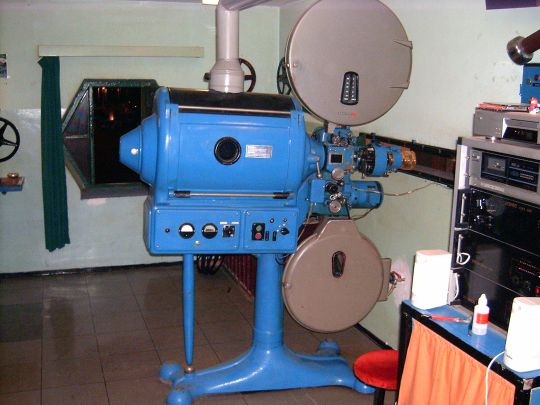
This is picture of ISKRA NP-21:
It's little stange that is painted in blue, this is because projectionist painted it because he got a couple of paint extra,hm?
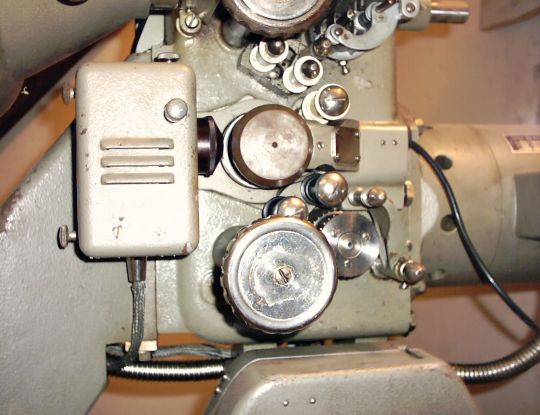
This is sound head of NP-21:
It's got 6V 5A exciter lamp
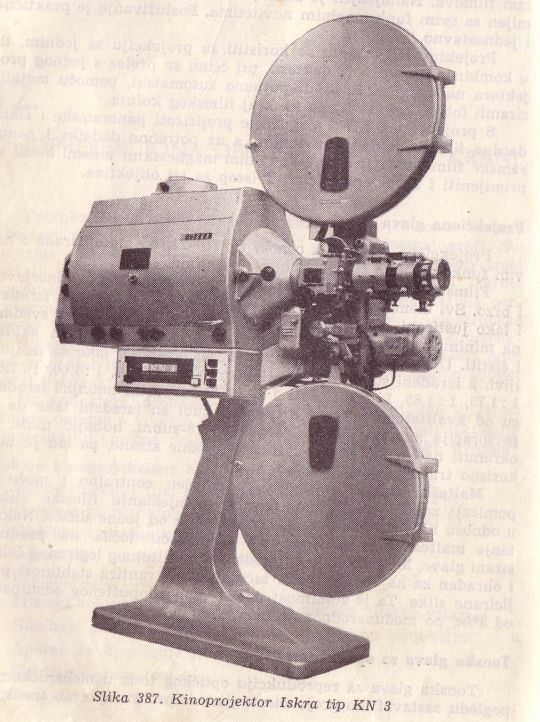
This is KN-3, made in 1960's from ISKRA:
Sorry but i don't have real picture, i scaned it from book
What are you'r opinion about this projectors???
| IP: Logged
|
|
|
|
|
|
|
|
|
|
|
|
Monte L Fullmer
Film God
Posts: 8367
From: Nampa, Idaho, USA
Registered: Nov 2004
|
posted 04-04-2005 03:00 AM
..and for us non-speaking German folks like us here, head on over to www.freetranslation.com , then cut the German text from the images, and paste them in the translation box in this site. Works pretty good. Only thing is that the translation is "gisted" or actual translation, instead of how the message is to be meant.
You get the idea though.
e.g. ->Filmvorführer Gallery and the translation ->Film demonstrator Gallery (once again, a "gisted" translation)
After seeing some of these pictures in this site, especially of the Ernemann machines, I bet the Ernemann were the "Simplex" of Germany. And what was interesting that the booth layout of the early cinemas, that the Ernemanns were built with right hand threading and left hand threading patterns, so the projectionist was dead center of the booth doing his changeovers and lacings. I bet that was a bit confusing, especially when the projectionist went to other cinemas (Kinos) and ran those Dresdens, and FF-99 machines-let along running US built Simplexes and MotioGraphs and the Philips DP-70 machines.
-Monte
[ 04-04-2005, 05:22 AM: Message edited by: Monte L Fullmer ]
| IP: Logged
|
|
|
|
|
|
Michael Schaffer
"Where is the
Boardwalk Hotel?"

Posts: 4143
From: Boston, MA
Registered: Apr 2002
|
posted 04-04-2005 06:55 AM

That thing is basically the same as the Carl Zeiss TK 35 which was built in large numbers after the war, from 1947 or so onwards. Zeiss-Ikon, the optical factory with great tradition, and Ernemann Projektorenwerke had merged some time before that, I think. The TK 35 was massively used in bringing cinema to the people. They were installed in trains and projectionists travelled the countryside, setting up their equipment in village taverns and community centres to play uplifiting features and newsreels to spread the good news of the unstoppable advance of communism to the happy people.
After the war, Germany was split in 2 parts, the free West and the communist East. A lot of the factories which were located in the East were dispossesed by the communists while the original owners reformed their businesses in the West. Of course, the "people's own" factories in the East didn't pay any royalties to or respected patents of the original owners who were, after all, evil capitalists. Many of the engineers in the East were actually top-notch people with excellent training and good grounding in traditional crafts on top of that. But the sad reality is that centralist communist mismanagement and shortage of materials often deprived them of the means to work on the level they were capable of.
Still, they made very good projectors in East Germany (the "Dresden series") until sometime in the 60s when the Eastern Block governments decided that they didn't need to manufacture the same stuff in every country, but should work together and share products to simplify production and create standards across all the communist countries. So, the manufacturing of projectors in East Germany came to an end, and from that time on, all the people's projectors were made in (then) Czechoslovakia by Meopta. They were actually quite decent machines too. I think they still make the MEO5XB. I had never heard of the Polish machines mentioned above. BTW, the MEOs all ran on 25fps. That was the standard in the Eastern Block, because it made cinema and TV transfers more compatible.
The TK 35 was actually a very solidly made unit, and many of them were still in use decades after they had been manufactured. After the reunifaction, we used to play with those machines a lot and played open air events with them. I think a fair number of the TK 35 are still in use, in community centres and student film theatres and similar locations.
| IP: Logged
|
|
|
|
|
|
Marin Zorica
Jedi Master Film Handler
Posts: 671
From: Biograd na Moru, Croatia
Registered: May 2003
|
posted 04-04-2005 01:28 PM
quote: Monte L Fullmer
Interesting machine to say. Question: does the lower loop tailing off of the intermittent sprocket, "float" above those three white rollers before heading down to the scanner drum assembly?
Reminds me of the way Cinemeccanica does their "floating" loop as well - being that there is no middle constant speed sprocket after the intermittent sprocket to gather up the lower loop before scanner drum.
Also, wonder if a picture could be taken of the "gear side" of the machine to see the inner workings....
-thx Monte
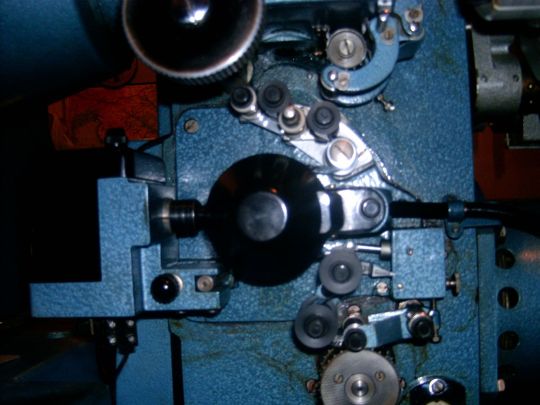
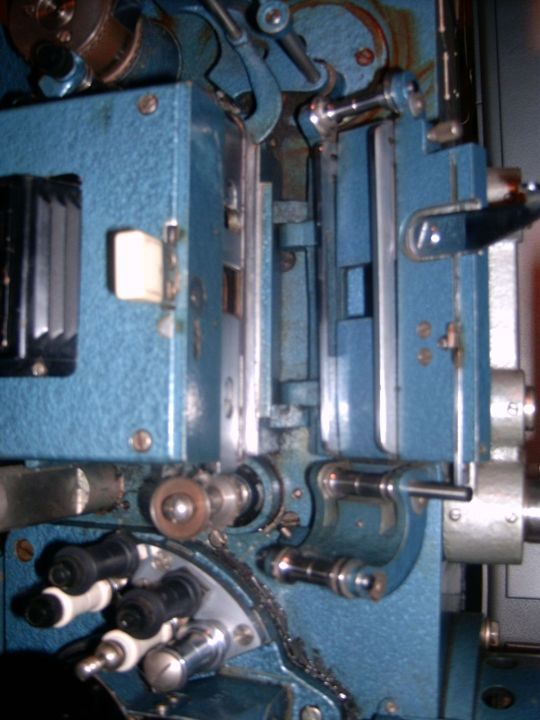
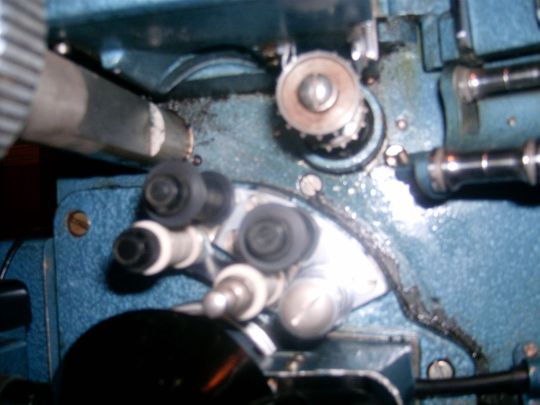
Actually there are four rollers, and fifth is in front of scanner drum, film goes in middle of big and small roller, then thru fifth and thru scanner drum.
The firs four rollers (two big and two small) we pass film in middle of them and then two upper smaller rollers are pressed to big rollers, so film is going thruu all four of them.
If you didn't understand me this is couple pictures of that four roller with and without film on prexer AP-61, is like on ISKRA, just difference is that smaller rollers pressing film from down, and on ISKRA are pressing from up.
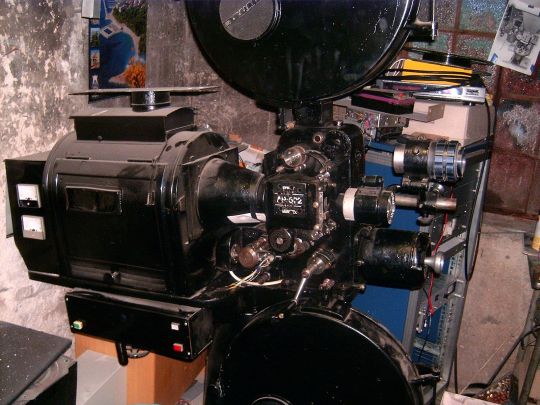
Considering Ernemann projector this is picture of mine
Ernemann 4 projector:
Also JAcek can you upload a pic of you're AP-51, i think is same as mine AP-61 but with different lamp house?
Also i will put picture of PREXER and ISKRA inside when i get mine camera.
| IP: Logged
|
|
|
|
|
|
All times are Central (GMT -6:00)
|
This topic comprises 19 pages: 1 2 3 ... 13 14 15 16 17 18 19
|
Powered by Infopop Corporation
UBB.classicTM
6.3.1.2
The Film-Tech Forums are designed for various members related to the cinema industry to express their opinions, viewpoints and testimonials on various products, services and events based upon speculation, personal knowledge and factual information through use, therefore all views represented here allow no liability upon the publishers of this web site and the owners of said views assume no liability for any ill will resulting from these postings. The posts made here are for educational as well as entertainment purposes and as such anyone viewing this portion of the website must accept these views as statements of the author of that opinion
and agrees to release the authors from any and all liability.
|

 Home
Home

![[thumbsup]](graemlins/thumbsup.gif) !! It is interesting to see whats going on in other areas of the world.
!! It is interesting to see whats going on in other areas of the world.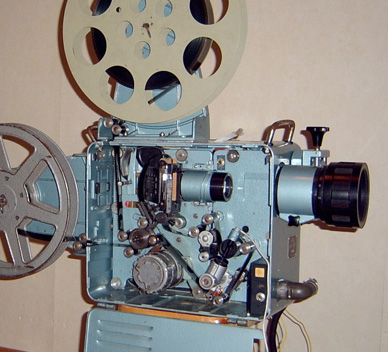


 Printer-friendly view of this topic